


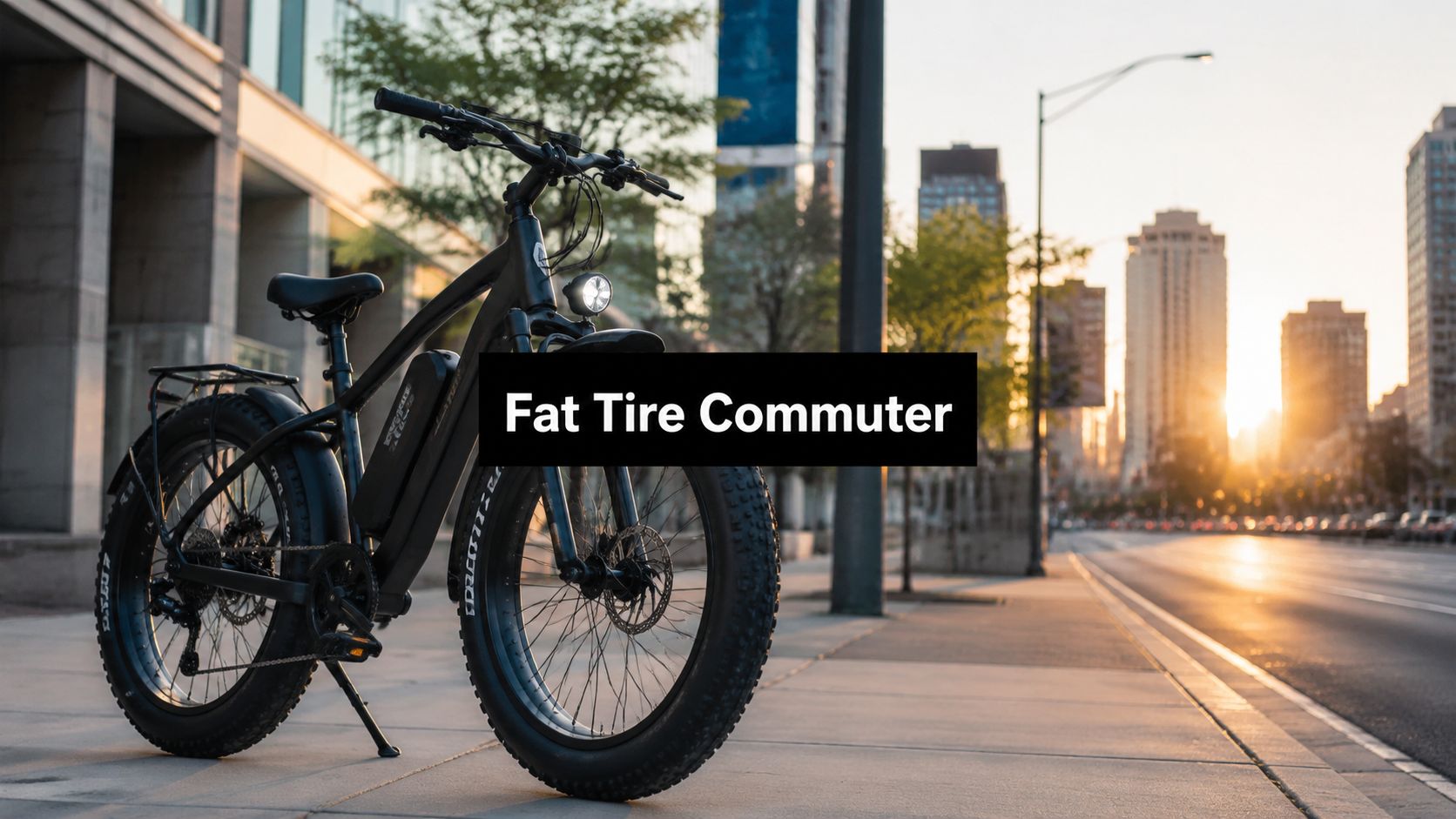
You're standing outside the shop in wet weather, looking at two very different e-bikes. One feels like a nimble city machine, the other looks like it could roll over broken tarmac, tram tracks, gravel shortcuts, and winter slush without complaining. If your commute includes rough streets, bad drainage, or the kind of corners where a narrow tyre skates a little too easily, a fat tire commuter ebike starts to make real sense. If your route is smooth and your main concern is efficiency, the honest answer may be that you don't need one.
The category has grown for a reason. One market estimate put the global fat tire e-bike market at $1.2 billion in 2024 and projected $4.5 billion by 2033 at a 16.4% CAGR (Accio). Another estimate valued the fat tire electric bike market at USD 49.6 billion in 2023 and projected USD 71.5 billion by 2031 at 6.6% CAGR (Accio). The exact size depends on how the category is defined, but the direction is clear. Fat tyres aren't a stunt anymore, they're a serious commuter option for riders who need more traction and comfort than a standard city bike gives them.
What a Fat Tire Commuter Ebike Actually Is
A fat tire commuter ebike is built for routes that punish ordinary commuter bikes. The usual setup pairs extra-wide tyres, often around 3.8 to 5.0 inches, with a reinforced frame, a battery sized to support the extra rolling resistance, and a motor tuned to keep the bike usable on mixed surfaces (Mokwheel, Engwe). That wide footprint is the whole point. It gives you more contact patch, more grip, and more confidence when the road surface changes under you.

A standard commuter ebike, by contrast, usually sits on 2.0 to 2.4 inch tyres and aims for efficiency first. It's lighter, usually quicker on smooth pavement, and easier to carry upstairs or onto a train. The fat-tire bike gives up some of that neatness in exchange for a calmer ride over potholes, rough asphalt, gravel cut-throughs, and winter grime.
The simple way to think about it
A narrow commuter bike is a road specialist. A fat tire commuter ebike is a route specialist.
That difference matters more than most spec sheets admit. The wide tyres and stronger build don't exist because they look tougher. They exist because some urban routes are messy enough that the rider needs flotation, grip, and a more forgiving chassis to keep moving comfortably.
Practical rule: buy fat tyres for the surface you actually ride, not for the way the bike looks in a showroom.
A lot of buyers get this wrong. They focus on the size of the tyres, then discover the bike feels heavier than expected, takes more effort to manoeuvre in tight storage, and doesn't deliver the range they assumed. So keep the mental model simple. You're not buying a default upgrade, you're buying a specific answer to a specific route problem.
Why Fat Tires Feel So Different on the Road
The first thing you notice is that the bike feels calmer under you. A wide tyre spreads the load across a bigger contact patch, so the bike doesn't drop into cracks and chatter over rough patches the way a narrow tyre can. It's a bit like stepping in snowshoes instead of sinking through fresh snow. You stay on top of the surface instead of fighting it.
Comfort comes from the contact patch
That extra width also lets you run lower pressure in many setups, which softens the ride over sharp edges, broken paving, and shallow potholes. The bike stops feeling nervous when the surface gets ugly. On wet tram tracks, loose gravel, or patched cycle lanes, that extra grip can make the difference between relaxed commuting and constant micro-corrections.
For newer riders, or riders returning after a long break, that stability matters a lot. The bike feels planted when you start, stop, and turn. The handling is less twitchy, and that makes daily commuting less fatiguing even when the route itself is messy.
The same physics creates the downside
The trade-off is straightforward. Wider tyres bring more rolling resistance and more rotating mass, which makes the bike harder to accelerate and less efficient on smooth pavement. That's why fat tires feel so good on rough ground and so plain on pristine road. They're doing more work just to stay composed.
A fat tire commuter ebike rewards bad surfaces. On clean, predictable pavement, it mostly rewards patience.
That's the key distinction. If your commute is full of potholes, drain covers, broken edges, and damp corners, the comfort gain is real and immediate. If your route is already smooth and well-maintained, the bike's best trait becomes less important, while its weight and energy cost stay very real.
The right reaction isn't to dismiss the category. It's to match it to the road in front of you. Fat tyres make sense when the ride condition is the limiting factor, not when you just want a bigger-looking bike.
Weight, Range, and Price Trade-Offs
If you ride smooth streets and carry your bike upstairs every day, the trade-off is easy to see. A fat tire commuter ebike is usually heavier than a standard commuter ebike, with a reported average mass of 70 to 79 lb and a common price band around $1,399 to $1,999 (Heybike). That weight comes from the parts that make the bike feel steady, bigger tyres, stronger frames, and larger batteries all add up.

Range drops, and that is the part riders feel first
A commuter-focused comparison notes that fat tire ebikes can deliver 20–30% less range on pavement than similarly equipped commuter ebikes because of higher rolling resistance (Leoguar Bikes). Another guide puts the usual range penalty at 10–20% versus standard 2.0–2.4 inch tyres, with winter conditions potentially cutting range by another 20–30%. That is the practical cost of extra grip and stability on rougher streets (Leoguar Bikes).
The bigger battery that helps cover that loss also adds more weight, so the bike ends up feeling substantial instead of light on its feet. That is fine if your route is full of broken pavement, wet corners, and rough edges. It is a poor fit if you care more about carrying the bike, lifting it into storage, or squeezing every mile out of a charge.
What the numbers mean on a daily commute
If you live in a walk-up, haul the bike into a hallway, or load it into a car often, the extra weight is not a small detail. It changes the bike you deal with every single day. If your commute is flat, dry, and predictable, the efficiency hit will feel like a penalty you pay for looks and comfort you do not really need.
If your route includes winter roads, rough shoulders, gravel shortcuts, or a lot of debris, the penalty can be worth it because the bike stays calm when narrower tyres start to feel twitchy. That is where a fat tire commuter ebike makes sense. It earns its keep on ugly streets, not on perfect pavement.
Bottom line
A fat tire commuter ebike is a route-specific purchase. Treat it that way.
- Choose it if your streets are rough, your weather is bad, or you want more stability on slippery surfaces.
- Skip it if your route is smooth and your priority is range, portability, and quick handling.
- Check the weight before you buy, especially if you lift the bike, store it upstairs, or share space with work gear like a laptop bag. If you are comparing carry options too, the Urban Totes guide to laptop totes is a useful place to size up what fits your routine.
The honest test is simple. If the streets on your commute justify the extra mass and the shorter range, fat tyres earn their place. If they do not, you are paying for comfort you will barely notice and hauling weight you will notice every day.
Matching the Setup to Your Actual Commute
A good commuter bike isn't the one with the most impressive brochure. It's the one that matches your route without making your daily routine harder than it needs to be. A fat tire commuter ebike shines when the road surface is the main problem, not when the trip is merely long.
Use the route, not the hype, to choose
If your ride is short but ugly, fat tyres can be the right answer. If your ride is long and smooth, they usually aren't. If your bike lives in a tight flat or gets lifted often, weight should be part of the decision from day one.
| Commute profile | Tire width | Motor power | Battery | Frame |
|---|---|---|---|---|
| Mixed-terrain urban ride with potholes and gravel paths | Fat tyre, around 3.8 to 5.0 inches | Stronger assist tuned for traction | Higher-capacity pack to offset rolling resistance | Reinforced frame, step-through works well for easy mounting |
| Smooth cycle-lane commute | Standard commuter tyre | Efficient, lighter setup | Smaller pack can make sense | Lighter frame for easier handling |
| Stop-start city route with lifting and storage | Wider only if the streets demand it | Practical assist, not oversized power | Balance range against carry weight | Step-through or compact frame for easier day-to-day use |
Fit matters more than people admit
Shorter riders often do better with a step-through frame because the bike already sits high and heavy. Parents or cargo users should pay close attention to frame stability and rack compatibility, because a fat tyre bike with a shaky rear setup is a bad idea. If you haul a laptop, lunch, and a change of clothes, a proper bag matters too, and the Urban Totes guide to laptop totes is a useful way to think about protecting work gear on a daily ride.
Practical rule: if you need to carry the bike more than you ride it, you've probably chosen the wrong tyre width.
The best match is usually obvious once you strip away the spec sheet. Rough roads, winter grime, and mixed surfaces point toward fat tyres. Clean bike lanes, light carrying, and longer smooth rides point back toward a standard commuter bike.
Don't buy the bike for the rare ride you hope to take. Buy it for the route you'll repeat four or five days a week.
UK, EU, US, and Australian Rules You Must Check
A fat tire commuter ebike that feels perfect on your street can still be illegal on the road you ride. Check the rules before you pay, because compliance decides whether the bike is a normal commuter tool or an awkward import that gives you problems later.
In the UK and EU, the EPAC definition is the first test. The motor must assist only while you are pedalling, the continuous rated motor power must not exceed 250 watts, and assistance must cut off at 25 km/h. Bikes outside that definition are handled under type-approval rules rather than as standard bicycles. YouTube explainer on EPAC rules

Check the rules before checkout
The US uses the familiar class 1, 2, and 3 system, while Australian rules can vary by state, so the same bike does not always fit every market cleanly. For a plain-language check on street legality, the street legality guide is worth reading before you buy.
Recent buying guidance also puts more emphasis on UL 2849 certification for U.S. sales, hardware-enforced motor cut-off at class speed limits, and tamper-resistant labelling. Those details matter because they affect whether the bike is accepted, insurable, and easier to resell later. The Alibaba buying guide covers that side of the purchase in practical terms.
A quick buyer checklist
- UK and EU buyers: look for pedal-assist only, 250W continuous rating, and a 25 km/h cut-off.
- US buyers: confirm the class, the throttle rules, and whether the bike aligns with your state and city rules.
- Australian buyers: check local state requirements before ordering, because one national assumption can get expensive fast.
- All buyers: ask for certification details and electrical safety documentation before you pay.
If you want a fast way to sanity-check the listing, start with this e-bike compliance checklist infographic, then compare the seller's wording against the rules in your market.
Compliance is not a side issue. It decides whether the bike is legal, insurable, and worth buying for daily commuting.
Accessories That Make the Extra Weight Worth It
A heavy commuter bike needs gear that can handle the bike, not just the ride. If you skip the support items, the weight penalty feels worse than it should. If you choose the right accessories, the bike becomes easier to live with every day.
Spend on the parts that carry the load
A fat tyre commuter bike needs a proper rear rack rated for the mass, not a flimsy afterthought. It also needs a lock sized for a bike that's harder to muscle around, because the whole point of a good anti-theft setup is making the bike inconvenient to steal.
Full-coverage fenders matter too. Wide tyres throw more water and road grime than many buyers expect, and a narrow splash guard leaves your jacket and drivetrain paying the price. On dark winter routes, lighting should be treated as core equipment, not an optional extra. A dim front lamp on a heavy commuter bike is a false economy.
For a broader shortlist of useful kit, the best electric bike accessories guide is a sensible reference point.
Where to save and where not to
You can often save money on cosmetic add-ons. Don't save on the rack, the lock, or rain protection. Those are the items that decide whether the bike feels like a practical commuter or a bulky object you regret buying.
- Buy first: solid lock, rack, fenders, bright lights.
- Buy next: weather gear that fits upright riding.
- Consider carefully: child seats, only if the frame and rack are clearly rated for it.
- Skip the cheap version: anything that carries weight, braking load, or weather exposure.
Don't treat the bike as finished when it leaves the box. A commuter setup lives or dies by the accessories around it.
The right gear doesn't erase the mass of a fat tyre bike. It makes the mass useful. That's the whole game.
Maintenance and Battery Care for Daily Riders
Daily commuting punishes small neglects. On a heavy bike, a loose bolt or soft tyre doesn't stay a small issue for long. The upside is that fat tyre bikes are easy to keep in good shape if you're consistent.

Keep the routine short and regular
Once a week, check tyre pressure, test the brakes, wipe and lube the chain, make sure the lights work, and visually inspect the frame bolts. That doesn't need to turn into a workshop session. Ten focused minutes is enough if you do it.
A monthly check should go deeper. Look at spoke tension, battery contacts, and any firmware updates from the manufacturer. If something sounds rough, feels loose, or shows unusual wear, fix it early instead of letting it turn into a bigger repair.
Battery habits matter more than people think
Good battery care is mostly boring. Don't leave the battery in extreme cold, and store it indoors during winter whenever you can. Partial charge cycles are generally kinder than constantly running the pack flat, and that simple habit helps preserve usable range over time.
For a deeper battery-care primer, this battery life guide is a useful reference. It's also smart to adjust tyre pressure seasonally. Lower pressure can help in snow or rough conditions, while firmer pressure makes more sense on warmer pavement.
Mechanic's rule: when a commuter bike starts feeling sluggish, check pressure before you blame the motor.
Schedule a professional service when braking feel changes, the drivetrain gets noisy despite cleaning, or the bike starts wandering under load. That's not overreacting. It's the right time to stop guessing.
A fat tire commuter ebike can be a daily workhorse, but only if you treat the battery, tyres, and braking system like parts that do real labour. They are.
Common Questions Commuters Still Ask
Are fat tire commuter ebikes overkill for smooth city streets? Usually, yes. If your route is clean, dry, and well maintained, the extra width mostly adds weight and rolling resistance without giving you much in return. That is why the key question is not whether fat tires look capable, it is whether your streets truly call for them.
Are they legal on UK cycle paths and EU bike lanes? They can be, but only if the bike fits the EPAC rules, meaning pedal-assist only, 250W continuous motor rating, and a 25 km/h cut-off. If it falls outside that definition, it is treated differently, so do not assume a fat tyre bike is street-legal just because it looks like a bicycle.
Can I trust the published range in winter? No, not without adjusting your expectations. Fat tyre bikes already lose range on pavement because of rolling resistance, and winter conditions can cut it further, as noted earlier in the guide. If you commute in cold weather, assume the bike will work harder than the brochure suggests, and plan for that gap.
Is the higher price worth it? Only if your commute is rough enough to use the extra grip, stability, and comfort every week. If you are paying more just to get a bigger-looking bike, you are buying vanity. If your streets are broken, wet, or slippery, you are paying for control that shows up on the ride.
What's the smartest first move if I'm unsure? Measure your route carefully. Note the worst surface you hit most days, how often you need to lift the bike, and whether your city rules allow the model you want. That answer is usually more useful than reading another spec sheet or chasing market trends.
If you want a commuter bike that matches your actual streets instead of just your wishlist, talk to Punk Ride LLC and use your real route as the filter. Compare the options against your commute, then buy the bike that makes Monday morning easier, not heavier.
Share:
What Is Class 3 Ebike: Your 2026 Guide to Speed & Laws
Scooter Tire Replacement Cost: What You Will Actually Pay