


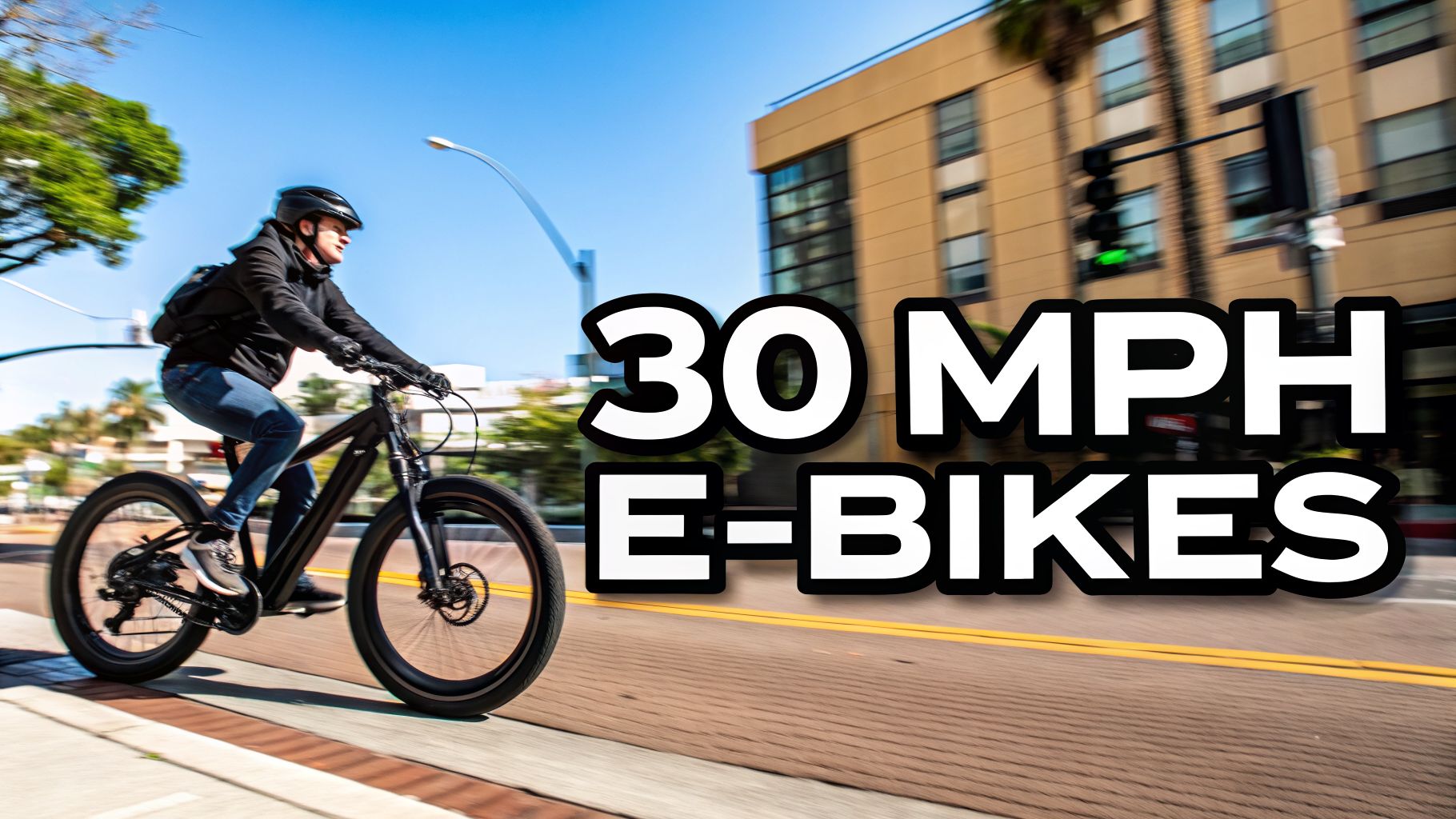
Of course. Hitting 30 mph on an electric bike is absolutely possible, and it’s a total game-changer for both city commuters and thrill-seekers. These powerful e-bikes, often exceeding standard legal classifications in many regions, are built to hit speeds around 28-30 mph with pedal assistance, turning a regular ride into something way more exciting and efficient.
Unlocking High-Speed E-Bike Performance

The thought of zipping past traffic at nearly 30 mph isn't some futuristic dream—it's what high-performance e-biking is all about now. These bikes strike that perfect balance between a good workout and electric muscle, letting you carve up your commute, power up steep hills, and just flat-out enjoy the ride more.
So, how do they pull off these speeds? It boils down to a mix of powerful parts and clever design, which are regulated by different legal frameworks, particularly when comparing the US, Australian, and UK/EU markets.
The E-Bike Class System (US & Australia)
In the United States and Australia, e-bikes are generally organized into a class system to help regulate their use and define where they can be ridden.
- Class 1 (US) / 'Pedalec' (Australia): These provide pedal-assist up to 20 mph (32 km/h) in the US or 25 km/h (15.5 mph) in Australia, with a maximum motor output of 250W in Australia.
- Class 2 (US): These bikes also top out at 20 mph but include a throttle, allowing for unassisted cruising. Australia does not have a similar throttle-based category for road-legal e-bikes.
- Class 3 (US): This is where speed increases. These bikes offer pedal-assist up to a brisk 28 mph (45 km/h), making them the fastest street-legal e-bikes in many parts of the US.
The demand for these faster models is soaring. In the US, the e-bike market is projected to hit $1.6 billion by 2028, while in Australia, e-bike sales have surged by over 800% in recent years. People love speed.
What Makes a 30 Mph E-Bike Tick
Getting up to 30 mph and staying safe requires some serious hardware. These bikes are a different breed, built from the ground up with performance and durability in mind. Just a quick glance at their specs shows you they're not your average e-bike.
Let's break down the key components that give these bikes their serious speed.
30 Mph E-Bike at a Glance
Here’s a quick summary of what you'll typically find under the hood of an e-bike built to hit these higher speeds, particularly common in the more liberal US market.
| Characteristic | Typical Specification |
|---|---|
| E-Bike Class | Class 3 (or Unrestricted/Off-Road) |
| Motor Power | 750W to 1000W+ (Nominal) |
| Battery Voltage | 48V or Higher |
| Top Assisted Speed | 28-30+ mph |
| Brake System | Hydraulic Disc Brakes (Essential) |
These specs are the foundation for high-speed performance. If you want to dive deeper, you can learn more about what affects an e-bike's top speed and really get a feel for the engineering at play.
What Makes a 30 MPH E-Bike Tick?
So, how does an e-bike actually hit 30 mph without falling apart? It’s not just about slapping a giant motor on a frame. Getting that kind of performance—and keeping it safe and reliable—is a balancing act between three key players.
Think of it like a high-performance race car. You've got the engine for raw power, the fuel tank for endurance, and the onboard computer making sure everything works together seamlessly. On an e-bike, it’s the motor, the battery, and the controller. If one part can’t keep up, the whole system sputters.
Let's look under the hood at this high-speed trio.
The Motor: Your Powerplant
This is where the magic starts. The motor is the muscle, the brute force that gets you up to speed. To comfortably cruise past 28 mph and hit that 30 mph mark, you'll generally need a motor with a power rating of at least 750W. But it's not just about the watts; the type of motor makes a huge difference in how the bike feels.
You’ll typically run into two main kinds on fast e-bikes:
- Hub Motors: These are tucked right into the center of the rear wheel (and sometimes the front). They give you a powerful, direct push that feels a bit like being launched forward. They’re fantastic for raw acceleration and holding speed on flat roads.
- Mid-Drive Motors: You'll find these in the middle of the frame, right where your pedals connect. Instead of pushing the wheel directly, they add power to the chain. This feels much more natural, like you suddenly have superhuman legs, and it’s brilliant for chewing up steep hills because it uses the bike's gears.
For pure, unadulterated speed, hub motors often get the nod. But if you want a bike that feels balanced and can conquer varied terrain, a mid-drive is a serious contender.
The Battery: The Fuel in the Tank
If the motor is the engine, the battery is the fuel tank. Flying along at 30 mph is a serious power drain, so you need a battery that can keep up. Skimp here, and your thrilling ride will be over before you know it.
Two numbers on the battery tell you most of the story.
First, there's Voltage (V). Think of this as the electrical "pressure." A higher voltage pushes power to the motor more efficiently, which means less heat and less strain on the system. For a high-speed bike, a 48V system is pretty much the standard, though you’ll see some performance-junkie bikes rocking 52V systems for that extra punch.
How to calculate your e-bike's "gas tank": A battery's total energy is measured in Watt-hours (Wh). Just multiply its Voltage (V) by its Amp-hours (Ah). So, a 48V, 20Ah battery has 960Wh of juice—way more range at top speed than a 48V, 15Ah battery with only 720Wh.
The second number is Amp-hours (Ah). This is your capacity—basically, the size of your fuel tank. For an e-bike that can actually maintain 30 mph for a decent amount of time, look for something in the 15-20Ah range, minimum.
Even more crucial than performance, though, is safety. Make sure any battery you consider is UL 2849 certified (a key standard in the US). This isn't just a sticker; it's your assurance that the entire electrical system has been rigorously tested to prevent fires. It's a non-negotiable.
The Controller: The Brains of the Operation
The controller is the unsung hero. It's a small computer that acts as the mission control for your bike. It takes the signals from your throttle or pedal sensor and tells the battery exactly how much power to feed the motor, and when.
A cheap controller delivers power in clumsy, jerky jolts. A good one, however, makes the whole experience feel smooth and intuitive. On a high-speed bike, the controller is tuned to handle the intense electrical currents needed for 30 mph without frying itself or the motor. It’s what stands between a controlled, exhilarating ride and a twitchy, unpredictable mess. And when you're moving that fast, control is everything.
Understanding E-Bike Speed Laws in the US and UK
Look, going fast is fun. There's no denying it. But when you’re zipping along on an electric bike that can go 30 mph, you're basically keeping pace with city traffic. That means knowing the rules of the road isn't just a good idea—it's essential. The laws that govern your ride can change dramatically depending on where you are, so let's break down what you need to know, especially when comparing the US, UK, and Australia.
The legal world for e-bikes is a bit of a patchwork quilt. What's perfectly legal in one country or state might require a license and registration in another. This is especially true when you're talking about high-speed bikes, since most of the rules were written with much slower models in mind.
E-Bike Laws in the United States
Thankfully, things are getting a bit clearer in the U.S. Most states have adopted a three-class system to make sense of it all. This is your starting point for figuring out what's what.
- Class 1: These are pedal-assist only. The motor helps you pedal, but it cuts out once you hit 20 mph.
- Class 2: These have a throttle, meaning you don't have to pedal for the motor to kick in. They also top out at 20 mph.
- Class 3: Back to pedal-assist only, but with a higher speed cap. The motor will help you all the way up to 28 mph.
If you're eyeing an electric bike that can hit 30 mph, you're looking at something that goes beyond the standard Class 3. These faster bikes are the quickest you can legally ride in most places, but that's the catch—"most places." While the class system is a great federal guideline, the final say comes down to your state, or even your city.
What does that mean for you? A Class 3 e-bike might be fine on the streets of Los Angeles but banned from the bike paths right next to them. The rules can get hyper-local, fast. That's why you absolutely have to check your local regulations. For a full rundown, our guide on electric bike laws by state is a great resource.
Here's the bottom line for US riders: an e-bike that can actually hit 30 mph usually falls into an "unrestricted" or "off-road" category. To ride it legally on public roads, you have to keep it within the local speed and power limits for e-bikes.
Navigating the Stricter UK and EU Regulations
Hop over to the UK and Europe, and the rules are a lot simpler—and a whole lot stricter. Here, an e-bike is legally an "electrically assisted pedal cycle," or EAPC for short.
To be considered an EAPC and get treated like a regular bicycle (no license, registration, or insurance), a bike has to play by a very specific set of rules:
- The motor can only work when you're actively pedaling. No throttles allowed.
- The motor can't exceed a maximum continuous power output of 250 watts.
- All motor assistance must completely stop once you reach 15.5 mph (that's 25 km/h).
Any bike that steps over these lines—and an e-bike that can go 30 mph definitely does—is no longer an EAPC. It gets reclassified as a moped or motorcycle. That means you'll need a license, registration, insurance, and a proper motorcycle helmet. It’s a completely different ballgame, similar to how other two-wheeled vehicles are regulated, like the need for motorcycle endorsement requirements in certain places.
This strict legal framework has a massive impact on the market. In the US, high-speed e-bikes are taking off in cities where speed limits are already around 25-28 mph. Meanwhile, Europe is seeing its own e-bike boom, just with different rules. Germany, a huge market for us at Punk Ride, sold an incredible 2.1 million e-bikes in 2023. Government programs like the UK's Cycle to Work scheme, which saves riders up to 40%, and fuel prices jumping 25% since 2022 are pushing more people than ever onto two wheels.
This diagram shows how the key components—the motor, battery, and controller—all work together to power your ride.

Think of the controller as the brain of the operation. It's constantly managing the flow of juice from the battery to the motor to give you the speed you're asking for.
So, you might be thinking, "Can't I just 'derestrict' my bike in the UK?" People do modify their bikes to remove that 15.5 mph speed limiter. But once you do, it's no longer legal to ride on public roads. A derestricted e-bike is for private land only, and you'll need the landowner's permission. Take it out on a public street, and you’re just asking for trouble with the law.
How To Choose Your Perfect High-Speed E-Bike

Alright, now for the fun part—picking out your ride. Finding the right electric bike that can go 30 mph isn't just about grabbing the one with the biggest motor. It’s about finding a bike that clicks with your lifestyle.
The bike that’s perfect for bombing down a forest trail would be a clunky beast on a city street, and a sleek commuter would get eaten alive on rugged terrain. It really comes down to one simple question: where are you actually going to be riding this thing most of the time?
Your answer changes everything. Let's dig into the two main types of riders to help you zero in on what really matters.
The Urban Commuter
If you're navigating the concrete jungle, you need a bike that’s more of a trusty workhorse than a wild stallion. Speed is fantastic for keeping pace with traffic, but day-in, day-out convenience is what really counts.
Think of it as your ultimate urban tool—something that makes getting to work, running errands, and zipping around town genuinely enjoyable.
For this kind of riding, focus on the practical stuff:
- Integrated Lights: This is a total must-have. When your lights are wired directly into the bike’s main battery, you never have to worry about them dying mid-ride. You're always seen.
- Fenders and Racks: Rain happens. Puddles are everywhere. A good set of fenders is the difference between showing up to work clean or with a muddy streak up your back. A sturdy rack is just as key for hauling your laptop, groceries, or gym bag.
- A Comfy Riding Position: You want an upright posture. It's easier on your back and gives you a commanding view of the traffic around you, which is critical for staying safe.
- Puncture-Resistant Tires: City streets are a minefield of glass, nails, and other junk. Tough tires with a protective lining will save you from the soul-crushing experience of fixing a flat when you’re already late.
A commuter's bike is a tool, plain and simple. It should blend into your daily routine seamlessly, ready for any weather and equipped for utility.
The Off-Road Adventurer
On the other hand, if you’re itching to escape the pavement and hit the trails, you need a completely different animal. An off-road electric bike that can go 30 mph is all about raw durability, dialed-in control, and an appetite for dirt.
This is your ticket to exploration. It’s for tackling steep climbs you couldn't conquer before and carving down descents with a massive grin on your face. Forget racks and fenders—here, it’s all about performance components that can take a serious beating.
Here’s what you should be looking for:
- Rock-Solid Suspension: This is priority number one. A good front suspension fork is the minimum, but a full-suspension setup is the gold standard. It soaks up rocks and roots, keeping your tires glued to the ground for way more traction and control.
- Knobby, High-Grip Tires: You need tires that bite. Wide, aggressive treads dig into loose dirt, mud, and gravel, giving you the confidence to lean into corners and power up sketchy climbs.
- A Tough-as-Nails Frame: Your frame is going to take some hits. Look for reinforced aluminum or carbon fiber designs and components built specifically for the demands of mountain biking.
- Powerful Hydraulic Brakes: Stopping a heavy, fast e-bike on a steep, loose trail requires serious stopping power. Big, four-piston hydraulic disc brakes give you the muscle and fine-tuned control you need to ride aggressively and safely.
To help you see the difference more clearly, we’ve put together a little cheat sheet.
Which High-Speed E-Bike Fits Your Ride Style?
Thinking about your daily reality is the key. Are you more of a "grab the laptop and go" rider, or a "load up the hydration pack" adventurer? This table should help you decide.
| Feature | Urban Commuter | Off-Road Adventurer |
|---|---|---|
| Primary Goal | Fast, safe, and practical city travel. | Thrilling performance on rugged, unpaved trails. |
| Suspension | Front suspension is a nice-to-have for comfort. | Full suspension (front and rear) is ideal for control. |
| Tires | Puncture-resistant with a smoother tread. | Wide, knobby tires with aggressive tread. |
| Frame Geometry | Upright and comfortable for visibility in traffic. | Lower and more agile for better handling on trails. |
| Essential Accessories | Integrated lights, fenders, and a cargo rack. | Dropper seatpost and frame guards. |
| Brakes | Reliable two-piston hydraulic disc brakes. | Powerful four-piston hydraulic disc brakes. |
Ultimately, choosing the right bike is about being honest with yourself about how you'll use it. When you focus on the features that match your riding style, you’ll end up with a high-speed e-bike that doesn’t just go fast—it makes every single ride better.
Essential Safety Gear for Riding at 30 Mph
 Let's be real: hitting 30 mph on an e-bike is an absolute blast, but it also puts you in a completely different risk league. At that speed, you're not just a cyclist anymore; you're moving right alongside city traffic. This means your whole mindset around safety needs a serious level-up.
This is about more than just checking a box. When things go sideways at these speeds, the gear you'd wear for a casual 15-mph jaunt just won't cut it. It’s time to start thinking less like a bicyclist and more like a motorcyclist, because the consequences of a fall are a lot more serious.
Gearing Up for the Speed
Your helmet is, without a doubt, the single most important piece of gear you own. But at 30 mph, a standard, flimsy bike helmet isn't going to provide the protection you need for the kind of impact you could face.
You've got a couple of solid options here:
- Downhill Mountain Bike (MTB) Helmet: These are built tough and certified for higher speeds and bigger hits. The full-face design is a game-changer for protecting your chin and jaw, which is often the first point of contact in a forward crash.
- Motorcycle Helmet: If you want the absolute best protection, this is it. A DOT (US) or ECE (Europe/Australia) certified motorcycle helmet is the gold standard, engineered and tested specifically for high-speed crashes on unforgiving pavement.
Your hands are almost always the first thing to hit the ground when you fall. A pair of full-fingered, armored gloves can be the difference between a few scrapes and some seriously painful road rash or broken bones.
And don't forget about the rest of your body. A durable jacket and pants add a crucial layer of defense against abrasion. A quick look at the potential injuries from motorcycle accidents is a pretty stark reminder of why dressing for the slide, not just the ride, is so important.
Your Bike's Built-In Safety
Safety isn't just about what you wear; it's also about what you ride. An electric bike that goes 30 mph has to be built from the ground up to handle that kind of performance safely and reliably.
Powerful hydraulic disc brakes are completely non-negotiable. They deliver the massive stopping power needed to bring a heavy, fast e-bike to a controlled halt without fading. Pair those with some high-grip tires that stick to the road, and you have your most critical safety system.
This demand for faster e-bikes is exploding. In Europe, for instance, a staggering 42.87% of e-mountain bike revenue—models often built for speed—comes from that region alone. Stateside, Class 3 e-bikes now make up 15-20% of sales in places like California, thanks to powerful lithium-ion batteries and torquey hub motors becoming the norm.
Finally, you have to ride differently at higher speeds. Give yourself way more following distance from cars so you have time to react. Run bright lights, even in broad daylight, to make sure drivers see you coming. For a deeper dive into head protection, check out our guide on choosing the best helmet for your e-bike.
Got Questions About 30 Mph E-Bikes? We've Got Answers.
Alright, so we've covered the tech that gets these bikes flying and the rules of the road. But you probably still have a few practical questions rattling around in your head. That’s a good thing. When you're looking at an electric bike that can go 30 mph, you want to be absolutely sure you know what you’re getting into.
Let's dive into some of the most common questions we get from riders. We'll clear up everything from real-world battery range to essential maintenance, so you can feel totally confident before you hit the pavement.
How Much Range Can I Really Expect at 30 Mph?
This is the million-dollar question, and the honest answer is… it really depends. Riding flat-out at 30 mph is the absolute quickest way to drain your battery. Just think of it like flooring the gas pedal in your car—your miles per gallon will nosedive.
A few key things will make or break your range when you're pushing the limits:
- Battery Capacity: This is the big one. A battery with more Watt-hours (Wh) is like having a bigger gas tank. It's simple math: a 960Wh battery will always get you further at high speed than a 720Wh one will.
- Rider and Cargo Weight: The more weight the motor has to lug around, the harder it works. A heavier rider, or someone with a backpack full of groceries, is going to see their range shrink.
- The Terrain: Cruising on flat, smooth pavement is easy on the battery. Start climbing steep hills or hitting rough trails, and that motor has to work overtime, chugging down power.
- Weather Conditions: You might not think about it, but a stiff headwind is your battery's worst enemy. Fighting against it forces the motor to work much harder just to maintain speed.
As a general rule of thumb, you can expect your e-bike's range to be reduced by as much as 40-50% when riding consistently at or near its top speed compared to cruising at a more moderate 15-20 mph.
Do I Need a Special License or Insurance in the US?
Navigating the legal stuff can feel like a headache, but for most riders in the US, the answer is surprisingly simple. In the vast majority of states that use the three-class system, a Class 3 e-bike (which is limited to 28 mph with pedal assist) doesn't require a special license, registration, or insurance. You can ride it just like a regular bicycle, as long as you follow the local rules.
But here’s where it gets a little tricky. An electric bike that goes 30 mph is technically faster than the legal Class 3 limit. This puts it in a bit of a legal gray area, and it's often considered an "unrestricted" or "off-road" e-bike.
On public roads, you are still legally required to keep it within the local e-bike speed limits. If you're clocked doing over 28 mph, you could risk a ticket. And be aware, a few states like New Jersey have their own set of rules, sometimes classifying all e-bikes as motorized vehicles that need a license and registration. Your best bet is to always check your specific state and city laws to be 100% sure.
What Kind of Maintenance Does a Fast E-Bike Need?
Keeping an electric bike that goes 30 mph in top shape takes a little more diligence than your old ten-speed. The high speeds and powerful motor put a lot more stress on all the components. Think of regular maintenance not just as a chore, but as a critical part of staying safe.
Here’s a quick maintenance checklist to live by:
- Brake Checks (Before Every Ride): Seriously, your brakes are your best friends. Give the levers a squeeze before you head out to make sure they feel firm and responsive. Keep an eye on your brake pads and swap them out before they get dangerously thin.
- Tire Pressure (Weekly): The right tire pressure is huge for good handling and efficiency. Check it at least once a week to make sure it’s in the recommended range you see printed on the tire’s sidewall.
- Chain Care (Every 100-200 Miles): A high-power motor is tough on a chain. Keep it clean and lubed up to guarantee smooth shifting and prevent it from wearing out your drivetrain prematurely.
- Bolt Checks (Monthly): All those vibrations from riding at speed can work bolts loose over time. Once a month, just do a quick once-over on the important stuff—handlebars, seat, wheels, and any suspension parts.
- Battery Health (Ongoing): Want your battery to last? Try not to run it completely dead on every single ride. Store it somewhere cool and dry, and don't leave it plugged into the charger for days on end after it's already full.
By staying on top of these simple tasks, you'll make sure your high-performance e-bike stays safe, reliable, and ready for whatever adventure you throw at it.
Ready to find a high-performance electric ride that matches your style and meets all the right standards? At Punk Ride, we offer a carefully selected range of e-bikes and e-scooters from trusted brands, ensuring you get the perfect blend of speed, safety, and quality. Explore our collection at https://www.punkride.com and start your next adventure.
Share:
The Ultimate DIY Ninebot Scooter Repair Guide
Scooter Law in NC Explained for 2026 Riders