


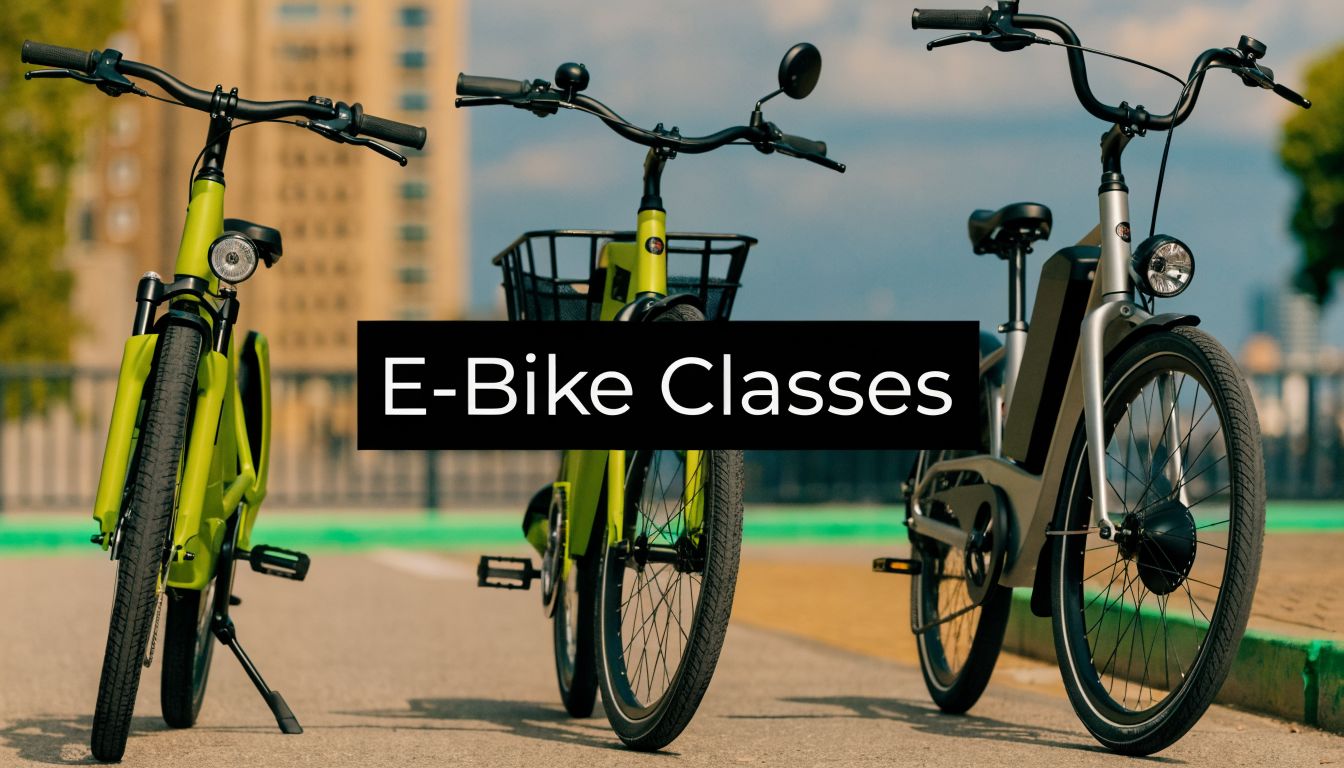
You’re probably doing what a lot of first-time buyers do. You find an e-bike you like, then the product page hits you with terms like Class 1, Class 2, Class 3, pedal assist, throttle, nominal power, peak power, and suddenly a simple shopping decision starts feeling technical.
That confusion is normal.
Most riders don’t start by asking, “What class of electric bike do I need?” They start with practical questions. Can I ride it to work without arriving sweaty? Will it be allowed on the bike path near my house? If I live in the UK or EU, does the US class label even matter? And if I’m buying for cargo, commuting, or weekend rides, which setup feels best on the road?
The classes of electric bikes matter because they shape the riding experience and the legal one. They affect where you can ride, how the motor helps, whether you get a throttle, and how natural or scooter-like the bike feels.
So You Want an E-Bike But What Class Are You In
A customer walks into a bike shop and points at two nearly identical e-bikes. Same frame style. Similar battery placement. Similar tires. One is labeled Class 1. The other is Class 2. The customer’s first question usually isn’t about motor specs. It’s, “Why is this one allowed on more paths?”
That’s the right question.
With classes of electric bikes, the label isn’t just a technical detail. It tells you how the bike delivers power and often hints at where you can legally use it. Two bikes can look almost the same and still behave very differently in daily riding.
Here’s where people usually get stuck:
- The names sound abstract. Class 1, 2, and 3 don’t tell you much by themselves.
- Online shops mix markets. A bike described for US riders may not line up cleanly with UK or EU rules.
- Specs get messy fast. Riders see watts, speed cutoffs, throttle notes, and legal disclaimers all on one page.
- Local rules aren’t universal. The same e-bike may be welcome on one route and restricted on another.
Buy for your riding life first, then confirm the legal fit for your area. Doing it the other way around usually creates regret.
A simple example helps. If you want a bike that feels closest to a normal bicycle, helps when you pedal, and is often the easiest option for mixed-use riding, one class will stand out. If you want the option to move without pedaling at all, another class makes more sense. If your priority is a faster commute on roads, a different class comes into focus.
That’s why understanding the classes of electric bikes before you buy saves time, money, and frustration. It helps you narrow the field quickly, and it keeps you from falling for a bike that looks perfect online but doesn’t suit your local rules or riding habits.
Decoding the Big Three US E-Bike Classes
In the United States, the most common framework is the three-class system. It was established in 2014 by PeopleForBikes and is built around three things: motor power, top assisted speed, and whether the bike has a throttle, according to Bicycling’s guide to e-bike classes. That same source notes that the system uses a maximum of 750W motor power and that Class 1 bikes hold over 72% market share because they’re widely accepted on bike paths and trails.

Start with two ideas
First, pedal-assist means the motor helps only when you’re pedaling. Stop pedaling, and the motor stops helping.
Second, throttle means the bike can move under motor power without pedaling, similar to the feel many riders expect from a scooter.
If you want a quick refresher on how the first system works in practice, this explanation of e-bike pedal assist helps translate the jargon into road feel.
The three classes in plain English
| Class | How the motor works | Assisted speed | Typical feel |
|---|---|---|---|
| Class 1 | Pedal-assist only | Up to 20 mph | Most like a normal bicycle |
| Class 2 | Pedal-assist and throttle | Up to 20 mph | More flexible, lower-effort riding |
| Class 3 | Pedal-assist up to a higher speed | Up to 28 mph | Best suited to faster road commuting |
The logic is simple once you see it.
Class 1 is for riders who want assistance but still want to pedal for all forward motion. It tends to feel the most bicycle-like.
Class 2 adds a throttle. That one feature changes a lot about the experience. It can make starts easier, hills less intimidating, and short errands less work.
Class 3 is the faster road-focused option. It’s for riders who care more about covering distance efficiently than about trail access.
Why this system matters in real life
Classes of electric bikes aren’t just labels for product pages. They shape buying decisions in a practical way:
- Route choice: Some paths and trails are more open to one class than another.
- Ride feel: Pedal-assist and throttle setups feel different from the first minute.
- Use case: A fast commuter and a relaxed leisure bike don’t need the same class.
- Cross-border confusion: A US class label doesn’t automatically translate to UK or EU legality.
If you keep those three questions in mind, pedal-assist or throttle, 20 mph or 28 mph, and where you’ll ride, you can sort most e-bike listings much faster.
Class 1 vs Class 2 vs Class 3 A Head-to-Head Look
A spec sheet can make these three classes look neatly separated. On the road, the differences feel more personal. The same rider might test a Class 1 and think, “This feels like cycling, just easier,” then try a Class 2 and realize the throttle changes how starts, hills, and tired legs feel, then ride a Class 3 and notice how much faster a commute begins to shrink.

Class 1 for riders who want a bicycle first
Class 1 is usually the easiest place to start because the riding logic is simple. You pedal, the motor adds support, and the assistance stops at 20 mph. No throttle. No second way to power the bike forward.
For many first-time buyers, that makes Class 1 feel the most intuitive. It works like riding with a steady tailwind. Hills flatten out, headwinds stop feeling punishing, and longer rides ask less from your legs without changing the basic rhythm of cycling.
Class 1 often suits riders who want:
- A familiar ride feel: Pedaling is still the center of the experience
- Fewer controls to manage: You are not switching between pedal assist and throttle input
- Better odds of access: This class is often the least disputed on mixed-use routes
The trade-off is straightforward. If you want help without pedaling, Class 1 cannot give it.
Class 2 for flexibility and easy starts
Class 2 keeps the same 20 mph assisted limit, but it adds a throttle. That sounds like a small hardware change. In practice, it changes the personality of the bike.
A throttle helps at the moments new riders notice most. Pulling away from a traffic light. Restarting on an incline. Getting a loaded bike moving with groceries, a child seat, or work gear. Riders with knee pain, limited mobility, or lower confidence often notice that Class 2 removes some of the stress from those situations.
If you want a closer look at how throttle riding works day to day, this guide to the Class 2 e-bike riding experience and use cases can help.
Class 2 often makes sense for:
- Urban utility rides: errands, shopping, short commutes
- Stop-and-go streets: frequent junctions and repeated starts
- Riders who want backup: pedal when you feel good, throttle when you need a break
One point catches buyers out. A throttle can affect where you are allowed to ride, especially on local trails or shared paths. The class label tells you how the bike works. It does not guarantee access everywhere.
Class 3 for faster commuting
Class 3 is built for riders who care about speed on practical road rides. It gives pedal assist up to 28 mph, which can make a long commute feel less like a workout and more like reliable transport.
That higher ceiling matters most on open bike lanes, roads, and longer suburban routes. The bike keeps helping at speeds where Class 1 and Class 2 have already stopped assisting, so you spend less time fighting to maintain momentum.
One detail causes a lot of confusion. As explained in Pedego’s breakdown of how Class 3 speed and throttle limits work, Class 3 pedal assist can reach 28 mph, but a throttle, if the bike has one, is still limited to 20 mph. So the extra speed comes from pedaling with assistance, not from sitting back and using throttle alone.
That makes Class 3 feel different from Class 2 even before you look at the number on paper.
| Point of comparison | Class 2 | Class 3 |
|---|---|---|
| Top assisted speed | 20 mph | 28 mph |
| Throttle behavior | Can power the bike up to 20 mph | If present, throttle stays limited to 20 mph |
| Best use | Errands, utility riding, easy starts | Longer road commutes and faster daily travel |
| Typical access | Often mixed, depends on local rules | More commonly restricted on shared paths and trails |
The part many buyers misunderstand
The classes are not just about top speed. They also hint at the kind of riding life each bike fits.
Class 1 is the closest to traditional cycling. Class 2 is the most forgiving if you want options. Class 3 is the clear choice for riders who want to cover ground quickly on roads.
If you shop across countries, this comparison needs one extra layer. A bike that makes perfect sense in the US class system may not line up neatly with UK or EU expectations, where lower assisted speeds and different power rules are much more common. For international riders, that means “best class” is not only about comfort or commute length. It is also about where the bike will be legal to ride.
The short version
Use this as your quick filter:
- Choose Class 1 if you want the most natural, bike-like feel
- Choose Class 2 if throttle help would make daily riding easier
- Choose Class 3 if faster road commuting matters more than broad path access
The right choice is the one that matches your route, your body, and the rules where you ride most often.
How E-Bike Rules Change in the UK and EU
You find an e-bike online that sounds perfect for your commute. It is sold as a US Class 3, the reviews are strong, and the range looks right. Then you ship it to London, Amsterdam, or Berlin and learn that the label on the product page did not answer the question that matters most. Can you legally ride it there as a normal bicycle?

The UK and EU start from a different rulebook
The US class system sorts bikes into Class 1, 2, and 3. The UK and much of Europe usually start with a different question. Is the bike a road-legal pedelec under local bicycle rules, or is it treated more like a motor vehicle?
That difference matters because the categories do not map neatly across borders. A bike can feel ordinary in the US market and still fall outside standard UK or EU bicycle rules because of its motor setup, assisted speed, or throttle.
A simple way to frame it is this. The US system is a retail label that helps buyers compare bikes. The UK and EU approach is more like a compliance checklist tied to where and how the bike can be used.
What “pedelec” usually means in practice
A typical UK or EU-legal pedelec is built to assist your pedaling, then stop assisting at a lower speed than many US riders expect. It usually feels calm, steady, and bike-like rather than scooter-like.
That is where international buyers often get tripped up.
Many riders assume a US Class 1 bike is basically the same as a European pedelec because both rely on pedal assist. The riding feel may be similar, but the legal details are not identical. Power limits differ. Speed cutoffs differ. Product versions can differ too, even when the bike name stays the same.
If you want a riding-focused explanation of those speed differences, this guide on how fast electric bikes go in real-world use helps put the numbers into context.
Why throttles and higher speeds change the picture
In the US, a throttle can still fit within the familiar class system. In the UK and EU, a throttle often raises a bigger legal question because it can push the bike outside the standard pedelec category.
The same goes for faster models. In parts of Europe, riders often use the term speed pedelec or S-pedelec for higher-speed e-bikes. That sounds close to a fast US commuter bike, but the road treatment is often very different. Once a bike moves beyond standard pedelec rules, requirements can shift toward registration, insurance, approved equipment, or restrictions on where you can ride.
A bike shop mechanic would describe it like this. In the US, the class label often tells you what kind of ride to expect. In the UK and EU, the first check is whether the bike still counts as a bicycle under local law.
A quick visual explainer helps if you want to see how some of these categories are discussed in rider-friendly terms.
A better way to shop across markets
If you live in the UK or EU, start with local compliance, then compare riding style. That order saves a lot of frustration.
Use this filter before you buy:
- Check the assisted speed limit: US listings often normalize faster support than UK or EU bicycle rules allow.
- Check the motor rating: European rules pay close attention to the rated motor output, not just how the bike feels on the road.
- Check for a throttle: A throttle can change the bike’s legal category quickly.
- Check the regional version: The same model name may be sold in different legal configurations for different countries.
A bike built for a US customer and a bike built for a UK or EU customer can share a name but follow different rules.
For Punk Ride’s global customers, that is the big takeaway. “Class” is useful shorthand inside the US. For cross-border buying, it is only the starting point. The smarter question is whether the exact version of the bike matches the rules where you will ride it.
Choosing the Right E-Bike Class for Your Lifestyle
The easiest way to choose between classes of electric bikes is to stop thinking like a spec sheet and start thinking like a rider. Your best class depends less on abstract features and more on what your week looks like.

For the city commuter
If your ride is mostly roads, painted bike lanes, junctions, and longer stretches between stops, you’ll probably end up choosing between Class 2 and Class 3.
Class 2 feels easier in stop-start traffic because the throttle can help you move off smoothly. Class 3 makes more sense if your commute is longer and you want higher pedal-assisted cruising speed.
Choose based on your route:
- More stops and starts: Class 2 often feels friendlier.
- Longer road distance: Class 3 often feels more efficient.
- Mixed paths and uncertain access: The lower-speed classes are usually easier to live with.
For the weekend trail rider
If your ideal ride includes greenways, shared paths, or mountain bike trails where e-bikes are permitted, Class 1 is often the safest first look. Riders who want that traditional cycling feel usually end up happiest here anyway.
This isn’t about one class being more “serious.” It’s about choosing the one that lines up with the places you want to ride.
For errands, cargo, and family use
A rider carrying groceries, work kit, or a child seat often values easy low-speed control more than top-end speed. That’s where Class 2 can feel especially useful.
The throttle can help when starting from a heavy load or pulling away uphill. You still have pedal-assist when you want it, but you’re not relying on leg force alone for every launch.
The best utility e-bike is often the one that makes awkward moments easy. Starting loaded, turning in tight spaces, and getting moving uphill matter more than bragging rights.
For the rider who wants the least fuss
This buyer doesn’t want to compare ten technical features. They want the option that’s easiest to understand and easiest to use.
In many cases, that rider should begin with Class 1. It keeps the learning curve smaller, preserves the bicycle feel, and avoids a lot of the “Do I use throttle here?” questions that come with other setups.
A fast self-check before you buy
Ask yourself these four questions:
- Do I want to pedal every time the bike moves?
- Will I ride mainly on roads, or do paths and trails matter more?
- Am I carrying cargo, shopping bags, or passengers regularly?
- Am I shopping in the US system, or do I need UK or EU compliance first?
Answer those truthfully and your ideal class usually becomes much clearer.
Your Guide to Safe and Legal Riding
You buy an e-bike that looks perfect on paper, then find out your local riverside path bans throttles, your park trail only allows pedal assist, or your city wants lights and a helmet after dark. That is the part many first-time buyers miss. The class label matters, but the place you ride matters just as much.
For U.S. riders, the three-class system gives you a useful starting point. For UK and EU riders, the legal question usually starts somewhere else, with whether the bike fits local e-bike definitions at all. For Punk Ride’s global customer base, that difference matters because a bike that feels straightforward in one country can fall into a more restricted category in another.
A good way to see it is to treat the class sticker like a passport, not a free pass. It identifies what the bike is. It does not guarantee entry everywhere.
What to check before your first ride
Start with the route, not the spec sheet. A product page can tell you the bike’s class, top assisted speed, and whether it has a throttle. It cannot tell you whether your local greenway, canal path, forest track, beachfront promenade, or city bike lane allows that setup.
Check these four things before your first proper ride:
- Path or trail rules: State or national rules may allow an e-bike category broadly, while a specific park, council, or trail manager sets stricter access rules.
- Throttle restrictions: In many places, a throttle changes where the bike is welcome, even if the motor power seems modest.
- Rider requirements: Helmet, age, bell, lights, reflectors, and insurance rules can vary by region.
- Country-specific definitions: In the UK and EU, whether the motor assists only while pedalling and where assistance cuts off can matter more than the U.S. class name.
That last point catches international buyers off guard. A U.S. Class 2 bike may make perfect sense for errands in one state, but a throttle-equipped setup can create very different legal questions in the UK or much of Europe.
Safe habits that matter in every class
Legal access is only half the job. Good riding manners keep everyone more comfortable, and they protect access for other e-bike riders too.
- Match your speed to the space: A bike can be legally allowed on a shared path and still be going too fast for walkers, dogs, or blind corners.
- Signal early and ride predictably: People around you react better when your line and intentions are easy to read.
- Slow down where paths narrow: Bridges, gates, tight bends, and busy crossings are the spots where surprises happen.
- Practice low-speed control: Starts, braking, and tight turns feel different on an e-bike, especially with cargo or a throttle.
A simple shop-floor rule helps here. Ride in a way that would not startle someone five metres ahead of you. That mindset works in New York, Manchester, Berlin, or on a local rail trail.
A smart e-bike rider checks two things before every route: “Is my bike allowed here?” and “Can I ride here in a way that feels safe for everyone else?”
Your E-Bike Class Questions Answered
Is there really a Class 4 e-bike
People use the phrase Class 4 informally, but it’s not part of the standard three-class bicycle system. Bikes above the 750W nominal threshold are treated as motor vehicles rather than standard e-bikes in that framework, as explained earlier. In practical terms, that means they move into a different legal category with very different rules.
Can I modify my bike to make it faster
You can physically modify many e-bikes, but legality is a separate issue. If a change alters the bike’s class or pushes it outside bicycle definitions, the places you can ride it and the rules that apply may change too.
That’s where riders get into trouble. They think they’ve made a better e-bike when they may have created something regulated more like a motor vehicle.
Does bike weight determine the class
No. The classes of electric bikes are defined by how the motor assists, the assistance cutoff speed, and the relevant power standard. Weight affects handling, storage, and carrying the bike upstairs, but it doesn’t define the class.
Why do some listings show nominal power and peak power
Because they measure different things. Nominal power is the continuous rated output used for classification in the US framework. Peak power refers to short bursts. Buyers often mistake peak output for the legal class-defining figure, which creates a lot of confusion.
Which class is best for a first-time buyer
If you want the shortest answer, Class 1 is often the easiest starting point for riders who want a familiar bicycle feel. But if you know you want throttle support for comfort, cargo, or accessibility, Class 2 may suit you better. If your use is mainly road commuting and speed matters most, Class 3 deserves a serious look.
If you’re comparing models across the US, UK, and EU markets, Punk Ride LLC is a useful place to explore electric bikes and scooters from a global retailer with US headquarters and UK and Germany warehouse coverage. Browse the range with your local rules in mind, and use what you’ve learned here to choose the class that fits the way you ride.
Share:
Reliable Electric Scooters & Bikes for Everyday Commuting
Sustainable Living: Embrace Electric Transport Today!