


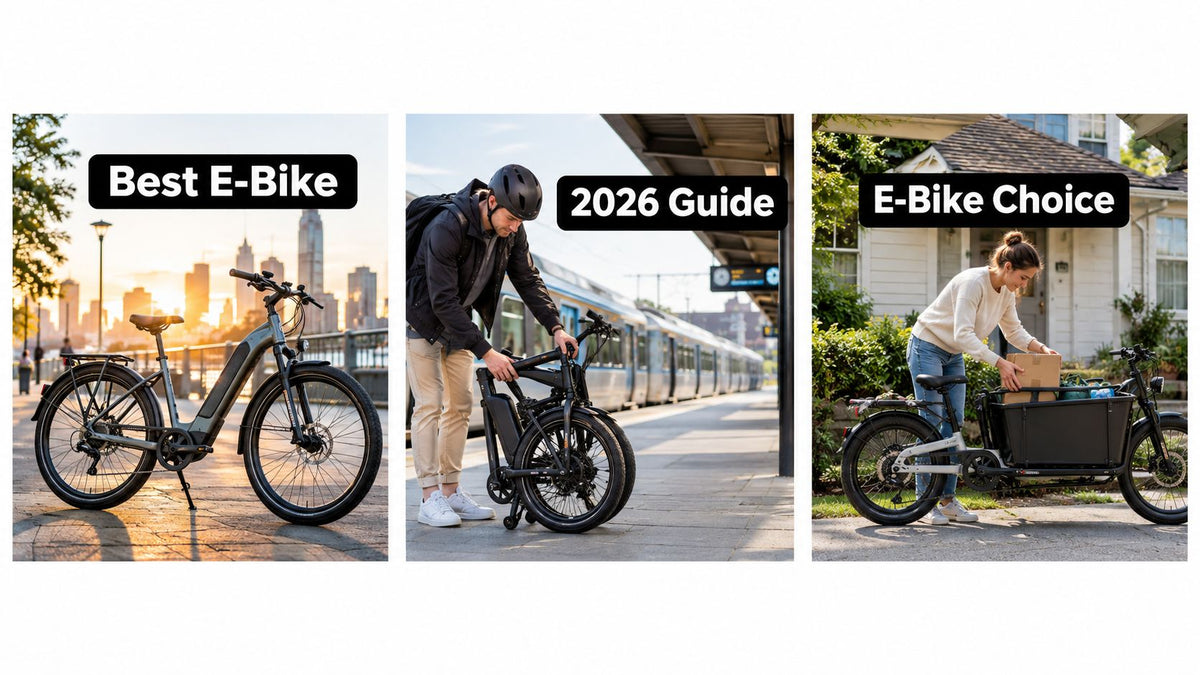
You're standing in the rain with a backpack digging into one shoulder, one hand on a wet rail, and the usual morning thought in your head, "There has to be a better way." There is. The best electric bike to buy is the one that fits your route, your hills, your storage space, and the rules where you ride, not the flashiest spec sheet on a product page.
| Buyer Type | Best Category | What to Prioritise | What to Avoid |
|---|---|---|---|
| Daily commuter | Commuter or hybrid | Upright fit, racks, lights, sensible battery size | Overbuilt frames you'll hate lifting |
| Train-plus-bike rider | Folding | Low weight, quick fold, easy carry | Heavy folders that only fold for storage |
| School run or cargo hauler | Cargo | Strong brakes, stable frame, serious load carrying | Cheap rear racks and weak stopping power |
| Trails and rough roads | Mountain or fat-tire | Suspension, grip, durability | Trying to make it feel like a light city bike |
The Quick Answer Most Buyers Actually Need
If your morning looks like a soaked backpack, a late start, and a bike lock that's already cold in your hand, you don't need a spec lecture. You need a bike that makes that ride easier, faster, and less annoying. For many riders, that means a commuter or hybrid e-bike with a sensible battery, proper lights, and a fit that doesn't punish you after 20 minutes.
The right choice changes with your route. Short, flat city hops point to a lighter commuter or folder. School runs and grocery runs push you toward cargo. Hilly routes and mixed terrain point to a mid-drive bike with enough torque to feel calm instead of strained. A lot of people buy for the wrong reason, then end up dragging a bike they barely use.
My blunt recommendation
If you ride daily in a city or suburb, buy the bike that feels easiest to live with, not the one that sounds fastest on paper. The real world reward goes to bikes that are comfortable, legal where you live, and simple enough that you take them out every day.
Practical rule: if you need to think hard about whether the bike is “too much,” it probably is.
That's the lens for the rest of this guide. I'm going to match bike type to route, then to law, then to battery reality, then to price. That's how you avoid buying the wrong machine and then trying to justify it later.
The Four Specs That Really Matter When You Buy
Motor first, because hills don't care about marketing
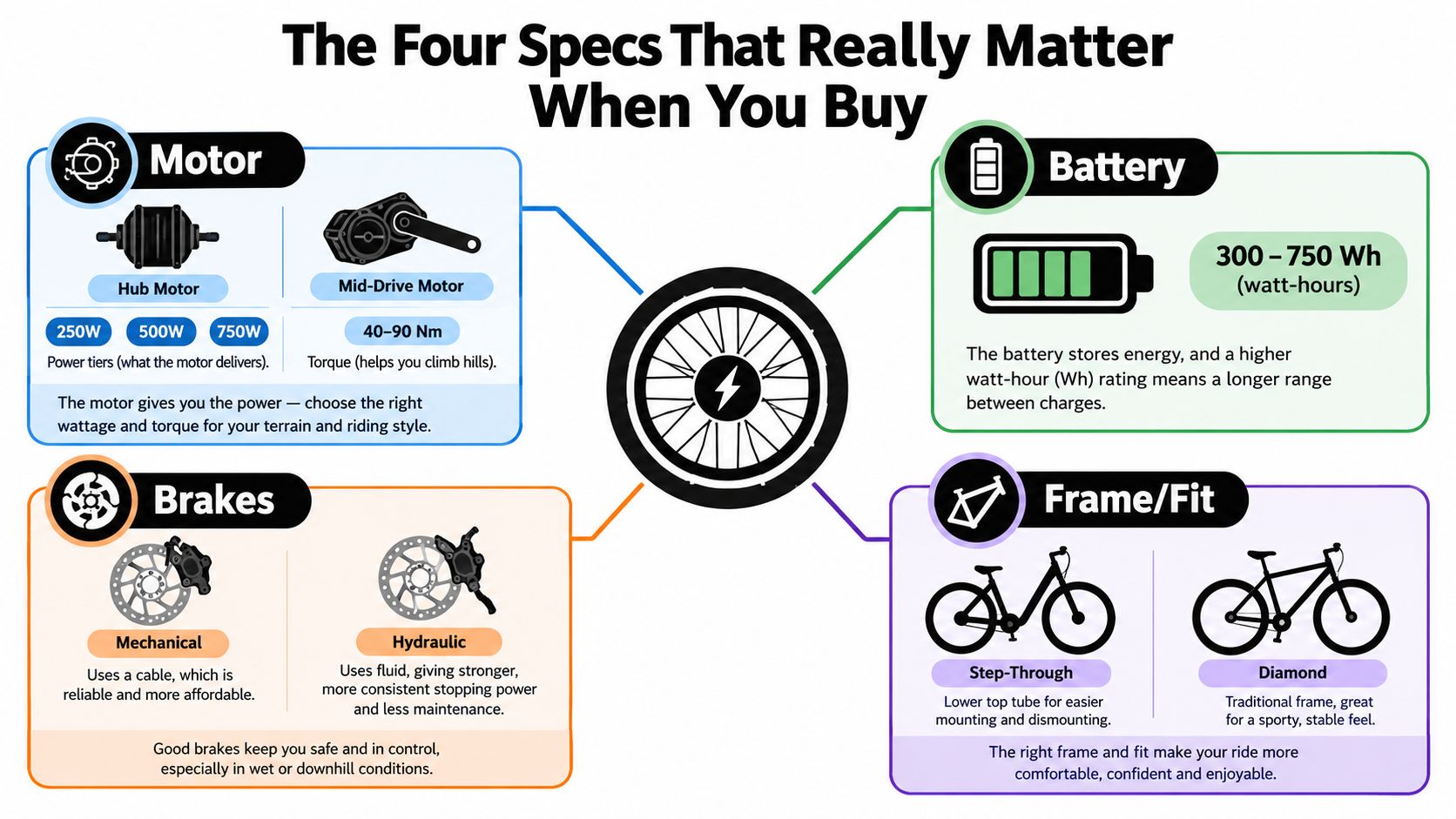
Motor type changes how a bike feels more than almost anything else. Hub motors are simple and common, and they're fine for flatter commutes. Mid-drive motors feel better on hills and with cargo because they push through the bike's gears instead of just spinning the wheel.
Wattage gets hyped too much. A 250W bike can be a brilliant commuter in the UK and much of Europe, while a 500W or 750W setup makes more sense where the law allows it and the route actually needs it. Torque matters more than headline watts when you start on a hill or pull extra weight.
Battery, because Wh tells the truth
For battery size, watt-hours (Wh) is the number that matters. It's a better guide to usable energy than voltage alone, and many mainstream e-bikes live in the 400 to 750 Wh band, which is the right place to start comparing models. A removable battery is more convenient if you live upstairs or want indoor charging, while an integrated battery often looks cleaner and can be harder to spot.
Charge time depends on the charger and pack size, but the main decision is simple. Bigger battery, more range, more weight, more cost. Smaller battery, lighter bike, more frequent charging.
Range and weight, the two things buyers underestimate
Advertised range is always the cheerful version of reality. Real range drops when you add hills, wind, cold weather, cargo, or a heavier rider, and practical guidance says to think in safe commuter range, not brochure range. The battery number gets you in the right neighbourhood, but your route decides whether you finish the week without a top-up.
Weight changes whether you'll love the bike or resent it. A bike around 18 to 25 kg is still manageable for everyday use. Once you get past 30 kg, carrying it upstairs, lifting it onto a train, or manoeuvring it into a hallway starts to matter enough that you'll avoid riding more often than you should.
If you're prioritising one thing, choose the spec that matches your daily pain point. Hills mean motor. Long rides mean battery. Tight storage means weight. A loaded commute means all three, plus brakes that don't make you nervous in the wet.
Matching Bike Categories to Real Riding
Commuter, folding, cargo and off-road side by side
| Category | Best For | Typical Range | Weight | Watch Out For |
|---|---|---|---|---|
| Commuter or hybrid | Daily rides, errands, upright comfort | Moderate to good, depending on battery | Usually manageable for daily use | Buying too much bike for a short flat route |
| Folding | Trains, flat storage, apartment living | Usually shorter than full-size bikes | Varies widely, but weight matters more than fold size | Thinking foldable means easy to carry |
| Cargo or family | Kids, groceries, school runs, heavy loads | Often strong, but depends on pack size | Usually heavier by design | Underestimating stopping distance |
| Mountain or fat-tire | Trails, gravel, rough commuting | Depends on terrain and assist use | Heavier, with more rolling mass | Buying one just because it looks adventurous |
A commuter or hybrid is the safest default for most buyers. Upright geometry, racks, and integrated lights make everyday riding easier, and it's the category that best fits normal city and suburb life. If you ride to work, stop for groceries, and want one bike to do all of it, that's the natural place for most riders to start.
A folding e-bike is for mixed-mode riders, not for everyone who likes the idea of compactness. If you carry it onto a train, store it under a desk, or live in a small flat, folding makes sense. The mistake is buying a folder for portability, then discovering it still weighs enough to annoy you every time you lift it. If you need a useful side reference for ride comfort, a practical guide to bike water bottles can help you think through what fits your route and carry setup.
A cargo bike is the blunt instrument of the e-bike world, in a good way. It solves the school-run problem and the shopping problem by being stable, strong, and built for load. The common mistake is buying one for occasional hauling when a normal commuter would've been easier, cheaper, and less cumbersome.
A mountain or fat-tire bike is for rough surfaces, trails, and riders who really do leave the pavement often. It gives you grip and comfort where a city bike would feel nervous. The mistake is buying it for style, then discovering the extra weight and bulk are a pain on normal roads.
Where You Ride Changes What You Can Legally Buy
The law sets the ceiling before the showroom does
Before you get attached to a motor size, check what your local rules allow. In Great Britain, an Electrically Assisted Pedal Cycle needs a motor with a maximum continuous rated power of no more than 250 watts, and assistance must cut off at 15.5 mph, or 25 km/h. The pedals also need to be turning for the motor to engage, and London transport guidance mirrors that same standard for local e-bike use. Great Britain EPAC rules and TfL e-bike safety guidance both reinforce that point.
In the United States, the common three-class system is different. Class 1 and Class 2 assistance cuts out at 20 mph, while Class 3 cuts out at 28 mph, and federal guidance says a legal e-bike typically has operable pedals and a motor of no more than 750 watts. If you're shopping in the US, class matters as much as motor brand.
Region matters more than brochure claims
Australia keeps things tighter than a lot of buyers expect. Legal e-bikes generally cut motor assistance at 25 km/h, and any throttle or walk-assist feature must cut out at 6 km/h. NSW's guidance matches that nationwide baseline, so this isn't something to guess at after payment.
For EU buyers, the practical default is a 250W, 25 km/h pedelec if you want the broadest road-friendly fit in dense city use. That's the safe starting point for most urban shoppers, especially where local enforcement and shared-path rules are strict. If you want to check state-by-state detail for a broader buying shortlist, this electric bike laws by state guide is the kind of reference worth saving.
Short version: buy the bike the law can't argue with. It saves you from paying extra for power you can't legally use on your normal roads.
Range, Battery and the Commute That Will Not Quit on You
Start with Wh, not the brochure claim
The smartest battery question is not “How far does it go?” It's “Will it finish my route on a bad day?” Real-world range depends on the battery's Wh rating, your weight, hills, tyre pressure, wind, assist level, and temperature, which is why advertised mileage usually flatters the bike. A 500Wh battery can be perfectly fine for many commuters, but only if you treat the number as a starting point, not a promise.
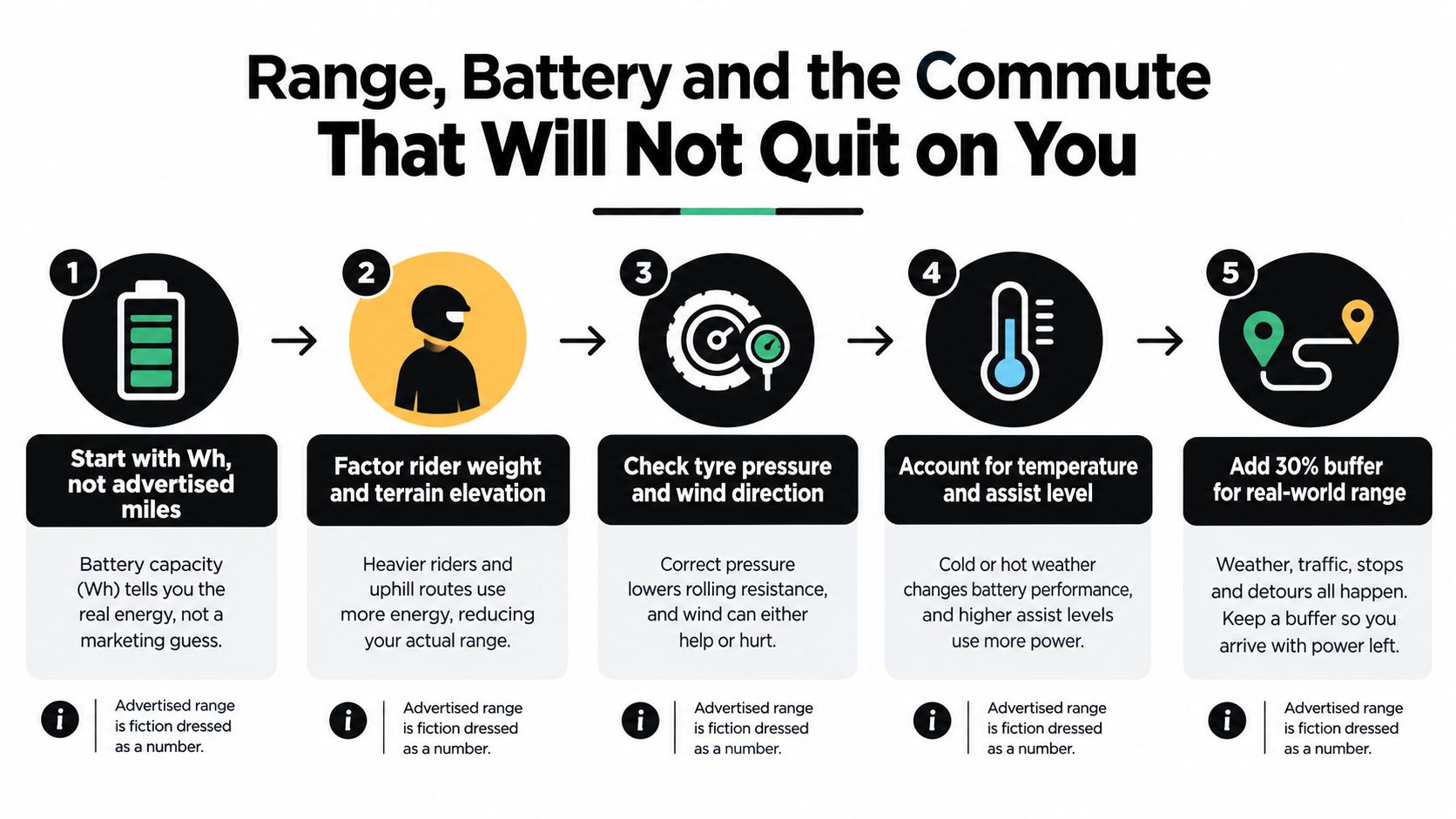
A rough planning formula helps. Take the battery's Wh, then expect your route to use more than the brochure suggests because hills, rider weight, and assist level all pull the number down. If you ride in cold weather or in high assist most of the time, keep a bigger buffer than you think you need.
What to check before you pay
- Battery size first: more Wh usually means more usable range, but also more weight.
- Removable pack: useful if charging indoors matters to your routine.
- Dealer support: a battery that can be replaced and serviced locally is worth more than one that looks clever on paper.
- Realistic commuting margin: don't plan your week around the best-case number.
Advertised range is fiction dressed as a number. Buy for the route you actually ride, not the calm test-track day in the brochure.
If your shortlist includes bikes with big claims, test them on your own route or at least on a route that matches your hills and stops. The moment you compare brochure optimism to your actual commute, the right battery size gets obvious fast. For more background on how battery life is affected by use and care, this battery life guide is worth a look.
Safety, Certification and the Checks You Should Not Skip
The quiet part is the part that matters
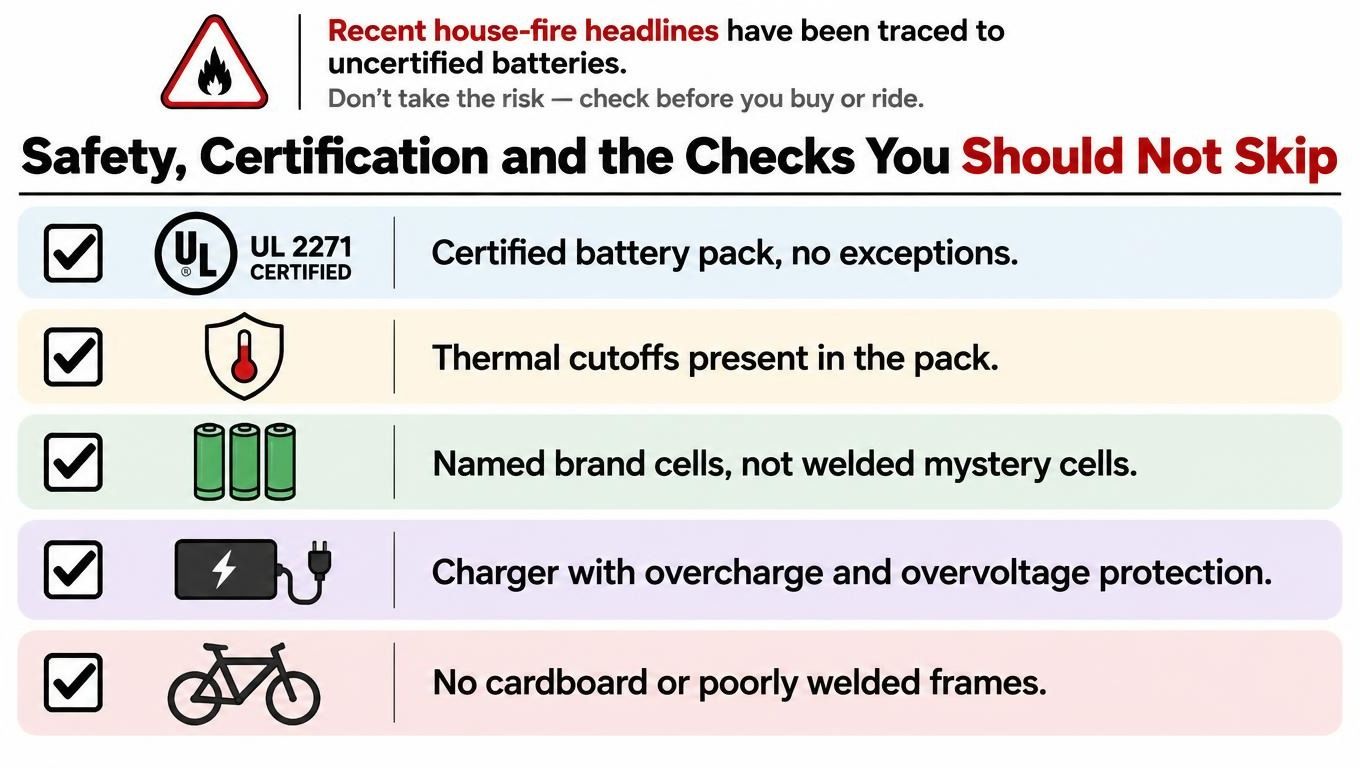
A cheap e-bike can look fine until you inspect the parts that keep it safe. The biggest red flag is a battery or charger that doesn't have proper certification, because that's where bad builds become fire risks. Independent guidance now pushes buyers toward UL 2849 or equivalent certification for the full electrical system, and that's not bureaucratic fuss, it's the line between a serious product and a gamble.
Check the battery, charger, and electrical system as one unit. Use branded cells where possible, avoid uncertified replacement batteries, and don't touch third-party chargers unless they're clearly approved for the bike. If a seller can't explain the battery management system, thermal cutoffs, or service process, move on.
Mechanical safety is part of the deal too
Hydraulic disc brakes beat mechanical brakes for most riders because they stop more confidently and need less hand effort. Hub motors should have proper torque arms if the bike design calls for them, because that helps manage load on the frame and dropouts. Integrated lights and reflective sidewalls matter more than riders think, especially on dark commutes and wet roads.
Punk Ride LLC sits in this broader category as a retailer of electric rides, including electric bikes in its collection, so it belongs in the conversation only as one shopping option among many. If you're comparing brands, keep the same standard everywhere: certified battery system, serviceable motor, matched charger, and a dealer who can actually support the bike after purchase.
For a deeper brake-focused check, this hydraulic brakes guide is useful if you're deciding between a budget build and something you'll trust in traffic. A cheap bike without those checks isn't a bargain, it's a liability with a throttle.
Price Tiers and the Picks Worth Your Money
Budget, mid-range and premium all solve different problems
| Price Tier | Price Range (USD/EUR/GBP) | Best For | Example Model Type | Motor | Battery | Standout Feature | Watch Out For |
|---|---|---|---|---|---|---|---|
| Budget | Under £1,000 / $1,200 | First-time buyers, short commutes | Basic commuter, simple folder | Reliable hub motor | About 400 to 500 Wh | Low entry cost | Weak brakes, poor service support |
| Mid-range | £1,500 to £2,500 / $1,800 to $3,000 | Daily riders who want better feel | Commuter, folder, light cargo, trail hardtail | Mid-drive from Bosch, Shimano, or Bafang M-series | About 500 to 625 Wh | Better ride quality and torque | Buying too much power for flat routes |
| Premium | £3,000+ / $3,000+ | Heavy use, cargo, long-distance comfort | Premium commuter, full-suspension e-MTB, family cargo | Refined mid-drive systems | 750 Wh-plus packs | Smart features, belts, higher-capacity systems | Paying for novelty instead of serviceability |
Budget bikes should focus on the basics that matter, not shiny extras. If the frame is decent, the battery is honest, the brakes are workable, and the dealer network is real, you've got a solid starter bike. Spend here only if you're riding shorter routes and you can live without premium finishing.
Mid-range is where the market gets serious. This is the sweet spot for most buyers because you start seeing better motors, better braking, better batteries, and less compromise in the way the bike feels on real roads. If I were buying for my own commute and wanted the safest bet, I would look here first.
Premium makes sense when the bike is a daily tool, not an occasional toy. That's where smarter connectivity, belt drives, and bigger batteries earn their keep. The next £500 rarely buys more useful wattage, it usually buys better brakes, better support, and a more polished ride.
Your Next Steps to the Right Electric Bike
Make the shortlist from your route, not from the showroom
Write down your real round-trip commute and add 30% for buffer. Then filter by your local legal class first, motor and wattage second, and brand reputation third. That order saves you from getting seduced by a bike that's wrong for your roads.
Book at least two test rides on different categories. Bring the bag, child seat, or pannier setup you'd really use, because a bike can feel great empty and feel awful loaded. Check dealer service, warranty length, and battery replacement cost before you pay anything.
Do this week's shopping like a grown-up: ride the bike you think you want, then ride the one that makes your commute easier.
Budget for the lock, helmet, lights, and a year of servicing too. That extra spend is what keeps the purchase useful after the novelty wears off. If you want a simple next move, use the tier table above, pick three realistic models, and visit a local shop or demo day with your route in mind.
If you're ready to narrow this down fast, Punk Ride LLC carries electric rides for urban commuting and mixed-use riding, so it's a practical place to compare real options instead of staring at spec sheets all night. Visit Punk Ride LLC, check the current electric bike lineup, and choose three models that fit your route, your law, and your budget before you book the first test ride.
Share:
Electric Bike Used
Electric Scooter Troubleshooting Guide That Works