


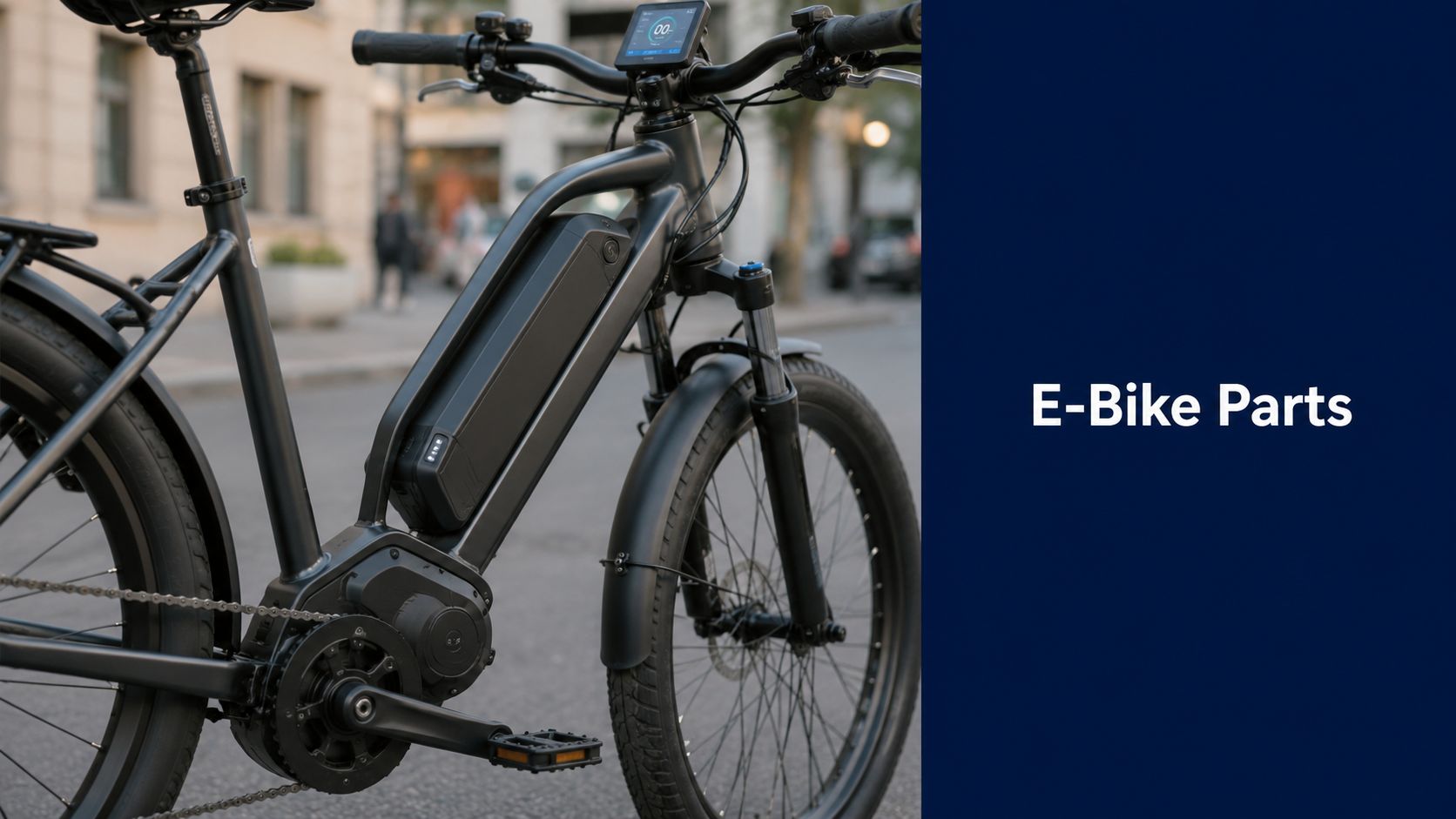
Your commute usually tells you first. The bike still works, but it doesn't feel as lively off the lights. The hill near the station seems steeper than it used to. By Thursday, the battery bar is dropping faster than your patience. Then you start browsing electric bike parts and run into the usual mess: flashy upgrade kits, vague compatibility claims, and listings that somehow tell you everything except whether the part will fit your bike.
That's where most riders get stuck.
A modern e-bike isn't just a bicycle with a battery bolted on. It's a system. When one part goes tired, drifts out of spec, or doesn't play nicely with the rest, the whole ride changes. The good news is that you don't need to become a workshop lifer to understand what matters. You just need to know which parts do the heavy lifting, which ones wear out fastest, and which upgrades are more trouble than they're worth.
Your E-Bike Is More Than Just a Bike
Daily commuter e-bikes live a hard life. Wet roads, kerb drops, hurried charging, full-load panniers, and stop-start traffic all add up. A regular pushbike can often shrug off a slightly rough chain or a tired brake pad for a while. An e-bike is less forgiving because extra weight and motor torque put more stress on nearly everything.
That's why knowing your electric bike parts pays off quickly. It saves money, helps you ask better questions at the shop, and stops you from buying a shiny replacement that turns out to be electrically wrong or legally awkward for UK and EU road use.
The market has also matured enough that finding replacements is easier than it used to be. The global e-bike market reached USD 53.78 billion in 2024 and is projected to reach USD 75.68 billion by 2032, according to Data Bridge Market Research. That matters to ordinary riders because a bigger market usually means broader parts availability, more standard replacement options, and less reliance on mystery components that vanish after one season.
Why riders get tripped up
Often, shopping focuses on a symptom.
They search “better battery,” “stronger brakes,” or “more power uphill.” Fair enough. But often, the underlying issue is upstream. A weak-feeling bike might have a battery problem, a controller problem, a tired drivetrain, dragging brakes, or a sensor that's feeding bad information. Swapping one expensive part without checking the rest is how riders burn cash.
Shop-floor truth: The part that fixes the problem is often not the part that looked guilty first.
The practical mindset
Think of your bike in two groups:
- Core electrical parts that make assistance happen
- Mechanical support parts that survive the extra load and speed
If you understand those two groups, you stop being the rider who says “it just feels off” and start being the rider who can say “assist cuts in late, battery drains fast under load, and the rear brake is doing too much work.” That conversation gets better results, whether you're ordering parts online or wheeling the bike into a workshop.
The Power Trio Motor Battery and Controller
These three parts run the show. If you're learning electric bike parts, start here and stay here until it clicks. Everything else on the bike either supports this trio or suffers when this trio is mismatched.

Industry guidance consistently treats the battery, motor, and controller as the most critical e-bike components, and compatibility failures between them are a primary cause of damage. The same guidance notes that modern lithium-ion e-bike batteries are typically rated for 500 to 1,000 full charge cycles, which can translate to roughly 3 to 7 years of use for a daily commuter, depending on care and riding habits, as outlined in this component guide from Bee Cool Bikes.
What each part actually does
The easiest way to think about it:
| Part | Plain-English job | What happens when it's wrong |
|---|---|---|
| Motor | Turns electrical power into forward movement | Weak pull, rough assist, overheating, odd noises |
| Battery | Stores and delivers the energy | Short range, voltage sag, random cutouts |
| Controller | Decides how and when power gets sent | Jerky assist, poor cutoff behaviour, mismatch faults |
The motor is the muscle. For commuting, riders usually bump into two broad styles: hub motors and mid-drives. Hub motors feel simple and tidy because the drive unit sits in the wheel. Mid-drives push through the bike's drivetrain, which often gives a more natural climbing feel and better use of the gears.
If you're comparing layouts, this guide on e-bike hub motor basics is a useful primer for understanding what hub systems are trying to do well.
Motor feel matters more than bragging rights
A lot of commuters assume “more motor” automatically means “better bike.” Usually it means a bike that pulls harder in some situations and asks more from the rest of the system.
For stop-start city riding, what matters is how smoothly the assist comes in, how predictable it is in traffic, and whether it stays composed on damp streets and tight turns. A motor that lunges feels fast for five minutes and annoying for five months.
The battery is the fuel tank, but not in the old petrol sense. What most riders care about is whether the bike can support their trip, their cargo, and their weather without dropping off halfway home. Battery quality isn't just about range. It's about how stable the power delivery stays under load and whether the pack is built around sane connectors and decent thermal management.
The controller is the bit riders forget
The controller is the bike's traffic manager. It reads inputs from sensors, decides how much help to give, and keeps the motor and battery from fighting each other. When a bike feels snatchy, hesitant, or strangely delayed, the controller often deserves attention before the motor gets blamed.
If you want a deeper, electronics-focused look at how that logic works, this overview of motor control circuitry does a solid job of explaining the brains behind controlled power delivery.
A healthy e-bike feels coordinated. It shouldn't surge, hesitate, or act surprised by your pedalling.
What works and what doesn't
A good commuter setup usually has these traits:
- Matched voltage across the system so the bike behaves predictably
- Clean connector standards so servicing doesn't turn into detective work
- Controller tuning that feels smooth rather than dramatic
- Battery care habits that aren't abusive, especially around storage and charging
What doesn't work is mixing parts because the plugs “look close enough,” chasing extra punch without checking controller limits, or buying a bargain battery from a listing that says almost nothing about compatibility.
The Supporting Cast That Makes It All Roll
The flashy bits get attention, but daily reliability often comes down to the parts that don't make the sales listing headline. Electric bike parts include plenty of plain old bicycle hardware, but on an e-bike those parts work harder and wear differently.
Drivetrain parts take more punishment
Chains, cassettes, chainrings, and derailleur components deal with rider input plus motor assistance. That means more load moving through the drivetrain, especially when riders shift badly under power or mash the pedals in the wrong gear.
A commuter with a strong motor and a neglected chain usually sounds rough before it fails. You'll hear skipping, feel crunchy shifts, and notice that the bike starts chewing through cogs faster than expected. The fix isn't glamorous. Keep the chain clean, replace worn drivetrain parts before they ruin the next one in line, and avoid shifting with the motor pushing hard.
Brakes are not the place to get stingy
An e-bike carries more mass and often reaches assisted speed more quickly than a non-electric bike. That changes brake demands straight away. Pads wear. Rotors run hotter. Cables and hoses have to cope with repeated stopping in traffic, rain, and winter grime.
A lot of riders only think about brakes when they start squealing. Bad move. If the lever feel changes, stopping distances creep up, or the bike starts pulsing under braking, inspect the system before the commute does it for you at the worst possible junction.
Practical rule: On a commuter e-bike, strong consistent braking matters more than adding a tiny bit of extra speed.
The display, frame, wheels, and tyres all matter
The display is your cockpit. It tells you battery state, assist level, and often fault information. If it starts acting oddly, don't assume the screen itself is dead. Sometimes it's reporting a deeper issue from the controller, sensor wiring, or battery connection.
Frames, wheels, and tyres also need to be up to the job. E-bikes place different loads through rims, spokes, and tyres, especially with luggage, potholes, and kerb hits in city use. A bike can have a perfectly healthy motor system and still feel awful because the tyres are wrong for the route or the rear wheel is slowly going out of true.
For riders who like seeing how heavier-duty electric vehicle components are organised outside the bike world, catalogs for quality UTV parts and accessories can be oddly helpful. Not because bike parts and UTV parts are interchangeable, obviously, but because they show the same real-world lesson: once vehicles get electrified and carry more load, support components stop being afterthoughts.
One useful way to think about the rest of the bike
- Drivetrain parts transfer force and wear with use
- Brakes convert speed into heat and safety
- Tyres and wheels manage grip, impact, and tracking
- The display and sensors translate rider input into usable system behaviour
A good commuter e-bike feels sorted because all of these parts are doing boring, dependable work in the background.
Upgrading Your Ride Without The Headaches
Most upgrade disasters start with optimism. A rider wants more range, stronger climbing, or a fresher cockpit display. They order one promising part, fit it on a Saturday, and by Sunday they've got error codes, cutouts, or a bike that technically turns on but rides worse than before.
That's the trap. In electric bike parts, the “best” option is usually the one that matches the bike properly.

Technical guidance aimed at real-world builds and retrofits puts the compatibility question front and centre: voltage, current draw, connectors, and controller settings must match, and staying within a 36V to 52V range is often a practical choice because lower-voltage systems need heavier wiring while higher-voltage systems can raise safety risks, as explained by Grin Technologies at ebikes.ca.
Start with the system you already have
Before buying anything, check these points on the bike itself:
- Battery label and mount. Voltage, connector style, and physical fit all matter.
- Controller limits. If the controller can't support the new part, the upgrade is dead on arrival.
- Motor type and frame format. Hub and mid-drive upgrades bring very different fitting issues.
- Display and sensor compatibility. Some systems are friendly. Some are completely proprietary.
The ugly truth is that many commuters don't own a “modular” e-bike. They own a bike that looks modular until they try to swap the wrong display or battery and discover the manufacturer used a locked-down ecosystem.
Batteries are where good intentions go wrong
A battery upgrade sounds simple. More capacity, more range. Sometimes yes. Sometimes not.
If the new battery doesn't physically secure properly, doesn't share the right connector standard, or doesn't match the controller and motor expectations, you're not upgrading. You're building an electrical argument between expensive components.
Here's the shortlist I use when someone asks whether a battery swap is sensible:
| Check | Why it matters |
|---|---|
| Voltage match | Wrong voltage can damage components or trigger faults |
| Connector type | Adapters can introduce weakness, heat, and poor contact |
| Mount and case fit | A loose battery on rough roads is trouble waiting to happen |
| Controller behaviour | Some controllers are fussy even when the basic numbers look right |
If you have to “make it fit” electrically, stop and reassess. Mechanical adaptation is one thing. Electrical guesswork is another.
Better upgrades than chasing outright speed
A lot of riders search for speed first. That's usually the least sensible place to start, especially on UK and EU commuter bikes where legality matters. If you're curious about the speed topic and the compromises involved, this article on how to make an electric bike faster is worth reading with a critical eye toward legality, safety, and component stress.
The upgrades that age well tend to be less dramatic:
- Brake improvements if your current setup feels under-gunned in wet traffic
- Tyres that suit your route better, especially for puncture resistance and grip
- A fresh chain and cassette if the bike feels noisy or sloppy under load
- A replacement display only if it's confirmed compatible with the controller and sensors
If you need straightforward replacement consumables, Punk Ride LLC lists practical items like tyres, tubes, brake pads, chains, grips, fenders, and lights, which is often more useful for commuters than diving straight into major electrical swaps.
Retrofit logic for hub and mid-drive systems
Hub motor bikes often look easier to modify, but wheel build quality, dropout compatibility, cable routing, and controller pairing still matter. Mid-drives can deliver a lovely ride feel, yet they ask more from the chainline, drivetrain wear parts, and frame-specific fit.
The cleanest upgrade is the one that respects the original bike's design. If the frame was built around a certain battery shape, controller location, and cable path, don't force a conversion that leaves wires dangling, connectors exposed, or key components under strain.
Essential E-Bike Maintenance and Quick Fixes
A lot of workshop jobs could have been avoided with ten calm minutes in a shed or hallway. Not every fault is owner-fixable, and there's no shame in taking an electrical problem to a mechanic. But there are several maintenance habits that stop small issues turning into expensive ones.
This visual checklist is a good starting point.

The weekly commuter check
Treat this like brushing your teeth. Quick, regular, essential.
- Inspect connectors for moisture, dirt, bent pins, or looseness. Don't yank cables by the wire.
- Check the battery fit in its cradle or mount. It should sit tight without rattling.
- Look over visible wiring where cables pass the head tube, frame joints, and rear stays.
- Test the brakes before rolling off. Don't assume yesterday's lever feel means today's is fine.
- Spin the wheels and watch the tyres for cuts, embedded debris, or pressure that's clearly off.
If you commute with a mini pump or inflator, keep one that's easy enough to carry and use. A compact option like this pro-grade Ryobi inflator for less makes more sense than a bulky tool that lives in a drawer.
Battery habits that help
Battery life is shaped by use and care, not luck. Avoid treating the battery like a rugged brick just because it sits in a rugged-looking housing.
Good habits include:
- Charge in a dry, stable environment
- Let the battery cool after a hard ride before charging
- Keep the contacts clean
- Don't ignore weird warmth, smell, or swelling
If your range suddenly falls off, don't jump straight to “battery is dead.” Check tyre pressure, brake drag, assist settings, and route conditions first. Plenty of range complaints are really rolling-resistance complaints.
Quick fault finding at home
This walkthrough on electric bike repair basics can help if you want a broader troubleshooting reference before booking service.
A few common symptoms and first checks:
| Symptom | First thing to check |
|---|---|
| Display won't power on | Battery seated properly, charge level, main connector |
| Motor cuts in and out | Cable strain, sensor connection, loose battery mount |
| Assist feels weak | Brake drag, tyre pressure, drivetrain wear |
| Bike feels rough under load | Chain wear, cassette wear, wheel or brake rub |
Most “electrical” commuter faults still begin with a physical check. Loose fittings, dirty contacts, and damaged cables cause a lot of drama.
For riders who prefer a video refresher, this one covers practical service basics:
Know when to stop
Don't open battery packs. Don't bypass safety cutoffs. Don't keep riding a bike that's making electrical smells, throwing intermittent faults under power, or heating up where it shouldn't. There's a big difference between sensible home maintenance and poking at components that can bite back.
Staying Legal and Safe on UK and EU Roads
Upgrade discussions often go off the rails. Riders read advice aimed at the US market, order parts that promise more speed, then discover that what sounds normal in one market can make a bike awkward or unlawful in another.
For UK and EU riders, the legal side matters because it directly affects which electric bike parts make sense to buy in the first place.

Why controller calibration matters so much
Consumer guidance notes that in the U.S., Class 1 and Class 2 e-bikes are typically capped at 20 mph, while in the EU the common pedelec standard restricts motor assistance to 25 km/h (15.5 mph). That's why the pedal-assist sensor and controller calibration are so important for smooth, legal power delivery, as outlined in Consumer Reports' e-bike buying guidance.
For a UK or EU commuter, that changes the shopping logic. A part isn't suitable just because it fits electrically. It also needs to preserve legal assist behaviour on public roads.
The parts that create legal trouble fastest
Three categories deserve extra caution:
- Displays and controllers with hidden settings that can alter assist cutoff behaviour
- Throttle conversions that push the bike outside standard road-legal pedelec expectations
- Derestriction kits sold as harmless tweaks when they can change the legal status of the bike
The risky bit is that many of these products are marketed like simple accessories. They're not. They can affect road legality, insurance position, and the way the bike behaves in traffic.
A commuter e-bike should feel predictable at the assist limit. If it surges, overruns, or cuts awkwardly near the limit, that's not just annoying. It can become a safety issue.
UK and EU buying judgment
When you're evaluating replacement electric bike parts for a road-going commuter, ask:
- Does this part preserve legal assist behaviour for my market?
- Does it rely on standalone throttle use where that may be problematic?
- Will fitting it make the bike harder to insure, service, or explain after an incident?
That third question gets ignored far too often. Workshop reality is simple. Once a bike has been modified in a messy or legally dubious way, many mechanics become cautious about touching it. Not because they're fussy, but because a badly altered e-bike can be unsafe and difficult to verify.
Safe upgrades for road riders
The smart commuter upgrades are usually boring in the best way:
| Upgrade type | Usually sensible for UK and EU commuting |
|---|---|
| Brake service parts | Yes, provided they fit properly |
| Tyres and tubes | Yes, often one of the best improvements |
| Lights and visibility kit | Yes, strongly worth attention |
| Like-for-like battery replacement | Often sensible if confirmed compatible |
| Speed-altering electronics | High caution, often a bad idea for public-road use |
If you ride private land, different practical questions may apply. But for public roads, cycle lanes, and day-to-day commuting, keeping the bike compliant is part of keeping it useful. A technically impressive setup that you can't legally ride where you need to go is not much of an upgrade.
You Are Now Your E-Bikes Best Friend
You don't need to know every wire colour, firmware quirk, or motor internals diagram to take better care of your bike. You just need enough confidence to spot what matters. The core system has to match. Wear parts need regular attention. Legal road use in the UK and EU should guide your buying decisions as much as performance does.
That shift changes everything.
You stop shopping by hype and start shopping by fit, function, and safety. You catch problems earlier. You ask sharper questions. And when you do hand the bike to a mechanic, you're not walking in blind. You already know whether the issue smells like battery fit, controller behaviour, brake wear, connector trouble, or plain old commuter neglect.
That's how a daily e-bike stays sweet. Not through magic parts. Through sensible choices, routine checks, and upgrades that respect the whole machine.
If you need commuter-focused replacement parts or accessories, Punk Ride LLC is one place to browse practical options for urban electric rides, especially if you're looking for everyday items that keep a bike safe, legal, and ready for the next trip across town.
Share:
Choose Your Best Rack for Scooter: 2026 Buyer's Guide
The Right Ebike Chain Lube and How to Use It