


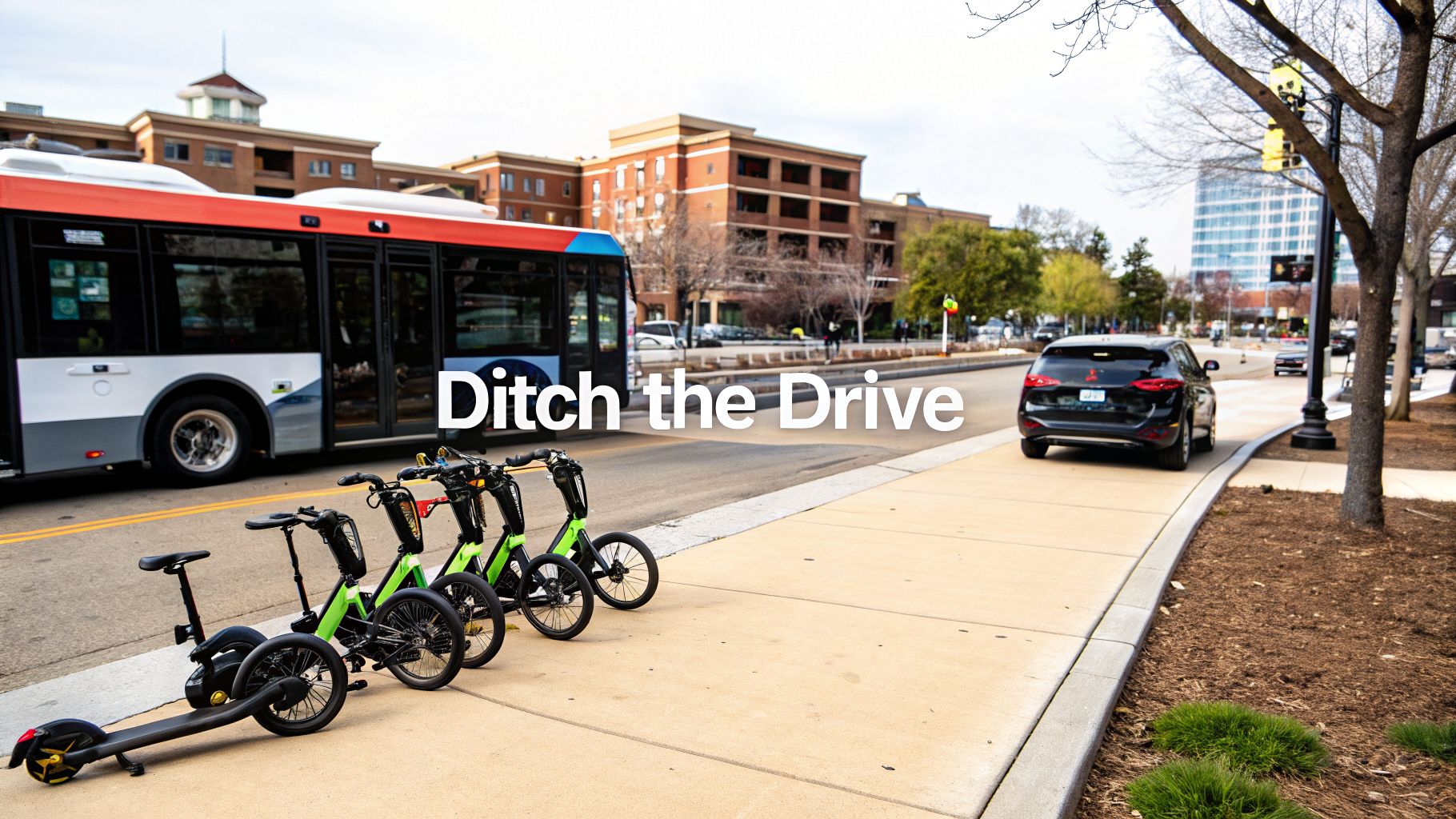
Feeling trapped by traffic, parking fees, and endless maintenance bills? You're not alone. More people than ever are discovering the freedom and financial benefits of exploring alternatives to car ownership. Whether you're in a sprawling US suburb, sunny Australia, or a bustling UK city, the options for getting around are smarter, greener, and more flexible than they have ever been. This isn't about giving up convenience; it's about gaining a lifestyle that's more affordable, active, and tailored to your actual needs. Forget the one-size-fits-all model of a car sitting in the driveway.
This guide is your roadmap to a car-free or 'car-lite' life, packed with practical tips and real-world examples. We'll dive into 10 powerful options, from the growing micromobility networks in the US and Australia to the e-scooter and e-bike revolution sweeping Europe. Seeing how others embrace this shift can be a great motivator; some have even mastered taking vacations without a car, proving that a rich life doesn't require a personal vehicle.
You'll get a clear look at:
- The best options for your commute: E-scooters, e-bikes, public transit, and more.
- Cost and environmental savings: How much you can actually save by ditching four wheels.
- Practical advice: When each option makes sense and how to combine them for maximum effect.
Ready to find the perfect mix of mobility that fits your life, not the other way around? Let’s explore the smarter ways to move.
1. Electric Scooters (E-Scooters)
Zooming through city streets faster than walking but with more freedom than a bus, electric scooters have quickly become a go-to choice for urbanites ditching their cars. These lightweight, battery-powered machines are perfect for short to medium-distance commutes, especially the dreaded “last mile” from the train station to your office. E-scooters offer a zippy, fun, and green way to get around, making them one of the most popular alternatives to car ownership today.

Why Choose an E-Scooter?
An e-scooter shines in congested city centers where car travel is slow and parking is a nightmare. They are exceptionally portable; you can fold one up and carry it onto a bus or train, or tuck it under your desk at work. This makes them a fantastic tool for multimodal commuting, bridging the gaps in public transport networks. Brands like Niu and Segway have become household names across the United States, while shared schemes from Lime and Bird are ubiquitous in Australian cities like Melbourne and Brisbane. Deciding between an e-scooter and an e-bike can be tough, but for pure portability and quick trips, the scooter often wins. You can explore a detailed comparison of an electric scooter vs an electric bike to see which fits your needs best.
Getting Started with Your E-Scooter
Ready to join the scooter revolution? Here are a few practical tips to ensure a smooth ride:
- Safety First, Always: Invest in a quality helmet, lights for visibility, and even knee/elbow pads. Your safety is non-negotiable.
- Know the Rules: E-scooter regulations vary wildly between cities, states, and countries. In Australia, rules differ from Queensland to Victoria, while US states have a patchwork of laws. Before you buy, check the local laws in your area regarding speed limits, where you can ride (sidewalks, bike lanes, or road), and any insurance requirements.
- Practice Makes Perfect: Find an empty car park or a quiet, flat area to get a feel for the accelerator and brakes before hitting busy streets.
- Maintenance is Key: Regularly check your tire pressure and brake function. A well-maintained scooter is a safe scooter.
2. Electric Bicycles (E-Bikes)
Imagine all the benefits of cycling, like exercise and fresh air, but with a powerful boost to flatten hills and shrink long distances. That’s the magic of an electric bicycle. E-bikes merge traditional pedal power with an electric motor, offering pedal-assist or throttle-based propulsion. This makes them a fantastic choice for commuters who want to arrive at work without breaking a sweat, or for anyone looking to tackle longer journeys than they could on a regular bike. As one of the most versatile alternatives to car ownership, they blend fitness with practical, eco-friendly transportation.

Why Choose an E-Bike?
An e-bike is your best friend for commutes that are too long for a scooter but don’t justify the cost and hassle of a car. They let you conquer challenging terrains, carry groceries with ease, and keep up with faster traffic in dedicated bike lanes. Their growing popularity is evident across the United States and Australia, where brands like Rad Power Bikes, Aventon, and Specialized lead the market. E-bike sales in the US have surged, reflecting a major shift in how Americans approach commuting and recreation. An e-bike gives you the freedom of a bicycle with the power to make every journey manageable and fun.
For a closer look at what makes these machines tick, this video breaks down the core components of an e-bike:
Getting Started with Your E-Bike
Ready to start your electric-powered cycling adventure? Here are some essential tips to get you rolling:
- Pick Your Power: Choose between a hub-drive motor (often more affordable and simpler) or a mid-drive motor (provides better balance and a more natural pedalling feel).
- Lock It Down: E-bikes are valuable and attract thieves. Invest in a high-quality D-lock or a heavy-duty chain to secure your investment.
- Master the Assist: Get familiar with the different pedal-assist levels. Using lower settings on flat ground will significantly extend your battery life and overall range.
- Maintain for Miles: Simple, regular maintenance is crucial. Keep your tires properly inflated, your chain lubricated, and check your brakes before every ride.
3. Car Sharing (Round-Trip and One-Way)
What if you could have access to a car for errands, weekend trips, or moving furniture without the headaches of insurance, maintenance, and parking? That's the freedom car sharing offers. These membership-based services provide on-demand vehicle access, allowing you to book a car for as little as an hour or for a full day, making them a cornerstone among alternatives to car ownership. You get the convenience of a car, but only when you truly need one.
Why Choose Car Sharing?
Car sharing is the perfect middle ground for those who mostly rely on public transport or micromobility but occasionally need a car. It excels for tasks like a big grocery shop, visiting family out of town, or a rainy day commute. Services like Zipcar are popular across North America, while GoGet is a major player in Australian cities like Sydney, Melbourne, and Brisbane. There are two main models: round-trip, where you return the car to its original spot, and one-way, which allows you to drop it off in a different location within a defined zone. Beyond traditional car-sharing, exploring flexible options like car subscription models can provide vehicle access without the full burden of ownership.
Getting Started with Car Sharing
Ready to book your first ride? Here’s how to make the most of car-sharing services:
- Join Multiple Services: Sign up for a few different providers in your city. This gives you better vehicle availability and the flexibility to choose the best rate for each trip.
- Book Smart: For better rates and guaranteed availability, try to book during off-peak hours. Weekend and evening demand is often higher.
- Pre-Trip Inspection: Before you drive off, walk around the car and take photos of any existing scratches or dents. Report them through the app to ensure you aren’t held responsible.
- Fuel and Battery Etiquette: Most services require you to leave the car with a certain amount of fuel or charge (often at least a quarter tank). Failing to do so can result in extra fees.
- Know Your Insurance: Familiarize yourself with the insurance coverage provided by the service. Understand the excess amount you’d be liable for in case of an accident and see if your personal insurance or credit card offers supplemental coverage.
4. Public Transit (Buses, Trains, Metro)
The backbone of urban mobility, public transit encompasses the network of buses, trains, and metro systems that move millions of people daily. From the NYC Subway to Sydney's extensive train network and Melbourne's iconic trams, these shared transportation networks offer an affordable, high-capacity, and often stress-free way to travel. For many, public transit is not just an option but a superior choice, making it one of the most fundamental alternatives to car ownership.

Why Choose Public Transit?
Public transit excels in densely populated areas, allowing you to bypass traffic congestion, avoid the endless hunt for parking, and save a significant amount of money on fuel, insurance, and maintenance. Instead of gripping a steering wheel in rush hour, you can read, work, or simply relax. Modern systems in the US and Australia are increasingly integrating real-time tracking and contactless payments, enhancing convenience. Furthermore, combining public transit with a personal mobility device like an e-scooter or e-bike perfectly solves the challenge of first-mile, last-mile transportation, giving you complete door-to-door freedom without a car.
Getting Started with Public Transit
Ready to make the switch? Here are some practical tips to become a transit pro:
- Go Digital: Download your local transit authority's app. These tools provide real-time tracking, service alerts, and journey planning, taking the guesswork out of your commute.
- Get a Pass: If you're a regular rider, a weekly or monthly pass almost always offers substantial savings over paying per trip. Look for reloadable cards like Australia's Opal or Myki cards, or similar passes in US cities.
- Plan Your Route: Use apps like Google Maps or Citymapper to plan your journey in advance. They show you the fastest routes, including transfers and walking times.
- Know the System: Take a moment to understand the payment system, whether it’s a dedicated card, a mobile app, or contactless bank card taps. Knowing how to pay keeps things moving smoothly.
5. Bike Sharing Systems
For those who love the idea of cycling but don't want the hassle of owning and maintaining a bike, bike sharing systems are a perfect solution. These networks of publicly available bicycles, often found at docking stations across cities, allow you to pick up a bike from one location and drop it off at another. This point-to-point convenience makes them an outstanding alternative to car ownership for quick errands, daily commutes, or leisurely rides through the park. Modern systems, like New York's Citi Bike and Melbourne's Lime bikes, have grown to include e-bikes and are managed through easy-to-use mobile apps.
Why Choose a Bike Sharing System?
Bike sharing excels at offering the health and environmental benefits of cycling without the commitment. You never have to worry about bike theft, storage space, or performing maintenance. It’s an ideal choice for spontaneous trips or for visitors exploring a new city. These systems are especially effective when combined with public transport, allowing you to cycle the first or last leg of your journey. Major cities across the US and Australia have embraced this model, from Chicago's Divvy to Brisbane's Neuron Mobility, proving its effectiveness in reducing urban congestion and promoting active transport.
Getting Started with Bike Sharing
Ready to start pedalling? Here are some practical tips for using a bike sharing service:
- Choose Your Plan: Most services offer pay-per-ride options or memberships. If you plan to ride frequently, an annual or monthly membership is usually much more cost-effective.
- Bring Your Own Helmet: While some systems may offer helmets, it's always safer and more hygienic to bring your own. In Australia, helmets are legally required for cyclists.
- Check and Reserve: Before heading to a dock, use the system's app to check for bike availability. Some apps even let you reserve a bike in advance, which is useful during peak hours.
- Dock It Right: Always ensure your bike is securely locked back into a docking station when you're finished. You'll typically hear a click or see a green light. Improperly returned bikes can lead to extra charges.
- Go Electric for Hills: Many services now include e-bikes in their fleets. These are fantastic for tackling hills or longer distances without breaking a sweat, making cycling a viable option for more people.
6. Ride-Hailing Services (Uber, Lyft, Local Apps)
For on-demand, door-to-door convenience, few options can match the simplicity of ride-hailing services. At the tap of a button on your smartphone, you can summon a private car to take you almost anywhere, anytime, without the hassles of driving, parking, or maintenance. This model connects passengers with nearby drivers through apps like Uber and Lyft, providing a flexible and immediate solution for everything from late-night trips home to airport runs, making it a powerful alternative to car ownership.
Why Choose Ride-Hailing?
Ride-hailing is the ultimate problem-solver for trips where public transport is inconvenient or unavailable, or when you’re carrying heavy bags. It excels for direct, point-to-point journeys, especially during bad weather or late at night. While Uber and Lyft are dominant in the US, Australia also has popular local options like DiDi and Ola. This makes ride-hailing a reliable option whether you're at home or travelling. It's particularly useful for social outings where you plan to drink, providing a safe and responsible way back.
Getting Started with Ride-Hailing
Ready to book your first ride? Here’s how to make the most of on-demand transport:
- Avoid Surge Pricing: Fares can increase significantly during peak hours. If your trip isn't urgent, wait a little while for demand to drop, or schedule your ride in advance to lock in a standard rate.
- Safety Checks: Before getting in the car, always verify that the license plate, car model, and driver's photo match the details provided in the app. Share your trip status with a friend or family member for added peace of mind.
- Be a Good Passenger: Pin your location as accurately as possible to help your driver find you quickly. Rate your driver honestly after the trip to help maintain a high-quality, reliable service for everyone.
- Combine and Save: For longer distances, consider a multimodal approach. You can take a train for the main leg of your journey and use a ride-hailing service for the first or last mile to save money and time.
7. Moped and Scooter Rental (Gas and Electric)
For those who need a bit more speed and range than a kick scooter but still want the open-air freedom of two wheels, moped and scooter rentals are a fantastic solution. These services offer on-demand access to licensed, insured mopeds, both gas and electric, without the financial burden of ownership. They bridge the gap between public transport and personal micromobility, providing a powerful and efficient way to navigate urban environments for daily commutes or weekend explorations.
Why Choose a Moped Rental?
Moped sharing works brilliantly in dense urban areas where you need to cover more ground than is practical on an e-scooter. In the US, services like Revel have gained popularity in cities like New York and San Francisco, offering fleets of electric mopeds. These services handle maintenance, insurance, and often provide helmets. The rise of electric models also makes this one of the quieter and cleaner alternatives to car ownership. They offer more power than an e-bike, which can be a key factor for some riders. If you're weighing your options, you can explore more about the differences between a moped and an e-bike to see which is a better fit for your commute.
Getting Started with Moped Rentals
Ready to feel the wind in your face? Follow these tips for a safe and enjoyable rental experience:
- Licensing is a Must: Unlike e-scooters, mopeds require a valid driver's license. Check the specific requirements of the service and local laws before you sign up.
- Safety Gear is Non-Negotiable: Always wear the provided helmet, or bring your own. Consider wearing sturdy shoes, gloves, and a jacket for extra protection.
- Start Slow: If you're new to mopeds, find a quiet side street or an empty car park to get comfortable with the acceleration, braking, and handling before merging into traffic.
- Ride Defensively: Always be aware of your surroundings. Use your mirrors, check your blind spots, and maintain a safe following distance from other vehicles.
- Park Properly: End your ride by parking the moped in a designated area according to the service’s rules to avoid fines and ensure it's available for the next user.
8. Traditional Cycling (Non-Electric)
Long before batteries and motors entered the scene, the humble bicycle stood as the original champion of personal, eco-friendly transport. Traditional, human-powered cycling remains one of the purest alternatives to car ownership, combining physical exercise, zero emissions, and incredibly low running costs. It’s a timeless way to connect with your surroundings, whether you're navigating the streets of a US city or cruising along a dedicated path in an Australian suburb.
Why Choose a Traditional Bicycle?
A traditional bike is the perfect choice for anyone looking to integrate fitness into their daily routine while keeping expenses to an absolute minimum. Without a battery or motor, these bikes are lighter, simpler to maintain, and completely free from range anxiety. The initial cost is often much lower than an e-bike, and the ongoing costs are limited to basic maintenance like chain lube and occasional tyre changes. Cities like Portland, Oregon, with its extensive network of bike lanes, and Australian cities investing in cycling infrastructure, prove that with the right support, traditional cycling can be an efficient and enjoyable way to get around. It's a fantastic option for short-to-medium journeys and for those who value the health benefits of a good workout.
Getting Started with Traditional Cycling
Ready to embrace pedal power? Here are a few practical tips to get you rolling safely and confidently:
- Lock It or Lose It: Invest in a high-quality D-lock or a heavy-duty chain. Bike theft is common, so securing your frame and wheels is crucial.
- Be Seen and Be Safe: Brightly coloured clothing and reflective gear are your best friends, especially in low-light conditions. Always use front and rear lights at night; it's a legal requirement in many places, including Australia and most US states.
- Learn the Language of the Road: Familiarise yourself with local traffic laws and standard hand signals for turning and stopping. This helps drivers and other cyclists understand your intentions.
- Basic Maintenance is a Must: Learn how to check your tyre pressure, lubricate your chain, and test your brakes. A well-kept bike is not just more reliable; it's much safer to ride.
- Plan Your Route: Use apps like Google Maps (with the cycling layer) or Komoot to find routes that use dedicated bike lanes and quieter streets, avoiding heavy traffic where possible.
9. Micro-Mobility Stations and Integration
Imagine stepping off a train and immediately finding an e-bike, scooter, or car-share vehicle waiting for you, all bookable through a single app. This isn't a futuristic dream; it's the reality of micro-mobility stations and integrated transport systems. These hubs combine multiple transport options in one convenient location, often near bus or train stations, allowing you to seamlessly switch from one mode to another. By bundling public transit, bike-sharing, and scooter rentals into one service, cities are creating powerful, flexible alternatives to car ownership.
Why Choose an Integrated System?
The real power of integrated mobility, often called Mobility-as-a-Service (MaaS), is its convenience. Instead of juggling multiple apps and payment methods for the bus, a scooter, and a rental bike, you use one platform for everything. This approach shines in large, complex urban areas where a single trip might require several different types of transport. While pioneering in Europe, these concepts are gaining traction in the US and Australia. Transit apps are increasingly incorporating real-time data from bike-share and scooter companies, making it easier for users to plan multimodal trips. This all-in-one planning and payment removes the friction that can make car-free life challenging.
Getting Started with Integrated Mobility
Ready to build your perfect multimodal commute? Here are some tips for making the most of these connected systems:
- Find Your City's App: Start by searching for a "MaaS" or "integrated mobility" app in your area. While dedicated apps are still emerging in the US and Australia, general transit apps like Citymapper or even Google Maps are increasingly integrating these features.
- Plan Your Whole Journey: Use the app’s journey planner to compare multimodal routes. You might discover that a train-to-scooter combo is faster and cheaper than taking the bus the entire way.
- Check Availability in Real-Time: Before you leave, use the app to see if your preferred vehicle (e-bike, scooter, etc.) is available at the station. This avoids showing up to an empty dock.
- Provide Feedback: These systems are constantly improving. Use the app's feedback features to report issues or suggest improvements; your input helps make the service better for everyone.
10. Walking and Pedestrian Infrastructure
Rediscovering our own two feet is the original, and still one of the best, alternatives to car ownership. Walking is humanity's most fundamental form of mobility, and in modern cities, it’s being re-prioritised with supportive infrastructure. Well-designed sidewalks, safe crossings, and traffic-calming measures transform a simple stroll into a viable and pleasant transportation strategy. Cities that get this right are not just easier to navigate, but are also healthier, more connected, and more vibrant places to live.
Why Choose Walking?
Walking is the ultimate low-cost, high-reward option. It requires no special equipment beyond comfortable shoes, produces zero emissions, and doubles as fantastic daily exercise. In dense urban areas, walking can often be faster than driving for short trips, especially when you factor in traffic and the hunt for parking. For longer journeys, it’s the crucial first and last link in a multimodal trip, connecting you seamlessly to bus stops, train stations, or scooter-hire spots. Websites and apps that use a 'Walk Score' metric are great tools for evaluating how pedestrian-friendly a particular neighbourhood is before you move or even just plan a visit in cities across the US and Australia.
Getting Started with Walking as Your Transport
Ready to make walking a core part of your daily travel? These tips will help you put your best foot forward:
- Footwear is Everything: Invest in a comfortable, supportive pair of shoes. This single choice will make the biggest difference in your daily comfort and willingness to walk longer distances.
- Plan Pedestrian-Friendly Routes: Use mapping apps with a walking mode to find routes that stick to proper sidewalks, greenways, and low-traffic streets. Prioritise safety and enjoyment over the absolute shortest path.
- Combine and Conquer: Don’t feel you have to walk the entire way. Combine a brisk walk to the station with a train ride and another short walk to your destination. This is where walking shines as part of a flexible transport system.
- Know Your Crossings: Pay attention to pedestrian signals, "zebra" crossings, and local right-of-way laws. Staying aware and predictable is key to sharing the road safely with vehicles and cyclists.
- Support Local Initiatives: Many towns and cities have community groups or planning committees focused on improving walkability. Getting involved is a great way to advocate for better sidewalks, safer crossings, and more pedestrian-only zones in your area.
10 Alternatives to Car Ownership: Quick Comparison
| Mode | Implementation Complexity 🔄 | Speed / Efficiency ⚡ | Expected Outcomes 📊 | Ideal Use Cases 💡 | Key Advantages ⭐ |
|---|---|---|---|---|---|
| Electric Scooters (E-Scooters) | Low for individuals; moderate for city deployment (charging/parking) | Fast for short trips (15–25 mph); quick boarding | Reduced car short trips, low local emissions; limited range | Last-mile, short urban commutes, campus trips | Affordable, portable, low-maintenance |
| Electric Bicycles (E-Bikes) | Moderate: electrical components and heavier maintenance | Efficient for medium-long commutes; assists hills (20–28+ mph) | Enables longer commutes, increased transit catchment, health benefits | Commuting, hilly routes, cargo-capable trips | Exercise + motor aid, extended range, cargo options |
| Car Sharing (Round-Trip / One-Way) | High: fleet ops, insurance, app/platform management | Car-speed door-to-door; variable by availability | Lowers ownership costs for occasional drivers; reduces parking needs | Occasional long trips, group travel, cargo needs | Access to cars without ownership, insured/maintained |
| Public Transit (Buses, Trains, Metro) | Very high: infrastructure, scheduling, operations | High capacity but slower point-to-point due to stops | Mass mobility, congestion reduction, high ridership impact | Daily commuting on high-density corridors | Affordable, high-capacity, reliable when well-run |
| Bike Sharing Systems | Moderate: docking/fleet ops and redistribution | Efficient for short point-to-point trips (≤3 miles) | Reduced short car trips, increased active travel | Short urban trips, tourists, feeder trips to transit | No ownership cost, affordable, scalable (e-bikes available) |
| Ride-Hailing Services (Uber, Lyft, Local Apps) | Moderate-high: platform, driver network, regulation | Fast and flexible door-to-door; subject to congestion/surge | On-demand mobility, convenience; can increase traffic | Late-night, off-transit hours, origin/destination convenience | High convenience, wide availability, tiered service options |
| Moped & Scooter Rental (Gas & Electric) | Moderate: vehicle fleet, safety regulation, parking | Faster than bikes/e-scooters for medium distances | Replaces some car trips, tourism-friendly; regulatory limits | Tourism, medium urban distances, quick errands | Higher speed/range than micro-mobility, easy parking |
| Traditional Cycling (Non-Electric) | Low: individual purchase, minimal systems needed | Moderate; depends on rider fitness and infrastructure | Health improvements, near-zero operating cost, limited range | Short commutes, recreation, errands in bike-friendly cities | Very affordable, zero emissions, strong health benefits |
| Micro-Mobility Stations & Integration | Very high: multi-operator integration, secure infrastructure | High system efficiency when integrated; seamless transfers | Seamless multimodal trips, reduced car dependence | Transit hubs, urban redevelopment, first/last-mile planning | Unified payment/planning, optimized modal choice, scalable |
| Walking & Pedestrian Infrastructure | Low individual; moderate-to-high municipal investment | Slow for distance but efficient for very short trips | Health and community benefits; zero operating cost | Short trips, dense mixed-use neighborhoods, access to transit | Free, healthiest option, improves local economic activity |
Your Custom Commute: Mix and Match for the Win
The journey away from constant car dependency isn't about finding a single, perfect replacement. As we've explored, the real power lies in building a personalized transportation toolkit. The era of the "one-size-fits-all" commute is over. Instead, it’s about creating a flexible, intelligent system where you match the mode to the mission.
Think of yourself as a mobility architect. Your job is to design a daily routine that is efficient, affordable, and enjoyable. You now have the blueprint, detailing everything from the freedom of e-scooters and e-bikes to the reliability of public transit and the convenience of car-sharing services. The most successful car-free or "car-lite" individuals don't just pick one alternative; they combine several to create a dynamic and responsive travel plan. This is the core principle behind mastering the world of alternatives to car ownership.
Building Your Multimodal Masterplan
The real breakthrough happens when you stop thinking in terms of "my car" and start thinking in terms of "my journey." Consider these practical combinations that are already working for commuters just like you:
- The Urban Explorer: You might pair a morning train ride with a final-mile journey on a foldable e-scooter you carry with you. This combo eliminates the stress of city parking and the frustration of waiting for a connecting bus.
- The Weekend Adventurer: An e-bike could be your daily driver for work, errands, and fitness, while a car-sharing membership with a service like Zipcar or GoGet gives you access to a vehicle for those bigger weekend trips or furniture store runs.
- The All-Weather Strategist: On sunny days, a traditional bicycle or a walk might be perfect. When the weather turns, you seamlessly switch to the bus or a ride-hailing app. No single choice locks you in.
This mix-and-match approach is where you unlock the biggest benefits. You’re not just saving money on fuel, insurance, and maintenance; you’re reclaiming your time and reducing your daily stress levels.
Key Insight: True transportation freedom isn't about owning one vehicle that does everything poorly. It's about having access to a range of specialized tools and knowing exactly when to use each one.
From Theory to Action: Your Next Steps
Feeling inspired? Good. Now, let’s turn that inspiration into action. Don't try to change everything overnight. Start small.
- Map Your Week: For one week, track every trip you take. Note the distance, purpose, and time of day. This data is your goldmine.
- Identify the "Low-Hanging Fruit": Find one or two regular car trips that could easily be replaced. Is it the 2-mile drive to the gym? The daily coffee run? The commute to a train station with ample bike parking?
- Run a Pilot Program: Choose an alternative and commit to using it for that specific trip for two weeks. Rent a city bike, try the bus, or borrow a friend's e-scooter. See how it feels in practice, not just in theory.
- Do the Math: Use a cost-comparison calculator to see the tangible financial impact of replacing even a few car trips a month. The numbers often provide all the motivation you need.
Whether you're navigating the expanding bike paths in a US city or taking advantage of new e-scooter trials in Australian cities, the infrastructure to support these alternatives is growing daily. The most important step is simply starting. You’ll find that a life less dependent on a personal car is not a life of sacrifice, but one of newfound flexibility and freedom.
Ready to anchor your new commute with the ultimate personal mobility tool? At Punk Ride LLC, we specialize in high-quality electric scooters and e-bikes designed for real-world reliability and fun. Explore our collection at Punk Ride LLC and find the perfect ride to kickstart your journey toward smarter, more enjoyable travel.
Share:
Your Guide to the Best E Scooter Bag for Urban Riding
Electric scooter safety gear: Essential gear for safer rides in 2026