


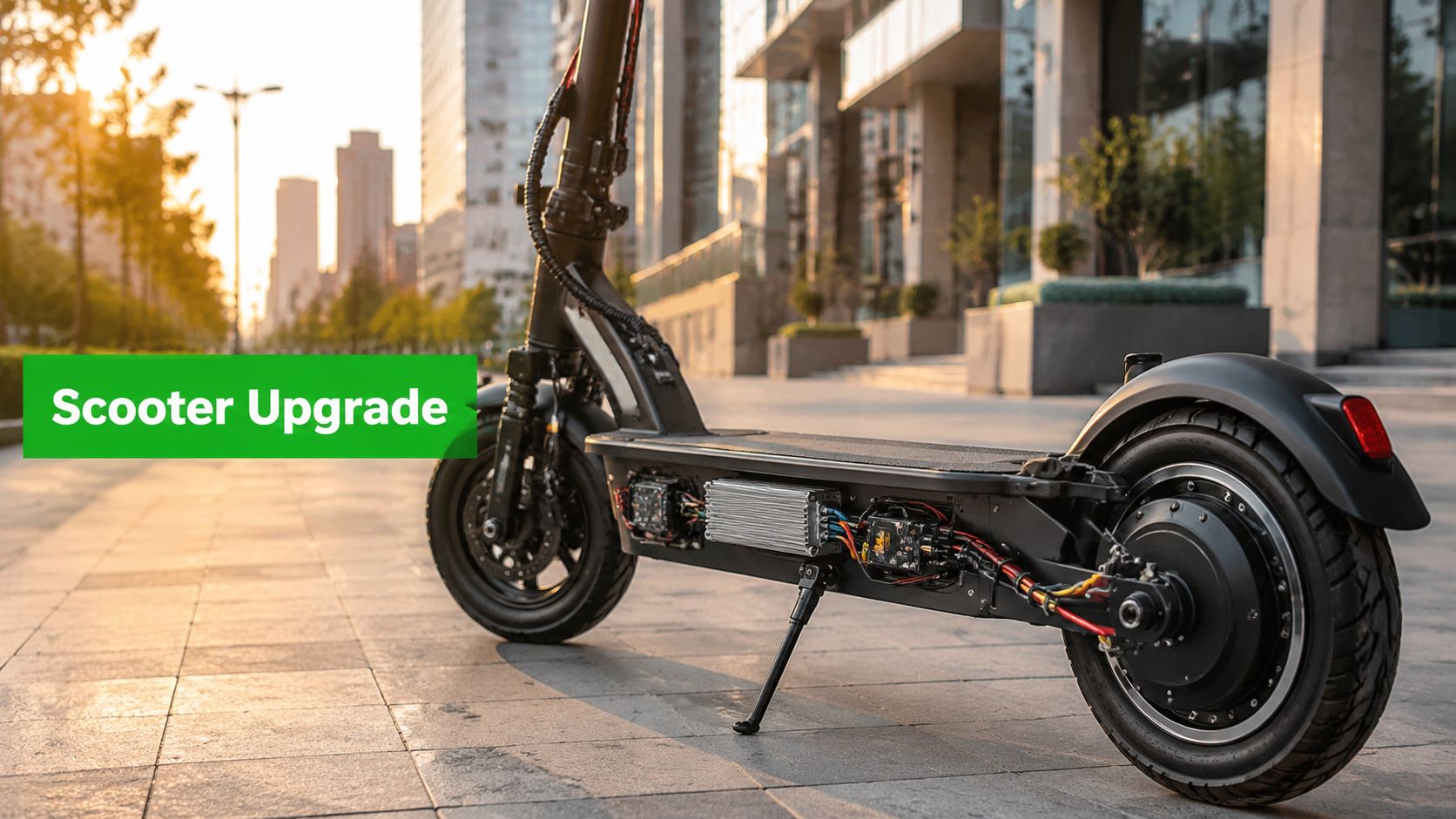
Your scooter still works. It just doesn't work the way it used to.
The battery sags halfway through the commute, the motor feels flat on mild hills, and what used to be a quick urban run now feels like coaxing an old machine along. That's the point where most riders start comparing new models. But replacing the whole scooter isn't the only move. Sometimes the smarter fix is an electric scooter kit that upgrades the parts holding your ride back.
That route makes the most sense when the frame is still solid and your problem is specific. Weak motor, tired controller, dated battery, poor braking integration. If that sounds familiar, it's worth brushing up on electric scooter maintenance basics before you spend money, because some “performance” problems are really maintenance problems in disguise.
Giving Your Old Scooter a New Spark
A commuter scooter usually fades gradually, not all at once. One month it's a little slower from the lights. Then it starts losing confidence on the same hill it climbed last spring. Then range drops enough that you begin charging around your schedule instead of riding around your schedule.
That's where a kit can make sense. Not as a flashy mod for bragging rights, but as a practical reset. A proper electric scooter kit can repair a failing system, replace a weak motor, or rebuild the electrical side of a scooter that still has a perfectly usable frame and deck.
For UK and EU riders, that matters because commuting priorities are different from hobbyist priorities. Commuters don't need a wild top speed number. They need reliable pull-off power, stable braking, sensible range, and a setup that doesn't create legal headaches the moment it touches a public road.
Practical rule: If your frame, folding mechanism, and brakes are sound, upgrading the power system can be more rational than binning the entire scooter.
There's also a less obvious benefit. A kit forces you to think about how the scooter works. Once you understand the relationship between motor, controller, battery, and braking, you stop buying parts based on hype and start buying parts that fit your real commute.
Understanding the Different Types of Scooter Kits
An electric scooter kit isn't one product. It's a category. Some kits replace one weak component. Others are closer to a full transplant.
The easiest way to think about it is like upgrading a computer. Sometimes you swap one part because it's the bottleneck. Sometimes you replace the whole core system because the old platform can't support what you want.
The category is also getting more attention because the wider scooter market keeps expanding. One industry analysis valued the global electric scooter market at USD 41.78 billion in 2024 and projected USD 98.96 billion by 2033 in its electric scooter market forecast. More riders usually means more parts demand, more repair demand, and more interest in upgrades instead of full replacement.

The main kit categories
| Kit type | What it usually includes | Best for | Where it goes wrong |
|---|---|---|---|
| Motor upgrade kit | Hub motor, controller, throttle, wiring | Riders whose scooter feels weak or struggles on hills | Buyers ignore axle fit, wheel size, or brake mounting |
| Battery upgrade kit | Battery pack, charger, mounting hardware, sometimes a BMS-integrated setup | Riders chasing better usable range or voltage compatibility | The pack may not physically fit or may not match controller demand |
| Controller and display kit | Controller, throttle or display, wiring loom, brake cut-off connectors | Scooters with jerky acceleration, poor tuning, or dead electronics | Connector mismatches and unclear pinouts cause headaches |
| Full conversion kit | Motor, controller, throttle, battery-related hardware, cables, mounts | DIY builds or full overhauls | Installation is much heavier than the listing makes it sound |
Which one matches your project
If your scooter already has a decent chassis and the battery still holds up, a motor upgrade kit or controller kit is often enough. That's common on commuter scooters where the hardware is tired, but the platform itself isn't finished.
If the battery is the weak point, don't let a motor listing distract you. A stronger motor attached to an exhausted battery won't feel strong for long. You'll get voltage sag, heat, and disappointment.
A full conversion kit is a different job entirely. That's for riders building from scratch, reviving an old non-electric platform, or replacing so many parts that it no longer makes sense to call it a simple upgrade.
Buying the wrong kit doesn't usually fail at checkout. It fails on the workbench, when connectors don't match, the wheel won't seat properly, or the battery can't support the controller.
A quick way to choose
Start with the fault, not the product category.
- Poor hill climbing: Look at motor and controller first.
- Range collapse: Look at the battery and total system draw.
- Dead controls or erratic power delivery: Start with the controller, throttle, and wiring.
- Old chassis you want to electrify: Consider a full conversion package, but only after measuring everything.
That sequence saves money because it stops you replacing healthy parts just because the listing looks complete.
Whats Inside a Typical Electric Scooter Kit
Open a typical kit and you'll usually find the same core pieces. The exact parts vary, but the system logic doesn't. You have one part that makes motion, one part that manages power, one part that stores it, and several parts that let the rider control it safely.

The parts that matter most
The motor is the muscle. In most commuter kits, that means a hub motor built into the wheel. It determines how much pull you get from a standstill, how well the scooter copes with incline, and how strained it feels with a heavier rider or loaded backpack.
The controller is the brain. It meters current from the battery to the motor and shapes how the scooter behaves. Smooth launch, abrupt throttle response, regen feel, brake cut-off behaviour. That's controller territory. If you want a better sense of how this part affects ride feel, this guide to an electric scooter controller is a useful background read.
The battery pack is the fuel tank, but with more caveats than people expect. Voltage has to match the system. Delivery capability matters. So does physical size. A powerful motor setup with the wrong battery is one of the most common upgrade mistakes.
Here's a helpful technical side note. If you've ever wondered why battery pack design and wiring layout affect performance so much, Jolt Electric circuit explanations give a clear primer on series and parallel circuits without drowning you in theory.
Why wattage isn't the whole story
Many listings push motor wattage as if that alone decides everything. It doesn't. Wattage matters, but so do wheel size, rider weight, terrain, controller settings, and battery support.
One useful benchmark from Rider Guide's definitive scooter guide is this: for urban commuting, 500W to 1000W is the practical minimum. The same source notes that a setup below 500W, especially with 8-inch wheels, will likely struggle to maintain speeds above 12 km/h on inclines greater than 5 degrees.
That lines up with workshop reality. A low-power kit can feel fine on flat ground and still turn miserable the moment your route includes bridges, ramps, or rolling city streets.
More motor only helps when the rest of the system can feed it properly.
The rider controls and support hardware
Most kits also include:
- Throttle unit. Thumb, twist, or trigger style. This changes comfort more than many riders expect.
- Brake levers or e-brake connectors. These cut motor power when braking and can support regenerative behaviour on some systems.
- Wiring harness. This is the least glamorous part and one of the most important. Bad connectors and poor routing create faults that look like expensive component failures.
- Display or dashboard unit. Sometimes basic, sometimes programmable. Useful for setting ride modes or checking system errors.
If you want to see the parts laid out in a real build format, this video gives a practical visual reference before buying:
Your Pre-Purchase Compatibility Checklist
Compatibility is the step people skip when they're excited, and it's the step that decides whether the project succeeds.
A powerful kit that doesn't fit your fork, doesn't match your battery, or won't integrate with your braking setup is not an upgrade. It's a box of expensive delays. Most bad purchases stem from such scenarios, especially when buyers assume “universal” means “suitable.”

The non-negotiable checks
- Model fit first. Start with your exact scooter brand and model, then confirm whether the kit was built for that platform or only resembles it. Similar-looking commuter scooters often use different axle flats, fork widths, and connector types.
- Voltage match. The kit controller and your battery must speak the same language. If they don't, the upgrade can fail before the first ride.
- Physical mounting. Measure wheel size, axle width, deck space, controller location, and cable routing paths before ordering.
- Brake integration. Check whether your scooter uses disc, drum, or electronic braking inputs, and whether the new controls support them.
- Skill level. Some kits are plug-and-play. Others require splicing, soldering, bracket fabrication, or firmware-style setup.
Battery compatibility is where builds get expensive
This is the issue that catches riders who shop only by motor listing. A common gap in kit guides is battery integration. As explained in this motor kit reference from Monster Scooter Parts, a powerful motor kit is useless if the existing battery can't handle the load. Mismatched voltage or amperage can cause poor performance, sharply reduced range, and even damage to the controller or battery.
That's not theory. It's what happens when riders bolt on stronger hardware and assume the old battery will somehow keep up.
What to inspect before you click buy
Use this bench-check list before ordering:
-
Take photos of every connector
Connector shape matters as much as the written spec. Listings often stay vague. -
Measure the fork and dropouts
Hub motors don't “nearly fit.” They fit or they don't. -
Check where the controller will live
Some decks have space. Some don't. External mounting can expose wiring to spray and impacts. -
Inspect the battery casing and mount
Even when voltage is right, battery shape and mounting points can ruin a plan. -
Look at cable path and steering movement
If the harness binds when the bars turn, you'll wear through insulation quickly.
Workshop habit: Never buy the motor first and “figure out the battery later.” Buy the system on paper before you buy the parts in real life.
That single discipline prevents most costly rebuilds.
An Overview of the Installation Process
Installing an electric scooter kit is usually a weekend project, not a quick lunch-break swap. Some jobs go smoothly. Many don't, especially when you discover a missing bracket, a short cable run, or a connector that looked identical in the product photos but isn't.
What the job normally involves
The usual sequence is straightforward in principle. Remove the original wheel or motor assembly. Mount the new hub motor or drive component. Fit the controller somewhere secure and ventilated. Install the throttle or display on the bars. Then route and connect the harness cleanly.
That last part often takes longer than expected. Cable management decides whether the scooter feels factory-finished or homemade in the worst way.
Tools and mindset
A basic setup usually includes:
- Allen keys and sockets for deck covers, clamps, and axle hardware
- Open-ended spanners for wheel and brake adjustments
- Wire tools if the kit isn't fully plug-and-play
- Zip ties and protective wrap for cable routing
- A stand or stable work surface so the scooter doesn't move while you work
The best approach is slow and methodical. Lay out each component first. Test-fit before fully tightening. Keep photos of the original wiring and bar controls so you can reverse mistakes without guessing.
Where installs usually go wrong
Three things cause most installation trouble.
First, wire routing. Cables get pinched near the stem, rubbed against sharp edges, or stretched at full steering lock.
Second, mounting assumptions. The controller or battery bracket often needs more clearance than expected.
Third, brake and throttle setup. A scooter can power on and still be unsafe if the brake cut-off doesn't work or the throttle engages too abruptly.
If any part of the install requires force, stop. Scooter parts are small, electrical tolerances are unforgiving, and “close enough” tends to become a roadside problem later.
Navigating Safety and Legal Rules in the UK and EU
This is the part many kit listings barely mention, and for UK and EU commuters it's often the deciding factor.
A scooter can be mechanically excellent and legally awkward at the same time. Once you change motor output, speed capability, or braking setup, you may also change how that scooter is treated under local rules. That matters a lot more than a flashy performance claim.

Why the fastest kit often isn't the smartest one
A lot of shoppers start by asking how much extra speed a kit can provide. For public-road commuting in Europe, that's often the wrong starting point. In many EU markets, riders are dealing with speed-limited frameworks and city enforcement attitudes that favour compliant, predictable machines over heavily modified ones.
The UK adds another layer of caution because private e-scooter use on public land remains highly restricted. A heavily modified private scooter doesn't become easier to justify just because the parts are better.
One useful warning from this electric scooter kit legality overview is that many kit adverts focus on performance while giving little guidance on legality or safety integration. That matters because power output and braking functionality can affect legal status, and the rules differ across the US, UK, and EU.
The safety checks that matter in practice
For commuter use, pay attention to these points:
- Braking integration. If the kit supports e-braking, make sure it complements rather than replaces dependable mechanical braking.
- Throttle behaviour. Aggressive initial power delivery is fun in a car park and annoying in city traffic.
- Heat under load. A scooter that copes on a dry test run may behave differently on a long incline with a rider, backpack, and stop-start traffic.
- Battery handling. If your upgrade includes a battery change, storage and charging habits become part of safety, not just convenience. This guide on how to store lithium batteries safely is worth reading if your scooter lives in a hallway, shed, or office corner.
A compliant, predictable scooter with solid braking is more useful than a faster build you can't confidently ride where you need to go.
A practical UK and EU buying mindset
For this region, choose a kit by asking:
- Will it keep the scooter manageable in dense urban riding?
- Does it preserve or improve braking quality?
- Could the upgrade create an obvious compliance problem for public use?
- Is the benefit in range consistency and hill support, rather than raw speed?
That mindset leads to better commuter builds. It also filters out the listings written for hobbyist buyers in markets with different rules.
Is a Scooter Kit the Right Choice for You?
By this point, the main question isn't whether a kit can improve a scooter. It can. The question is whether it improves your scooter enough to justify the time, risk, and extra parts that often follow the first purchase.
When a kit makes sense
A kit is usually a sensible choice if your scooter has a good frame, sound folding hardware, and a problem you can clearly identify. Weak hill climbing, failed controller, dead motor, tired controls. Those are upgrade-friendly faults.
It also makes sense if you enjoy mechanical work and don't mind problem-solving. Not everyone wants that. Some riders want transport, not a project.
If you're comparing options, keep the market benchmarks in mind. Rider Guide's 2026 scooter pricing data puts the average mid-range electric scooter at $934 and budget models at $335. That's a useful reality check when a kit starts as a “cheap fix” and grows into a motor, controller, battery, tools, and spare connectors.
When buying new is the better call
Buy new if any of these are true:
- Your battery likely needs replacing anyway
- The frame or folding hardware is questionable
- You need a warranty more than a hobby
- You want predictable commuting with minimal downtime
- Your local rules make modified scooters a grey area you'd rather avoid
That's also where a complete scooter option can be more rational than a rebuild. For example, a ready-to-ride model such as the Punk Rider electric scooter is one factual alternative in the same wider mobility category, rather than trying to revive a platform that may still leave you chasing faults after the upgrade.
A simple decision filter
Ask yourself three things.
First, is the current scooter worth saving mechanically?
Second, can you define the upgrade goal in one sentence? Better hill performance. Better usable range. Replace failed electronics. If you can't state the goal clearly, you'll probably buy the wrong parts.
Third, after adding everything up, are you still saving enough money to make the work worthwhile?
If the project only makes sense while ignoring battery cost, installation time, and legal limitations, it doesn't really make sense.
An electric scooter kit is a good choice for riders who want a targeted fix and understand the trade-offs. It's a bad choice for anyone hoping random extra wattage will solve every weakness in an ageing scooter.
If you're weighing repair, upgrade, or replacement, Punk Ride LLC is a practical place to compare complete scooters and urban mobility options before you commit to a kit build. Sometimes the right answer is a smarter rebuild. Sometimes it's a fresh platform with fewer compromises.
Share:
Electric Scooter Key Switch: A Complete Repair Guide
Best Electric Scooter Covers: Guide for UK & EU Riders