


A lot of riders still shop for scooters by range and speed first. That misses the point. In Great Britain, e-scooter casualties reached 1,477 in 2025, including an estimated 484 serious injuries, up from 428 in 2024, according to the Department for Transport e-scooter factsheet for 2025.
When you read those figures like a trainer instead of a shopper, the question changes. It's no longer “How fast does this one go?” It becomes “What on this scooter helps me stay upright, stop cleanly, be seen early, and avoid turning a small fault into a bad crash or battery fire?”
That's the lens that makes electric scooter safety features worth understanding before you buy, and again before every ride.
Why Electric Scooter Safety Features Matter Now
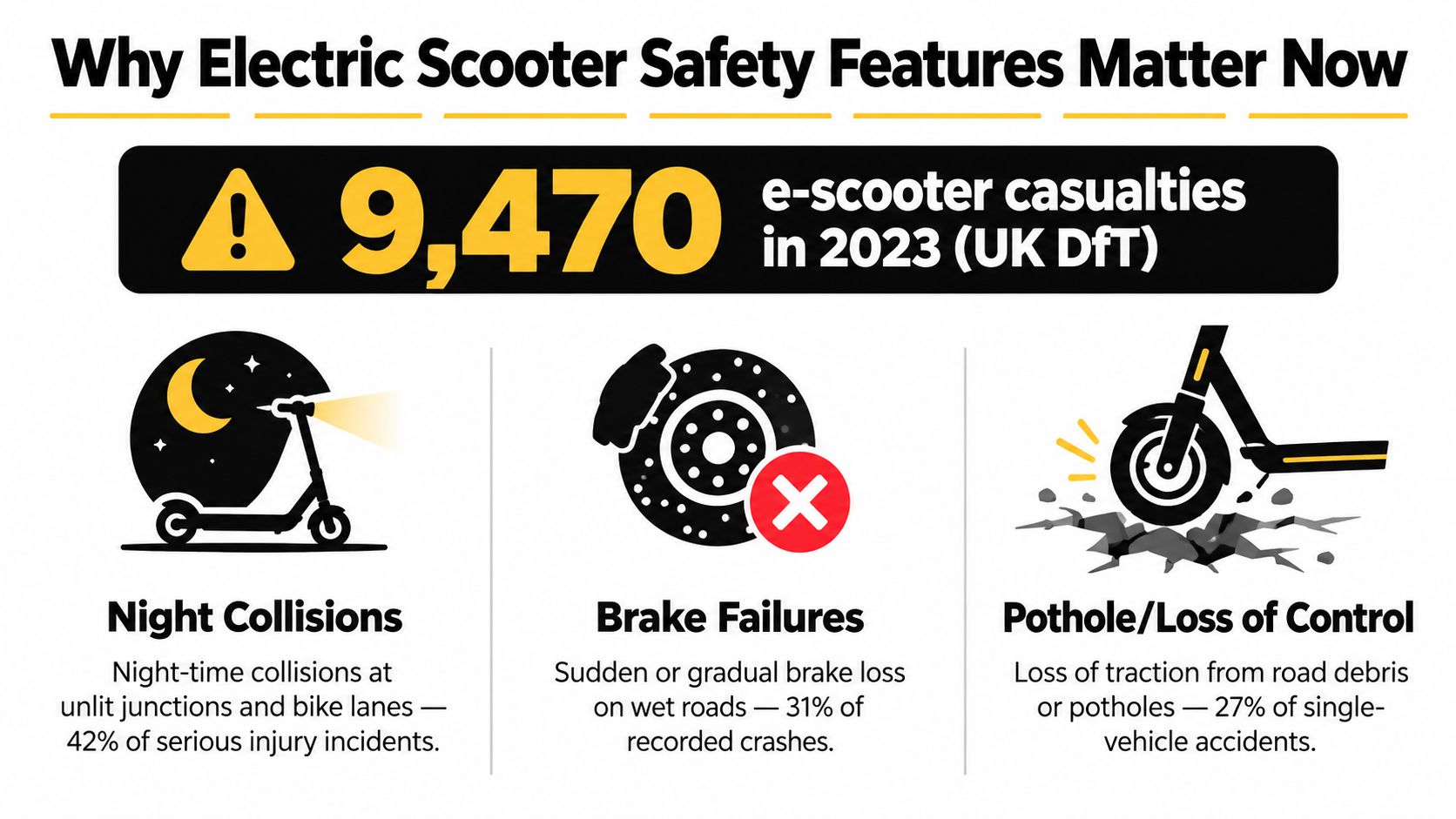
The UK numbers are a useful wake-up call because they point to the kind of incidents riders face. Great Britain recorded 1,312 e-scooter collisions, 1,390 casualties, and 6 deaths in 2024, with 1,096 of those casualties being e-scooter users. The same factsheet says 306 collisions were single-vehicle incidents, which tells you something important. A lot of harm doesn't come from dramatic high-speed crashes with cars. It also comes from riders losing control, misjudging grip, or failing to stop cleanly on their own line of travel, according to the 2024 DfT e-scooter factsheet.
What those crashes usually look like
In day-to-day riding, the repeat patterns are familiar. A rider enters a damp painted bike lane and the front end feels light. A commuter gets to a junction and has to signal, brake, and look over a shoulder all at once. Someone rides home after dark with weak lights and discovers too late that being able to see the road isn't the same as other people seeing you.
Battery safety belongs in the same conversation. It's less visible than tyres or brakes, but it matters just as much because a badly protected lithium-ion pack can fail during charging or use if the control system isn't doing its job.
Practical rule: If a feature helps with control, visibility, stopping, or battery protection, it isn't cosmetic. It's part of the scooter's safety system.
Why the UK, EU, Australia, and US frames matter
Most articles on this topic should stay focused on the UK and EU e-scooter and e-bike markets, because that's where a lot of the clearest trial rules and equipment recommendations have been spelled out. At least once per week, though, it also makes sense to write for the Australian and US markets, because riders there deal with a more fragmented rulebook and often have to judge equipment quality for themselves.
In the UK, trial guidance is fairly direct about braking and vehicle setup. In the EU, safety bodies such as ETSC and PACTS push for visible, predictable, lower-risk scooters with caps, lights, indicators, mirrors, and independent brakes. Australia often sits in between, with state-based rules that can change what's road-legal from one place to the next. The US is patchier again, especially once you compare private ownership with shared fleets.
So when you step onto a deck or scan a product page, don't treat safety features as a bonus list. Think of them as direct answers to real crash patterns: stability and visibility, braking, battery protection, smart controls, rider aids, and pre-ride checks.
Stability and Visibility Essentials
A stable scooter feels boring in the best possible way. It tracks straight, doesn't skip over rough patches, and doesn't make you tense up every time the surface changes. Most new riders underestimate how much of that feeling comes from a cluster of simple parts working together.
Start with what touches the ground
Tyres are your scooter's trainers. If the sole is wrong for the pavement, the rest of the body has to work harder.
A technical review highlighted larger wheel diameter and pneumatic tyres as among the most promising stability improvements for PLEV safety, while the same European analysis noted that scooters are safer when equipped with direction indicators, a sound signal, rear-view mirrors, and reflective elements, as outlined in the European safety analysis indexed on PubMed.
For a rider, that translates into plain buying advice:
- Choose tyres for your roads: Pneumatic tyres usually do a better job absorbing vibration and keeping contact on cracked or uneven pavement.
- Don't ignore wheel size: Larger wheels roll over shallow potholes, rough joins, and drain covers more calmly than tiny wheels.
- Look at deck grip: A textured deck works like a bath mat in a wet bathroom. It gives your shoes something to bite into when the surface is damp.
If your route includes kerb transitions, rough cycle paths, or patched asphalt, some front suspension can help. If the scooter doesn't have suspension, chunkier tyres can still take some edge off harsh impacts.
Then make sure other people can read you
Good lighting isn't about decorating the scooter. It's your high-vis jacket. Front and rear lights, side reflectors, and indicators help other road users understand where you are and what you're about to do.
Look for:
- A white front light that gives you a usable beam, not just a token glow.
- A red rear light that stays visible in traffic clutter.
- Amber side reflectors or side lighting so you don't disappear when a car approaches from the side.
- A bell or horn that can cut through headphones, traffic, or pedestrian chatter without delay.
A scooter such as the Punk Rider is one example of this approach because it includes integrated turn signals plus side deck and stem lighting. That doesn't guarantee safe riding on its own, but it shows what useful visibility hardware looks like in practice.
For riders comparing options, I'd also spend a minute with this guide to LED lights for scooters, because it helps you separate real visibility from decorative lighting.
If you can't signal clearly without taking your hands off the bar, or if your feet shift on the deck when it's wet, the scooter is already asking too much from you.
Braking Systems and Stopping Power
A scooter's brake setup tells you very quickly whether the manufacturer built it for real streets or smooth marketing photos. Legal requirements line up neatly with common sense.
Why two brakes matter
UK trial guidance requires 2 independent braking systems capable of safely stopping the scooter. It also says at least one brake must be hand-operated, and when all brakes are used together the vehicle must achieve a minimum deceleration rate of 3.5 m/s² or stop within 7 m from 15.5 mph, according to the UK e-scooter trials guidance.
That rule is easy to understand in real life. If one braking system fades, slips, cuts out, or loses power, the other one still gives you a way to stop.
European safety recommendations from ETSC and PACTS also call for independent front and rear brakes, lights, indicators, and an audible warning device, along with a factory-set 20 km/h speed cap, as summarised in the ETSC and PACTS recommendations.
How common brake types feel on the road
A rear electronic brake often feels smooth and tidy. It can help settle the scooter and may recover a little energy. But regen-only braking should never be your only plan. If the battery is full, the controller faults, or grip changes suddenly, you need a mechanical fallback.
A front drum or disc brake usually gives stronger physical stopping power. Used well, it helps cut stopping distance. Used badly, especially on gravel or paint, it can make the front tyre complain fast.
A foot brake is old-school but useful as backup. It's simple, separate from the main controls, and can save a ride if another system stops behaving.
Brake type performance compared
| Brake Setup | Dry Tarmac Stopping (approx.) | Wet Tarmac Stopping (approx.) | Notes |
|---|---|---|---|
| Regen only | Longer | Longer again | Smooth feel, but not enough as the sole stopping system |
| Mechanical rear only | Moderate | Longer | Can skid if grabbed too hard |
| Front disc or drum only | Shorter if used well | Variable | Stronger bite, but demands better rider control |
| Two independent brakes used together | Shortest of the group | Better controlled than single-brake setups | Best balance of stopping power and backup |
The exact feel depends on tyre grip, rider weight, setup, and maintenance, so treat the table as a buying guide, not a lab result.
What to test on a ride
Don't test brakes by staring at spec sheets. Test them on asphalt.
- Squeeze each lever separately: One should not feel dead because the other is doing all the work.
- Check bite point: The brake should engage well before the lever comes close to the bar.
- Do one firm stop in a straight line: The scooter should slow predictably, not wobble, chirp immediately, or pull sharply to one side.
- Try a gentle wet-surface stop if conditions allow: That's where weak setups reveal themselves.
If you want a plain-language guide to getting more from a brake setup you already own, this article on how to improve braking performance is worth a look.
Battery Protection and Fire Prevention
The battery management system is the quiet adult in the room. You don't notice it when everything is normal, but when something starts going wrong, it's the part that's supposed to step in first.
What a proper BMS actually does
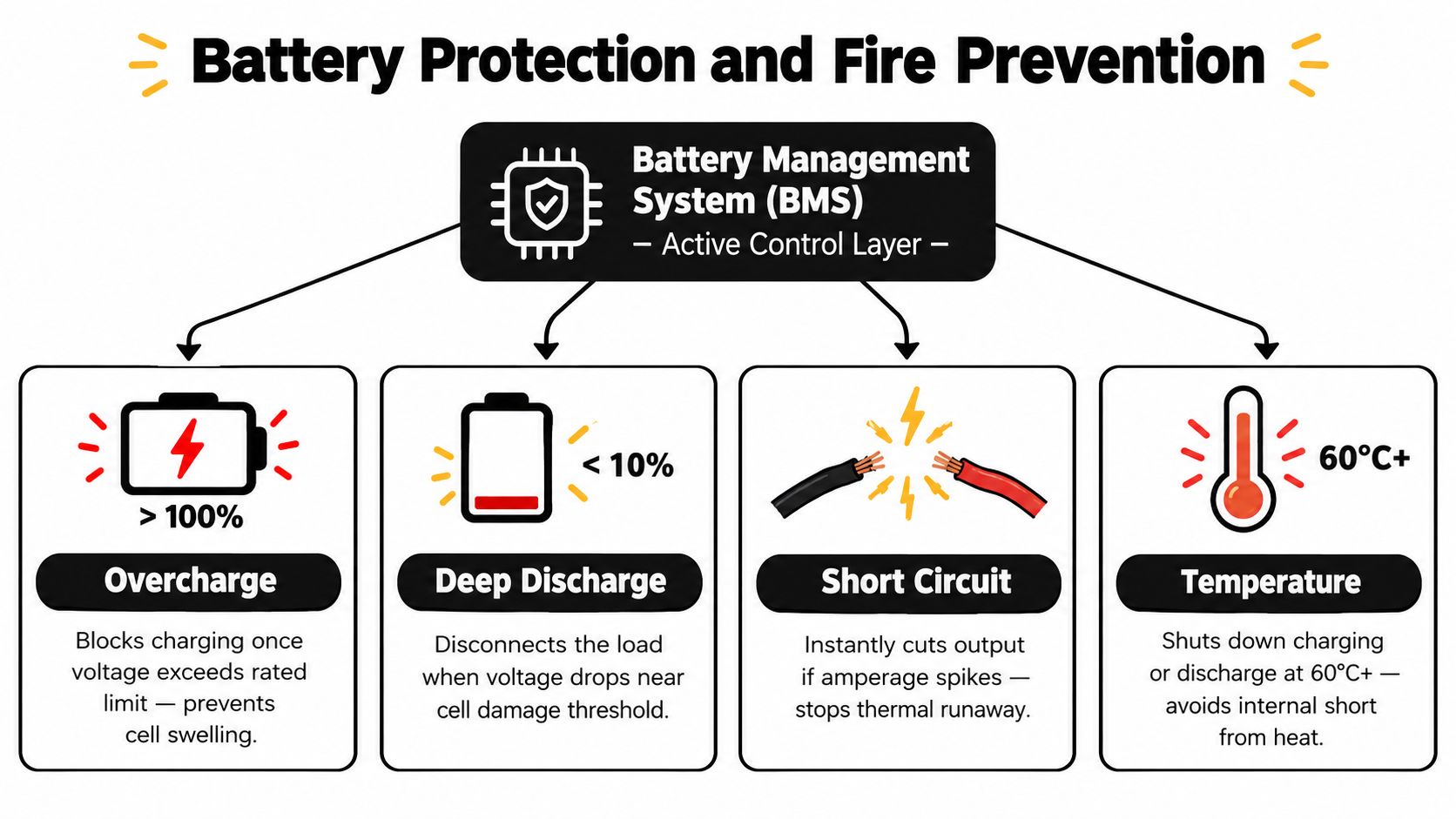
UK safety guidance describes a compliant battery protection system as one that actively monitors individual cell voltage, pack current, and cell temperature during both charging and discharge. It should prevent over-voltage, under-voltage, over-current, and over- or under-temperature conditions so the pack doesn't enter thermal runaway, including when an incompatible charger is used, according to the integrative electric scooter safety review hosted by RISE.
That's more than a fuse. A fuse reacts after a major problem. A BMS watches for the setup that leads to the problem.
Think of a hill climb on a warm day. One damaged cell starts heating faster than the rest. Without monitoring, that heat can spread. With a proper BMS, temperature sensors and control logic can limit discharge or shut the pack down before the hot cell drags the others with it.
Four battery failures riders should understand
- Overcharge: The system stops charging before cell voltage climbs too high.
- Deep discharge: The system cuts the load before cells are dragged into damaging low voltage.
- Short circuit or over-current: The system interrupts output if current spikes suddenly.
- Thermal runaway risk: The system reacts to dangerous temperature conditions during use or charging.
A lot of marketing pages blur these together into “smart battery protection.” I'd rather see specifics. Does the brand mention cell monitoring, thermal sensors, and charger compatibility? Is the battery housing sealed properly? Are there credible certification marks and clear documentation?
This short video gives a useful visual primer before you inspect a scooter in person.
Workshop habit: If a battery pack smells of solvent, shows swelling, or throws repeated temperature or charging errors, park the scooter and stop troubleshooting by riding it.
Storage matters too. Heat, poor chargers, and careless charging locations undo a lot of good engineering. For practical handling tips, see how to store lithium batteries safely.
Smart Controls, Speed Caps and Rider Aids
Not every useful safety feature looks dramatic. Some of the most effective ones stop you from asking too much of the scooter at the wrong time.
Which controls match European recommendations
A UK parliamentary evidence summary says the government first considered a 12.5 mph top speed for trials but settled on 15.5 mph, and witnesses also highlighted reflectors, lights, and brakes independent of the electrical system as important design requirements, according to the House of Commons transport committee evidence summary.
That matters because speed caps are often misunderstood. Riders hear “cap” and think “restriction.” Trainers hear “cap” and think “predictability.” A capped scooter is easier to judge in traffic, easier to brake consistently, and less likely to surprise a new rider with abrupt acceleration.
Ride modes work the same way. Think of them like car drive modes. An eco or beginner mode softens takeoff and limits top-end push. That usually means a calmer launch, cleaner control in crowded areas, and less temptation to over-commit on shared paths.
Smart Features vs EU Recommendations
| Feature | EU Trial Rule Status | Real-World Benefit |
|---|---|---|
| Factory speed cap | Recommended in European safety guidance | Keeps performance predictable in public riding |
| Geofencing | Common operator tool, beyond basic hardware minimums | Automatically slows scooters in sensitive areas |
| Ride modes | Helpful extra, not the main legal talking point | Lets new riders choose smoother acceleration |
| Turn indicators | Recommended | Lets riders signal without removing a hand |
| Rear-view mirrors | Recommended | Improves awareness before moving across traffic |
| Audible warning device | Recommended | Alerts pedestrians and other riders quickly |
What's worth prioritising
Indicators and mirrors are still the most overlooked commuter upgrades. Riders often think of them as optional accessories, but in mixed traffic they reduce the number of tasks your body has to juggle at once. You can keep both hands planted, glance, signal, and move.
A bell or horn is cheap and easy to dismiss until a pedestrian steps sideways into your line. Then it becomes one of the best low-cost rider aids on the scooter.
For UK and EU buyers, I'd rank smart controls like this:
- Speed cap that matches local rules
- Two clear ride modes, especially for new riders
- Indicators for urban riding
- Audible warning device
- Mirrors if your route includes regular lane positioning or overtakes
Riders in Real Conditions
The same feature list doesn't matter equally to every rider. Context decides what rises to the top.
The UK commuter
A weekday rider in a British city cares first about damp surfaces, visibility, and stop-start traffic. On a rainy morning, bright daytime lights help the scooter stand out against grey roads and dark coats. Wider tyres or more forgiving pneumatic ones make painted cycle-lane markings feel less twitchy. If the scooter has regen paired with mechanical braking, the ride feels smoother in repeated low-speed slowing.
This rider also notices battery and casing quality more than a fair-weather user does. Water spray, repeated charging, and daily mileage punish weak seals and sloppy connectors fast.
In commuter use, the safest scooter is often the one that feels easiest to read and control when you're tired, late, and riding on a slick road.
The US weekend rider
A US recreational rider may deal with a different mix. Less junction pressure, more shared trails, family use, and varying skill levels.
That rider usually values:
- Suspension or larger pneumatic tyres for rougher surfaces
- A gentle ride mode when a partner or teenager is learning
- A clear bell or horn on mixed-use paths
- Stable brakes that don't feel grabby after a week parked in the garage
The scooter hasn't changed. The priorities have.
A feature that feels minor in one setting becomes central in another. Mirrors may matter more downtown than on a park trail. Speed-limit modes may matter more in family use than for an experienced solo commuter. What doesn't change is the rider's job. Use the features that are fitted. Don't ignore warning beeps, disable caps, or treat safety aids as decorative electronics.
Your Pre-Ride Safety Checklist
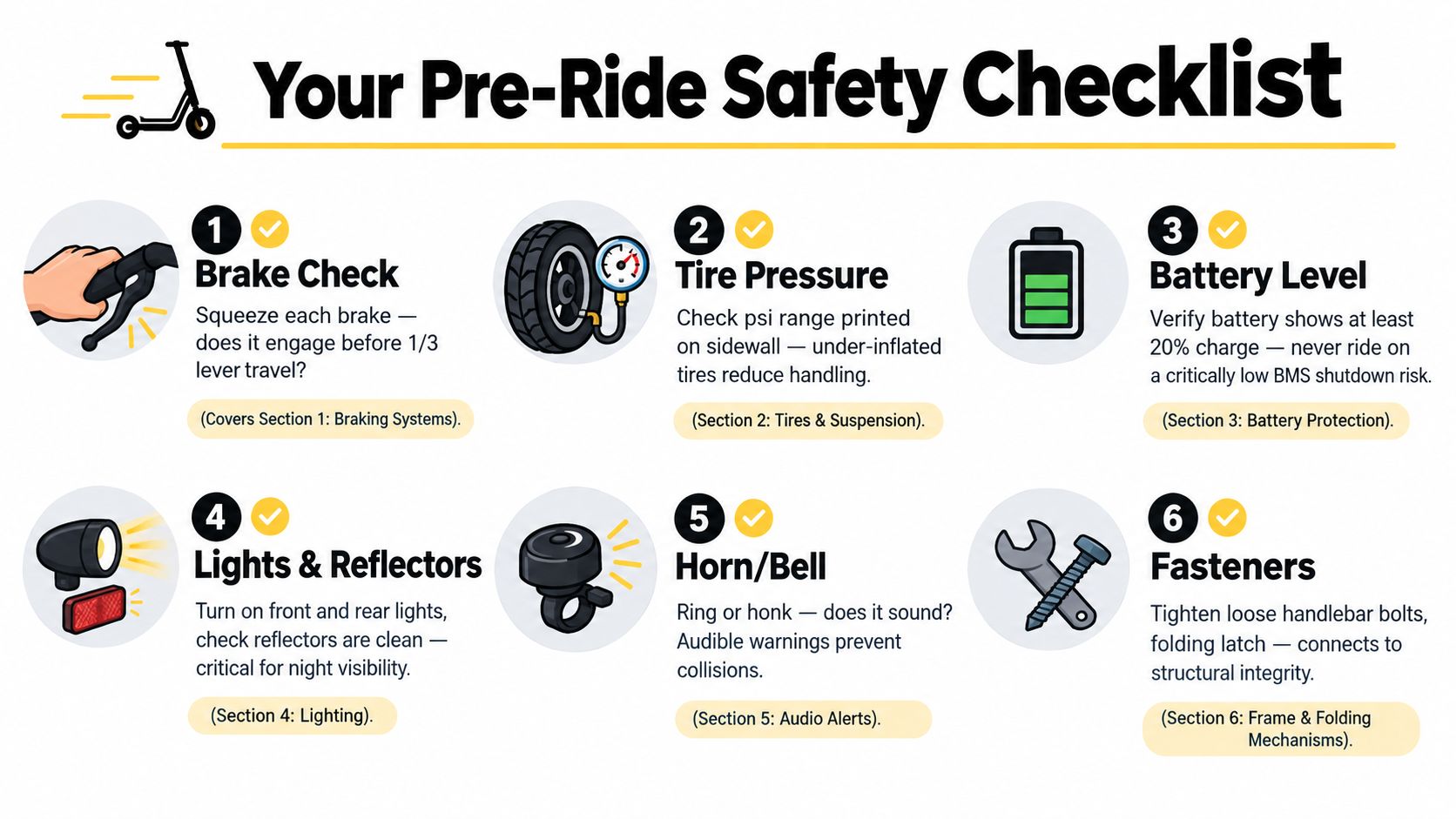
Good riders don't leave safety in the spec sheet. They touch the parts that matter before the wheels move.
The two-minute walk-around
Do this in the same order every time so nothing gets missed.
- Brake levers: Squeeze both. If a lever travels more than about a thumb length before it starts biting, treat that as a fail. If one brake feels much weaker than the other, don't ride.
- Throttle response: Roll on gently while the driven wheel is clear and safe to test. It should come in smoothly, not lurch.
- Tyres and tread: Press or gauge-check the tyres. Low pressure makes steering vague and increases pinch risk on rough surfaces. If the tread looks tired or the tyre looks cracked, that's a stop sign.
- Lights and reflectors: Turn them on. Front, rear, side visibility, all of it. Dirty reflectors count as not working well enough.
- Bell, horn, and indicators: Make each one do its job before traffic asks for it.
- Deck and folding latch: The grip surface should be clean and dry. The folding mechanism should lock firmly with no doubtful movement.
- Battery area: Look for error lights, swelling, damaged casing, or unusual smell. Any one of those is reason to park it.
Pass or fail cues that are easy to remember
Some checks are technical in the workshop. On the pavement, keep them simple.
| Check | Pass | Fail |
|---|---|---|
| Brake feel | Bites early and evenly | Lever comes too far back or feels mushy |
| Tyres | Firm, intact, visible tread | Soft, cracked, cut, or visibly worn |
| Lights | Bright and immediate | Dim, flickering, or dead |
| Deck grip | Dry and grippy | Slippery, muddy, peeling |
| Folding latch | Locked with confidence | Play, rattle, or uncertain lock |
| Battery status | Normal display, no smell | Error code, swelling, heat, or odour |
One check many riders forget
For UK and EU riders, confirm the speed cap still matches local limits before the first ride of the day. App settings, mode changes, and software toggles can leave a scooter in a state you didn't expect.
Daily checks should stay short. Weekly checks can go deeper and include fasteners, pad wear, tyre condition, and charging equipment. But one rule never changes.
Any fail means don't ride. Fix it first.
Punk Ride LLC offers electric scooters and e-bikes across the US, UK, and Germany, including models with safety-relevant features such as integrated lighting, turn signals, and multi-brake setups. If you're comparing real-world commuter hardware instead of just speed and range, visit Punk Ride LLC and look closely at how each model handles visibility, braking, and rider control.
Share:
Electric Scooter Handlebar Replacement: A Practical Guide