


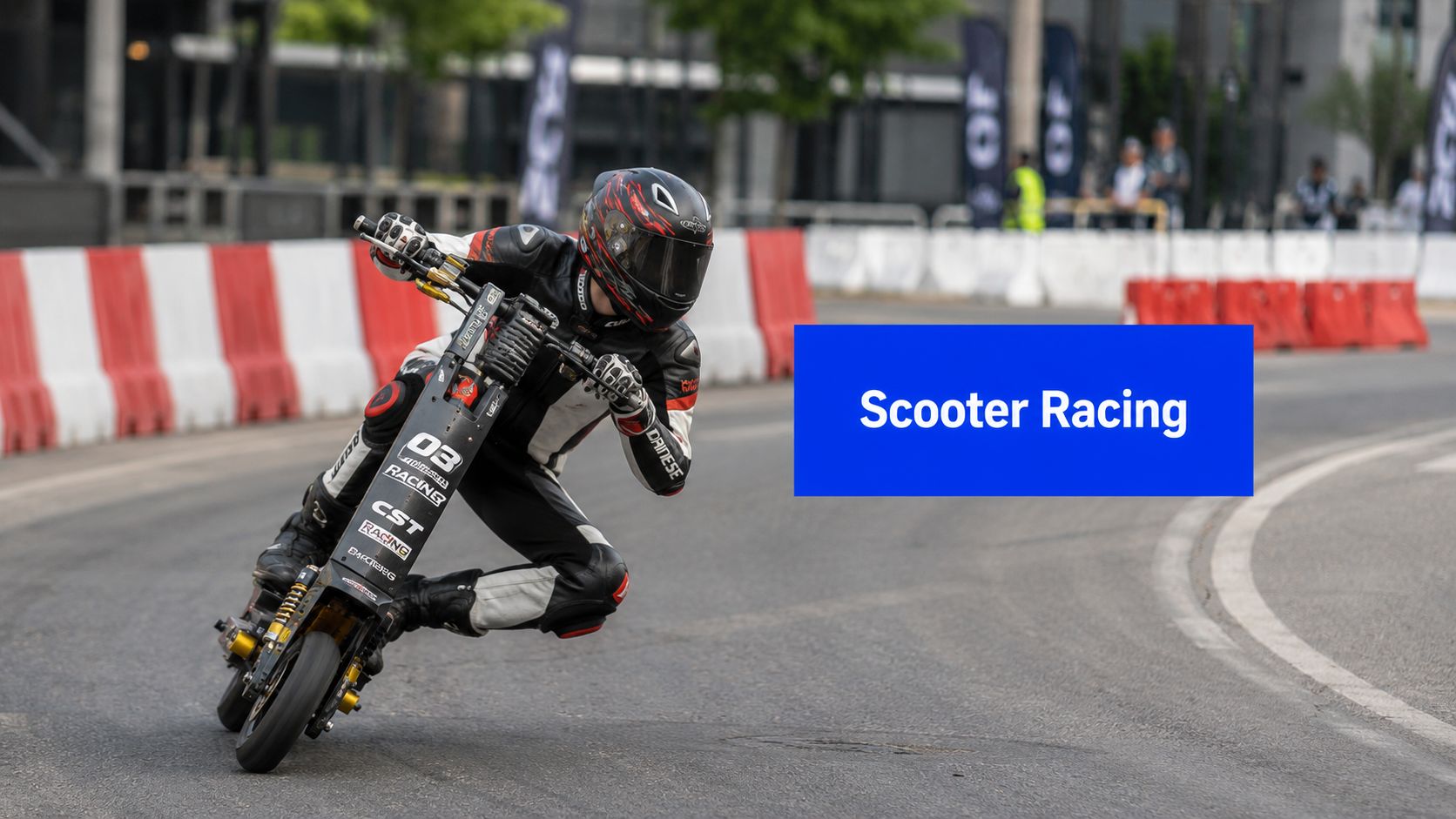
A rider flicks an electric scooter into a tight city corner, elbows out, knees bent, looking more MotoGP than morning commute. That contrast is the whole point of electric scooter racing. It takes something typically filed under “last-mile transport” and turns it into a real motorsport with lines, overtakes, setup choices, and nerves.
The Birth of a New Motorsport
E-scooters are often encountered as rental machines, folding commuters, or something teenagers argue about in the cycle lane. Racing changed that image almost overnight when the eSkootr Championship arrived.
The series is widely cited as the first international electric scooter racing series. It launched its inaugural season in 2022, and its first race took place in London in May 2022, where Matis Neyroud won the opening event, according to the eSkootr Championship overview. That mattered because the championship wasn't built around remote circuits in the middle of nowhere. It was designed for major city-centre locations, which gave the sport a very different identity from karting, club bikes, or traditional track racing.

Why London mattered
London was the perfect proof of concept. If you can put racing scooters in a city people already associate with congestion, public transport, and micromobility, you instantly make a statement. This isn't a novelty. It's a new branch of electric motorsport.
That urban setting is what separates scooter racing from the usual “small vehicle, small ambition” stereotype. Formula 1 built its aura through engineering extremes. MotoGP built its reputation through balance, bravery, and body control. Electric scooter racing borrows a little from both, but the visual language is all its own. Riders stand, shift weight aggressively, and manage a machine that looks familiar until it dives into a corner at speed.
Electric scooter racing makes sense the moment you stop comparing it to commuting and start comparing it to other forms of close-quarters racing.
For UK and EU readers, that rise also sits inside a wider mobility shift. Everyday scooters and e-bikes changed how people think about short urban trips, and the broader transportation revolution in electric bikes and scooters helps explain why a racing version suddenly feels plausible instead of weird.
Why people get hooked so fast
New viewers usually ask the same question. “Is this a sport, or just a stunt?” The answer becomes obvious once you watch riders fight for position through a technical section.
You're seeing real racecraft. Braking points matter. Exit speed matters. Passing discipline matters. The scooter is only the entry ticket. The competition comes from what the rider does with it.
Not Your Average Commuter Scooter
Forget the rental scooter image. The machines used at the top end of this sport are purpose-built race hardware.

The clearest example is the S1-X, the best-documented pro-spec platform tied to the eSkootr Championship. It uses two 6 kW wheel motors, for 12 kW total, paired with a 1.33 kWh battery, a reported top speed above 100 km/h, and a lean angle of over 50°, with +55° listed by the championship, as described in this S1-X racing scooter breakdown.
What those numbers actually mean
If you're new to motorsport, raw specs don't always tell the story. Here's the practical version.
- Two wheel motors mean immediate electric drive and strong drive out of corners.
- A racing battery setup isn't just about range. It supports repeated hard efforts under race conditions.
- A top speed above 100 km/h tells you this is far beyond consumer rental territory.
- A lean angle past 50° is the stat that really changes your mental picture. That's the point where scooter racing stops looking toy-like and starts looking serious.
In F1, people talk about downforce and braking zones. In MotoGP, they talk about edge grip and lean angle. In electric scooter racing, that lean angle is one of the easiest ways to grasp the level of commitment involved. A commuter scooter is built to be stable and forgiving. A race scooter is built to corner hard, accelerate sharply, and put the emphasis on rider control.
For a closer visual sense of how these machines move on track, this race footage helps:
Why standardised hardware matters
One of the smartest things about pro scooter racing is that it leans toward parity racing. That means organisers try to reduce hardware advantage so the outcome depends more on the rider.
That changes how you watch the action. Instead of asking, “Who bought the fastest machine?” you start asking better racing questions:
- Who brakes later without losing the front
- Who picks the cleaner line
- Who gets on power smoothly at corner exit
- Who stays calm in traffic
That's a big part of why this sport feels approachable for enthusiasts in the UK and EU. Yes, the pro machines are extreme. But the principle behind them is useful even for grassroots riders. The goal isn't just “more speed.” The goal is usable performance.
If you want a sense of how high-powered consumer machines sit near the edge of that conversation, this guide to high-powered electric scooters is a useful reference point. Just keep the distinction clear. A fast road-going scooter isn't automatically a race scooter, in the same way a quick road car isn't an F1 car.
Understanding Race Formats and Rules
Electric scooter racing isn't one single thing. That confuses beginners because media clips often flatten everything into “people going fast on scooters.” In reality, the format shapes the whole sport.
At the headline level, the eSkootr Championship gives us the cleanest example of organised competition. The championship fields 10 teams of 3 riders, which makes 30 riders, and runs over a two-day weekend, as outlined in this electric scooter racing format summary. That already sounds much closer to mainstream motorsport than to an informal meetup in a car park.
The main racing formats
Grassroots scenes are broader than the pro series. Some events focus on short circuit battles. Others lean toward drag-style acceleration contests. Some push into rougher terrain with off-road riding.
Here's a simple comparison:
| Format | Primary Skill | Typical Venue | Key Scooter Trait |
|---|---|---|---|
| Circuit | Cornering rhythm and racecraft | Kart track, closed tarmac course, private urban-style layout | Stable handling |
| Drag | Launch control and straight-line composure | Closed straight, runway-style private space | Strong acceleration |
| Off-road | Balance and terrain reading | Dirt course, mixed-surface private land | Suspension compliance |
Why format changes everything
A circuit rider cares about repeated braking, consistent lines, and carrying speed through corners. A drag rider cares more about getting cleanly off the line and keeping the machine composed under hard acceleration. An off-road rider has to think about bumps, changing grip, and body movement over rough ground.
That's why copying a setup from one type of event to another can backfire. The best scooter for a smooth, tight tarmac circuit won't necessarily feel right on a rough-surface course.
Trackside truth: The format tells you what “fast” means. On one course it means clean corner exits. On another it means surviving the surface without losing confidence.
The rules most newcomers miss
Grassroots events vary, but a few habits carry over from almost every kind of racing.
- Hold your line: Sudden weaving is dangerous, especially in close packs.
- Brake predictably: Late braking is part of racing. Erratic braking isn't.
- Look ahead, not down: Riders who stare at the front wheel miss hazards and passing opportunities.
- Pass with margin: A bold move is fine. A desperate lunge usually ruins both riders' lap.
If you've watched MotoGP, you already understand the spirit of this. Riders don't just aim for the shortest route. They manage space, timing, and risk. Scooter racing is the same, only more upright and often tighter.
How to watch like an insider
If you're spectating, don't focus only on top speed. Watch these moments instead:
-
Corner entry
Does the rider arrive settled, or does the scooter look nervous? -
Mid-corner line
Are they turning once and committing, or making corrections? -
Exit drive
Smooth power usually beats jerky power. -
Traffic management
The best riders don't just go fast. They stay composed when the line disappears.
That's where scooter racing stops being a curiosity and starts becoming legible as motorsport.
Staying Safe and Racing Legally
This sport looks fun because it is fun. It also carries real risk, because riders combine speed, lean angle, and close proximity on small machines. Safety isn't an optional layer you add later when things get serious. It's part of the sport from the start.

Gear that deserves zero debate
For any proper racing or track session, riders should think like racers, not commuters.
- Full-face helmet: Your normal urban lid isn't enough for race conditions.
- Armoured clothing: Abrasion resistance matters when speeds rise.
- Gloves: Hands usually meet the ground first.
- Sturdy boots or protective footwear: Ankles and feet take a lot of punishment in falls.
- Eye protection and secure fit: You need clear vision and gear that stays put.
The exact event requirements may differ, but the principle doesn't. If the setting includes repeated high-speed laps, wear gear intended for impact and slide protection.
The legal line in the UK and EU
For UK and EU enthusiasts, this point needs to be blunt. Electric scooter racing belongs on private land and closed circuits, not public roads.
That distinction matters because people often blur three different things together: everyday scooter use, public trial schemes, and organised motorsport. They aren't the same. A closed-course event runs under event-specific controls, marshals, barriers, and agreed rules. Public roads don't offer that environment.
Racing on public streets doesn't make you part of the sport. It puts you outside it.
If you're helping run a club day, practice meet, or local event, formal planning helps. A solid practical guide to risk assessment is worth using before anyone unloads a scooter. It helps organisers think clearly about hazards, controls, rider flow, and what happens when something goes wrong.
Community responsibility matters
A local scene survives only if riders act like adults. That means respecting venue rules, noise expectations, landowner conditions, and insurance or waiver requirements where applicable. It also means shutting down the “just race in an empty industrial estate” mindset before it damages the community.
For riders coming from normal street use, these electric scooter safety tips are a good starting point for building safer habits. Racing then adds another layer of discipline on top.
The strongest grassroots scenes in any motorsport aren't built by the wildest riders. They're built by the reliable ones. The people who turn up prepared, respect the venue, and make it easier for organisers to say yes next time.
Your Path to the Starting Grid
The jump from fan to participant feels bigger than it really is. Most newcomers imagine they need pro contacts, a giant budget, or a works-level machine. In practice, the first real step is usually much simpler. You need a legal place to ride, a community to learn from, and a realistic idea of what makes a rider competitive.
That last point is easy to miss. For newcomers, the key isn't raw top speed. As noted in this guide to scooter racing track techniques, success depends more on repeatable lap consistency, thermal stability, and braking control under race conditions than on pure headline speed.

Start with the community, not the shopping list
A lot of people do this backwards. They buy hardware first, then try to discover where they can use it. A better approach is to find the scene before you build the machine.
Look for:
- Local track-day groups: Even if they're mixed micromobility or small-vehicle events, they're useful.
- Closed-course practice sessions: These teach more than endless street riding ever will.
- Club organisers and independent venues: They know what rules, noise limits, and safety standards apply.
- Online owner groups with a racing focus: Good for hearing what survives track use and what doesn't.
A local community does more than share event dates. It shortens your learning curve. You'll hear what breaks, what gets rejected at scrutineering, and what beginners usually overlook.
Build rider skill before chasing outright pace
If you come from bicycles, motorcycles, karting, BMX, or even technical commuting, you already have something useful. Balance, vision, and rhythm transfer well. What changes on a racing scooter is how quickly mistakes stack up when grip, braking, and body position all matter at once.
A sensible beginner progression looks like this:
-
Practice smooth braking on private land
Not panic stops. Smooth, repeatable slowing. -
Work on line choice
Enter wide, clip the apex cleanly, exit under control. -
Learn to look through the corner
Riders who look ahead ride calmer. -
Do longer practice runs
That's how you notice heat, fatigue, and fading consistency.
The rider who can repeat a good lap usually beats the rider who can produce one dramatic lap.
What to expect at your first amateur event
Don't expect polished grandstands and factory hospitality. Expect a more hands-on day. People unload tools, chat about tyre feel, compare brake setup, and help each other solve practical problems.
That's a good thing. Grassroots motorsport is where you learn the language of the sport for real.
Some riders arrive to compete. Others arrive to test. Your first target should be simple: finish sessions safely, listen carefully, and leave with better notes than you arrived with. If your scooter stays reliable and you become more consistent by the end of the day, that's a strong debut.
Basic Race Prep and Scooter Tuning
Beginners often make the same mistake car novices make at track days. They chase power before control. For racing, the smarter path is usually the opposite.
The most useful setup advice is refreshingly unglamorous. According to this scooter racing setup guide, pneumatic tires and suspension are essential, solid tires are unsuitable for competitive cornering, riders should use lower tire pressure than street settings to increase contact patch, and regenerative braking should be reduced to about 1 to 2 on a 5-point scale to keep the chassis calmer on corner entry.
The changes that matter first
Start with contact and control.
- Pneumatic tyres: These give grip and feedback. That feedback matters because racing is full of tiny traction decisions.
- Suspension: Even a smooth circuit has imperfections. A scooter that skips across them won't inspire confidence.
- Lower tyre pressure than your street baseline: More contact patch can make the scooter feel less nervous in turns.
That doesn't mean “go as soft as possible.” It means tune for grip and predictability, not just convenience.
Why less regen can feel better
A lot of road riders like strong regenerative braking because it feels efficient and helps slow the scooter without heavy brake use. On track, too much regen can upset the chassis when you're trying to settle the scooter into a corner.
Reducing regen to a lower setting can make braking feel more natural and consistent. Instead of the scooter pitching or dragging awkwardly as you roll off, you get a cleaner transition into the turn.
That's one of the first real race-engineering lessons in this sport. More intervention isn't always better. Sometimes the faster setup is the one that lets the rider stay calm.
Smooth power beats dramatic power
The same logic applies to acceleration maps. Beginners often assume maximum launch is always the target. On a road course, that can create wheelspin, instability, and rushed exits.
A slightly softer initial response can help you pick the scooter up and drive out cleanly. The stopwatch usually prefers tidy exits over theatrical ones.
Ask yourself three questions after every session:
| Checkpoint | What to ask |
|---|---|
| Grip | Did the scooter feel planted or skittish? |
| Braking | Could I slow it consistently without surprise weight shifts? |
| Drive | Could I get back on power smoothly? |
If you can answer those clearly, you're already tuning like a racer instead of shopping like one.
The Future of Scooter Racing and How to Join In
Electric scooter racing still feels young, and that's part of the appeal. The rules, communities, and event styles are still taking shape. For riders in the UK and EU, that creates a rare window. You don't have to arrive after the culture is finished. You can help build it.
For spectators, the easiest entry point is simple. Follow event clips, look for local closed-course days, and learn to watch the details that matter: line choice, braking confidence, and how riders manage tight traffic. Once you understand those pieces, a scooter race stops looking chaotic and starts looking technical.
For riders, the path is equally clear. Find a community. Ride legally. Build skill in controlled settings. Treat safety gear and setup work as part of the sport, not chores that sit outside it.
If you want to help grow the scene
Not everyone needs to race. Some people will marshal, organise practice days, handle media, or help with logistics. Grassroots motorsport always needs more than riders. If that side of the paddock interests you, this definitive guide for aspiring motorsport professionals is a useful starting read.
A healthy racing scene is built by riders, organisers, officials, helpers, and fans who all take the sport seriously.
Electric scooter racing has already shown it can be more than a gimmick. It has real machines, real formats, and real sporting demands. The next step isn't waiting for permission to take it seriously. It's showing up, learning the craft, and helping create the kind of local scene you'd want to join.
If you're exploring electric scooters or e-bikes for everyday riding before making the leap into track culture, Punk Ride LLC is a useful place to browse the wider world of modern electric mobility. Their range covers practical urban machines as well as higher-performance options, which makes them a solid reference point for riders in the UK, EU, and beyond.
Share:
Electric Bike Golf Cart: A US Buyer's Guide for 2026
Police Electric Bikes: Agency Insights for 2026