


You've got somewhere to be, the battery icon is blinking, and your bike is plugged in beside the kitchen counter while you grab a coffee. The charger label says 2A, the battery says 500Wh, and the display gives you no useful clue about when you can ride again. Is the charger slow, is the battery unusually large, or would a faster replacement put the cells at risk?
The answer comes down to electric bike charging rate, which links charger current, battery capacity, charging power, heat, and waiting time. Once you understand those links, the numbers on the charger stop looking mysterious. You'll know what the rate means, how long a recharge really takes, and when faster charging is useful rather than unnecessary.
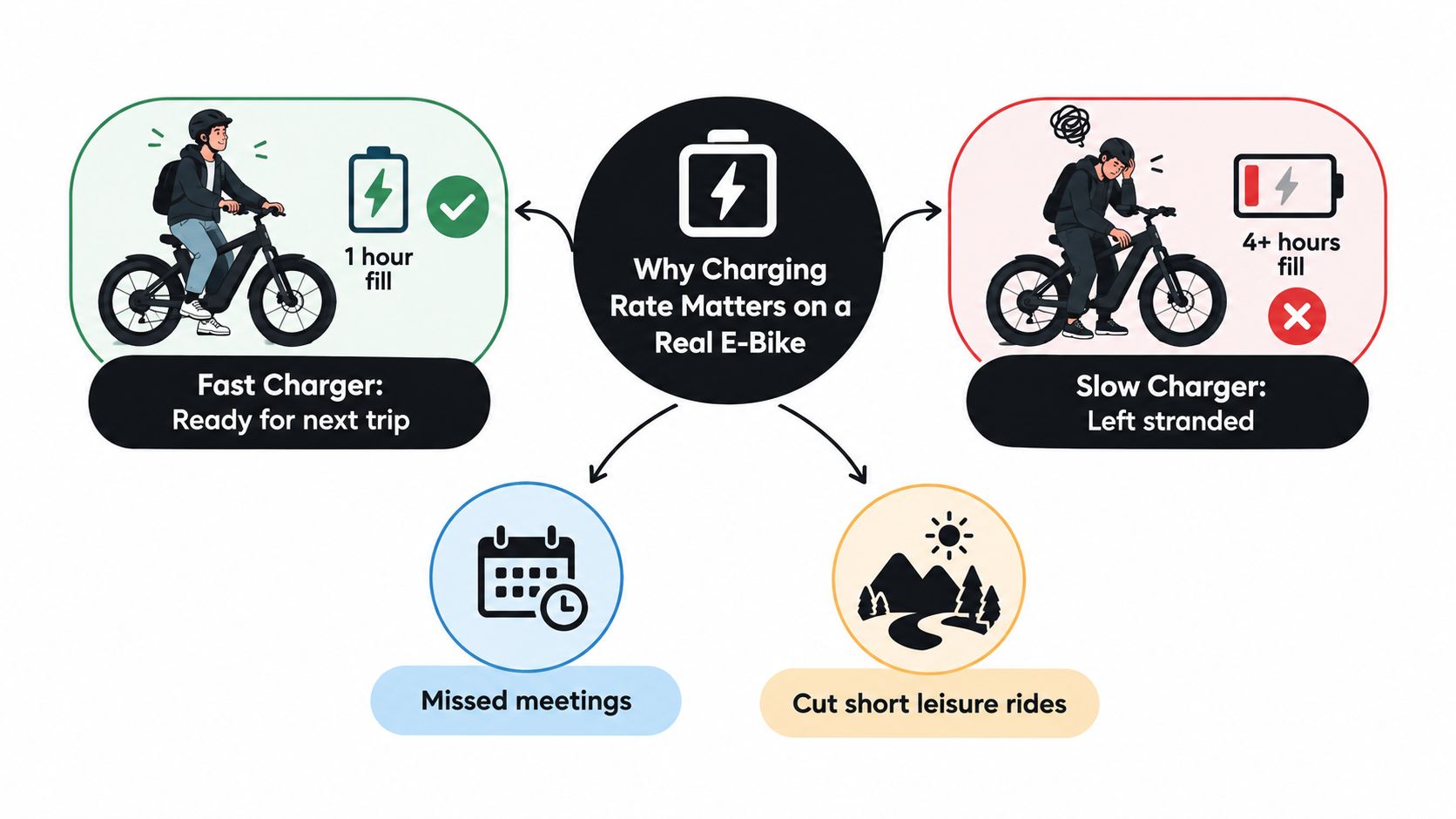
Why Charging Rate Matters on a Real E-Bike
A rider who plugs in before work needs a different charging setup from someone who charges after every weekend trail ride. A slow charger might leave a commuter waiting through a meeting or shorten an evening ride. A charger that pushes too much current can add heat and stress, especially when the battery is already warm from a long climb on a summer day.
That's why charging rate isn't a race for the highest amperage. It's the balance between how much energy the battery holds, how much current the charger supplies, and how quickly the battery can safely accept that current. Many lithium-ion e-bike packs take about 5 to 8 hours to reach full charge under standard consumer conditions, while some systems charge much faster with suitable chemistry and charger current. Research on e-bike lithium-ion batteries describes examples of about 1.5 hours at 1C and about 0.5 hours at 3C, showing how sharply charging time can change when current rises.
The three questions that matter
Before buying a replacement charger, ask:
- What does the rate mean? The amperage printed on the charger tells you how much current it can provide, not exactly how fast the battery will charge from empty to full.
- How long will it take? Battery capacity divided by charger current gives a useful starting estimate, but the battery management system slows the final stage.
- Is faster worth it? A higher-current charger can reduce downtime, but it may create more thermal load and may exceed the battery's approved charging limit.
The older shift from lead-acid systems to lithium-ion packs helped shorten charging windows and improve everyday usability. A comparative study reports that lithium batteries can charge about four times faster than SLA batteries, with some systems reaching full charge in two hours or less. The comparative battery study also places many practical e-bike charging sessions in the 3 to 8 hour range.
For a commuter, that difference changes the routine. A charger that refills the battery during a workday may be perfectly adequate, while a rider making two trips close together may value a faster unit. The right choice starts with the battery label, not the most impressive number on a charger box. For battery lifespan context, this guide on how long e-bike batteries last is a useful companion.
Volts, Amps, Watts, and C-Rate Without the Jargon
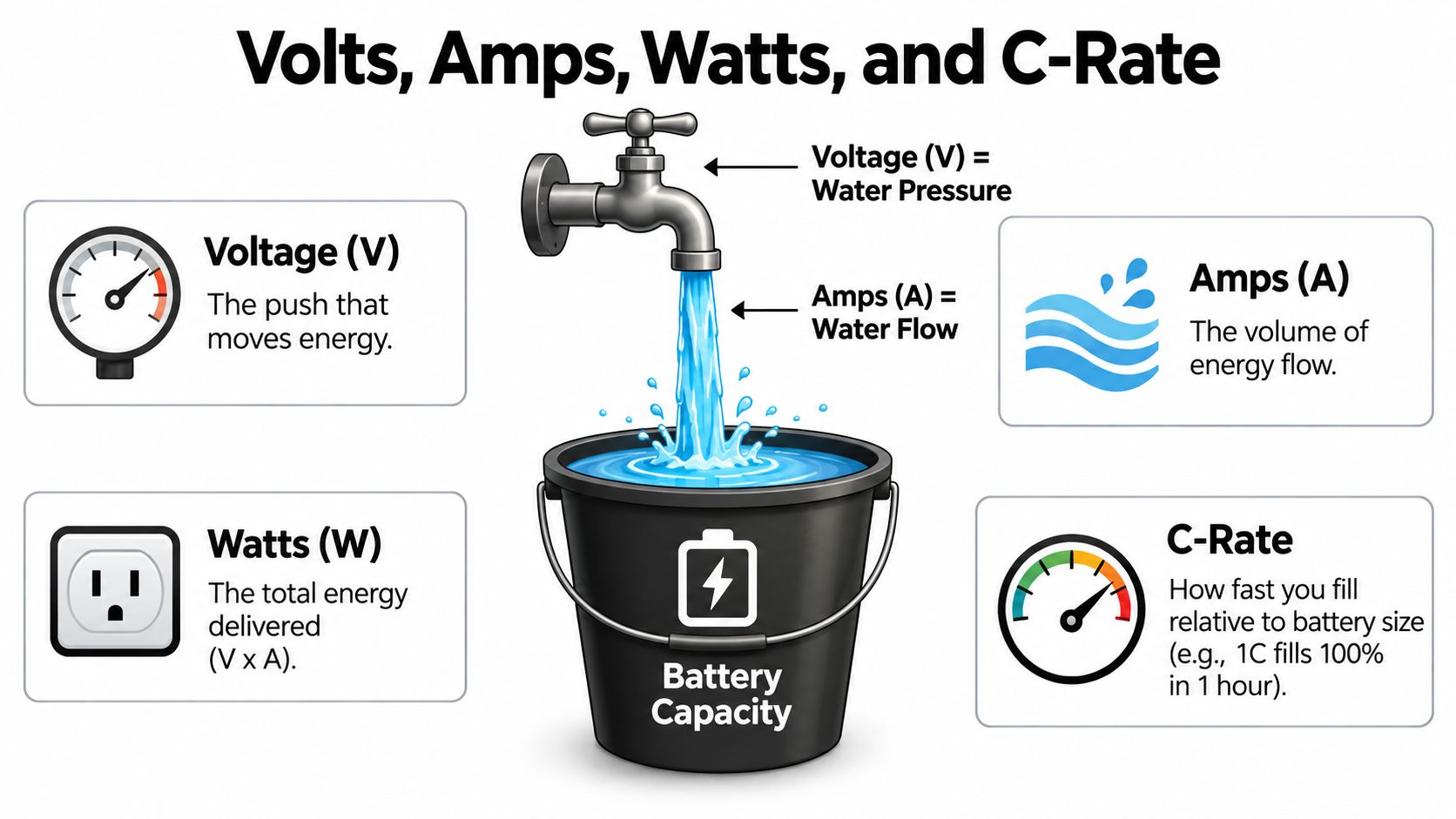
Think of charging as filling a bucket from a tap. The battery is the bucket, the charger is the tap, and the electrical terms describe the pressure, flow, and total filling work.
Voltage is the pressure
Voltage, written as V, is the electrical push that moves energy into the battery. In the tap analogy, it's water pressure. A 36V battery needs a charger designed for that battery system. A 48V charger isn't a stronger version of a 36V charger that you can safely substitute. It's a different electrical match.
Amps are the flow
Amperage, written as A, describes the flow of current. A 2A charger supplies a gentler stream than a 4A charger. If both chargers are correctly matched to the same battery, the 4A unit can move energy into the pack faster during the main constant-current stage.
A common technical charging window for lithium-ion e-bike chargers is about 0.5C to 1C, while many consumer e-bike and scooter chargers sit around 2A to 5A. This charger guidance explains that lithium-ion energy cells are generally advised to charge at 0.5C to 1C, with 0.8C or lower often preferred when extending cell life is the priority.
Watts combine voltage and current
Watts measure charging power. The formula is simple:
Watts = volts × amps
Take a typical 36V, 10Ah battery. Its nominal energy is:
36V × 10Ah = 360Wh
A 2A charger connected to that system provides about:
36V × 2A = 72W
A 4A charger provides about:
36V × 4A = 144W
The higher-current charger supplies twice the charging power at the same nominal voltage, but the battery still controls what it accepts.
C-rate compares flow with battery size
C-rate tells you how hard the battery is being asked to charge relative to its capacity. On a 10Ah battery, a 2A charging current equals 0.2C, while a 5A current equals 0.5C. A 1C rate would theoretically supply current equal to the battery's amp-hour capacity.
That comparison matters because a 5A charger isn't automatically gentle just because it works with the same voltage. The battery's cells, wiring, charger, and battery management system must all support the current. A bigger tap fills a bucket faster, but it also demands more from the plumbing.
How to Calculate Your Real Charge Time
The quick estimate starts with amp-hours:
Charge time = battery capacity in Ah ÷ charger current in A
For a 36V, 13.6Ah battery, which is roughly a 500Wh pack, a 2A charger gives:
13.6Ah ÷ 2A = 6.8 hours
That's the clean mathematical result. It isn't the full real-world answer because lithium-ion charging uses a constant-current, constant-voltage profile. The charger supplies steady current during the bulk stage, then the battery management system allows current to taper as the cells approach full charge.
A practical e-bike charging guide recommends adding about one hour for this top-end constant-voltage taper after dividing amp-hours by amps. This explanation of e-bike charger calculations makes the reason clear: the last part of the charge takes longer than a simple capacity calculation suggests.
Applying the formula to a 500Wh pack
Using the 13.6Ah figure, the basic results look like this:
| Charger Output | Ah Math Result | Realistic Charge Time |
|---|---|---|
| 2A | 6.8 hours | About 7 to 8 hours |
| 4A | 3.4 hours | About 3.5 to 4.5 hours |
| 5A | 2.72 hours | About 3 to 4 hours |
The exact finish time changes with starting state of charge, temperature, cell condition, charger efficiency, and the battery's programmed taper. A pack that starts partly charged won't need the same energy as one that's nearly empty, and a battery that reaches its voltage limit early may spend longer in the final stage.
A charger guide also gives the useful rule of adding roughly 10 to 15% overhead for charging losses and real operating conditions. The wattage and charging-time examples in this e-bike charger guide show why a nominal power calculation should be treated as an estimate, not a stopwatch.
For a 500Wh battery, a 2A charger is often fine if you plug in after dinner. A 4A charger makes more sense if the bike needs to return to service during the same day. A 5A charger may reduce the bulk-stage wait further, but the final taper prevents the result from shrinking in a perfectly straight line.
If you're comparing home charging equipment for other electric transport, home EV charger installation info offers useful context on how voltage, current, installation, and safety requirements interact at a larger scale. The principle is similar, even though an e-bike charger operates at far lower power.
2A vs 4A vs 5A Chargers and the Speed Tradeoff
A 500Wh, 36V, 13.6Ah battery makes charger labels easier to compare. A 2A charger supplies current gently, a 4A charger shortens the bulk stage substantially, and a 5A charger reduces it further. The improvement from 4A to 5A is smaller because the battery gradually limits current as it approaches full charge.
| Charger | Output Current | Approx. Charge Time | C-Rate | Heat Stress | Best Use |
|---|---|---|---|---|---|
| Standard charger | 2A | About 7 hours | About 0.15C | Lowest of the three | Overnight or daily top-ups |
| Faster charger | 4A | Roughly 3.5 hours | About 0.3C | Higher during bulk charging | Commuters with limited downtime |
| Fast charger | 5A | Near 2.7 hours in the bulk estimate | About 0.37C | Highest of the three | Occasional urgent recharges |
The C-rate comes from dividing charger current by the battery's 13.6Ah capacity. It describes the current being requested at the start of charging, not a constant rate that the cells maintain until 100%. The battery management system and charger taper current near the voltage limit, much like turning down a kitchen tap as a container approaches the brim.
What testing tells us
A side-by-side test recorded 7 hours 15 minutes for a 2A charger to raise a battery from 20% to 100%. The 4A charger took 3 hours 50 minutes, while the 5A charger took 3 hours 05 minutes. The reported implied rates were 0.12C, 0.3C, and 0.32C. The charger performance test shows the practical tradeoff clearly: increasing current saves time, but each extra amp produces a smaller time saving as tapering becomes more significant.
These results do not establish one temperature increase or lifespan effect for every battery. Heat varies with cell resistance, enclosure ventilation, surrounding temperature, wiring, and BMS settings. A well-built pack may manage a higher rate comfortably, while an aged or poorly ventilated pack can run warm with a modest charger.
Mechanic's rule: Use the highest charging current the battery maker explicitly supports, not the highest current a charger seller offers.
A removable battery can make charging easier when the bike is stored in a hallway or shared building. This guide to an electric bike removable battery covers the practical setup. For regular charging, 2A or 4A often fits ordinary schedules. A 5A charger suits occasional urgent turnarounds unless the manufacturer approves it for routine use.
Regional Charging Habits for Daily Commuters
Charging habits make more sense when you look at the rider's schedule and local conditions rather than treating every battery the same.
Mia rides in London and covers 12 km each way. Her 400Wh battery rarely falls below half charge during a normal working week, so she plugs in a 2A charger at 11 p.m. using a timer and takes advantage of Economy 7 off-peak electricity. She doesn't need a high-current charger because the bike has several hours to recharge before morning, and she only needs a full session occasionally.
Carlos rides in San Diego, where his routine is different. He uses a 625Wh battery for weekend trail loops and connects a 4A charger between Saturday and Sunday rides. He aims to reach about 80% before the second ride rather than automatically filling the pack, particularly when the battery has been sitting in a warm garage.
These examples show why the best electric bike charging rate depends on more than the charger label. A London commuter may value quiet, predictable overnight charging and off-peak scheduling. A California trail rider may value a faster mid-day turnaround, while warm storage conditions make ventilation and battery temperature more important.
Match the charger to the grid and the climate
Electricity prices vary widely between regions. Recent U.S. estimates place a typical full e-bike charge around 5 to 30 cents in many markets, with listed electricity prices ranging from about 6.6 cents per kWh-equivalent in Nevada to 26 cents in Hawaii, while California averages around 34.7 cents per kWh in the cited dataset. These regional e-bike charging cost estimates show why a daily rider in one state may make different tariff calculations from a rider elsewhere.
Neither rider needs to copy the other. Use a slower charger when your schedule gives the battery time, and choose a faster approved charger when the bike must return to the road quickly. Local tariffs, indoor space, ambient heat, and ride frequency all belong in the decision.
Choosing a Safe Replacement or Fast Charger
A third-party charger should pass four checks before it ever reaches the wall socket. Matching only the plug shape isn't enough.
Check the electrical match
First, match nominal voltage exactly. A 36V battery needs a charger designed for that battery system, and a 48V charger is not a safe upgrade. The charger's output voltage must suit the pack's full-charge voltage and BMS design.
Second, confirm the connector and pinout. Common connections include XLR-3, RCA, and DC barrel plugs such as 5.5 x 2.1 mm, while some premium brands use proprietary Rosenberger magnetic connectors. Two plugs can look similar while placing positive and negative pins differently. Check the manufacturer's wiring information rather than forcing a connector into place.
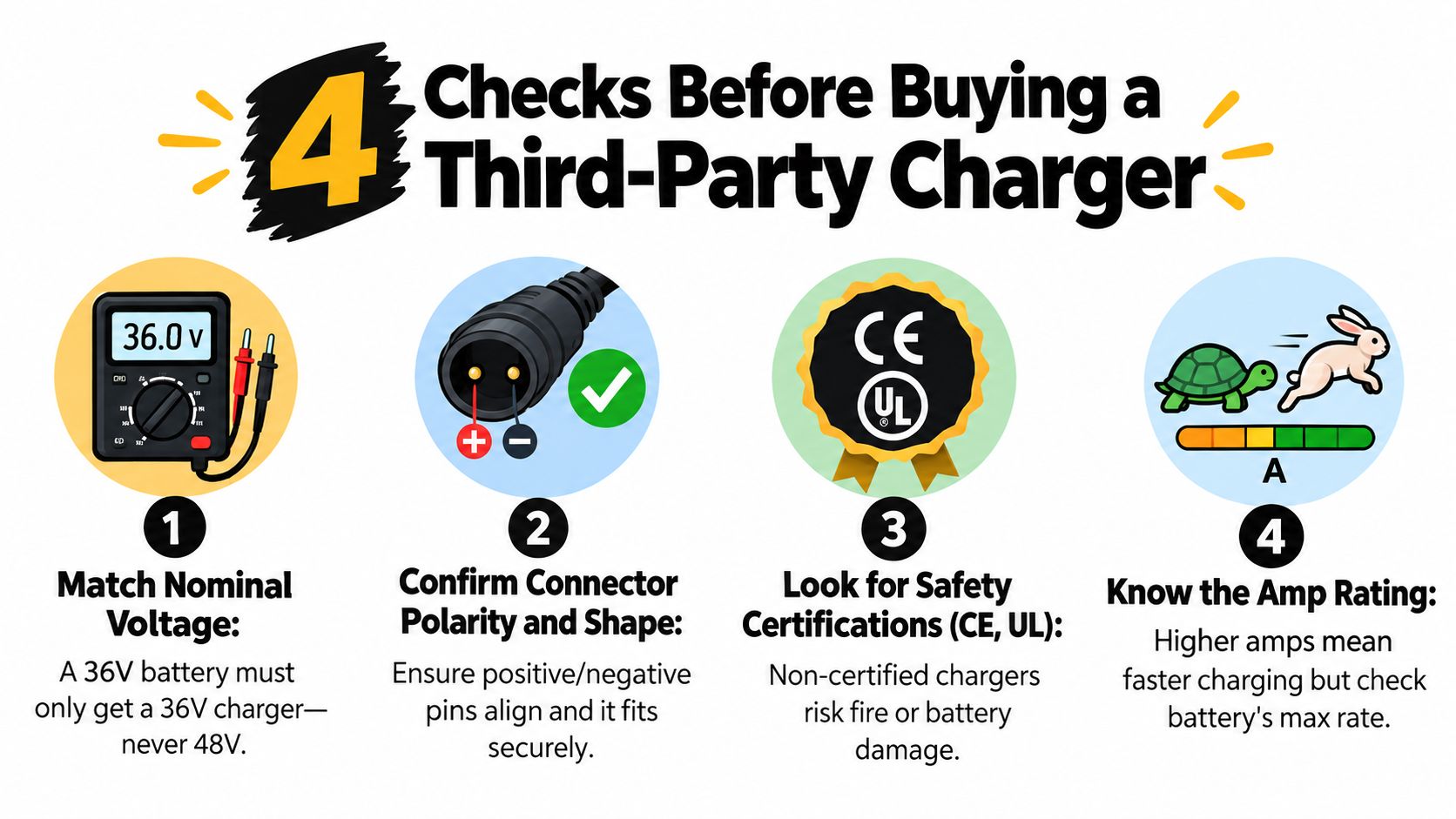
Third, stay within the battery management system's approved current. If the battery label gives a 5A maximum charging limit, a 4A charger remains below that ceiling, while a higher-output unit may not. More amperage isn't automatically better. It only helps when the cells, BMS, connector, and thermal design can handle it.
Fourth, look for credible safety certification. A charger carrying an appropriate UL, CE, or IEC 62133-2 reference should also provide protections against over-voltage, overheating, and short circuits. Certification markings should be genuine and traceable, not just printed decoration.
A worked replacement example
Suppose a 48V, 17.5Ah pack uses a stock 2A charger and the battery documentation lists a 5A maximum charging current. A 4A replacement stays below that stated cap and can shorten the bulk charging stage substantially. The simple capacity calculation is:
17.5Ah ÷ 4A = 4.375 hours
At 2A, the equivalent calculation is:
17.5Ah ÷ 2A = 8.75 hours
The battery still tapers near full, so real finish times won't follow those figures perfectly. Don't treat the faster charger as permission to ignore heat, connector condition, or the manufacturer's instructions. A practical electric bike battery guide can help you identify pack specifications before you compare replacement options.
For charger-specific details, use this electric bike charger guide to check output ratings, compatibility, and charging habits. This video provides another visual explanation of charger safety and battery care:
Common Charging Myths Worth Forgetting
A commuter leaves a bike charging overnight before work. The charger label says 5A, the battery feels warm, and the rider wonders whether one faster session has already shortened its life. That concern needs context.
Myth one, fast charging always kills batteries. Charging current can raise heat and electrical stress, but the effect also depends on cell chemistry, pack construction, BMS controls, temperature, and how frequently fast charging is used. The amperage printed on the charger is only one part of the picture.
Faster charging can create a measurable tradeoff in some testing, with more capacity loss over repeated cycles than a 2A charge. Treat that result as an example from the tested setup, not a prediction for every battery. Low-quality cells, poor cooling, and an incompatible charger may create greater problems than the label alone suggests.
A 4A or 5A charger may be reasonable if the battery maker approves that current and the pack remains at a moderate temperature. Use the higher rate for a real time constraint when the shorter wait matters more than minimizing long-term capacity stress.
Myth two, overnight charging is always safe. Modern e-bike systems commonly use a BMS to stop normal charging at full voltage and manage cell balancing. That protection cannot correct every hazard. An aging or swollen pack, damaged cable, unreliable charger, or enclosed space that traps heat still raises the risk.
A green indicator means the programmed charging cycle has reached its endpoint. It does not prove that a damaged battery or counterfeit charger is safe.
Charge on a hard, ventilated surface. Stop using a pack that smells unusual, swells, leaks, or becomes excessively hot. Fast charging an old battery overnight with an unknown charger is a poor combination. A healthy pack paired with a certified, compatible unit presents a different situation, but supervision and condition still matter.
A Simple Charging Rate Checklist for Riders
Save this list on your phone or tape it inside the garage cabinet. It covers the details that prevent most charger mistakes.
- Match voltage exactly: The charger output must match the battery system specified by the manufacturer.
- Stay at or below the rated current: Don't exceed the battery's approved charging amperage just because a replacement charger promises a shorter wait.
- Use a genuine safety mark: Choose the original charger or a properly certified replacement with a credible CE or UL marking.
- Watch the temperature: A case can become warm during the final constant-voltage stage, but it shouldn't become painfully hot, swell, or give off an unusual smell.
- Unplug when full: Once the indicator turns green, disconnect the charger instead of leaving the battery connected indefinitely.
- Store with partial charge: If the bike will sit for weeks, keep the battery at roughly 50 to 80% rather than leaving it completely full or empty.
- Let extreme temperatures settle: Don't charge immediately after a ride that left the battery overheated, and don't force a very cold pack to charge before it has warmed safely indoors.
- Use partial daily charges: Charging to about 80% for ordinary trips and reserving full charges for longer rides reduces time spent at maximum voltage.
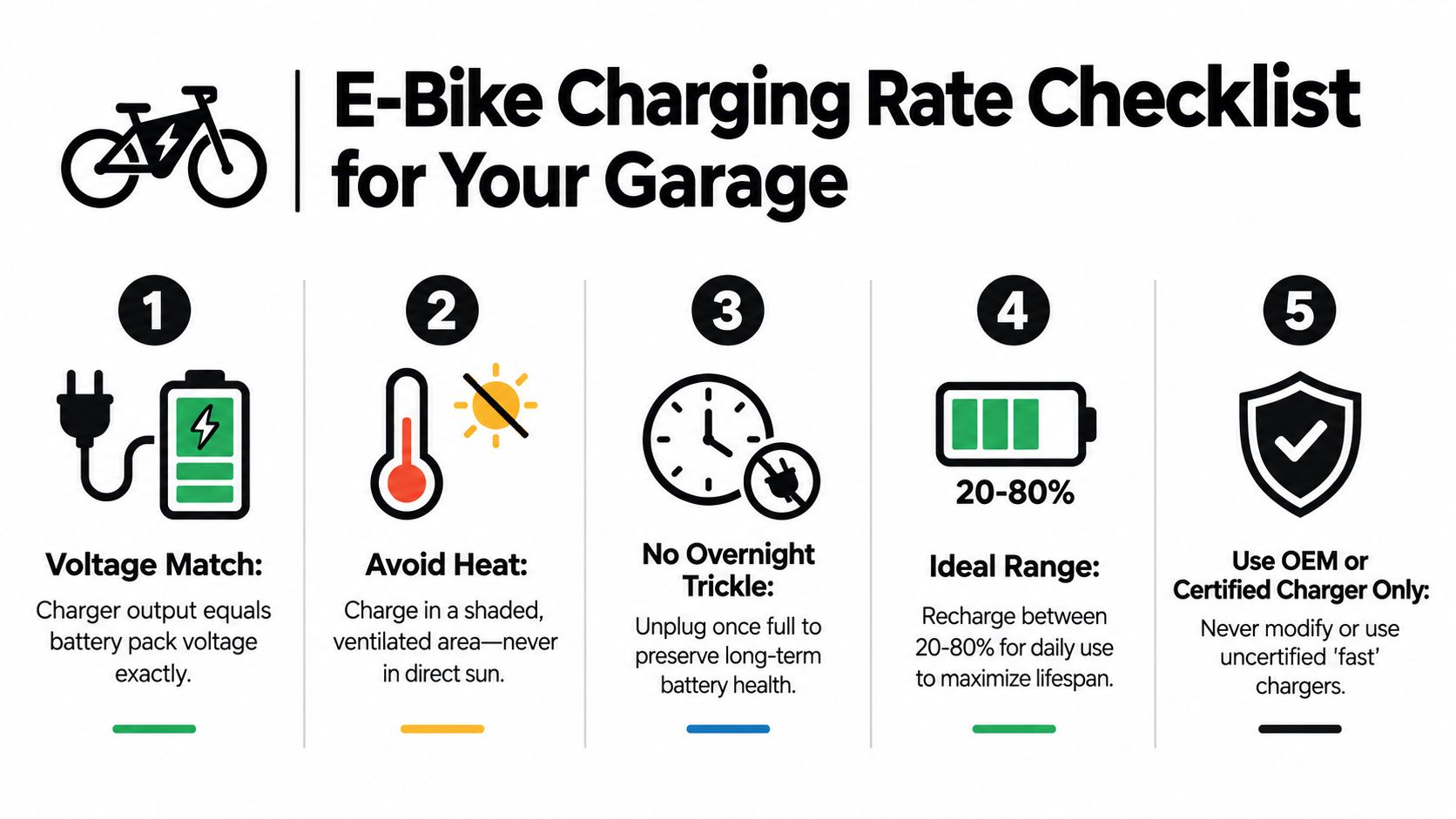
The most useful habit is simple: use a compatible charger at the manufacturer's approved rate, and avoid filling to 100% when you don't need the range. A 2A charger is fine for a long overnight window, while a properly approved 4A or 5A unit can help when your schedule is tight. Your battery doesn't need the fastest possible tap. It needs the right tap, in a cool and safe place.
Punk Ride LLC offers electric bikes, scooters, and related urban mobility products from brands including ISCOOTER, AOVO, DUOTTS, ENGWE, and others, with warehouses in the UK and Germany and headquarters in Florida. Visit Punk Ride LLC to compare suitable electric rides and find practical charging information before your next purchase.
Share:
10 Scooter Safety Rules for Safer Commutes
Bike Battery Maintenance That Actually Works in 2026
2 comments
Falschgeld kaufen WhatsApp +33633558934 🎁 Kostenlose Proben verfügbar
Vor der Bestellung testen. Nur begrenzte Mengen verfügbar. 📩 Telegram: @VicklundBrain
Wo man gefälschte Euro-Scheine kaufen kann, gefälschte Euros online, gefälschte Banknoten WhatsApp +33633558934)
Falschgeld Online Bestellen Telegram @Vicklund
Filmgeld Kaufen Legal – Für Film & Theater (WhatsApp +33633558934 Falschgeld kaufen
Semaglutid kaufen ,Tirzepatid kaufen (WhatsApp +33633558934)
Retatrutide kaufen, 📩 Telegram: @VicklundBrain
Falschgeld #FalschgeldErkennen #FalschgeldWarnung #FalschgeldPrävention #GefälschteGeldscheine #FalscheBanknoten #Banknoten #GeldscheinPrüfen #Betrugsprävention #BetrugWarnung #CounterfeitMoney #CounterfeitBanknotes #FakeBanknotes #CurrencyScam #ScamAwareness
WhatsApp +33633558934)
WhatsApp +49 152 16687201
Falschgeld kaufen,counterfeit deutsch , WhatsApp +33633558934) Fake Banknoten kaufen WhatsApp +33633558934) WO KANN ICH FALSCHE GELD KAUFEN
WhatsApp +33633558934)Fälschungen kaufen
Kaufen Sie gefälschte Banknoten online in Berlin
Kaufen Sie hochwertige Euro-Banknoten
Wo kann man gefälschte Banknoten online kaufen?
WhatsApp +33633558934)
WhatsApp +33633558934)
WO KANN ICH FALSCHGELD KAUFEN? WhatsApp +33633558934)
https://officialdocssupport.com https://officialdocssupport.com https://officialdocssupport.com https://officialdocssupport.com
Falschgeld kaufen WhatsApp +33633558934 🎁 Kostenlose Proben verfügbar
Vor der Bestellung testen. Nur begrenzte Mengen verfügbar. 📩 Telegram: @VicklundBrain
Wo man gefälschte Euro-Scheine kaufen kann, gefälschte Euros online, gefälschte Banknoten WhatsApp +33633558934)
Falschgeld Online Bestellen Telegram @Vicklund
Filmgeld Kaufen Legal – Für Film & Theater (WhatsApp +33633558934 Falschgeld kaufen
Semaglutid kaufen ,Tirzepatid kaufen (WhatsApp +33633558934)
Retatrutide kaufen, 📩 Telegram: @VicklundBrain
Falschgeld #FalschgeldErkennen #FalschgeldWarnung #FalschgeldPrävention #GefälschteGeldscheine #FalscheBanknoten #Banknoten #GeldscheinPrüfen #Betrugsprävention #BetrugWarnung #CounterfeitMoney #CounterfeitBanknotes #FakeBanknotes #CurrencyScam #ScamAwareness
WhatsApp +33633558934)
WhatsApp +49 152 16687201
Falschgeld kaufen,counterfeit deutsch , WhatsApp +33633558934) Fake Banknoten kaufen WhatsApp +33633558934) WO KANN ICH FALSCHE GELD KAUFEN
WhatsApp +33633558934)Fälschungen kaufen
Kaufen Sie gefälschte Banknoten online in Berlin
Kaufen Sie hochwertige Euro-Banknoten
Wo kann man gefälschte Banknoten online kaufen?
WhatsApp +33633558934)
WhatsApp +33633558934)
WO KANN ICH FALSCHGELD KAUFEN? WhatsApp +33633558934)
https://officialdocssupport.com https://officialdocssupport.com https://officialdocssupport.com https://officialdocssupport.com