


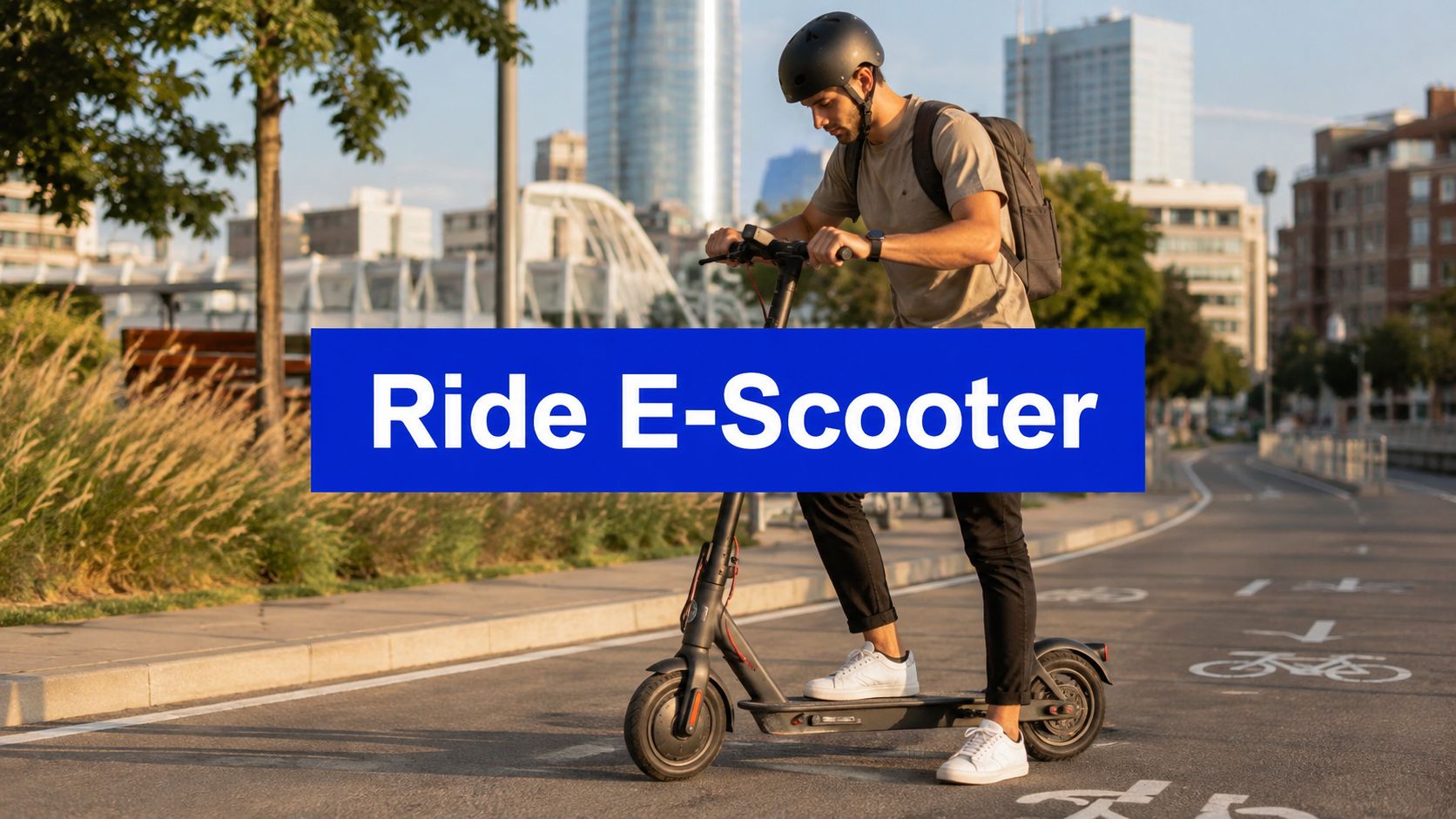
You're standing at the curb with a scooter that looks ready to go, the bike lane is full of commuters, and a car keeps edging forward from the side street. That's the moment people care about, not the glossy “how to ride” version. To ride an electric scooter well in a city, you need more than balance. You need gear, legal awareness, route judgment, and enough control to handle the messy parts of traffic without panicking.
Gear Up and Check the Legal Basics Before You Ride
Start with the things that protect you before the scooter even moves. A proper helmet is the first essential, and visibility matters just as much when you're threading through UK and EU streets at dawn, dusk, or in rain. I also like bright outer layers and reflective details because drivers don't always see a small scooter silhouette until you're already in their path. For eye protection, a practical guide like choosing safe motorcycle eyewear is useful if your usual commute includes wind, grit, or wet spray.

A quick legal check matters just as much as the helmet. In the UK and much of the EU, private scooters are often treated as motor vehicles or kept off public roads, while rental schemes usually run only in regulated trials or local authorizations. The practical takeaway is simple, if your scooter isn't approved for the place you want to ride, the smartest gear choice in the world won't save you from a fine or a confiscation issue.
Practical rule: Before the first ride, check the local rules for where the scooter can operate, whether lights are required after dark, and whether your model is legal for public streets.
I'd also do a two-minute pre-ride inspection every time. Squeeze the brakes, look at tire condition, check the folding mechanism, and make sure the battery is seated properly. If anything rattles, drags, or feels loose, sort it out before rolling.
For riders who want a compact gear checklist, Punk Ride's own electric scooter safety gear guide is worth a look, especially if you're deciding what to carry in a backpack versus what belongs on your body. For Australia and the US, local rules can be much more permissive in some places and much tighter in others, so the safest habit is always the same, verify your city and state or council rules before you ride.
Mounting, Balancing, and Getting Your First Ride Right
The first mistake beginners make is trying to stand “comfortably” instead of standing ready. Put one foot on the deck, keep the other foot planted on the ground, and set your body in a staggered stance before you touch the throttle. That stance gives you a wider balance base, and it matters because most commuter scooters don't creep away gently, they move off fast enough that a sloppy start turns into a wobble.
The front foot should sit far enough forward to help with braking stability later, and the rear foot should stay back enough to support acceleration. Keep your shoulders parallel to the handlebars, look down the road, and don't stare at the deck. Your scooter follows your eyes more than you might expect, so fixating on the front wheel usually makes steering worse, not better.

Start with a quiet, flat space
Roll off only after you've already shifted your weight into the standing foot. Then feed in throttle smoothly, not like you're trying to launch a motorbike. On tested commuter scooters, 0 to 10 mph in 2.6 to 2.7 seconds is normal enough to matter, because that's quick enough to catch out a rider who's still looking for the balance point. The control habit that works is simple, move first, then accelerate, and keep your knees soft so your body can absorb small bumps instead of stiffening up.
Keep the first rides boring
Do your first few runs in a wide, empty place where you can practice straight-line starts and gentle stops without traffic pressure. A lot of people want to “learn by commuting,” but that just adds cars, curbs, and lane changes before the muscle memory is there. The scooter should feel predictable before you try to make it useful. If you can start, coast, and stop cleanly five times in a row, you're ready for more demanding ground.
A helpful mindset is to treat the deck like a moving platform, not a standing room. Shift weight deliberately, and don't rush to max power.
Keep the first foot planted, let the scooter come under you, and only then settle into a stable riding stance.
Mastering Throttle Control, Braking, and Turning
The cleanest rides happen when your inputs are smooth enough that the scooter never feels surprised. Abrupt throttle changes, sudden front-brake grabs, and lazy body position are what turn a simple commute into a near-fall. The goal isn't aggression. It's control that stays tidy when a pedestrian steps out, a taxi cuts across a lane, or the surface changes under the wheels.
The best throttle habit is boring on purpose. Roll it on gradually, keep your upper body calm, and let the scooter build speed instead of punching it forward. That's even more important on stronger models, because road tests show a performance scooter can hit 0 to 30 mph in 4.1 seconds, while commuter models still reach 0 to 10 mph in 2.6 to 2.7 seconds. Faster response means less time to correct a mistake, so your body position has to stay ahead of the scooter, not behind it.
Before braking, shift your weight back and down, then apply the brakes progressively. Use both brakes with care, because hard front-brake use can pitch the front end and create a fall. A smooth stop usually feels longer than a panic grab, but it's safer and more predictable. The same applies to turning. Lean a little, steer gently, and don't snap the bars through the corner.

One of the simplest ways to improve turning is to look through the corner before you enter it. Your hands follow your gaze, and your shoulders will usually follow that too. If you go into a bend tense and upright, the scooter feels twitchy. If you enter with soft knees and a calm upper body, it settles.
For riders who want a deeper look at how the controller shapes the scooter's response, Punk Ride's electric scooter controller guide is a useful technical reference. It's especially relevant if you're trying to understand why some scooters feel smooth off the line and others feel snappy or abrupt.
A good emergency stop is mostly posture. Weight back, eyes forward, brakes applied in a controlled way, no one-handed riding, and no sudden panic movements. That pattern matters far more than bravery ever will.
Riding Safely in Urban Traffic and Complex Environments
The hardest part of riding isn't staying upright. It's making the right decisions while cars, bike lanes, junctions, and broken pavement all compete for your attention. A good city rider reads the street before the scooter reaches it, because by the time you're directly over a hazard, your options are already limited.
I've found that the safest urban rides start with route choice, not speed. Pick roads and lanes where traffic is predictable, avoid shortcuts that force you across awkward junctions, and don't assume the painted bike lane is always the smoothest or safest line. Curbs, manhole covers, grates, potholes, low visibility, and impaired road users all show up without warning, so your eyes should stay on the next problem spot, not the one you just passed.
A common mistake is entering traffic too early. Independent safety guidance recommends learning in a safe place before moving into street conditions, and that advice is still the right call. Once you're in mixed traffic, use the same logic every time, slow before intersections, cross with control, and leave yourself space to react if a driver drifts, a pedestrian steps out, or the surface changes suddenly. A scooter gives you flexibility, but only if you're not forcing it into tight margins.
Useful habit: Treat intersections like decision points, not straight-line gaps. Slow a little earlier than you think you need to, then look left, right, and ahead before committing.
If you're dealing with a crash or injury after a rental ride, practical legal information can help you understand scooter crash compensation options before you speak to anyone else. That's especially relevant in cities where rental fleets are common and blame gets argued quickly.
Low visibility deserves special caution. Wet roads, glare, dusk, and shadowed side streets make scooter riding feel deceptively easy right before conditions turn bad. When visibility drops, shorten your routes if you can, ride slower than your comfort level suggests, and avoid weaving to “find a better line.” The better line is usually the one that keeps you visible and predictable.
Battery Care, Range Estimation, and Basic Maintenance
Range anxiety usually starts with wishful thinking. People trust the number on the listing, then discover their commute is longer, hillier, colder, or faster than the marketing assumed. A better method is to estimate range from battery capacity in watt-hours, divide by a real-world consumption figure, then adjust for rider and route conditions. One independent guide uses about 20 Wh per mile as a baseline formula, then recommends derating by 10 to 15% for riders over 180 lb, 15 to 25% for hilly terrain, 30 to 40% for cold weather below 40°F, 20 to 30% for frequent high-speed riding, and 5 to 10% for under-inflated tires, all of which are the kinds of conditions commuters face. The same source also notes that the average scooter claims 39.3 miles of range, but real-world testing delivers only about 61% of claimed range on average, which is why spec sheets alone can mislead you. Source: Levy Electric range guide
What to do with the battery in real life
Charge with the recommended charger, don't leave the scooter baking in extreme heat, and store it in a cool, dry place if it's going unused for a while. If you're parking the scooter for weeks, keeping it somewhere around mid-charge is a sensible habit because batteries don't like being neglected at either extreme. Tire pressure also matters more than many riders expect, because low pressure makes the ride feel dull and eats into range.

Make maintenance part of the ride, not an afterthought
Check brakes, inspect tires, and listen for new noises before they become expensive ones. If the scooter feels rougher than usual, don't blame the road immediately, because a slow leak, loose fastener, or worn brake pad can show up in the way the scooter tracks and stops. That kind of basic upkeep is less glamorous than buying a new model, but it's what keeps a daily rider from getting stranded.
For a practical maintenance checklist, Punk Ride's how to extend battery life guide fits well with the habits above. I'd use it as a reminder that range isn't just a battery issue, it's a riding-style issue too.
Understanding UK and EU E-Scooter Laws and Safety Data
The legal split in the UK and EU is simple in concept, even if it's messy in practice. Many jurisdictions treat private e-scooters as motor vehicles or keep them off public roads, while rental fleets are more often allowed only under controlled trials or local authorization. That's why the UK trial model mattered so much, it created a supervised legal pathway for real-world deployment before broader regulation settled in.
The safety threshold that keeps coming up in consumer guidance is 15 mph. AAA notes that some cities advise riding on the road if the speed limit is 25 mph or lower, and a WorldMetrics safety report says speed limiters set at 15 mph can reduce crash severity by 32%. For riders, that makes the speed cap more than a convenience feature, it's a practical control linked to injury risk.
| Market | Private E-Scooter Status | Shared/ Rental Scheme | Speed Limit | Helmet Requirement |
|---|---|---|---|---|
| UK | Often restricted for public road use | Allowed in regulated trials | Often locally capped | Varies by local rule |
| EU | Often treated as motor vehicles or restricted | Usually local authorization only | Often lower city-set limits | Varies by country and city |
| US | State and city rules vary widely | Common in many cities | Often city-set or device-set | Varies by jurisdiction |
| Australia | State and city rules vary widely | Common in some cities | Often city-set or trial-based | Varies by jurisdiction |
The US and Australian markets deserve separate checks because local rules can shift by city, state, or council. The safest habit is still the same, confirm where the scooter is allowed, whether a helmet is required, and whether the device's top speed fits the local limit before you ride.
If you're shopping for a scooter or replacing one that doesn't fit your commute anymore, Punk Ride LLC carries electric rides and scooter options built for urban use across the UK, Germany, and the US. Visit Punk Ride LLC to compare models, check availability, and choose a setup that matches how you ride through city traffic.
Share:
Tie Down Straps for Bikes: A Safe Setup Guide
Best Rated Motor Scooter Buying Guide 2026