


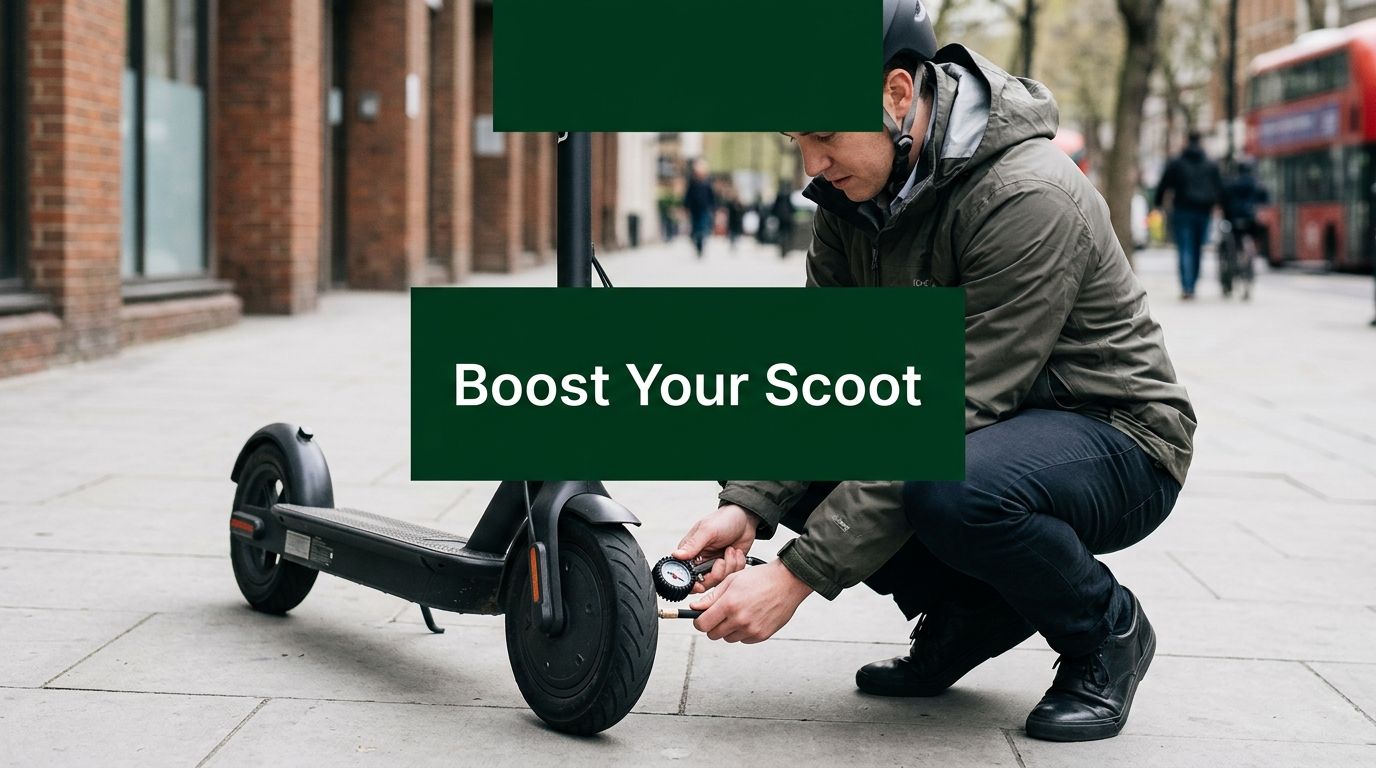
A lot of riders search for ways to boost your scoot when what they really mean is simple: the scooter doesn't feel as lively as it used to. It pulls a bit slower from the lights. The hill near the station feels steeper than last month. The ride home that used to be comfortable now triggers range anxiety halfway through.
That drop in feel is usually real, but it's rarely solved by the dramatic fixes people push in forums. In practice, the biggest gains come from three places. Better riding habits, boring but effective maintenance, and battery care that protects power over time. Actual mods come last, and in the UK and much of Europe, they also bring the biggest legal and safety trade-offs.
That Feeling When Your E-Scooter Loses Its Edge
If you ride often, you know the pattern. The scooter still works, so nothing feels urgent. But week by week it gets a little more sluggish. Acceleration softens. Range gets less predictable. Braking feels a touch grabby or draggy. You start wondering whether the battery is dying, the motor is tired, or the whole thing is just getting old.
For many riders, the actual issue is less dramatic. A scooter can lose its sharpness from a stack of small things: underinflated tyres, dirty rolling parts, brake rub, extra load in your bag, cold-weather charging habits, or a riding style that burns power at every junction.
Why this matters more for commuters
In the UK, scooter performance isn't just a hobby question for plenty of people. Department for Transport-related reporting cited in industry analysis found over 100,000 e-scooter trips per week in 2023 across trial cities, and a 2022 survey found roughly 60% of users rode e-scooters for commuting to work or education according to this scooter data reference. If your scooter is part of the daily routine, reliability matters as much as speed.
That's why the usual “just bypass its restrictions” advice misses the point. A commuter scooter that starts every morning, climbs predictably, and gets home with battery in reserve is more useful than a badly tuned one that feels fast for a week and then develops faults.
Practical rule: If your scooter feels slower, assume efficiency has slipped before you assume the hardware has failed.
What riders often get wrong
The first mistake is chasing a single magic fix. There usually isn't one. Most “my scooter has gone slow” complaints come from several minor losses adding up.
The second mistake is confusing sensation with true performance. A scooter can feel dull because of soft tyres or draggy brakes, even when the motor and battery are fine. On the flip side, a harsh acceleration setting can feel exciting yet hurt useful range.
A well-kept scooter feels quicker partly because it wastes less energy. That's the thread running through everything that follows. If you want to boost your scoot properly, start with the stuff that improves the whole ride, not just the top line on paper.
Instant Gains Without Spending a Penny
The fastest way to wake a scooter up is to stop riding it like every traffic light is a drag race. Smooth inputs beat aggressive ones. You save battery, reduce heat, and the scooter often feels cleaner and more controlled.

Ride for momentum, not for bursts
Most riders waste energy in the same places. Hard launches from a standstill, late braking, then another hard launch ten seconds later. That pattern feels punchy, but it drains range and makes weaker scooters feel weaker.
Try this on your next ride:
- Roll on the throttle smoothly: Feed power in instead of snapping it open. The scooter settles better, the front end stays calmer, and you stop wasting energy on abrupt surges.
- Look farther ahead: If the next light is red, coast early. Carrying momentum is easier on the battery than accelerating back up from zero.
- Use cleaner lines through bends: Gentle body lean and stable bars work better than sharp steering inputs. The scooter scrubs less speed and feels less twitchy.
- Stand properly: One foot slightly ahead of the other gives better balance under acceleration and braking. You waste less effort correcting wobble.
This is the least glamorous advice in the article, and it works.
Tyre pressure changes everything
If there's one free check that gives immediate payoff, it's tyre pressure. Soft tyres increase rolling resistance, sap range, and make the scooter feel lazy. They also make steering less precise.
Check the sidewall and your manual, then keep tyres within the maker's recommended range. Don't guess by thumb pressure. Use a pump with a gauge. On small scooter tyres, even a modest drop can be noticeable in speed, handling, and battery use.
Underinflated tyres can make a healthy scooter feel tired.
Remove weight you don't need
Riders tend to obsess over firmware and ignore the backpack stuffed with chargers, a lock, a water bottle, work shoes, and random junk. Extra load asks more from the motor every time you pull away or climb.
A few easy wins:
- Empty the bag: Carry only what you need for that trip.
- Mount gear sensibly: If you use a lock or bag, keep weight stable and secure rather than swinging from the bars.
- Avoid awkward posture: A heavy backpack can shift your centre of gravity and make the scooter feel less stable.
Free wins you can feel today
Here's the short version.
| Habit | What it changes |
|---|---|
| Smooth acceleration | Less battery strain, calmer launch |
| Early coasting | Fewer stop-start losses |
| Correct tyre pressure | Better roll, sharper handling |
| Lighter carry load | Easier climbing and pull-away |
| Stable stance | More control, less wasted movement |
People often search for tricks to boost your scoot when what they need is a better riding pattern. Start there before you spend money. If the scooter still feels off after that, maintenance is the next place to look.
The Maintain-to-Gain Performance Routine
A scooter doesn't usually get slow overnight. It gets slow because friction creeps in, bolts loosen, dirt builds up, and small mechanical problems go unchecked. Performance maintenance isn't about polishing for the sake of it. It's about removing losses.

The checks that actually matter
You don't need a workshop routine every weekend. You do need a habit. A quick monthly once-over catches most of the stuff that makes a scooter feel rough or inefficient.
Focus on these areas:
- Tyres and wheels: Look for pressure loss, cuts, uneven wear, and anything embedded in the rubber.
- Brakes: Spin the wheel and listen. If the brake is rubbing, the motor is fighting resistance all the time.
- Fasteners: Check the stem, bars, folding latch, mudguards, and visible chassis bolts. Loose hardware creates rattles, flex, and vague handling.
- Drive components: If your model uses a belt or chain, keep it clean and properly adjusted. Dirt adds drag.
- Deck and charging port area: Clean away grime before it gets forced into seals and moving parts.
Brake drag is a silent battery killer
One of the most common causes of a scooter feeling “down on power” is brake rub. It doesn't have to be severe. A slight scrape is enough to make the motor work harder and reduce the easy roll that makes a scooter feel lively.
If the wheel doesn't spin freely, sort that first. On many scooters, a basic caliper alignment and pad check makes a bigger difference than any accessory upgrade.
Workshop note: If a scooter feels heavy when you push it by hand, it'll feel heavy under power too.
Cleanliness is performance, not vanity
A dirty scooter isn't just messy. Grit around moving parts creates wear and resistance. Road film on braking surfaces can make stopping inconsistent. Mud around hinges and joints speeds up play and noise.
A simple routine works well:
- Wipe the scooter down after wet or dirty rides.
- Use a soft brush around wheel areas and folding joints.
- Keep water away from places it shouldn't be forced into.
- Dry it before charging or storing.
Avoid turning cleaning into a pressure-washer event. Water pushed into bearings, connectors, or seals causes more trouble than a bit of surface dirt ever did.
A simple monthly routine
| Check | Why it helps performance |
|---|---|
| Inflate tyres properly | Reduces rolling resistance |
| Align brakes if rubbing | Removes drag |
| Tighten key bolts | Improves stability and feel |
| Clean moving parts | Cuts friction and wear |
| Inspect for damage early | Prevents larger faults |
If your scooter still feels dull after this, don't jump straight to modifications. The battery is the next thing to assess, because power delivery and range both depend on how well it's being treated.
Mastering Your Battery for Maximum Range
The battery is where range, punch, and long-term cost all meet. Treat it well and your scooter stays useful for far longer. Treat it badly and no riding trick or shiny upgrade will fully cover for the decline.

Daily charging habits that help
A lot of riders think battery care is complicated. It isn't. It's mostly about avoiding extremes.
For day-to-day use, many experienced riders prefer not to run the battery flat or leave it sitting full for long periods unless maximum range is needed. That means charging with a bit more intention instead of plugging in blindly after every short trip and forgetting about it for days.
Useful habits include:
- Charge after the battery has settled: Let it cool after a hard ride before plugging in.
- Avoid deep draining: Don't make zero percent your normal finish line.
- Use full charges selectively: Charge fully when you need the extra range, not out of habit every single time.
- Use the correct charger: Match the charger to the scooter and avoid cheap unknown replacements.
Temperature matters more than most people think
Battery performance drops in the cold, and stress increases when cells are charged or used at the wrong temperature. Riders in the UK and northern Europe often notice this first in winter when the scooter suddenly feels weaker on the morning commute.
The key point is simple. Don't charge a battery that's very cold straight from outdoor storage. Bring the scooter indoors, let the battery reach a sensible temperature, then charge it. The same logic applies after a hard summer ride when the pack is hot.
Batteries hate extremes. Most avoidable battery problems start with heat, cold, or leaving the pack at the wrong state for too long.
Storage and end-of-life decisions
If you're storing the scooter for a while, don't leave it abandoned with a flat battery in a shed. Check it periodically and store it somewhere dry and moderate in temperature. Long periods of neglect do real damage.
Eventually, every battery reaches the point where reduced range becomes a replacement question rather than a maintenance question. When that happens, disposal matters. If you're dealing with an old or failed pack, it's worth reading about sustainable battery disposal so the battery is handled properly rather than tossed out like ordinary waste.
Myths worth ignoring
A few battery myths never seem to die:
- “Run it flat to reset it.” Usually bad advice for regular use.
- “Always leave it on charge overnight.” Convenience isn't the same as best practice.
- “More charging equals more wear no matter what.” Careless charging habits matter more than fear of charging itself.
If you want to boost your scoot for the long haul, battery care is the closest thing to a cheat code. Not because it provides crazy speed, but because it preserves the power and range you already paid for.
Exploring Safe and Legal Performance Upgrades
A lot of riders jump straight to mods because that feels like the fastest route to more performance. It usually isn't. The best upgrade is the one that improves control, reliability, or ride quality without turning the scooter into a legal or mechanical headache.

The useful distinction is simple. Some changes help the scooter work better within its design limits. Others push it past those limits and shift the risk onto you.
What upgrades can help, and what usually doesn't
Safe territory usually starts with parts that improve how the scooter puts power down or how clearly you can ride and be seen. Good tyres for your local roads can sharpen grip in the wet and make the scooter feel more planted in corners. Better lights and reflective kit do not add speed, but they often make more difference to real-world safety than any power tweak.
There are also manufacturer-supported changes that can be worth using. Some scooters let you adjust ride modes, acceleration response, or regen strength through the official app. That can make a scooter easier to control off the line or smoother in traffic without opening the controller or rewriting firmware.
Comfort upgrades sit in the same category. Better grips, a sensible bar setup, or supported suspension adjustment can reduce fatigue and improve control on rough surfaces. Those are modest gains, but they are real gains.
The risky stuff people underestimate
Firmware flashes, controller swaps, and battery conversions attract attention because they promise obvious results. They also create the biggest trade-offs. In practice, extra speed can bring more heat, harsher power delivery, shorter component life, and braking that no longer matches the scooter's new top end.
I've seen riders focus on motor output and ignore everything around it. That is how you end up with a scooter that feels exciting for one week and sketchy every day after.
The usual risk pattern looks like this:
| Upgrade type | Likely upside | Main downside |
|---|---|---|
| Manufacturer-approved settings | Reversible, lower risk | Limited change |
| Tyres and comfort parts | Better control and feel | No dramatic speed jump |
| Firmware hacks | Possible extra speed | Warranty, safety, legality |
| Controller or battery swaps | Bigger performance change | Higher technical and legal risk |
Before copying anything from a forum or video, ask a harder question than “does it work?” Ask whether the scooter can still stop, cool itself properly, stay reliable in wet weather, and remain legal where you ride.
UK and EU law changes the answer
Much upgrade advice becomes problematic for UK and EU riders. A modification might be technically possible and still be a poor decision once local rules enter the picture.
In the UK, private e-scooter use on public roads remains tightly restricted outside approved rental schemes, so any speed-related modification can add even more legal risk to something that is already heavily regulated. In the EU, the rules vary by country, and changes to speed, power, or core vehicle behaviour can affect whether the scooter still fits the local category it was sold under.
That matters before you spend money.
If your riding needs are changing, compare the vehicle classes before modifying a scooter into something it was never meant to be. This breakdown of the differences between a moped and an ebike helps show why classification matters once speed and use case start to shift.
A sensible upgrade should be reversible, supported by the manufacturer, and easy to justify from a safety point of view. If a mod gives a small speed gain but increases legal exposure, heat stress, and warranty problems, it is not a performance win. It is just a faster route to repairs and regret.
Ride Smart Ride Legal Ride Longer
The strongest scooter setup isn't the one with the wildest spec sheet. It's the one that still feels sharp after months of use, behaves predictably in poor weather, and doesn't create legal headaches every time you leave home.
That's the mindset that works. Ride smoothly. Keep the scooter mechanically clean and tight. Look after the battery like it matters, because it does. Treat modifications as the last step, not the first, and only when they're safe, supported, and legal where you ride.
What real performance looks like
Real performance is boring in the best way. The scooter rolls freely. The brakes don't drag. The battery gives consistent output. The bars feel solid. You know what range to expect, and the scooter behaves the same way on Tuesday morning as it did on Sunday afternoon.
That kind of consistency beats a sketchy extra bit of speed. It also makes the machine easier to trust in traffic and easier to keep on the road.
Keep the law in the loop
For UK riders, that means staying aware of the distinction between private scooters and trial use, and being careful with anything that changes speed or core operating behaviour. For EU riders, it means checking your own country's rules rather than assuming one-size-fits-all advice applies everywhere.
If your riding needs are changing, it can also help to step back and compare vehicle categories before spending money on mods. This look at moped vs ebike is useful if you're deciding whether a different electric ride would suit your commute better than pushing a scooter beyond what it was built to do.
A good boost your scoot strategy is simple. Protect efficiency first. Preserve safety second. Upgrade carefully, if at all. That's how you end up with a scooter that rides better for longer, and keeps you on the right side of the rules.
If you're looking at your next electric ride or replacing a scooter that's past its best, Punk Ride LLC offers electric scooters and bikes for riders in different markets, with UK and Germany fulfilment alongside its US base. It's a practical place to compare current models, features, and form factors before you decide whether to maintain, upgrade, or move to a different setup.
Share:
Electric City Travel: The Ultimate E-Bike & Scooter Guide
Best Electric Scooter for Adults 300 Lbs: A 2026 Guide