


Finding the best electric bike for your city commute really comes down to a simple trade-off between range, portability, and comfort, all tailored to your specific route. For some, a versatile hybrid model hits that sweet spot. For others who mix cycling with a train or bus ride, a compact folding bike is the only way to go.
The best bike isn't a specific model—it's the one that just clicks with your daily routine.
Why Your Commute Is Ready for an Electric Upgrade
Let's be honest: traffic is a nightmare, public transport can be a gamble, and nobody enjoys showing up to work already worn out. An electric bike is your way out, offering a smarter, quicker, and genuinely more enjoyable way to get around town. This guide is here to help you find the perfect ride, cutting through the tech specs to focus on what actually matters for your daily grind.
Whether you're navigating the sprawling suburbs of the US and Australia or the tight streets of a European city, we'll give you straight-up advice. We'll help you figure out if a nimble folding bike, a do-it-all hybrid, or a practical cargo hauler is right for you. It's time to take back your commute.
The Rise of the E-Bike Commuter
Over the last ten years, e-bikes have gone from a quirky novelty to a serious commuting machine. In the US, e-bike sales have skyrocketed, growing by 240% over the last few years. Similarly, Australia has seen a surge, with imports more than doubling annually as people embrace a better way to get to work.
Think about it: saving just 10–20 minutes each way every day adds up to 80–160 hours of your life back per year. That's a huge win.
The magic of an e-bike is that it just erases the common excuses for not riding. Steep hills, long distances, and the classic "I don't want to get all sweaty" problem? They all just disappear.
Comparing Your Commuting Options
When you switch to an e-bike, you're not just buying a new bike; you're changing your daily cost-benefit analysis. The upfront cost is more than a regular bike, sure, but the savings down the road are massive.
| Commuting Method | Daily Cost (Fuel/Fare) | Time Efficiency | Health & Wellness |
|---|---|---|---|
| Car | High | Low (Traffic) | Low (Sedentary) |
| Public Transport | Medium | Low (Delays) | Low |
| E-Bike | Very Low | High | High |
The benefits of electric bikes go way beyond your wallet. They bring together exercise, convenience, and a bit of fun that other modes of transport just can't touch.
Getting the Right Tech for Your Commute
Picking an e-bike is a bit like choosing a new laptop—what's under the hood really dictates the experience. To find the best ride for your daily city commute, you need to get a feel for the core components. They're what make the difference between gliding up a hill and grinding your way to the top.
Let's break down the tech that matters most so you know exactly what you're looking for.
The Great Motor Debate: Hub vs. Mid-Drive
The motor is the heart of your e-bike, and you'll typically face one big decision: a hub-drive or a mid-drive system. Each one feels totally different and shines in different kinds of cities.
A hub-drive motor sits, as you might guess, in the hub of a wheel—usually the rear one. It gives you a simple, direct push, almost like a gentle hand on your back. This setup is perfect for flatter cities like Melbourne or most urban centres in Florida, where you just need a consistent boost to cruise along.
On the other hand, a mid-drive motor is mounted right in the middle of the frame, by the pedals. It powers the chain itself, which is a huge advantage because it can use the bike's own gears. This is the undisputed champion for hilly cities like San Francisco or Sydney's North Shore.
A mid-drive motor feels incredibly natural, like it's just amplifying your own pedal strokes. It's a beast on steep climbs because it uses the bike's gearing to deliver torque exactly when you need it, making tough hills feel almost flat.
- Hub-Drive Motor: Your best bet for flat terrain. It's lower maintenance and generally easier on the wallet. A solid, reliable choice for straightforward urban trips.
- Mid-Drive Motor: The clear winner for hills. It offers better balance, is more efficient, and just feels more intuitive to ride. It’s the premium option for commuters who tackle any kind of elevation.
If you're still weighing these, our guide on how to choose an ebike gets into even more detail to help you nail down your decision.
Don't Run on Empty: Battery and Range
The motor may be the muscle, but the battery is your gas tank. Its capacity, measured in Watt-hours (Wh), is the single biggest clue to how far you can go. More Wh means more miles. Most commuter e-bikes pack a battery somewhere between 400Wh and 700Wh.
But be warned: the range listed on the box is usually a best-case scenario. Your actual mileage will change based on a few things:
- Your Weight: A heavier rider needs more juice.
- The Terrain: Hills are a battery's worst enemy.
- Assist Level: Cranking it up to "Turbo" will drain your battery fast.
- Wind and Weather: Fighting a headwind is like riding uphill—it sips power.
A smart rule of thumb is to figure out your daily round-trip distance and pick a bike with a battery that can handle at least 1.5 times that. That's your buffer to avoid the dreaded "range anxiety."
The Practical Stuff You Can’t Live Without
Beyond the motor and battery, it's the little design choices that turn a good e-bike into a great one for daily commuting. The frame style is a big one. A traditional step-over frame has that classic, sturdy feel. But a step-through frame is a lifesaver for hopping on and off in traffic, especially if you're riding in work clothes.
Weight is also a huge deal, particularly if you're a city dweller in a place like New York or Sydney and have to haul your bike up stairs to an apartment. If that's you, try to find a model that's under 20 kg (about 44 lbs).
Finally, some features are just non-negotiable for a commuter:
- Integrated Lights: A must-have for being seen on those early morning or late evening rides.
- Fenders (Mudguards): They'll save you from the "skunk stripe" of dirty water up your back on wet days.
- Rear Cargo Rack: Absolutely essential for carrying your laptop bag, groceries, or whatever else you need to lug around.
Which E-Bike Type Matches Your Commuting Style
Finding the right electric bike for your city commute isn't about picking the "best" one on the market. It’s about finding the one that seamlessly fits into your life. City e-bikes aren't a one-size-fits-all solution, so the perfect ride for you is the one that solves your specific daily challenges.
Let's break them down into three main categories. Each is built to tackle a different kind of urban commute, so we'll look at them through some real-world situations to see which one resonates with you.
Folding E-Bikes: The Last-Mile Solution
Picture this: you live just outside a major city, maybe a suburb of Sydney. Your daily trek involves a 15-minute ride to the train station, a 40-minute train ride, and then another 10 minutes on your bike to the office. Lugging a full-sized bike onto a packed train during rush hour? That's a definite no-go.
This is exactly where a folding e-bike shines. It’s built for this kind of "multi-modal" travel. You ride to the station, fold it up in less than a minute, and carry it aboard like a suitcase. Once you arrive, you unfold it and ride the rest of the way, zipping past crowded buses and long walks. Its tiny footprint also means you can tuck it under your desk, solving storage and security problems in one go.
For the commuter who mixes public transport with cycling, a folding e-bike isn't just a nice-to-have—it's the key to a faster, less stressful journey. It completely solves the classic 'first mile, last mile' headache.
These bikes are incredibly nimble, which is perfect for navigating dense city traffic. Sure, they might have smaller wheels and a bit less range than their bigger counterparts, but what you gain in portability is more than worth it for the right commute.
Hybrid E-Bikes: The Versatile All-Rounder
Now, imagine a commuter in Melbourne who lives about 10km from their job. Their route is a mix of bike paths, city streets, and a few rolling hills. They need something comfortable enough for a 30-minute ride, quick enough to keep pace with traffic, and practical enough for a laptop bag and maybe a quick grocery stop on the way home.
The hybrid e-bike is the undisputed champion of this scenario. It's the ultimate jack-of-all-trades, striking that perfect balance between comfort, speed, and utility. The upright riding position gives you great visibility in traffic, while the larger wheels and optional front suspension smooth out all those bumpy city roads.
This flowchart makes it easy to choose between the two main motor types you'll find on hybrids.
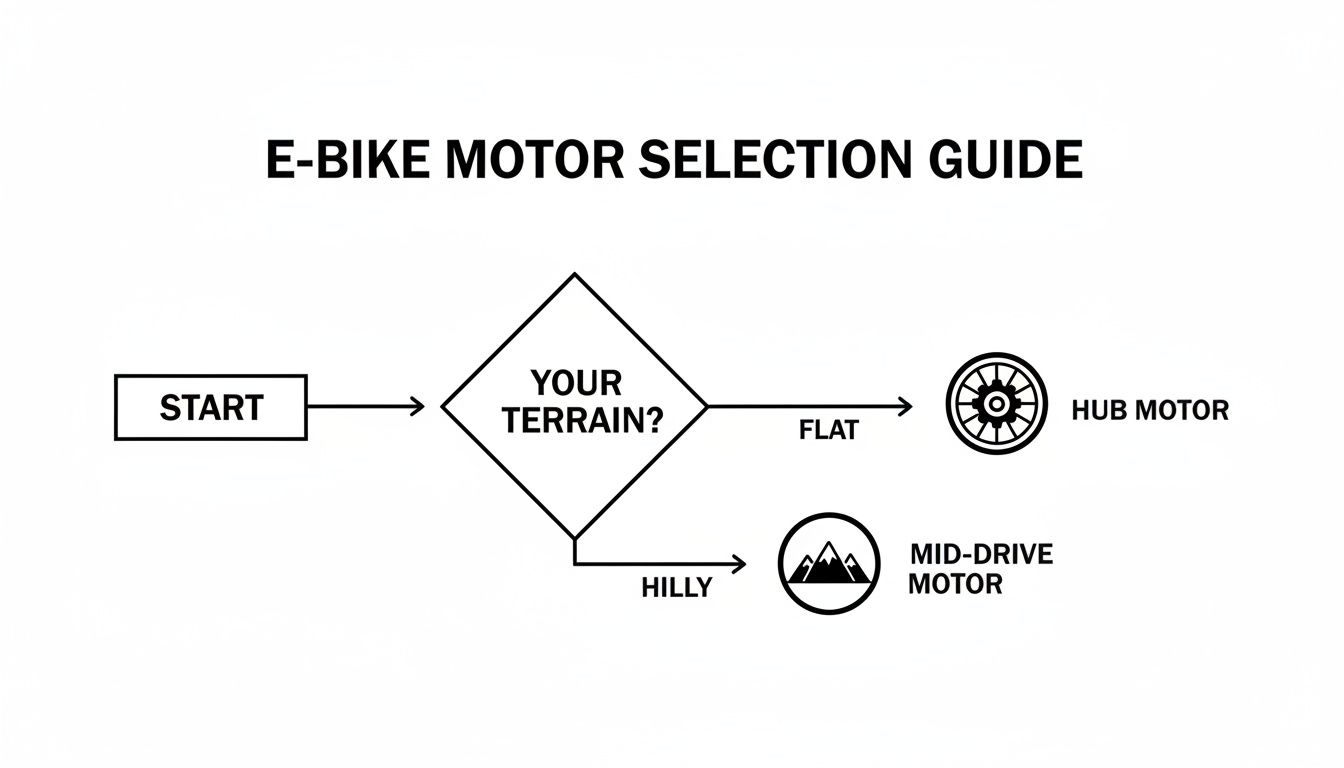
Bottom line: if your commute is mostly flat, a hub motor is a fantastic, budget-friendly choice. If you're dealing with hills, a mid-drive motor will give you the climbing power you need.
Most hybrids come ready to roll with commuter essentials like built-in racks, lights, and fenders. They have the range and power for longer city trips without giving up the practicality you need for daily errands.
Cargo E-Bikes: The Urban Workhorse
Finally, think about a family in a dense US suburb or a city like Adelaide. Their day involves dropping a kid at school before heading to work, then grabbing groceries on the way home. A regular bike just isn't going to cut it.
This is where the cargo e-bike comes in. These things are the SUVs of the bike world, designed to replace a second car. With their long frames, powerful motors, and built-in cargo capacity, they can haul a child in a safety seat, a week's worth of shopping, or even work gear. The electric assist is what makes it all possible, turning a heavy, sweaty slog into a surprisingly easy ride.
Yes, they're bigger and heavier, but their utility is off the charts. For parents on the school run or anyone who needs to move stuff across town, the cargo e-bike is a revelation. It proves you don't always need a car for a busy urban life, offering a powerful, green alternative for carrying just about anything.
Which City E-Bike Profile Fits Your Commute
To make it even clearer, here’s a quick breakdown of which bike fits which commuter. Think about your daily routine and see where you land.
| Commuter Profile | Folding E-Bike | Hybrid E-Bike | Cargo E-Bike |
|---|---|---|---|
| The Multi-Modal Commuter | ✅ Ideal Choice. Folds quickly for trains/buses, solving the "last mile" problem. | ❌ Impractical. Too large and heavy for public transport during peak hours. | ❌ Not Feasible. Far too bulky and heavy to carry on and off public transit. |
| The Direct Commuter (Under 10 miles/15km) | 🆗 Good Option. Great for storage in small apartments or offices, but less comfortable for longer rides. | ✅ Ideal Choice. The perfect all-rounder for comfort, speed, and carrying daily essentials like a laptop. | 🆗 Good Option. Great if you need to carry more than a backpack, but might be overkill for just one person. |
| The Parent on the School Run | ❌ Not Feasible. Lacks the space and stability to safely transport a child. | ❌ Impractical. You might fit a child seat, but it's not designed for the extra weight. | ✅ Ideal Choice. Designed to safely and easily carry children and all their gear. |
| The Small Business Owner / Freelancer | ❌ Not Feasible. No capacity for transporting goods, tools, or equipment. | ❌ Impractical. Can only handle what fits in panniers, limiting its utility. | ✅ Ideal Choice. A true car replacement for making deliveries or carrying equipment across town. |
As you can see, the "best" bike is less about specs and more about how it solves your personal commuting puzzle. The right choice will feel less like a purchase and more like a life upgrade.
Getting to Grips with Local E-Bike Laws and Riding Safely
An e-bike opens up your city in a whole new way, but zipping around responsibly is about more than just finding the best shortcuts. You’ve got to know the rules of the road. The legal side of e-biking can feel a bit like a patchwork quilt, with different laws and regulations depending on where you're riding.
This patchwork is really clear when you look at different countries. The United States does things a little differently, using a three-class system that changes from state to state. It offers more options, but it also means you really need to do your homework on local laws.
Navigating the Maze of Regional Rules
For a proper breakdown, you can dive into the specific electric bike laws by state to make sure you’re playing by the rules. Getting your head around these differences is the first step to riding with confidence and making sure the bike you buy is actually the best electric bike for city commuting where you live.
Australia generally follows the European model, also capping road-legal e-bikes at a 250W motor with assistance cutting out at 25km/h. However, some states have their own specific regulations regarding where you can ride, so it's always wise to check your local transport authority's website.
Knowing the rules isn't just about dodging a ticket. It's about being a predictable and safe part of the traffic flow. It helps everyone—from drivers to pedestrians—know what to expect from you.
Essential Safety Habits for Riding in the City
Beyond the legal stuff, your day-to-day safety really comes down to smart riding habits and having the right gear. City traffic is always changing, so you need to ride defensively. My number one rule? Always assume a driver hasn't seen you, and put yourself where you're most likely to be noticed.
High-visibility gear is absolutely non-negotiable. A bright helmet and a reflective jacket or even just some reflective ankle straps can make a massive difference, especially if you’re commuting at dawn or dusk. Think of it as your secret weapon for being seen.
Protecting Your Bike from Theft
Let's be real: your e-bike is a valuable piece of kit, which unfortunately makes it a prime target for thieves. Investing in a top-notch lock isn't just a good idea; it's a must-do. For real peace of mind, a lot of experienced riders swear by the "two-lock" method.
- Primary Lock (D-Lock/U-Lock): Get a tough, sold-secure rated D-lock. Use it to secure your frame and rear wheel to something solid and unmovable, like a proper bike rack.
- Secondary Lock (Chain or Cable): A second chain or a heavy-duty cable is perfect for looping through your front wheel and connecting it back to the D-lock or frame. This stops opportunistic thieves from just walking off with an easy-to-remove wheel.
While you're focused on riding safely, it's also smart to know what to do if the worst happens. Being aware of resources like an Atlanta Bicycle Accident Lawyer can help you understand your rights and the legal side of things if you're ever in an accident.
Must-Have Gear for Your Daily Commute
Finally, a few bits of gear can make your ride not just safer, but a lot more pleasant:
- A Quality Helmet: This is the single most important piece of safety gear you will ever buy. No exceptions.
- Bright, Integrated Lights: You need to be seen, even in broad daylight. Good lights are critical.
- A Loud Bell or Horn: It’s a simple tool, but it's incredibly effective for letting pedestrians and other cyclists know you're coming.
- Puncture-Resistant Tires: City streets are full of glass and other debris. These tires can be a lifesaver, preventing a frustrating flat on your way to work.
Crunching the Numbers: What an E-Bike Really Costs
An e-bike feels like a big purchase, but how does it actually stack up against your daily commute? It's easy to get fixated on the price tag, but the real story is in the long-term savings. A quick look at the numbers shows that the right e-bike isn't just a new toy—it’s one of the smartest financial moves a city dweller can make.
When you start browsing, you'll find everything from budget-friendly options to high-end machines. That price difference usually comes down to the quality of the motor, the size of the battery, and how durable the parts are. But that initial outlay is just the beginning of the story.
Thinking Beyond the Sticker Price
The real magic of an e-bike becomes clear when you look at the total cost of ownership. Unlike a car or even a monthly transit pass, an e-bike’s running costs are practically negligible.
Your main expense will be electricity, and we're talking pennies per charge. It's a tiny fraction of what you'd shell out for gas or public transport tickets. If you want to get precise and figure out exactly what it'll add to your power bill, it helps to understand how to calculate a kilowatt-hour. It really puts into perspective how cheap each trip is.
Routine maintenance is the next thing to consider, but it's far from a deal-breaker. It's mostly standard bike stuff:
- Brake Pads: You’ll wear through these eventually, especially with all the stopping and starting in city traffic.
- Chain Care: A little cleaning and lube now and then keeps everything running smoothly and makes your parts last longer.
- Tires: Flats happen, but good puncture-resistant tires make them a rare event.
The biggest future expense is replacing the battery, but don't sweat it too much. Modern lithium-ion batteries are tough, lasting thousands of charge cycles. You can expect 3 to 5 years of solid performance before you even notice a dip in range.
The Financial Argument for Going Electric
Let's put this into a real-world context. Think about the constant financial bleed from other ways of getting around. Whether it's gas and insurance in Sydney, insane parking fees in New York, or a monthly transit pass in Chicago, those costs add up shockingly fast.
When you switch to an e-bike, you're not just buying a new ride; you're effectively giving yourself a raise by slashing your daily travel expenses. The initial investment often pays for itself much faster than people realize.
As the costs of fuel and car ownership keep climbing, the economic case for e-bikes in big cities is stronger than ever. Many commuters can easily ride 125-250 miles a month on just a dollar or two of electricity. Over 3–5 years, the total cost can be less than 20–30% of what it takes to own a car in the city.
This isn't just a niche trend; it's a massive shift. The global e-bike market is expected to more than double, hitting over USD 120 billion by 2035. That kind of growth tells you just how many people are realizing an e-bike is the smartest, most economical way to navigate the urban jungle.
Making Your Final Decision with Confidence
Alright, you've waded through the technical specs, the cost breakdowns, and all the practical advice. Now it’s time for the fun part: putting it all together to pick your perfect ride. This is less about numbers and more about matching a machine to your life.
To make this dead simple, let's think in terms of "Rider Profiles." Find the one that sounds most like you, and your ideal e-bike will practically jump off the page.
Finding Your Rider Profile
Your daily routine tells the real story. The best bike for a Sydney commuter hopping on and off the train is a world away from what a commuter needs in the sprawling suburbs of a US city.
-
The Multi-Modal Maven (Sydney, Chicago, Melbourne): Is your commute a daily triathlon of bike lanes, train cars, and office elevators? You need a bike that's light enough to hustle up a flight of stairs and compact enough to tuck under your desk. A lightweight folding e-bike is your perfect match. Its superpower is portability, making those transitions between cycling and public transport totally painless.
-
The Suburban Super-Commuter (US, Australia): You’ve got a longer haul ahead, maybe 10-20 miles each way, across a mix of roads and dedicated paths. For you, comfort and a battery that won't quit are everything. A hybrid e-bike is calling your name. It gives you that comfortable, upright riding position and has enough juice to make range anxiety a thing of the past.
-
The Urban Hauler (US Suburbs, Australian Cities): You're doing more than just getting yourself from A to B. You're lugging groceries, work gear, or even the kids. Your bike isn't just transport; it's a car replacement. Look no further than a cargo e-bike. With a powerful motor and a rock-solid frame, it's built to handle heavy loads without breaking a sweat.
What the Future Holds for Commuter E-Bikes
The massive demand for the best electric bike for city commuting is forcing manufacturers to get smarter. It’s the city riders who are really driving innovation, pushing for features that solve the real-world problems of urban travel.
The next generation of commuter e-bikes is all about smart, seamless integration. We're talking built-in GPS for anti-theft tracking, app connectivity for monitoring battery health, and motors that deliver silky-smooth power exactly when you need it.
The global e-bike market is projected to grow by roughly USD 28.3 billion between 2024 and 2029, and that growth is fueled by commuters. For us, that means better tech is becoming standard. High-torque motors for tackling hills and dependable 400–700 Wh batteries that can easily handle a round trip with plenty of power to spare are now the baseline. If you're curious, you can read the full research on e-bike market trends to see where things are headed.
This wave of practical innovation means an investment you make today is built to last. By matching your rider profile with a bike that has these modern essentials, you’re getting more than just a ride—you're getting a reliable partner that will make your daily commute faster, cheaper, and way more fun.
Got Questions? We've Got Answers
Jumping into the world of e-bikes can feel like learning a new language. You've probably got a few questions buzzing around, especially when it comes to picking the right one for city life. Let's tackle some of the most common ones we hear from riders just starting out.
How Much Upkeep Does a City E-Bike Need?
Good news: if you can handle a regular bike, you can handle an e-bike. The day-to-day upkeep is pretty much the same. You’ll still need to pump up your tires, keep the chain clean and lubed, and give the brakes a squeeze to make sure they're sharp.
The electrical bits—the motor, battery, and controller—are usually sealed up tight and don't need any tinkering from you. Your main new task is just being smart about battery care. Keep it out of crazy temperatures, don't let it die completely for long periods, and top it up before it hits zero to keep it healthy. A once-a-year trip to the bike shop for a professional tune-up is always a solid move.
Can I Actually Ride My E-Bike in the Rain?
Yes, you can! Don't let a little drizzle derail your commute. Almost any e-bike worth its salt today is built to be water-resistant, so a normal rainy ride is no problem. All the important electrical parts are sealed to keep the water out.
Just remember, "water-resistant" isn't the same as "waterproof." So, maybe don't try to ford any deep puddles that could swallow the motor or battery. And whatever you do, don't blast it with a pressure washer. After a wet ride, just give your bike a quick wipe-down with a dry cloth—pay a little extra attention to the battery contacts and chain to keep rust away.
What's the Real-World Range of an E-Bike Battery?
Ah, the million-dollar question. That huge range number you see on the box? Think of it as a "best-case scenario" achieved on a flat road with no wind by a very light rider. In the real world, your mileage will vary. A lot.
Your weight, the hills on your route, how much you lean on the pedal assist, and even a strong headwind all take a bite out of your battery.
A bike with a 500Wh battery might be advertised with a 60-mile range. Realistically, if you're hitting hills and using a higher assist level, you're more likely to see 25-35 miles. A great rule of thumb is to take your daily round-trip commute distance and find a bike that can handle at least 1.5 times that. That way, you've always got a comfortable buffer and can say goodbye to range anxiety.
Do I Need a License or Insurance to Ride?
This is a big one, and the answer completely depends on where you live. Laws can change from one city or state to the next.
- In the US: It's a patchwork of state laws. Class 1 and Class 2 e-bikes (which usually stop assisting at 20 mph) often don't require a license, but it's essential to check your specific state's rules.
- In Australia: The rules are quite similar across states, sticking to a 250W power limit for e-bikes to be legal on public roads without needing a license or registration.
Always, always, always check your local regulations before you hit the road. It’s the only way to be 100% sure you’re riding legally and safely.
Ready to transform your daily commute? At Punk Ride LLC, we offer a curated selection of top-brand electric bikes designed to make city travel effortless and fun. Explore our collection and find your perfect ride today at https://www.punkride.com.
Share:
Can Electric Scooters Get Wet? A Rider's Guide to Rain
Your Guide to First Mile Last Mile Transportation