


You've got a dead scooter at the bottom of three flights of stairs, no socket in the car park, and a commute tomorrow morning. That's the exact moment electric scooters with removable battery designs stop sounding like a spec-sheet extra and start sounding like the only practical option. They're not automatically better, safer, or cheaper to run. They're a different charging routine, and you need to know what that routine really asks of you.
Removable Battery Scooters and Their Real Benefits
Two neighbours arrive home at the same time on the same street. One hauls a 17 kg scooter up three flights because the only socket is in the flat. The other releases a pack from under the deck, carries about 4 kg upstairs, and leaves the frame locked downstairs. Same commute, completely different evening.
That's the whole idea in plain terms. A removable-battery scooter lets you lift the pack out, charge it on its own, and clip it back in. You bring the battery to the power instead of bringing the scooter to the power. The approach has gone mainstream for electric two-wheelers: a 2024 electric two-wheelers market analysis estimated the removable-or-swappable-battery segment held a 57% market share in 2024.
What the trade-off looks like day to day
Removable versus fixed battery at a glance
| Factor | Removable battery | Fixed battery |
|---|---|---|
| Charging location | Pack comes off and charges indoors, at a desk or in a hallway | Scooter charges where it is parked, usually outside or in a shed |
| Carrying weight | Pack lifts out, about 4 kg; full scooter still 12-20 kg | Carry the whole scooter, typically 12-20 kg for a commuter model |
| Theft exposure | Pack can come inside overnight, scooter left outside is less valuable | Whole scooter stays outside, full value at risk |
| Replacement | Approved spare or replacement pack possible | Often a full scooter or a battery service visit |
| Upfront cost | Usually higher, spare packs cost extra | Usually lower |
| Mechanical wear | Lock and connector wear with every swap | Fewer exposed connections |
| Charging responsibility | You choose the location, so placement matters more | Charging setup is largely fixed by the scooter design |
Read the carrying row carefully. A lighter pack helps on stairs and trains, but it doesn't make the scooter light. If you still have to lift the frame onto a train, into a car boot, or up a kerb, you're lifting most of that 12 to 20 kg anyway. Removability solves the trip to the socket. It doesn't solve every carry.
The theft row cuts both ways. A pack that comes inside overnight leaves a frame outside with no power source and far less resale value, which is a genuine deterrent. During the day, though, a pack you can release in seconds is also a pack someone else can release if you leave it unsecured. Lock the pack to the frame when you're out, or take it with you in a bag. A simple latch outside a shop won't hold it.
A removable pack only reduces theft risk if you actually remove it or lock it. Left latched and unattended, it's the most valuable part sitting in plain sight.
Replacement is where the design earns its keep over years, not days. Batteries age even when motors and frames are fine, and swapping in an approved spare extends the scooter's working life without a workshop visit. A second pack can also double your daily range, one on the scooter and one charged at home. That convenience has limits. A spare adds mass to carry, costs extra upfront, and needs sensible storage. Buying a cheap, unapproved pack to save money undoes the benefit.
The weight limit you might not expect
Pack weight isn't just about your arms. In England, the GOV.UK rental e-scooter trials guidance defines a qualifying trial scooter as having an electric motor rated at no more than 500 W continuous power, a maximum speed of 15.5 mph, and a mass including the battery but excluding the rider of no more than 55 kg. A heavier removable pack counts toward that total, because the limit covers the scooter's own mass with its installed battery. Private scooters follow different rules, but the point stands for any buyer: the battery-inclusive weight is the number that matters, not the frame weight in isolation.
Connector wear is the quiet cost nobody puts on the box. Every removal cycles a lock, a latch, and electrical pins that live under a deck exposed to road spray and grit. Do it twice a day for two years and you've asked a lot of small moving parts. Check how solid that mechanism feels before you buy, and keep the contacts clean and dry once you own it.
Three questions before you decide
- Where will you charge: Do you have a safe, supervised spot indoors, or are you assuming the hallway will do?
- How far do you carry the scooter: Is the problem the socket location, or the total weight on stairs and trains?
- Do you really want a spare: Will a second pack change your commute, or sit in a cupboard ageing?
My verdict is simple. Removable packs pay off for riders who charge away from the scooter, especially flat dwellers in the UK and EU with no ground-floor socket. Fixed packs suit short commutes with a plug in the garage, where you'd be paying more for a mechanism you'd rarely use. Retailers such as Punk Ride LLC list selected models with removable batteries alongside fixed designs, so check each product's specification rather than assuming a brand means one layout.
How a Removable Battery Works Inside the Scooter
Think of the pack as a power bank that happens to live under the deck. It's a sealed box of cells with its own electronics, designed to slide out, charge elsewhere, and reconnect without tools in most commuter designs.
The diagram below shows how those parts fit together, from the tray that holds the pack to the connector that feeds the controller.
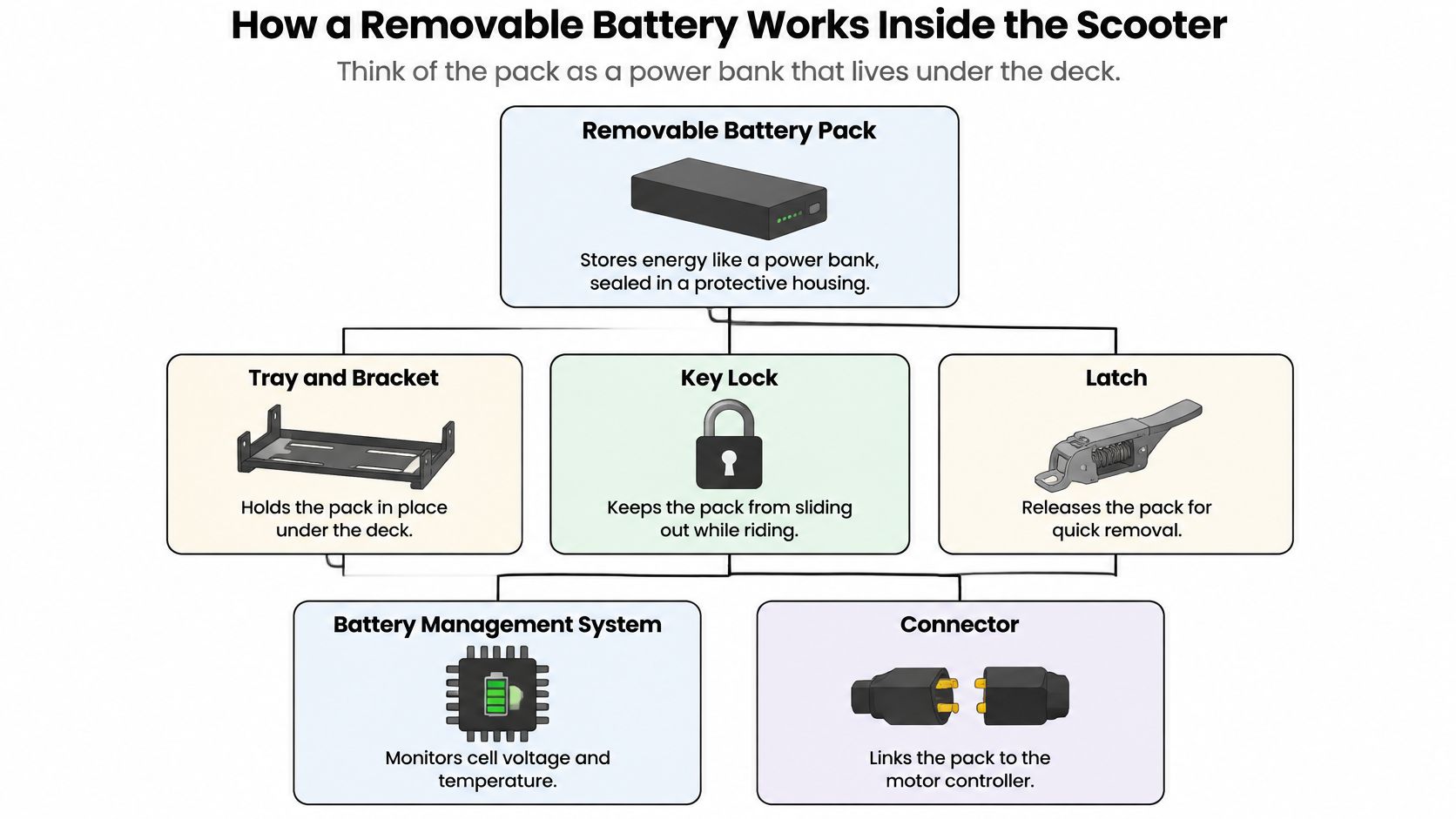
Start from the outside. The pack sits in a tray or bracket under the deck, held by a key lock, a spring latch, or bolts on service-focused models. That mounting has to stop the pack shifting over potholes while still releasing cleanly when your hands are cold. If a showroom model rattles or needs a hard yank, walk away. You'll repeat that movement hundreds of times.
From connector to cells
A multi-pin connector carries power to the motor controller and data back the other way. Inside the housing, the battery management system, or BMS, watches cell voltage, temperature, and current. When something moves out of range, the BMS cuts charging or discharge. It's the reason a pack isn't just cells in a box, and it's why you shouldn't open one or bypass its protections.
Chemistry decides how gracefully that box ages. In Pacific Northwest National Laboratory testing, lithium-iron-phosphate (LFP) battery strings maintained stable operation through more than 700 complete charge-discharge cycles, while tested nickel-manganese-cobalt (NMC) and nickel-cobalt-aluminum (NCA) strings showed measurable degradation during cycling.
That result isn't a guarantee for any specific scooter. Pack design, cell quality, depth of discharge, temperature, and current demand all change the outcome. Treat LFP as a reason to ask for documented cycle testing, usable watt-hours, and continuous current capability, not as a promise that your pack will hit a lab number. If durability and long-term commuting cost matter more than minimum weight, LFP deserves priority. A second pack can extend your riding day, but it adds weight and needs matched charging, storage, and electrical protection, so buy it as a system, not as a loose bargain.
Charging at Home Without Carrying the Whole Scooter
The biggest advantage shows up on night one. You leave the muddy scooter downstairs, bring the pack up, and plug it in. No scooter in the hallway, no extension lead out of a window.
Then comes the catch, and it's a serious one. The UK government battery safety guidance for e-scooter users warns that charging remains the highest-risk activity, and that visibly damaged, swollen, leaking, or odorous batteries pose an extremely high fire risk. Removability doesn't make a scooter automatically apartment-friendly. A loose, high-energy lithium-ion pack charging by your front door can block your escape route and create a hazard a fixed scooter in a garage never would.
The core rules don't change by room. Charge only while you're awake and present. Use the approved charger for that pack. Keep the battery uncovered and ventilated, and keep it away from bedrooms, hallways, exits, combustible materials, and hot locations.
Picking a spot that actually works
Where to charge a removable scooter battery
| Location | Verdict | Why |
|---|---|---|
| Garage with a working smoke alarm | Good | Ventilated, uncovered and away from fuel, paint and clutter |
| Shared office, supervised at a clear desk | Good with supervision | Away from paper and bags, and you are present while it charges |
| Ground-floor flat, spot off escape routes | Acceptable with conditions | Keep the pack out of hallways, stairs and exits |
| Apartment bedroom or bedside | Avoid | Sleeping area with no quick escape |
| Dormitory room | Avoid unless the building approves it | Shared escape routes and limited supervision |
| Balcony or outdoor shed | Use with care | Exposure to heat, cold and rain can affect the pack |
| Inside a parked car | Avoid | Heat build-up and no easy way to respond to a fault |
Once you've picked a location from the top half of that table, set it up properly. Clear a metre around the charger. Put the pack on a hard surface where bags and coats won't bury it, not on a bed or sofa. Stay within earshot of a working smoke alarm. Unplug once it's charged instead of leaving it connected all weekend.
Charging rule: If you couldn't get out of the building without walking past the charging pack, you've picked the wrong spot.
Charger matching matters as much as placement. UK guidance specifically warns that not all scooter batteries and chargers are safe when used together, even if the plug fits. If you're looking at LFP models, check the charger specification against the pack before you buy, as covered in this guide to choosing a LiFePO4 battery charger. A universal charger from a marketplace listing isn't a saving. It's an uncontrolled variable attached to the riskiest part of ownership.
Battery Care, Safety Checks and When to Retire a Pack
Removable packs need more care than fixed ones for a simple reason. You'll charge yours in flats, offices, and luggage areas, handle it daily, and knock it against door frames. A fixed pack lives in one protected enclosure. Yours lives in your routine.
The safety summary below covers the temperature ranges and inspection habits that matter most for a pack you handle every day.
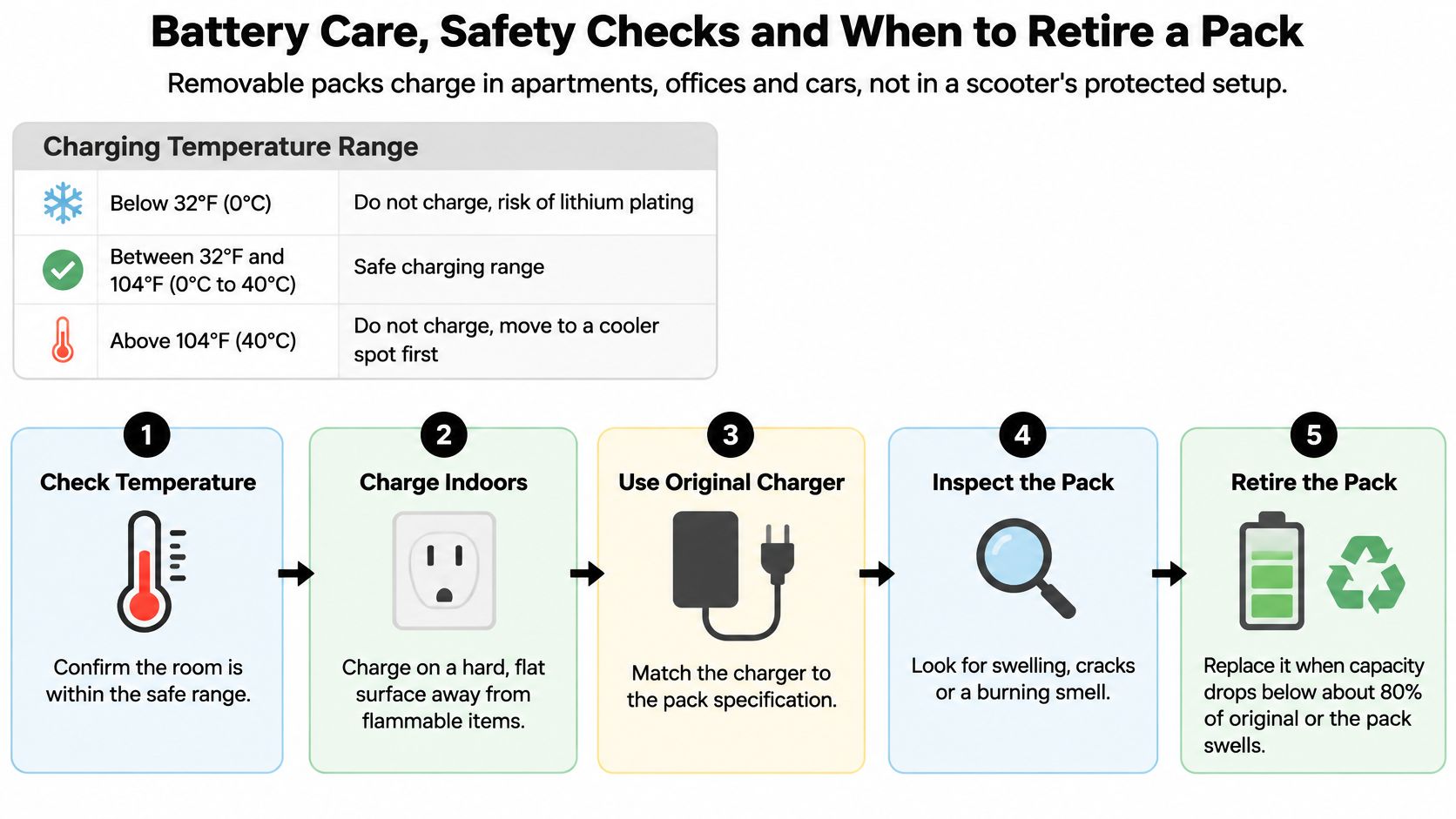
Temperature is the first control. A ScienceDirect study on lithium-ion charging behaviour notes that lithium-ion cells generally should not be charged below 0°C because lithium can plate onto the anode instead of intercalating into it, increasing internal resistance and potentially creating an internal short-circuit hazard, while charging above approximately 45°C accelerates side reactions and reduces cycle life.
Temperature and charging rules for removable packs
| Condition | Guideline | Why it matters |
|---|---|---|
| Charging | Only between about 0°C and 45°C | Below 0°C lithium can plate and raise short-circuit risk; above 45°C cells age quickly |
| After a cold or hot ride | Bring indoors and let the pack reach room temperature first | Avoids charging a pack that is still too cold or too hot |
| Storage | About 20-25°C at roughly 30-50% charge | A conservative range that slows calendar ageing |
| Charger | Only the manufacturer-matched charger and BMS | Mismatched chargers can leave a pack unsafe |
In practice, that means a winter commute in Berlin or Manchester needs a pause before you plug in. Bring the pack indoors, let it approach room temperature, then charge. Storing a spare at 20 to 25°C at roughly 30 to 50% charge slows calendar ageing far better than leaving it full in a hot car or empty in a freezing shed.
The stop-use sequence
Frequent handling creates failure modes fixed packs rarely face, drops, connector wear, and cracked housings. If a repair issue goes beyond a simple check, a professional scooter repair service is the right route, not a kitchen-table rebuild. Use this sequence every time something looks off:
- Check before each ride: Look for swelling, cracks, leakage, a sweet or chemical smell, unusual heat, impact damage, or sudden odd charging behaviour.
- Stop and don't charge: If you spot any sign, stop riding and keep the pack off the charger.
- Move it clear: Put it on a hard, clear surface away from anything combustible.
- Contact the manufacturer or an approved repairer: Describe the signs and follow their instructions.
- Use a battery drop-off point: Take a retired pack to a designated collection route, never the household bin.
The video below walks through basic pack handling and inspection, which is worth watching before your first winter of indoor charging.
Don't use modified or reworked packs, repurposed cells, or unapproved replacement batteries, and don't put lithium batteries in household trash or general recycling, as set out in Greater Manchester Fire and Rescue Service guidance on e-bikes and e-scooters. A removable pack only improves serviceability when the pack, charger, cells, and disposal route stay traceable and approved.
Range isn't the signal to watch. Condition is. A pack that still shows decent miles but has a swollen case or a chemical smell is finished, whatever the display says.
How to Evaluate a Removable Battery Before You Buy
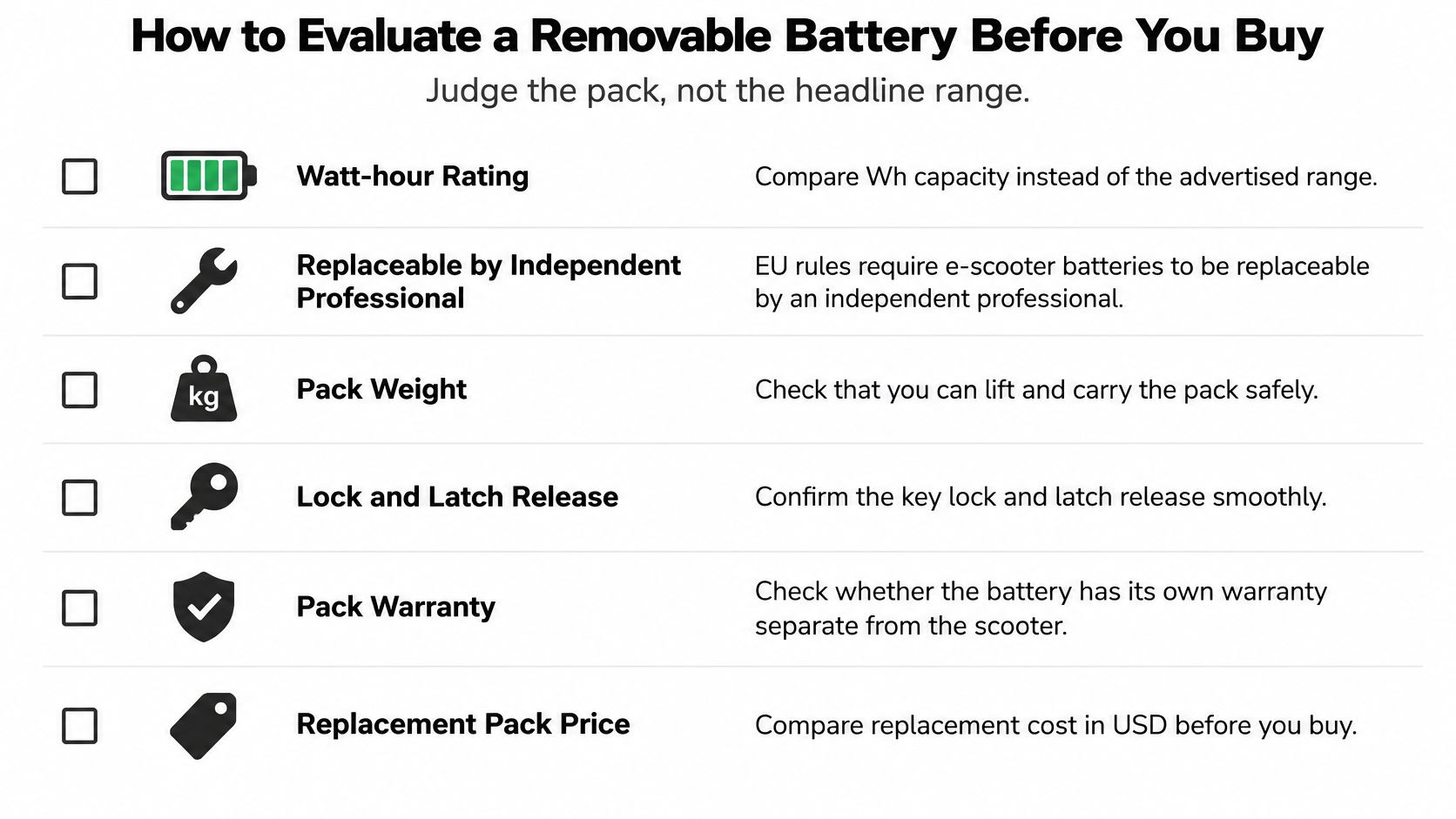
Advertised range assumes a light rider, flat ground, and gentle speeds, so the number on the box tells you little about daily life. The pack specification is what you live with for years: capacity you can use in practice, current the motor can draw, and a replacement route that exists on paper before you need it.
In the EU, replaceability is now a regulatory question as well as a design choice. The European Parliament legislative train summary of the EU Batteries Regulation explains that light means of transport (LMT) batteries, including those in e-bikes and e-scooters, are a distinct regulated category, and that every LMT battery must be replaceable by an independent professional. A scooter can keep its pack semi-fixed and still comply, as long as a qualified repairer can swap it safely. Ask who that repairer is before you pay.
Removability has a mechanical side too. A removable pack adds a latch, a release, and a set of mating contacts, and each one is a wear point. In the shop, push the pack home and feel for a firm, positive lock. A release that needs a key or tool is worth having, because a pack that pops out at a button press can be lifted out of a parked scooter. One that rattles in its cradle can break contact over a pothole. Removability earns its keep only when the mounting is solid.
The checklist below covers the checks worth running in the shop or on a product page.
Buying criteria for a removable battery
| Criterion | Good sign | Red flag |
|---|---|---|
| Usable capacity | Usable watt-hours stated next to the nominal figure | Only the nominal number is given |
| Chemistry | LFP stated, with documented cycle testing | Chemistry not disclosed |
| Continuous current | Continuous amps listed and matched to the motor | Only peak power is advertised |
| Replacement pack | Approved spare sold, with stock available in the UK or EU | No spare, so replacement means a whole scooter |
| Serviceability | Pack can be replaced by an independent professional, with documents | Sealed pack with no service route |
| Certification | EN 17128 and a clear battery marking | No standard named |
| Weight | Pack weight and total scooter weight both listed | Only one weight, or none |
| Labelling | Serial number and identification label on the pack | Unlabelled cells or packs |
Pack weight deserves its own line for a reason. That figure is what you carry up the stairs every evening, and a scooter that weighs 20 kg with a 3 kg pack is a different daily routine from a 20 kg fixed-pack machine. The warning signs cluster together: a seller who gives only a nominal capacity, won't name the chemistry, and quotes peak power with no continuous figure is asking you to buy on faith. Look for EN 17128 for personal light electric vehicles, a clear battery marking, and identification labels you could quote to a repairer in two years.
Ask the seller one question: how would I get a replacement pack in two years, and where would it come from? A vague answer means removability is mostly marketing.
If you're buying in Australia, certification is a separate battery check. The NSW Government guidance on supplying e-micromobility products requires batteries to comply with AS/NZS 60335.2.114:2023 or UL 2271:2023, with the guidance listing UL 2271:2018 as an accepted alternative only until 1 February 2027, plus an electrical safety marking on the product. A certified scooter with an uncertified spare pack doesn't pass that test.
Choose the Right Pack for Your Commute
Start with where the pack will spend its nights. A removable battery earns its keep when carrying the scooter is unrealistic, but it becomes a liability if the pack ends up charging on a shared stairwell, under a bed, or beside a fire exit.
Ground-floor flat, secure charging spot, short commute. Either design works. Pick on price, total weight, and how the scooter rides, because removability adds cost you do not need.
Three or more flights of stairs, no safe indoor charging spot. A removable pack helps only if you already have an approved place to charge it. Fix the charging spot first. Buying the scooter will not create one, and a pack charging in a shared hallway puts your neighbours at risk too.
Long daily commute. An LFP pack with an approved spare is worth the extra cost and weight for daily cycling and a swap option when you forget to charge. Use realistic figures in this guide to electric scooter range when you sense-check distance.
Rented home. Check your lease and building rules before planning indoor charging. Some landlords and building managers restrict lithium battery charging in flats, and finding out after delivery leaves you with a scooter you cannot use.
Shortlist two or three models with documented LFP packs. Confirm the spare-pack price and whether an approved spare is in stock. If you ride in the US or Australia, check local battery certification rules before ordering, using the criteria you have just worked through.
If you are ready to compare models with documented packs, clear battery specifications, and replacement options you can order, browse the electric scooter range at Punk Ride LLC and check each listing for removable battery details, pack weight, and charger matching before you buy. Our warehouses in the UK and Germany, alongside our Florida base, position us to serve customers efficiently on both sides of the Atlantic.



Share:
Best Electric Scooter for Adults 250 Lbs: 7 Picks for 2026