


If you're around the 300 lb mark, shopping for an e-scooter gets frustrating fast. Every product page says “max load,” but that sticker doesn't tell you how the scooter feels when you hit a hill, brake hard in traffic, or roll through patched-up city pavement. A scooter can technically hold your weight and still ride badly.
That's the gap most buying guides miss. They treat payload like a pass-fail number. In real use, rider weight changes acceleration, range, braking feel, tire behavior, and how much stress the frame takes every time you hit a seam in the road.
That matters even more in the US and Australian markets, where plenty of riders deal with longer suburban links, rougher surfaces, heat, and roads that punish lightweight commuter scooters. If you're trying to find the best electric scooter for adults 300 lbs, the right question isn't “Will it carry me?” It's “Will it carry me safely, predictably, and without feeling wrung out every ride?”
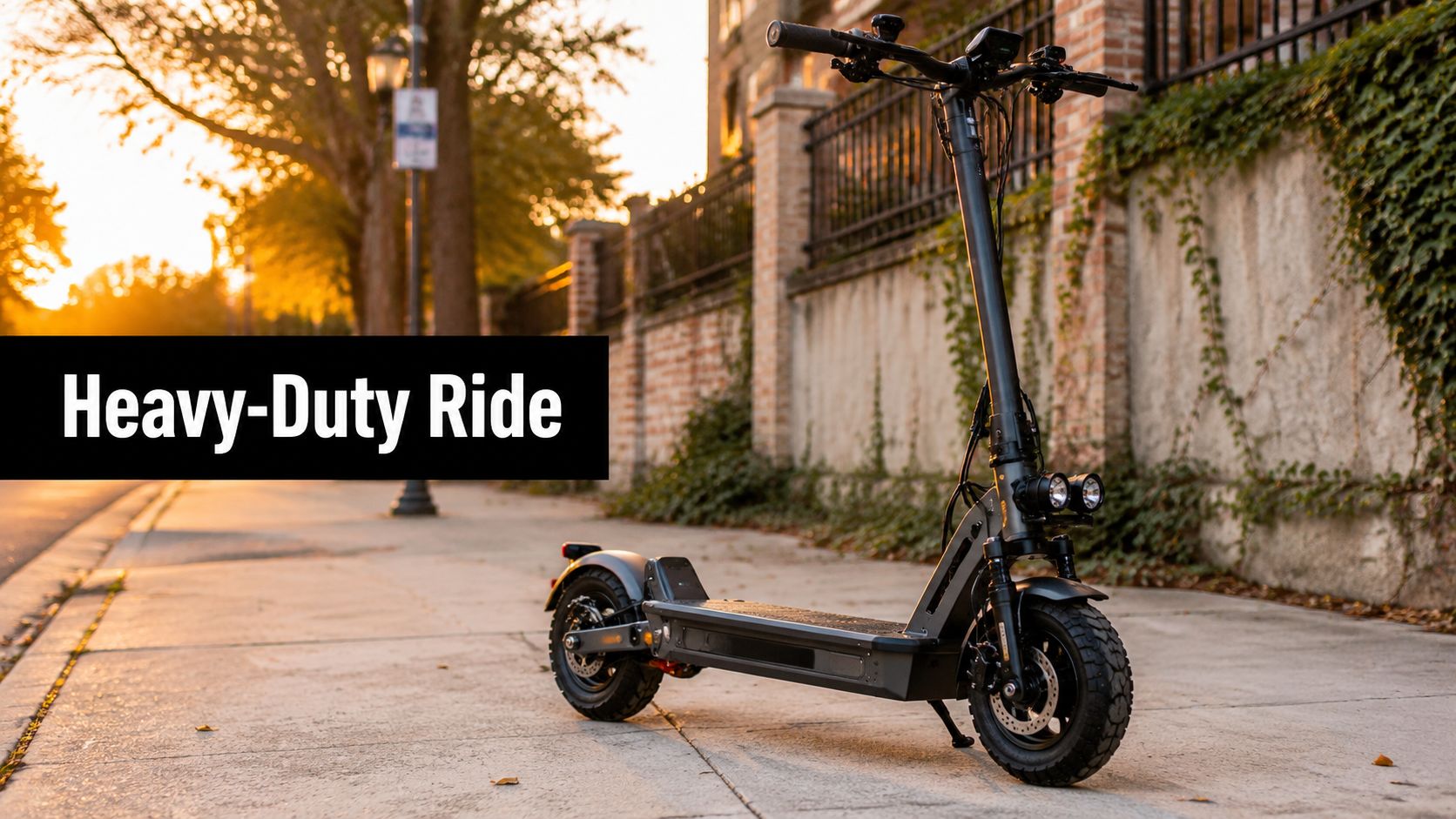
Your Search for a Heavy-Duty Electric Scooter
You find a scooter with a 300 lb rating, the photos look solid, and the price seems fair. Then you start reading the details and the market splits fast. One group is built for short, light-duty commuting. The other is built to carry more mass without feeling strained every time the road tilts up or traffic forces a hard stop.
That split matters because a posted load limit is only a starting point. For a rider around 300 lbs, the real question is how much performance the scooter loses once that weight is on board. A weak setup can still move you on flat ground, but it will drain the battery faster, brake longer, and feel less stable over rough pavement. In US and Australian urban riding, where patched asphalt, heat, and longer suburban stretches are common, those gaps show up quickly.
What the spec sheet usually hides
Listings usually lead with top speed and payload, then gloss over the parts that decide how the scooter behaves under a heavier rider. That is where bad buys hide.
Watch for these signs early:
- Feature-heavy listings with vague power details: If the page spends more time on the app and lighting than motor output or brake type, the priorities are off.
- Small or lightly described brakes: Extra rider mass means extra stopping energy. If the brake hardware looks minimal, stopping distances usually grow fast.
- Short deck or cramped bar position: A scooter can support the weight and still give you nowhere stable to stand.
- Basic suspension with little travel: On rough streets, impact load goes straight into the frame, stem, and your hands.
A true heavy-duty scooter is engineered differently, with the frame, motor system, brakes, and tire setup sized to work together under load. I judge these machines the same way I judge workshop repairs. The weakest part usually decides how the whole thing feels.
Why the category looks better now
The good news is simple. There are more legitimate options than there were a few years ago.
Manufacturers have started building scooters around adult riders who need real carrying capacity, not just a higher number on the box. You still have to sort through inflated claims, but there are more models with wider decks, stronger braking hardware, larger batteries, and chassis designs that make sense for heavier riders. That makes the search less about finding any scooter that can take 300 lbs, and more about finding one that still rides properly once it does.
Why a Standard Scooter Is Not Enough
A standard commuter scooter can fail long before it breaks. That's the part many riders don't see coming. The scooter still turns on, still rolls, and still technically supports the load. It just feels slow, nervous, and overworked.

Imagine putting a small engine in a loaded pickup. It might move, but every incline becomes a struggle, every stop takes more effort, and every component works hotter and harder than it should.
The motor doesn't just feel weaker
Power isn't about bragging rights. It's about reserve. Heavy-rider roundups and retailer specs consistently point to scooters in the 1000W–2400W range as the practical sweet spot, because once rider mass gets near the limit, underpowered scooters start losing hill-climbing ability and stability, as noted by Circooter's heavy-rider scooter overview.
That loss shows up in ways riders notice immediately:
- Starts feel lazy: The scooter hesitates off the line.
- Hills kill speed: Even mild inclines can turn a normal ride into a crawl.
- Heat builds faster: Strained systems run harder and age faster.
- Throttle gets less useful: You twist more and get less response.
Battery draw gets ugly under load
Manufacturers love headline range. Real riders live with actual battery drain. A heavier rider asks more from the motor on every launch and every climb, so the battery empties faster than the brochure suggests.
That's basic physics. More mass takes more energy to move, and repeated stop-start riding in city traffic makes that worse. In practice, a scooter that seems fine on paper can feel like it's always one hard ride away from low battery anxiety.
Workshop view: If a scooter already feels modest with a lighter rider, it usually feels strained with a heavier one.
Braking changes more than people expect
Stopping a heavier rider isn't just about having brakes. It's about having enough braking force, enough tire grip, and enough chassis composure to use that force without drama.
On a weaker commuter scooter, braking under load often feels like this:
| Problem | What you feel on the road |
|---|---|
| Soft front-end control | The scooter dives or feels unsettled |
| Limited brake bite | You pull harder than you should need to |
| Small tires skipping over bumps | Grip gets inconsistent on rough pavement |
| Flex in the chassis | The whole scooter feels vague during hard stops |
That's why “300 lb max load” on a standard scooter is often a technical limit, not a comfort limit and definitely not a confidence limit.
Core Specifications to Scrutinize for Heavier Riders
A 300 lb rider changes what each spec means on the road. The sticker on the deck might say the scooter can carry you, but the useful question is whether it can carry you without feeling strained every time you pull away from a light, hit a short hill, or brake hard on broken pavement.

Start with load rating headroom
For adults around 300 lbs, I would look for a scooter rated above your body weight, not one that merely matches it. NAVEE's heavy-rider guide makes the same basic point. Headroom matters because a scooter does not carry a static load in real use. It gets hit with weight transfer during braking, repeated shock loads from potholes and curb cuts, and extra chassis twist during acceleration and cornering.
A scooter at its stated limit can still roll. It just tends to feel busy and unsettled. The stem flexes more, the deck feels less planted, and the whole machine ages faster.
If you are sorting through similar-looking models, a side-by-side electric scooter comparison guide helps separate real hardware differences from spec-sheet noise.
Motor power and torque decide whether the scooter feels relaxed or overworked
For heavier riders, motor output is not about bragging rights. It is about reserve. A small motor at full effort all the time works like a small car engine towing a trailer uphill. It can do the job for a while, but it runs hot, drains fuel faster, and feels strained.
What usually works better:
- Higher continuous power: Better for repeated starts, short climbs, and keeping speed without the motor sounding or feeling tapped out.
- Dual motors for hilly routes: Useful in places with bridges, ramps, and steep urban grades common in parts of the US and Australia.
- Torque-focused tuning: Strong pull at low and mid speed matters more than a flashy top-speed number many riders rarely use.
What to treat cautiously:
- Spec sheets centered on top speed
- Low-power single-motor scooters with a high payload claim
- Models that only feel acceptable on flat, smooth paths
Battery capacity is your margin for reality
Heavier riders see the range penalty first. More rider mass means more energy used every time the scooter gets moving again. Add stop-start traffic, headwinds, rough pavement, or a few climbs, and battery draw climbs fast.
Shop for your worst ordinary ride, not your best possible one. A claimed range figure may be reachable in ideal conditions, but a 300 lb rider commuting through real city traffic needs battery reserve, not brochure optimism.
Practical rule: Treat advertised range as a best-case ceiling, not a daily promise.
The Punk Rider Pro, for example, is listed by Punk Ride LLC as a dual-motor scooter with a stated top speed of 32 mph and 43-mile range in eco mode, while the Punk Rider is listed with a 24 mph top speed and 40-mile range on a charge. Those are manufacturer claims. For a heavier rider, the useful takeaway is not the headline number. It is the size of the buffer you have after a normal ride.
The video below gives a useful visual sense of what to inspect when you're comparing higher-performance scooters.
Brakes, frame stiffness, and tires have to work as a system
A heavy rider can overpower a weak setup quickly. Strong brakes are only part of the answer. If the frame twists, the fork dives too much, or the tires are small and harsh, braking performance on rough pavement falls apart long before the brake caliper itself becomes the problem.
Look for these basics:
- Dual brakes: Front and rear braking gives more stopping control and better heat management than relying on one end to do too much.
- A stiff frame and stem: The scooter should track straight and feel planted under hard braking and mid-corner corrections.
- Larger pneumatic tires: Air-filled tires help maintain grip over patched asphalt, expansion joints, and rough suburban pavement.
- Real suspension: Suspension is not just for comfort. It helps the tires stay in contact with the ground so the brakes can do their job.
This is the part many buyers miss. A scooter can have enough motor and battery on paper, then still feel sketchy because the chassis and running gear were built to a commuter price point instead of a heavy-rider workload.
Balancing Power Performance and Comfort
More scooter isn't always better scooter. A machine with serious power can fix the problems heavier riders face, but it can also create new ones if the setup doesn't match your use.
That's why the best electric scooter for adults 300 lbs depends on where and how you ride. A flat urban commute in Florida is one thing. A hilly route in Seattle or a rough suburban run in Australia is another.

Power solves some problems and creates others
A stronger scooter usually launches better, climbs better, and feels less stressed. But once you move into more serious hardware, portability often gets worse. Heavier-duty scooters are bulkier, less pleasant to carry, and can feel like a chore if your day includes stairs, public transport links, or tight storage.
Here's the trade-off in plain language:
| If you choose for... | You usually gain | You usually give up |
|---|---|---|
| Stronger power | Better hill climbing and response | More scooter to move and store |
| Bigger battery | More usable range buffer | More weight |
| Softer, longer-travel suspension | Better control on broken pavement | Sometimes a larger overall chassis |
| Compact portability | Easier daily handling off the scooter | Less reserve under a heavy load |
Why suspension is a control feature
Heavy riders often hear suspension discussed like it's just about comfort. It isn't. Suspension keeps the tires connected to the ground when pavement gets rough. That improves both braking confidence and steering consistency.
Heavy-rider coverage also highlights that for this category, dual-motor or high-torque setups matter more than top speed, and larger tires with good suspension improve stability and stopping distance, as discussed in eRideHero's guide for heavy adults.
If you ride over patchwork asphalt, driveway lips, or expansion joints, a stiff scooter can bounce instead of track. The moment the tire skips, braking and steering both get worse.
More comfort can mean more safety, because a planted tire can actually do its job.
Fit gets ignored too often
A scooter can have the right payload and still fit badly. Taller or broader riders usually notice this fast. If the deck is short or narrow, your stance gets cramped. If the bars sit low, your upper body hunches forward and your wrists take more punishment.
Good fit usually means:
- Enough deck space for a wider stance
- Bars high enough that you're not folded over
- A cockpit that feels stable when braking
- A chassis that doesn't twitch under your body movement
If your route includes hills and rough pavement, it may make sense to look at high-powered electric scooters rather than trying to force a compact commuter into a job it wasn't built to do.
One mainstream benchmark, and why it matters
Independent 2026 testing from Car and Driver recorded the Segway Ninebot Max G2 at 34.4 miles of range and 21.4 mph top test-track speed, showing that a mainstream commuter can produce strong results, while heavy-duty guides and retailers point to 330 lbs upper limits on models such as the Wolf Warrior line and NAMI Burn E, according to Car and Driver's tested scooter roundup. The takeaway isn't that mainstream commuters are bad. It's that strong commuter numbers still don't automatically place a scooter in the heavy-rider class.
Essential Maintenance for Your Heavy-Duty Scooter
A scooter carrying a heavier rider needs closer attention. Not because it's fragile, but because every critical part sees more load. If you want safe braking, stable handling, and decent lifespan, maintenance can't be an afterthought.

Checks that deserve weekly attention
Some habits catch problems early before they become expensive or dangerous.
- Tire pressure: Low pressure hurts range, slows steering, and makes flats more likely.
- Brake feel: If the lever pull changes or the scooter starts taking longer to stop, inspect it right away.
- Fasteners: Stem bolts, deck hardware, and folding points work loose faster when the scooter carries more load.
- Visible frame condition: Look for paint cracking, odd gaps, or anything that suggests movement where there shouldn't be any.
A simple reference like Punk Ride's electric scooter maintenance guide can help you build a repeatable routine.
What heavier riders should watch more closely
Brakes and tires are the two big ones. They translate all the scooter's performance into actual road behavior, and both get punished under load.
Pay attention to patterns:
- If the scooter feels vague in corners, check tire condition and pressure.
- If braking gets noisy or inconsistent, inspect pads, rotors, or cable tension.
- If the front end starts knocking, stop riding until you check the stem and headset area.
- If suspension feels harsher than usual, look for dirt buildup, worn bushings, or hardware backing out.
A quick bolt check and tire check can prevent the kind of failure that strands you far from home.
Battery and drivetrain habits
Heavy riders pull more from the battery, so smooth charging habits matter. Keep the battery out of extreme heat when you can, and don't ignore sudden drops in performance. A scooter that starts sagging harder under acceleration is telling you something.
Also listen to the machine. Motors, brakes, and bearings usually announce trouble with sound before they fail with drama. Clicking, scraping, grinding, or a new wobble should never be filed under “probably fine.”
How to Make Your Final Decision
The final choice gets easier when you stop hunting for a magic model and start matching a scooter to your route, your body, and your tolerance for compromise.
A lot of listings answer the easy question. They tell you whether the scooter can support a certain payload. They don't answer the harder ones, like whether a taller rider feels cramped, whether the deck supports a comfortable stance, or whether the scooter still climbs and brakes well under load. As Fluid Free Ride's heavy-rider collection notes, weight capacity alone is an incomplete filter.
Ask these questions before you buy
Use this shortlist against any scooter you're considering:
-
How much of your route involves hills?
If hills are common, you need torque and reserve, not a scooter chosen for portability first. -
What's the pavement like?
Smooth cycle paths allow more compromise. Broken asphalt and driveway lips do not. -
Will you carry the scooter often?
A heavier-duty model solves riding problems but may create storage and lifting problems. -
Can you stand naturally on the deck?
If your feet feel crowded, the scooter will always feel less stable than it should. -
Are the brakes and tires worthy of the power?
A fast scooter with weak stopping confidence is the wrong scooter.
What a good decision looks like
A good choice usually feels boring on paper. It may not have the flashiest speed claim or the sleekest folded shape. But it has enough motor, enough battery, a real braking setup, and a chassis that doesn't feel busy under your weight.
That's what heavier riders should chase. Predictability. A scooter that starts cleanly, tracks straight, stops with confidence, and doesn't feel like it's one pothole away from protest.
Buy the scooter that feels underworked when you ride it. That reserve is what makes it safe and pleasant.
If you're trying to find the best electric scooter for adults 300 lbs, don't let the load sticker make the decision for you. Check the margin. Check the motor. Check the brakes. Check the fit. Then match the machine to your roads, not just to your body weight.
Punk Ride LLC offers electric scooters and bikes for riders who want practical urban mobility across the US, UK, and EU. If you're comparing commuter and heavy-duty options, browse the range at Punk Ride LLC and focus on the specs that affect real-world riding under load.
Share:
Boost Your Scoot: Safe Speed & Range Upgrades 2026 UK Guide
Electric Bike Motor Types a Practical US & AU Guide