


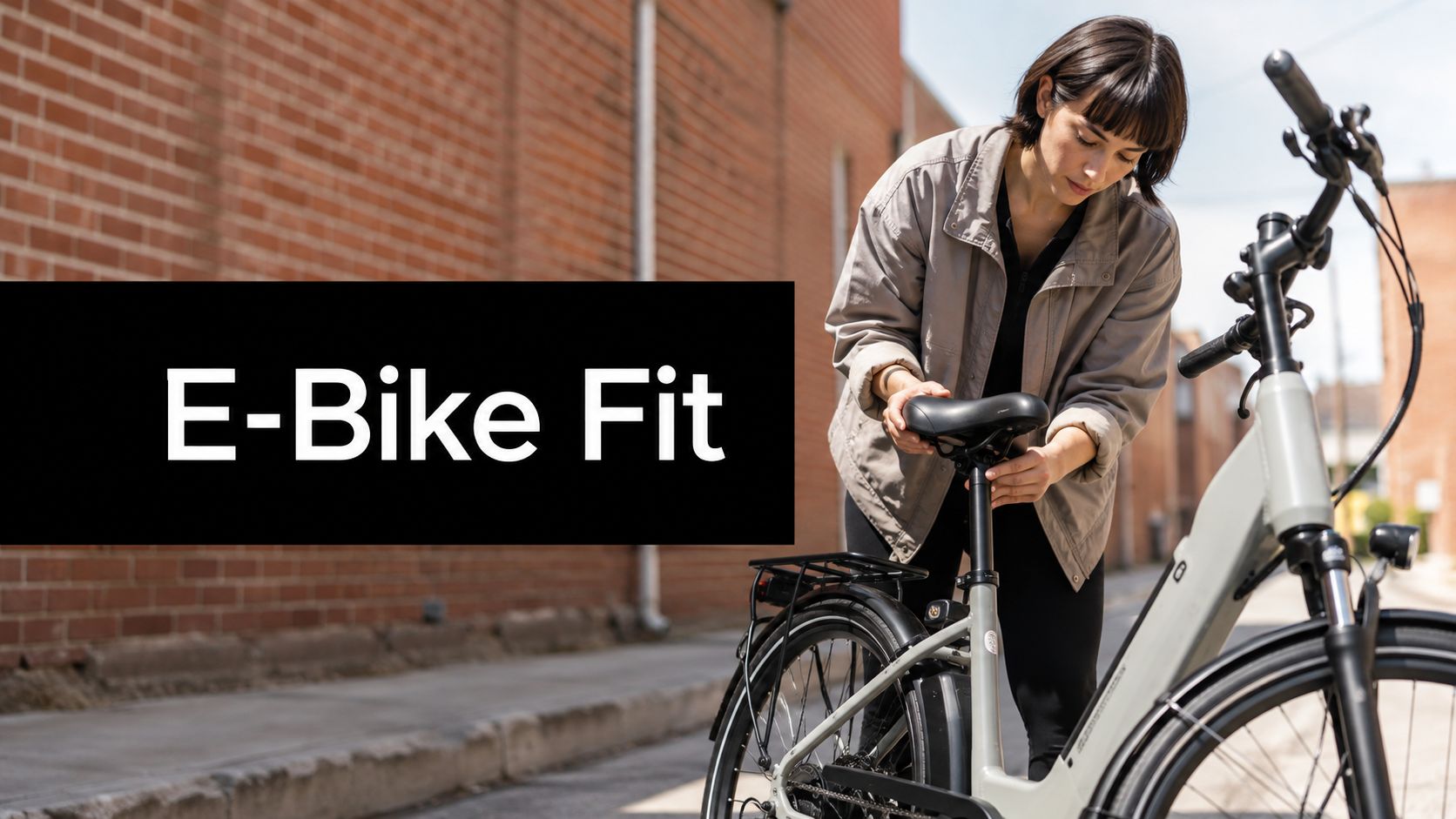
You're standing beside a sleek electric bike in a shop, one hand on the handlebars and one foot searching for solid ground. The frame looks friendly in the photos, but once you sit down, the saddle won't drop far enough, the bars feel distant, and stopping means balancing on your toes. That frustration is common, but it usually isn't caused by being “too short” for electric bikes. It comes from buying a bike by appearance or gender label instead of by inseam, standover height, wheel size, and cockpit reach.
The best electric bike for short female riders is the one that lets you mount calmly, stop securely, steer without stretching, and move the bike around without fighting its weight. This guide follows the same order a careful fitter uses in a shop, beginning with your inseam and ending with a practical test ride. The focus is mainly on UK and EU commuter bikes, with a clear note where US and Australian rules and motor classes can lead shoppers toward different choices.
Why Standard Bike Sizing Fails Shorter Female Riders
The problem often appears before the motor is switched on. A rider around five feet tall swings a leg toward a conventional frame, catches the top tube against the inner thigh, and hesitates. The bike may technically fit the manufacturer's broad height range, yet the rider still feels unstable because the saddle, frame, and bars were designed around a taller body.
That's why “women's bike” isn't the same thing as “short-rider bike.” A colour, step-through badge, or swept-back handlebar doesn't tell you whether the bike offers enough inseam clearance. The useful questions are more practical: Can you stand over the frame without pressure? Can the saddle drop low enough? Can you reach the controls with relaxed shoulders and slightly bent elbows?
A recent US industry profile placed women at roughly 24% of outdoor cyclists, showing a substantial rider group that has historically been underserved by standard sizing. The global e-bike market has also moved well beyond specialist status. One 2025 estimate valued the category at USD 22.85 billion, with a projection to USD 39.50 billion by 2033 at 7.3% CAGR, and linked that expansion with more step-through and compact geometry options from brands (market overview and e-bike sales context).
The three measurements that matter
Inseam tells you how much leg length you have available. Standover height tells you whether the frame leaves safe clearance when you straddle it. Cockpit reach determines whether your shoulders, wrists, and neck stay comfortable while you steer and brake.
Height can help you choose where to start, but it can't settle the fit by itself. Two riders with the same height may have different inseams, torso lengths, flexibility, and riding preferences. A shorter rider who stops frequently in city traffic needs different priorities from someone who rides on quiet paths and rarely dismounts.
Practical rule: Fit the bike to your contact points and control needs, not to the label printed on the frame.
The wider market is finally giving short riders more options, including low top tubes, small-wheel city bikes, and adjustable cockpits. That choice helps, but it also makes the measurements more important. A larger catalogue doesn't automatically produce a better fit.
Measuring Your Inseam the Right Way
Start with a measurement you can trust. Put on thin clothing, remove your shoes, and stand on a hard, level floor with your back against a wall. Keep your feet comfortably apart, roughly as they'd sit on the pedals, rather than pressing your ankles together.
Place a hardcover book between your legs and raise it until it makes firm contact with the area where a cycling saddle supports you. Keep the book level, mark the wall at its top edge, and measure from the floor to that mark. Repeat the process so you're not building an expensive purchase around one rushed reading.
Trouser inseams aren't reliable for this job. Clothing brands allow different amounts of fabric, and the point where trousers finish doesn't match the point where a saddle supports your body. Write down the barefoot measurement, then use it consistently when comparing geometry charts.
Turning inseam into useful targets
The first target is standover. Fit guides define it as the distance from the ground to the top tube and recommend 1–2 inches of clearance below your inseam, with short-rider guidance often narrowing the target to roughly 1 inch below inseam or around 24–26 inches for riders near five feet tall (short-women e-bike fit guidance).
For example, a rider who is five feet tall with a 27-inch inseam should look for a standover around 25–26 inches under the wider clearance rule, while a low-step or step-through frame may make mounting easier even when the top-tube measurement is less conventional. Don't assume the manufacturer's claimed height range proves this. Ask for the actual standover and the saddle's lowest usable position.
The second target is minimum saddle height. A practical starting estimate is roughly 0.65 to 0.7 times inseam, then you fine-tune it on the bike. For a 27-inch inseam, that gives a starting saddle-height range of about 17.55–18.9 inches, measured according to the manufacturer's stated reference points. Treat this as a setup guide, not a substitute for checking knee bend and foot control.

Keep your inseam and target standover in your phone notes or on paper. If a bike can't come close to those requirements with your shoes on, don't spend time trying to rescue it with a different saddle or handlebar.
Step-Through, Low-Step, and Trapezoid Frames Compared
Frame style changes the first and last moments of every ride. A step-through frame removes or sharply lowers the top tube, so you can step forward through the bike rather than lifting your leg over a high bar. That's valuable for short riders, anyone with limited hip mobility, and commuters who get on and off repeatedly.
A low-step or wave frame keeps more structure through the centre of the bike while lowering the crossing point. It's a useful compromise when you want easier access but prefer a little more frame rigidity. The exact feel depends on the design, battery placement, and frame construction, so don't judge stiffness from the name alone.
A trapezoid or mixte frame usually retains more of the traditional structure. It can feel secure and visually familiar, but it asks for a higher leg lift. For a rider under 5'4", that extra movement may be manageable for recreational use but irritating at every traffic light.
Match the frame to your stops
Consider two riders. One commutes through a busy town, stopping frequently at junctions, kerbs, and shop entrances. The other rides a riverside path, starts once, and returns home after a long uninterrupted loop. The first rider should usually prioritise a true step-through and easy foot placement. The second might accept a low-step or mixte if the riding position and clearance work.
Short-rider sizing guidance consistently favours step-through or low-step frames with smaller wheels. For riders around 4'11" to 5'2", one guide recommends 20-inch wheels and a maximum standover around 23–25 inches (short-rider frame and wheel guidance).
| Frame style | Mounting and stopping | Typical fit decision |
|---|---|---|
| Step-through | Easiest leg movement and simplest dismount | Strong default for frequent stops or limited flexibility |
| Low-step | Easier than a traditional frame, with more central structure | Useful middle ground for confident short riders |
| Trapezoid or mixte | More leg lift and greater clearance demands | Consider only after checking standover carefully |
Don't confuse a wide opening with a low overall bike. Some step-through models still use a tall seat tube, high saddle, or long reach. The opening solves mounting, but the complete geometry determines whether you can control the bike once seated.
Why Wheel Size Matters More Than Motor Power
Motor power attracts attention because it's easy to compare on a product page. Wheel size is less dramatic, but it often changes how a short rider feels during the first ten metres, the first stop, and the first tight turn.
A 16-inch wheel can create a very compact bike, which may suit an exceptionally short rider or a folding commuter. The trade-off is that small wheels can feel sharper over potholes and uneven surfaces. A 20-inch wheel keeps the bike compact while offering a more settled ride, especially when paired with sensible tyres.
A 24-inch wheel often balances adult-bike stability with a lower overall profile. A 26-inch wheel can roll smoothly and feel familiar, but it may raise the saddle, increase the frame's overall height, and make flat-foot stops harder. Wheel diameter alone never decides fit, because tyre volume, frame design, and axle position also affect the final height.
The low-speed advantage
Smaller wheels lower the bike's overall height and centre of gravity. For riders around 5'0"–5'4", 20-inch wheels can make it easier to plant both feet and reduce the tipping moment during slow manoeuvres (20-inch wheel fit explanation).
That matters in urban riding because confidence is often lost while mounting, waiting at a junction, easing around pedestrians, or recovering from a sudden stop. A powerful motor won't correct a bike that feels tall and awkward. In fact, brisk assistance can make a poor fit feel more intimidating.
A 20-inch commuter may also use a shorter wheelbase, which can make turning in confined spaces easier. The compromise is that very small wheels can react quickly to steering input, so a beginner should start with gentle assistance and test the brakes before riding in traffic.
The useful question isn't “How powerful is the motor?” It's “Can I control this bike comfortably when the motor isn't helping?”
Motor placement still matters once wheel size is settled. Riders comparing compact city builds with mid-drive systems can use this mid-drive electric bike guide to understand how the motor's position changes the riding experience. For a short commuter, the right wheel size and calm handling usually deserve attention before headline power.
Reading a Geometry Chart Without Getting Lost
Geometry charts look technical because they describe a bike in several directions at once. You don't need to memorise every term. Start with the numbers that affect your body directly, then use the remaining measurements to understand handling.
Stack is the vertical distance from the bottom bracket area to the top of the head tube. More stack generally places the bars higher, which can support an upright posture. Reach describes the horizontal distance from the bottom bracket area to the top of the head tube. More reach usually means a longer cockpit and a greater stretch to the grips.
Effective top tube estimates the horizontal length between the seat tube and head tube, even when the actual top tube slopes. For a short rider, an excessive effective top tube can create the familiar symptoms of straight elbows, raised shoulders, wrist pressure, and neck ache.
Seat tube length helps describe the frame's vertical structure, but it isn't a substitute for minimum saddle height. A bike can have a short-looking seat tube and still place the saddle too high once the seatpost, crank, and tyre dimensions are included.
Compare charts in a useful order
Read the chart like this:
- Check minimum saddle height first. The manufacturer's rider-height range is only a starting point. You need to know how low the saddle goes.
- Check standover next. A low saddle can't rescue a frame that presses into your body when you're standing over it.
- Compare reach. Choose the frame that lets your elbows remain softly bent and your shoulders relaxed.
- Look at stack. Raise the front end enough for comfort without creating a top-heavy, vague steering position.
- Study wheelbase last. A short wheelbase can help manoeuvrability, but excessive shortening may make steering feel twitchy.
An adjustable stem or riser handlebar can lift the bars and correct a modest reach problem. It can't lower the standover, shorten the wheelbase, or change where the pedals sit relative to the rear axle. Fit guidance also warns that a long reach encourages locked elbows and loads the neck and wrists, while adjustable cockpit parts can help scale a frame to a shorter rider (geometry and cockpit fit guidance).
If the frame is too long, don't treat accessories as a magic fix. A fitter may improve a near-fit bike, but a clearly oversized frame should be rejected before purchase.
Motor Placement and Total Weight for Lighter Riders
A shorter rider often notices handling before motor performance. A rear hub motor concentrates mass at the back wheel, while a mid-drive motor places the main drive unit near the crank. A centred battery can keep either design feeling more balanced, depending on the frame.
Rear hub motors can be straightforward and quiet for flat commuting, but extra rear-wheel mass may feel awkward during tight, slow turns or when lifting the front end over a small obstacle. Mid-drive motors keep weight closer to the bike's centre and can feel natural on climbs because the motor works through the bicycle's gearing.
Total weight deserves the same attention. A bike weighing 25 kg behaves differently under a rider weighing 55 kg than under a rider weighing 80 kg. That isn't a formal safety rating. It's a handling reality: the lighter rider has less body mass to counter a heavy frame when pushing, parking, braking, or correcting a lean.

A sensible default for city use
For a lighter rider, a mid-drive or rear hub bike with a centred battery and total weight under about 23 kg can be a sensible starting point. The reason is control, not bragging rights. A lighter bike is easier to turn around without assistance, guide through a doorway, and steady during a stop.
A removable battery can also make storage less awkward, particularly when the bike itself must be moved upstairs or into a narrow space. Before buying, switch the motor off and push the bike through the movements you'll perform at home. If it already feels difficult on level ground, daily ownership may become a chore.
UK riders should also confirm the legal category. Under UK electric bike rules, an electrically assisted pedal cycle applies when the rider is 14 or over and the bike meets the EAPC definition, including the familiar 250-watt and 25 kmh limits aligned with EU rules. US and Australian buyers may encounter higher-power or off-road classes, but those options can add weight and may carry different road-use requirements.
For a deeper explanation of how rider mass, bike mass, and rated capacity interact, see this guide to electric bike weight limits.
Your Test-Ride and Adjustment Checklist
Take the manufacturer's chart to the shop, but trust your body during the test. Ask the staff to place the saddle at its lowest position before you sit down. A claimed rider-height range can hide a saddle that remains too high for your inseam.
- Check the frame with your shoes on. Stand over the bike and confirm you have clear space between your body and the top tube. A step-through should still feel easy to straddle and steady.
- Test the lowest saddle position. Sit with both feet available for a controlled stop. You don't need to pedal permanently with your heels down, but you should be able to stabilise the bike without a panic stretch.
- Set the pedal position. At the bottom of the stroke, keep a slight bend in the knee. If your hips rock from side to side while pedalling firmly, the saddle is too high.
- Check the cockpit. Your elbows should stay slightly bent, your shoulders should remain down, and your wrists should feel neutral. Brake levers should be reachable without dropping your shoulders toward the grips.
- Ride without assistance first. Push off gently and make slow turns. This reveals whether the weight and steering feel manageable without the motor masking poor balance.
- Try a stop-start loop. Use a quiet area and practise mounting, braking, placing a foot down, restarting, and dismounting. Repeat it until the movement feels routine.
- Notice delayed discomfort. Wrist or neck ache after ten minutes often points to excessive reach. Don't dismiss it because the first few minutes felt fine.
Short rider fit targets
| Measurement | Target for Riders Near 5'0" | Target for Riders Near 5'4" | Why It Matters |
|---|---|---|---|
| Standover | Around 24–26 inches | Confirm clearance against inseam | Protects mounting and stopping confidence |
| Wheel class | Often 20 inches | 20 or 24 inches may suit the geometry | Affects overall height and low-speed control |
| Minimum saddle | Near 0.65–0.7 times inseam as a starting point | Calculate from the rider's own inseam | Prevents overextension and hip rocking |
| Reach | Short or adjustable | Compact or adjustable | Keeps elbows, neck, and wrists relaxed |
These targets are starting points, not guarantees. A rider near five feet with a longer torso may prefer a different cockpit from a rider of the same height with shorter arms.
Near-perfect bikes can often be refined with ergonomic grips, a suspension seatpost, or a wider saddle. Accessories can improve comfort after the core fit works, but they can't repair an unsafe standover or a saddle that refuses to drop low enough. Punk Ride's electric bike accessories guide is a useful place to compare comfort and utility additions.
Putting It Together and Choosing With Confidence
The decision flow is simple once the measurements are in the right order. Measure your inseam, write down a standover target, reject frames that can't provide clearance, then choose between step-through and low-step access. Select a wheel size that supports flat-foot control, check minimum saddle height, compare reach and stack, and test the bike with assistance switched off before judging the motor.
For UK and EU commuters, most mainstream city e-bikes are built around the 250-watt and 25 kmh EAPC framework, so step-through geometry, manageable weight, and predictable stopping usually matter more than extra power. US and Australian shoppers may have access to higher-power or off-road classes, but those bikes can be heavier and may not share the same public-road permissions. Check local rules before treating an off-road model as a commuter.
This week, measure your inseam barefoot, write the standover range beside it, and reject any bike that can't clear that target with your shoes on. That one habit will narrow the search faster than browsing motor labels.
Punk Ride LLC offers a curated selection of electric bikes, including compact and foldable options that may suit riders comparing lower-standover or easier-to-store designs. Visit Punk Ride LLC to compare available models and use the buying resources to check motor, battery, weight, and fit details before you commit.
Share:
Wide Bicycle Tires for E-Bikes and Urban Commuting
Mid Drive Electric Bike Explained for Real-World Riders