


The usual shortlist for best ebikes under $3000 opens with peak watts, a claimed top speed, and a brochure range. That order is how people end up with a bike they can't legally ride to work, or a pack they can't trace if something goes wrong. A motor number doesn't prove the battery and charger were tested together. A top speed doesn't tell you whether assistance has to cut out on your street.
I would hold the speed claim until two checks are done. Can the seller produce a certificate or test-report number for the electrical system, and does the assist cutoff match the country where you'll ride? Only after those answers are in writing is it worth comparing hill response, real range, and price. UK and EU rules set the bar for most daily riders here. US and Australian rules matter the week you're importing, travelling, or buying from a listing written for another market.
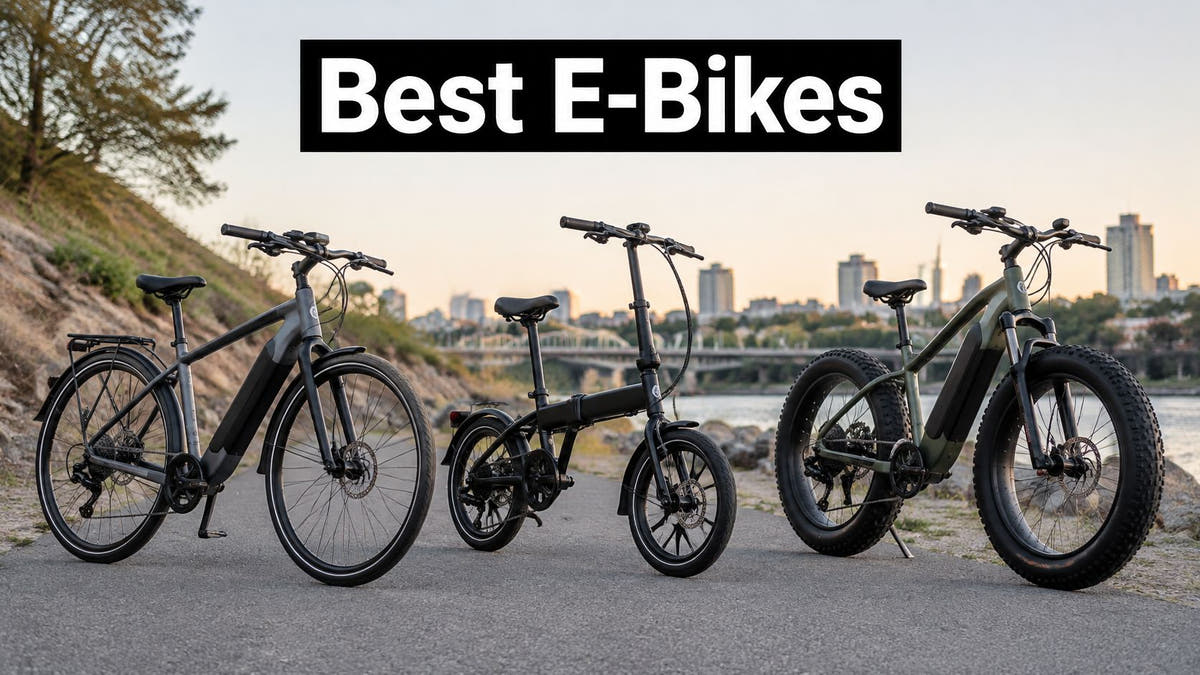
Quick Picks Matched to Your Route
A flat 5 km school run and a 20 km ride with one nasty bridge are not the same purchase. Match the build to the week you ride. Settle legal class and battery paperwork before you compare watts, top speed, or brochure range.
| Riding need | Example model | Sale price (GBP) | Check before buying |
|---|---|---|---|
| Budget urban commuter | DUOTTS C29 Lite 250W | £649.00 | Assist class for your roads, then the hill you actually climb |
| Folding for trains and small flats | ENGWE Engine Pro 2.0 | from £1,299.00 | Folded size and lift weight, after the cutoff matches your market |
| Fat-tyre for rough roads | HIDOES B9 | £569.00 | Pack and charger listed as a pair, then payload and brakes |
| Step-through for easy mounting | NAKTO Pony 20-Inch Step-Through | £405.68 | Step-over height and a rack that clears the battery |
Price is a starting point. The DUOTTS C29 Lite 250W at £649.00 is the budget urban row. Flat pavement all week, and that spend can be enough. A steep bridge or a long drag changes the test: ride that climb in the assist level you will use on a normal day, once you know the cutoff is legal where you live. A cheap flat-road bike that fades on the one hill you hate is a poor buy.
European Union e-bike sales increased tenfold between 2009 and 2021, reaching 5.1 million units in 2021, according to a 2025 peer-reviewed review from the University of Groningen. The same review found average trip distances from 2.7 to 24.0 kilometers, and in seven European cities an average commute of about 8 kilometers for e-bike users, against 5.3 kilometers for conventional cyclists. That spread is why the build matters more than a headline speed. A short paved hop and a 20 km mixed ride are different bikes.
Match the build to the week you actually ride
Say your longest regular trip is a 12 km commute with a train leg. A folder such as the ENGWE T14 usually beats a full-size frame, but only if the folded size fits the carriage and you can lift the weight onto the platform. The ENGWE Engine Pro 2.0, from £1,299.00 in Black, Green or Blue, is the folding row. Measure the folded package against your hallway and the train rack, not against a product photo.
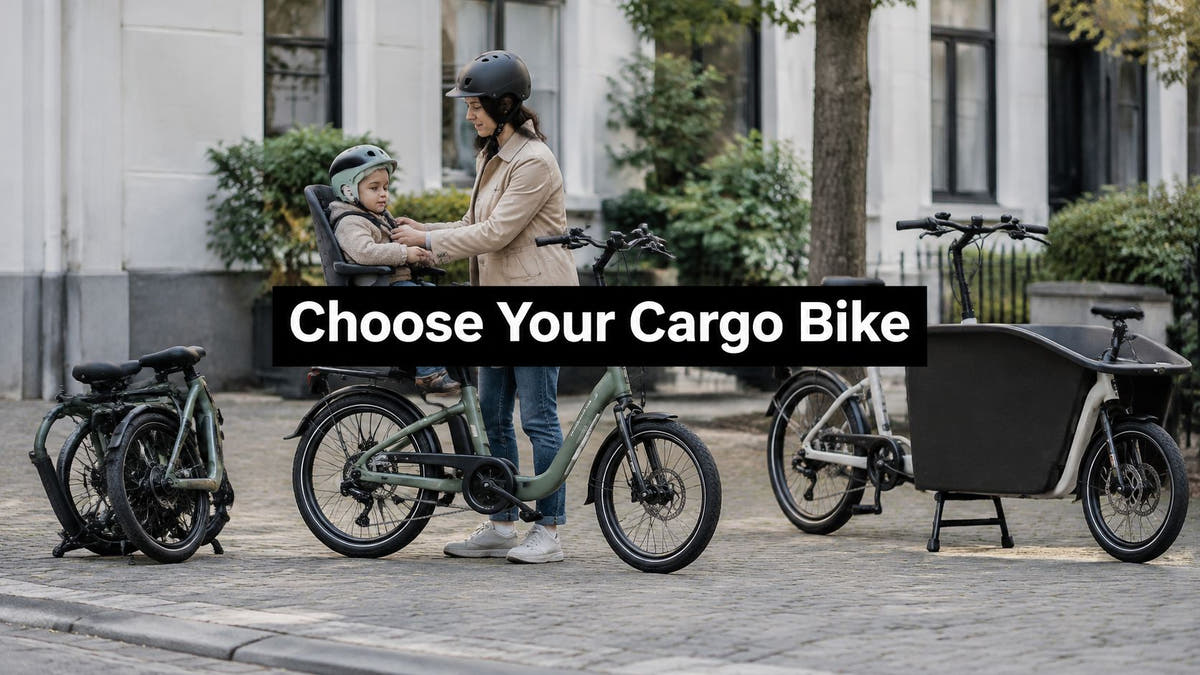
A school run plus a shop stop suits a step-through. The NAKTO Pony 20-Inch Step-Through is £405.68. ENGWE also lists step-through options such as the L20. The deciding check is frame height at the step-over, plus whether a rack will take a child seat or panniers without blocking the battery. I would not line it up against a faster commuter until that fit is obvious.
A hilly or gravel week suits a fat-tyre build such as the ENGWE E26 at £1,299.00, in High-Step or Step-Thru and in Yellow, Black or Green. The HIDOES B9 at £569.00 is the lower-priced fat-tyre row. On either, check published payload with you plus cargo, and whether the brakes still feel solid after a loaded descent. Wide tyres add grip. They also add mass. Look for a battery and charger sold as a matched pair before you treat either bike as the tougher option.
A flat, paved daily commute is usually a standard commuter, such as the DUOTTS S26 at £1,099.00. Skip fat tyres and a fold if the bike lives in a shed and the surface stays smooth.
Practical rule: Match the build to the surface and the longest trip you make each week. Legal class and a traceable battery come before top speed.
$3,000 is roughly £2,300. Confirm the live conversion on the day you order, then leave room for a helmet, a lock, and lights. A bike that spends the whole budget leaves you riding home in the dark with nothing to lock it to.
Legal Limits for Ebikes in the UK, EU, US and Australia
| Market | Motor limit | Assist cutoff | Throttle or walk-assist rule |
|---|---|---|---|
| UK (EAPC) | 250 W continuous | 15.5 mph (25 km/h) | Walk assist cuts out at 3.7 mph (6 km/h); twist-and-go is generally not road-legal |
| EU (EN 15194 pedelec) | 250 W continuous | 25 km/h | Pedal assist is typical; check national rules for registration and paths |
| Australia | 250 W continuous | 25 km/h | Motor cuts out when you stop pedalling above 6 km/h; other models may need import approval |
| US federal low-speed | Below 750 W | Below 20 mph motor-only | Federal baseline; state and local rules decide where you can ride |
Great Britain and the EU
In Great Britain, the GOV.UK electric bike rules say an e-bike is an electrically assisted pedal cycle (EAPC) only with usable pedals, a motor of 250 watts maximum continuous rated power, and assistance that cuts out at 15.5 mph (25 km/h). A compliant EAPC needs no registration, vehicle tax, insurance, or driving licence, and riders must be at least 14. Step outside those limits and the bike can be treated as a motor vehicle, with registration, insurance, tax, licensing, and helmet duties.
Transport for London's e-bike safety advice adds the throttle detail buyers miss. Walk assist must cut out at 3.7 mph (6 km/h). A twist-and-go bike that can move without pedalling is generally not road-legal as an ordinary EAPC unless it was sold before 1 January 2016 or it has the required type approval. If a sub-£3,000 listing boasts a throttle that pulls you along at riding speed, treat that as a legal problem, not a feature.
Across the EU, the usual pedelec shape is the same 250 W continuous motor and 25 km/h assist cutoff associated with EN 15194. Registration, insurance, and which paths you may use still change by country. A bike that is fine on a UK cycle lane can be the wrong class on a German or Dutch path. Read the destination country's rules before you ride across a border, or before you buy from a seller shipping out of another member state.
Our warehouses in the UK and Germany are there so a commuter bike doesn't have to cross an ocean to reach you. That doesn't replace a local class check. The same motor rating can be everyday transport in one city and a registration problem in the next. For a plain-language pass over street use, see our note on whether electric bikes are street legal.
United States and Australia
These two markets are the exception for importers and travellers, not a looser version of the UK rule.
The Australian Government importers' guide treats an e-bike as a bicycle when the motor is no more than 250 watts continuous and assistance stops at 25 km/h. An EN 15194-compliant power-assisted pedal cycle may be treated as a bicycle, but the motor must cut out at 25 km/h or when you stop pedalling above 6 km/h. Outside those limits, the bike may be a road vehicle and can need import approval before it enters Australia. A US-spec or unrestricted listing is not "the same bike" once it lands.
The CPSC summary of bicycle standards sets a wider federal baseline. A low-speed electric bicycle has operable pedals, a motor rated below 750 watts (1 horsepower), and a maximum motor-only speed below 20 mph on a paved level surface with a 170-pound operator. That definition does not decide bike-path access. State and local rules do. A faster, heavier model can look like more bike for the money and then lose ordinary cycling infrastructure, or pick up insurance and transport problems you didn't budget for.
Battery and Charger Checks Before You Pay
Ask for the certificate before you compare watt-hours. You want a UL 2849 or ANSI/CAN/UL 2849 certification or test-report number for the bike you're buying, not a logo on a product photo.
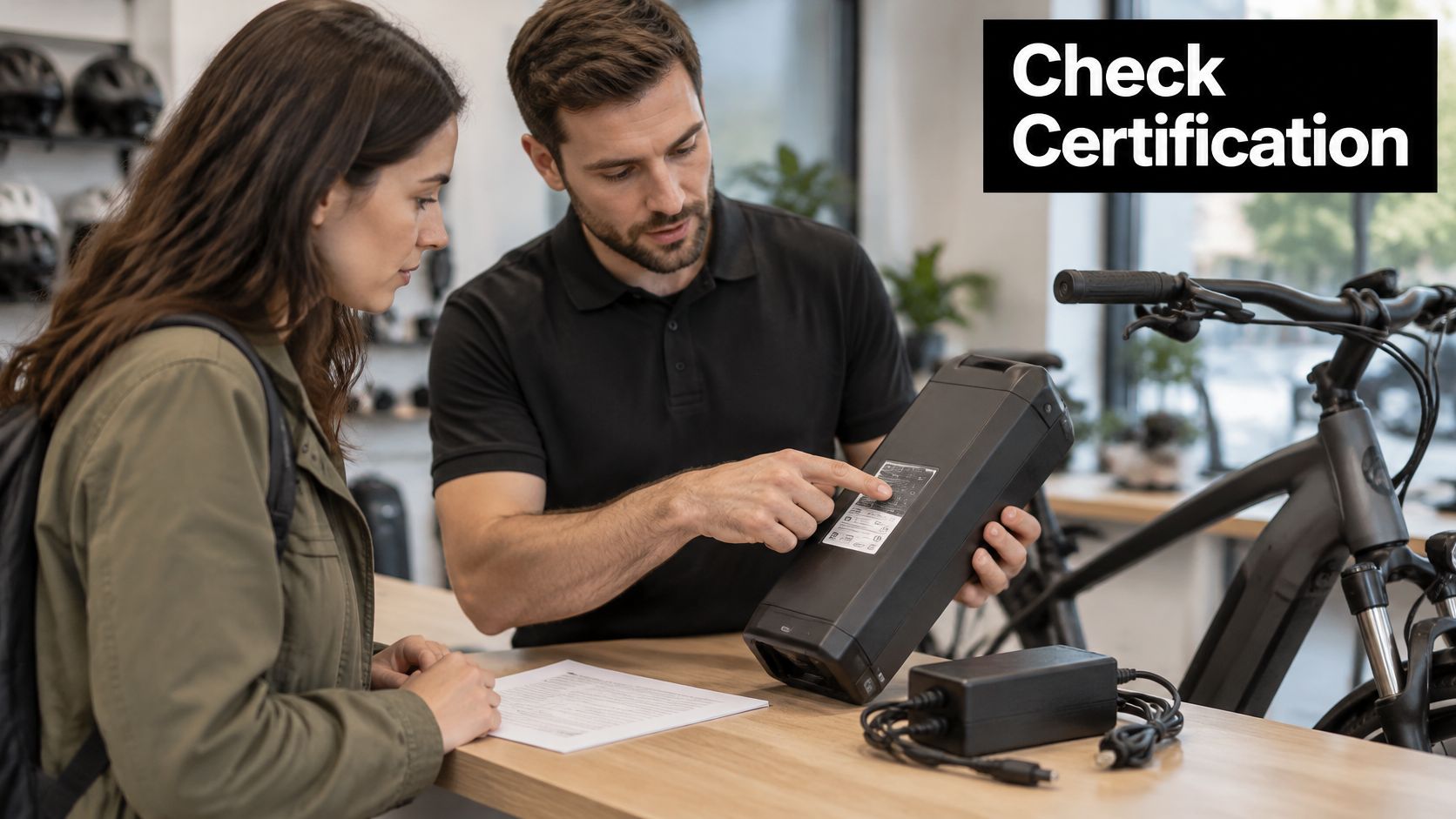
Underwriters Laboratories published UL 2849-20 in January 2020 as a U.S.-Canada standard for the e-bike electrical system. It evaluates the battery pack, battery-management system, motor, controller, charger, wiring, and power inlet as one system. Testing covers impact, flexing, temperature, humidity, overcharging, overload, short circuit, imbalanced charging, shock, and thermal cycling. A pack certified on its own does not cover the whole bike. In a December 2022 letter, the U.S. Consumer Product Safety Commission urged more than 2,000 manufacturers and importers to comply with applicable voluntary standards, including ANSI/CAN/UL 2849. The CPSC stated that compliance with applicable UL standards significantly reduces the risk of injuries and deaths from micromobility fires. Motor wattage, claimed range, and suspension do not establish that.
How long a pack lasts in daily use is a separate question from whether it was tested. Our guide to electric bike battery life is the place for charge habits and aging. The six checks below are about whether you should pay at all.
- Ask for the certification or test-report number. A sentence that says "UL certified" with no number cannot be checked.
- Confirm the report covers the complete system, or at least the battery and charger. A partial report leaves the controller, wiring, or inlet untested.
- Match the charger to the battery the maker specifies. A mismatched charger is a fire risk, even when the plug fits.
- Name the importer or manufacturer. Warranty and recall claims need a company you can trace, not a marketplace username.
- Search recall listings for the model and the battery. Budget imports show up there often enough that skipping the search is careless.
- Plan a replacement of the same approved type, and never charge unattended. A bargain with no spare pack becomes a parked frame.
If the seller can't produce any of these, walk away. A missing certificate is a missing safety record, and no discount fixes that.
The Specs and Mistakes That Decide Value
Advertised range is a marketing setting. Treat it as a ceiling you will not hit with cargo, cold air, and full assist.
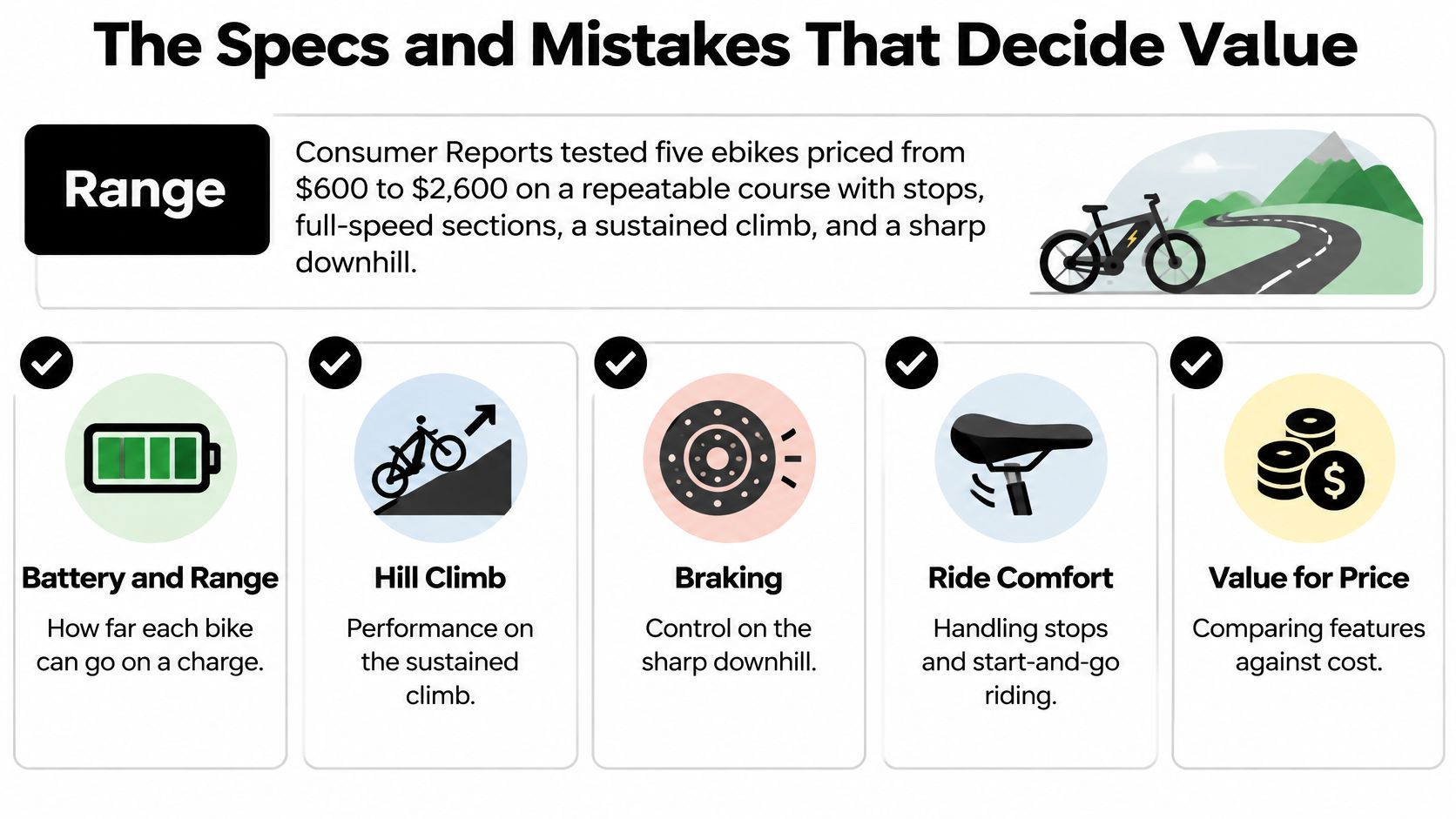
Range you can actually ride
Consumer Reports tested five e-bikes priced from $600 to $2,600 on a repeatable course with stops, starts, full-speed sections, U-turns, a sustained uphill, and a sharp downhill. Under maximum motor assistance, those bikes covered approximately 15 to 30 miles before the battery was done on that hilly course. Compare any tested figure at your load and your terrain, then keep a margin for cold weather, detours, and an aging pack. If your longest week is 18 miles with a hill and a shop bag, a claim of 60 miles in eco mode on flat ground doesn't answer the question.
The same testing found that e-bike riders average roughly 3 mph faster than traditional-bike riders. That gap is why acceleration and braking matter in traffic. A bike that surges, then grabs, is harder to place in a gap than one with a predictable ramp.
Pedal the bike with the battery empty before you commit, or at least ask what it feels like with the motor off. A heavy, wide-tyre, high-capacity model can be miserable to push home. If you can't turn the pedals usefully at zero assist, your "range" ends wherever the pack dies.
Motor architecture and brakes
Peak watts hide the layout of the motor. Consumer Reports' buying guide notes that entry-level models it tested commonly used rear hub motors. They were adequate on flat ground and weak on steep hills, because power went straight to the rear wheel instead of through the gears. If climbs are a normal part of the route, I would pick a torque-sensing system or a suitably geared mid-drive. A hub can still be the right, simpler choice on a flat city loop.
Bike mass also shows up in the brakes. Testers saw brake heating on some less expensive models during demanding descents. Look for hydraulic discs, or dependable mechanical discs, with real front and rear control. Then read the payload limit with rider and cargo included, not rider alone. Panniers, a child seat, or a week of shopping can put you over a number that looked fine for one person.
For a closer look at why a mid-drive changes hill behaviour, see our note on the e-bike mid motor. The short version is gearing. The motor can stay in a useful part of its range instead of shoving a single wheel ratio up a grade.
Mistakes that waste the budget
Buying on peak watts or top speed. The listing looks strong and the hill feels flat. Fix: test the actual climb in the assist you'll use, and ignore the peak number until the bike holds speed there.
Skipping the charger match. The plug fits, so it must be fine. It isn't. Fix: use only the charger specified for that battery, and don't charge it while you're out of the room.
Ignoring payload once the panniers go on. The bike was fine on a solo test ride. Fix: add your riding weight to the cargo you carry, and stay inside the published limit.
Picking a faster or heavier class without checking local rules. You gain speed and lose the path. Fix: match assist cutoff and throttle behaviour to the market where the bike will be ridden before you pay for power you can't use.
A good result on range, hills, and brakes beats a bigger motor number every time you have to stop, climb, or get home with a dead pack.
Warranty, Service and Replacement Parts
Ask these questions in writing before you pay, and keep the replies with the bike. A seller who goes quiet on parts will not get clearer after the money has moved.
Who supplies the replacement battery and the controller? If neither can be bought later, a failed part turns the whole bike into a write-off. Get the part number and the approved battery type, not a promise to "sort it if it happens."
What does the warranty cover, and for how long? Frame, motor, battery, and charger are often split. Many listings shout a long frame term and stay vague on the pack. You want four lengths, in writing, not one banner number.
Where does the bike ship from? A listing that looks local and then ships from abroad can pick up delay and customs cost that change the price. We fulfil from the UK and Germany as well as the US, which is the practical question for a commuter who doesn't want the bike stuck in transit. Confirm the ship-from location on your specific order anyway.
Who acts on a recall for this model? You need a name that will contact you, or honour a notice, for the serial number you own. "Check the website" is not a process.
Can you get brakes, tyres, and a controller without a long wait? A minor fault becomes a month off the road when the part is obscure. Ask for lead times on those three, not a general "parts are available."
Who pays for a return? Read whether the return postage is yours or the seller's, and how many days you have. A heavy e-bike is expensive to send back if that line is buried.
Who is responsible for local compliance on an import? UK assist limits, EU pedelec rules, Australian import approval, or US state rules sit with the importer when the bike doesn't match. If nobody will say they carry that risk, you're the one who finds out at the roadside.
Keep the receipt, the warranty card, and the charger details in one place with the bike. A support desk can't match a claim to a serial number you no longer have.
Confirm These Checks Before You Order
Run this on the day you order, in this order. Skipping ahead to the discount is how the wrong bike gets bought.
- Pick the row that matches your main riding need. Urban pavement, a train fold, rough roads, or an easy step-through. One job, one build.
- Confirm tested range at your load and terrain. Keep a margin for weather and an older pack. Brochure miles don't count.
- Pedal it with the battery empty. If you can't ride it home under your own power, the range figure is a cliff edge.
- Verify the certification number covers the battery and charger. The charger in the box has to be the one specified for that pack.
- Confirm assist cutoff and the throttle or walk-assist rule for the UK, EU, Australia, or the US state where you'll ride. A faster cutoff you can't legally use is not extra value.
- Check payload with your weight plus cargo. Rider-only limits fail the first time the panniers are full.
- Get warranty, replacement battery, and parts supply in writing. Verbal reassurance doesn't survive a staff change.
A model that passes all seven is a safer buy than one that wins on price or headline speed alone. If any answer is missing, contact the seller and wait for it before you pay. Store the certificate, the charger details, and the warranty terms with the bike.
Two small habits sit next to that paperwork. We offer free delivery on all orders, so the delivery line shouldn't be what pushes you over budget. And once the bike lives at a station or in a shared hallway, a finder is worth fitting before the first week, not after a scare. 3rd-i's remote finder app guide walks through using a small Bluetooth finder so a locked bike is easier to locate if you lose the spot or the fob.
Punk Ride LLC keeps a curated range of commuter, folding, and fat-tyre e-bikes from brands such as DUOTTS, ENGWE, and HIDOES, with UK and German warehouses alongside our Florida base. If you're shortlisting best ebikes under $3000, start with the legal class and the battery paperwork, then compare the builds on the site. Visit Punk Ride LLC and line the model up against the route you ride each week.
Share:
Compact Cargo Bikes: How to Choose the Right One