


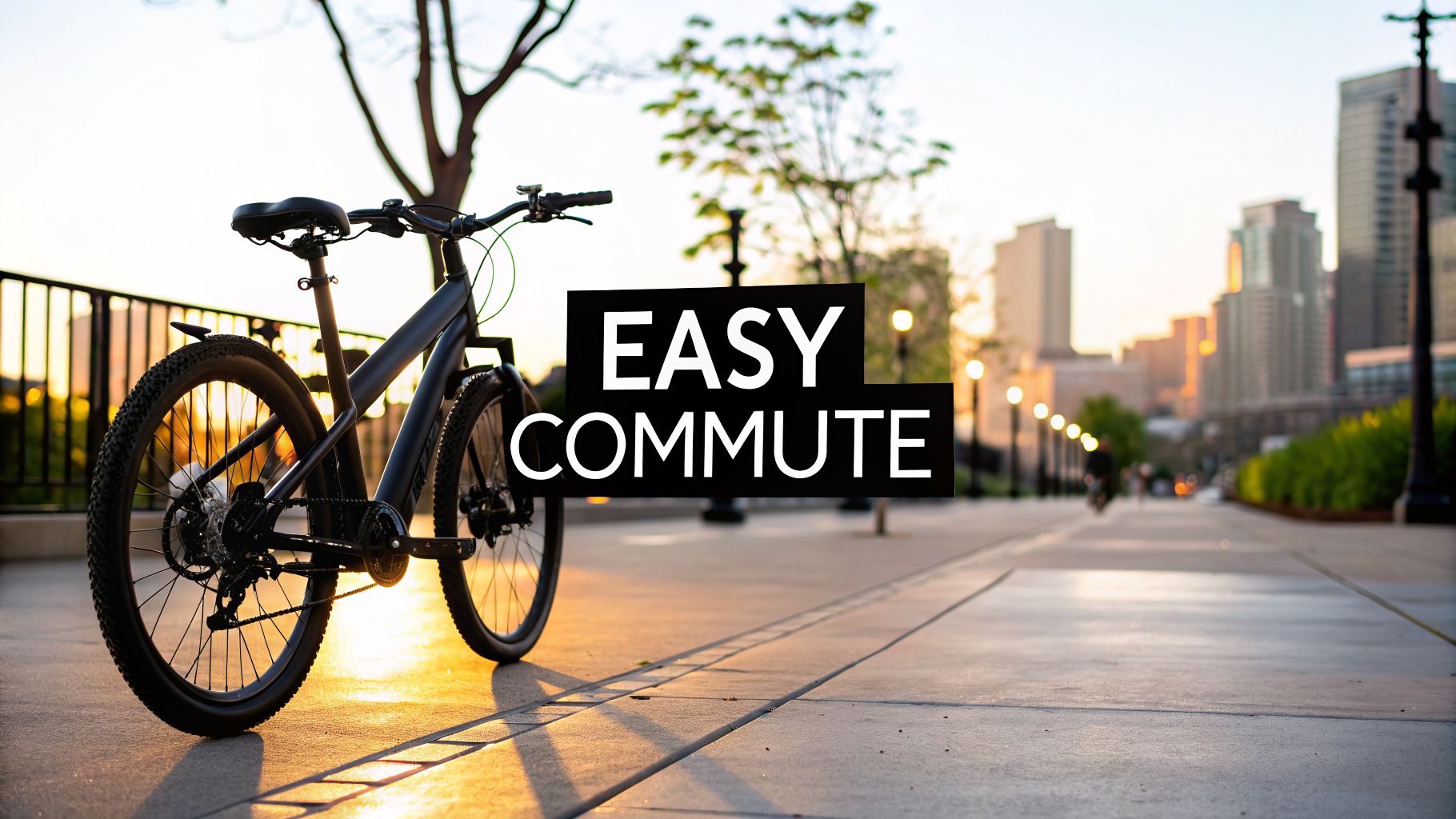
A step-through ebike is simply an electric bike designed to be as easy as possible to get on and off. It has a very low or non-existent top bar (that's the one you usually have to swing your leg over), so you can just step right through the frame. This design makes mounting and dismounting feel completely natural and effortless, opening up the joy of cycling to just about everyone.
Unlocking a New Way to Ride

Let’s be real—bike jargon can be a bit much. At its core, a step-through ebike is all about convenience. Think of it this way: getting on a step-through is like sliding into the driver's seat of a modern car. Getting on a traditional "step-over" bike can feel more like climbing into a classic sports car. One is just a lot easier for everyday use.
This simple but brilliant design tweak is a huge reason ebikes are becoming the go-to choice for smarter, greener travel in cities across the US and Australia. It’s not just a small feature; it's a completely different approach to getting around, removing a physical hurdle that kept a lot of people off bikes.
To help you see the difference right away, here's a quick rundown of how the two frame styles stack up.
Step Through vs Step Over Ebike at a Glance
This table breaks down the key distinctions between the two main ebike frames. It's a handy cheat sheet to help you decide which style is right for your needs.
| Feature | Step Through Ebike | Step Over (Crossbar) Ebike |
|---|---|---|
| Mounting/Dismounting | Effortless; step through the frame | Requires swinging a leg over the top tube |
| Riding Posture | Typically upright and relaxed | Often a more forward-leaning, athletic stance |
| Best For | City commuting, casual rides, carrying cargo, riders with limited mobility | Sporty riding, off-road trails, riders seeking maximum frame rigidity |
| Accessibility | High; great for all ages and abilities | Lower; can be challenging for some riders |
| Frame Rigidity | Good, but slightly less rigid due to the open design | Excellent; the top tube adds significant structural strength |
Ultimately, both are fantastic options, but the step-through's focus on ease of use makes it a clear winner for daily urban life.
Accessibility for All Riders
The biggest win for a step-through ebike is its incredibly welcoming design. You don't need the flexibility of a yoga instructor to hop on. This is a total game-changer for anyone who has ever found traditional bikes a bit of a struggle.
Just think about who this helps:
- Commuters in Work Clothes: No more awkward high-kicks in a skirt, dress, or nice pair of pants. Just step on and go.
- Riders with Limited Mobility: If you have stiff hips, bad knees, or balance concerns, the low frame removes the pain and strain of lifting your leg high.
- Anyone Carrying Stuff: When your bike is loaded with groceries, a child seat, or a heavy backpack, the step-through frame makes getting on and off much safer and more stable.
Models like this Women's Step-Through E-bike are built specifically to maximize this ease of use, but honestly, the design is a favorite for riders of all genders for its sheer practicality.
A step-through frame takes cycling from being a "sport" and turns it into a seamless part of your day. It’s all about confidence and convenience, letting you hop on for a quick trip to the store as easily as you would for a long weekend ride.
A Market That's Taking Off
This focus on making ebikes easy for everyone is a key reason the market is absolutely booming. As our cities get more crowded and people look for sustainable ways to get around, the ebike has shown up as the perfect tool for the job. And the market isn't just growing—it's exploding.
The global e-bike market has seen incredible growth, with projections expecting it to hit a value of USD 70-77 billion by 2026. This surge is driven by people moving to cities and caring more about the environment, and it signals a huge shift in how we think about transportation. Step-through models are a massive part of this trend because they appeal to almost everyone.
Another huge plus is the comfortable, upright riding position you'll find on most step-throughs. It gives you a better view of traffic and puts less strain on your back and neck. If you want to get into the nitty-gritty of this frame style, you might want to read our guide on what a step-through bike is. This design isn't just about comfort—it's about making cycling a practical, everyday choice for anyone and everyone.
How a Step Through Ebike Transforms Your Daily Routine

A step-through ebike isn't just about a different frame style—it’s about changing how you move through your day. It chips away at all the little hassles of traditional bikes, making cycling the easy and obvious choice for your commute, errands, and weekend fun. Let's get into what that actually looks like in real life.
Think about your morning commute. Instead of having to swing your leg over a high bar while wearing work clothes, you just step through, sit down, and go. No awkward balancing act, no worrying about ripping your nice pants or skirt, and no need for a change of clothes at the office. It’s a genuinely smooth and pleasant way to start the day, turning a potentially stressful trip into a mini-adventure.
This easy-on, easy-off design makes a huge difference at every stoplight and coffee break. When you're navigating a busy city like Sydney or New York, you can just step off and stand comfortably. That feeling of being stable and in control is a massive confidence booster, especially in unpredictable traffic.
From Groceries to Getaways
The real magic of a step-through ebike becomes crystal clear the moment you try to carry something. We’ve all done that wobbly, one-legged dance trying to get on a bike loaded down with groceries. A step-through frame gets rid of that problem completely.
You can load up your basket or pannier bags with a week's worth of food and still hop on and off with zero drama. It turns the dreaded grocery trip into a quick, simple task. Suddenly, the question isn’t if you can carry it all on your bike, but just how much you can fit.
It's this practical design that makes a step-through a fantastic car replacement for all sorts of local trips:
- Farmers Market Runs: Load up on fresh produce without the fear of tipping over the second you try to get on.
- Dropping off Packages: Zip to the post office with your packages safely secured on a rear rack.
- Carrying a Child Seat: The low frame makes it so much easier—and safer—to manage getting on and off with a little one in a seat behind you.
Plus, the upright and relaxed riding position that's common on these bikes means you can ride for longer without the sore neck and back you might get from a more aggressive, hunched-over bike.
A step-through frame makes your ebike a true utility vehicle. It’s designed for the reality of daily life, where you’re not always just riding for sport—you’re running errands, carrying items, and navigating a busy world.
A Safer, More Confident Ride
Feeling confident is everything when it comes to riding in the city, and a step-through ebike is practically designed to build it. Being able to plant both feet firmly on the ground in a split second gives you a huge feeling of security. When you hit a patch of dense traffic or something unexpected happens, that immediate stability can make all the difference.
Picture yourself on a crowded street. A car door swings open or a pedestrian steps out without looking. With a step-through, you can stop and step off instantly, without that flash of panic as you try to swing a leg over a high bar while braking. This is a game-changer for riders who are new to ebikes, a bit older, or have some mobility issues. It gives you a sense of control that just makes you want to ride more often.
For instance, a study of e-bike riders in Sedona, Arizona, found that people on step-through models felt way more secure, especially on varied terrain or during frequent stops. One tour guide there even tells new riders, "If your bike tips, ditch it and save yourself!" That’s much easier to do when you can just step away from the frame. This built-in safety net makes the step-through ebike an incredibly forgiving and welcoming choice for anyone looking to make cycling a regular thing.
Getting to Know the Tech on Your First E-bike
Staring at a spec sheet for a step-through e-bike can feel like you're trying to decipher a secret code. Motors, batteries, brakes... it's easy to get lost in the jargon. Let's cut through all that noise and talk about what these specs actually mean for your ride, so you can check out any product page and know exactly what you're looking at.
First up, the motor. Think of it as the heart of your e-bike—it’s what gives you that awesome pedal-assisted boost. You’ll mainly see two types, and each one offers a totally different feel.
Getting a handle on motors is a great place to start. The technology is getting better all the time, which is fantastic news for riders. In fact, the e-bike motor market was valued at a whopping USD 12.79 billion in 2025 and is expected to explode to USD 42.73 billion by 2034. This crazy growth, which you can read more about on Fortune Business Insights, shows just how much people want better performance—especially for city commuting, which makes up 63.7% of the market.
Hub Motors vs. Mid-Drive Motors
The most common motor you'll find, especially on city bikes and more affordable models, is the hub motor. Just like the name says, it’s built right into the hub of one of the wheels.
- Rear Hub Motor: This is the fan favorite. It gives you a sensation of being gently pushed from behind. It’s a smooth, steady power that’s perfect for cruising around town and tackling gentle hills on your daily commute.
- Front Hub Motor: You don’t see these as often anymore. A front hub motor pulls you along, which can feel a bit like an all-wheel-drive car. The downside is that it can sometimes make the steering feel a little odd and might lose grip on wet or loose ground.
The other main option is a mid-drive motor. This powerhouse is located right in the middle of the bike’s frame, down by the pedals. It applies power directly to the crank, which makes for an incredibly natural and balanced ride.
Here’s an easy way to think about it: a hub motor is like a helpful friend giving you a steady push up a hill. A mid-drive motor, on the other hand, feels like you suddenly have superhuman legs. It syncs perfectly with your own pedaling, so it feels incredibly intuitive and gives you a ton of torque for climbing steep hills. That's why you usually find them on higher-end e-bikes built for performance.
Understanding Your E-bike's Battery
If the motor is the heart, the battery is the gas tank. Its capacity is what dictates how far you can ride before needing to recharge. You’ll see a couple of key numbers here, but one is way more important than the other.
Watt-hours (Wh) is the number to pay attention to. It’s the best measure of a battery's total energy capacity—think of it as the size of the gas tank. The higher the Wh, the longer your potential range.
Most commuter e-bikes have batteries somewhere in the 300Wh to 700Wh range. For the average city rider, a 400-500Wh battery is a great sweet spot. It’ll give you more than enough juice for your daily trips, with some power left in reserve. Just remember, your actual range always depends on things like your weight, the terrain, how much assistance you’re using, and even a strong headwind.
Brakes, Frames, and Wheels
Beyond the flashy electronics, a few other parts are absolutely crucial for a safe and comfy ride on your step-through e-bike.
- Brakes are non-negotiable. E-bikes are heavier and faster than regular bikes, so you need serious stopping power. Look for hydraulic disc brakes if you can—they give you the best, most reliable performance in any weather. Mechanical disc brakes are a decent second choice, but hydraulic brakes offer more power with less hand effort.
- Frame Material mostly comes down to weight and cost. The vast majority of step-through frames are made from aluminum, which hits that perfect balance of being strong, durable, and not too expensive. Steel is tougher but heavier, while carbon fiber is super light but comes with a much higher price tag.
- Wheel Size changes how the bike feels on the road. Most city e-bikes use either 26-inch or 700c (which is about 28-inch) wheels. Smaller wheels feel zippy and accelerate quickly, while bigger wheels are better at smoothing out bumps and holding their speed.
Getting familiar with these key specs will make you a much smarter shopper. If you want to go even deeper and make sure you're picking the perfect bike, you might find our complete guide on how to choose an ebike really helpful. It’s all about matching the right tech to what you actually need.
Finding the Right Fit for a Comfortable and Safe Ride
Think of it this way: an e-bike that doesn't fit you is like a great pair of hiking boots in the wrong size. No matter how cool they look or what features they have, you’re just not going to want to wear them. Getting the fit right is everything when it comes to both comfort and safety, making sure you actually enjoy every single ride.
Even with a super-convenient low-step frame, you still need to check the standover height. That’s just the distance from the ground to the top bar of the frame. You want to be able to stand over the bike with both feet flat on the ground and still have an inch or two of clearance. This is a big deal for safety—it means you can hop off quickly and confidently if you need to stop suddenly.
Ultimately, a good fit means your body is in a natural, ergonomic position that won’t put stress on your back, neck, or wrists. The goal is a relaxed, upright posture that also gives you a great view of the road ahead.
This diagram shows how all the key tech on your bike works in harmony.

You can see how the motor, battery, and brakes aren't just separate parts but an interconnected system. Each one relies on the others to give you a smooth, safe, and functional ride.
Adjusting for a Perfect Fit
Once you’ve got the right frame size, it’s time to fine-tune the details. It's like getting a suit tailored—a few small tweaks can make a world of difference in how it feels.
- Saddle Height: Your seat should be high enough that when you put your foot on the pedal at its lowest point, your leg has just a slight bend. You don't want it totally locked straight, but you don't want it deeply bent either. This simple adjustment gives you the most power from each pedal stroke and saves your knees from getting sore.
- Handlebar Position: Play with the height and angle of your handlebars until you’re sitting comfortably upright. Your arms should be slightly bent at the elbows, not stretched out straight or hunched over. This is key to avoiding wrist and shoulder pain, especially on longer commutes.
Most step-throughs are already designed for this laid-back riding style, but spending a few minutes dialing in these settings for your specific body will make your rides so much more comfortable.
Safety First on City Streets
Riding in the city has its own set of challenges. A step-through e-bike is a fantastic confidence-booster because it's so easy to get on and off, but developing good safety habits is what will truly make you a smart urban rider. This is especially true in the US and Australia, where e-bike laws can change from state to state, or even city to city.
For instance, in places like New York, the law is starting to treat e-bike accidents more like car accidents. If there’s a crash that causes an injury or more than $1,000 in property damage, everyone involved has to file an official report. It’s a serious reminder to ride defensively and know your responsibilities on the road.
Your number one job is to be seen. Always ride as if you're invisible to drivers, and then do everything you can to prove that assumption wrong. This mindset is the heart of safe city cycling.
Mastering these key skills will make you feel more confident from day one:
- Be Seen: Use your lights! Seriously, run them day and night. A flashing front and rear light makes you way more noticeable to cars. Bright clothing is a huge plus, too.
- Make Some Noise: Your bell isn't just for fun. Use it early and often when you're coming up on pedestrians, passing other cyclists, or heading into a blind corner. A friendly ding-ding is better than a sudden surprise.
- Master Your Brakes: Remember, e-bikes are heavier and faster than regular bikes. Take some time in an empty parking lot to get a feel for how long it takes to stop. Practice braking smoothly, and always use both brakes together for the most effective stopping power.
Simple Maintenance to Keep Your Ebike Running Smoothly
Worried that owning a step-through ebike means you'll have to become a part-time bike mechanic? Relax. Keeping your electric bike in top shape is way easier than you think, and a few simple habits will protect your investment for the long haul.
You really don't need a toolbox full of professional gear. Just a little regular attention is all it takes to keep your ride feeling smooth, safe, and ready to go whenever you are. Think of it like a car—you wouldn't go years without checking the tire pressure, right? Same deal here. A few minutes of care ensures your ebike is always primed for that daily commute or weekend spin.
Your Weekly Ebike Checklist
Just set aside five minutes a week for these quick checks. It’s the best way to catch small issues before they turn into bigger headaches.
- Tire Pressure: Give your tires a good squeeze. They should feel firm, not soft and squishy. Keeping them properly inflated is your best defense against flats, and it helps your battery last longer on each ride. The right pressure (PSI) is always printed right on the side of the tire.
- Brake Check: Pull both brake levers. Do they feel solid and responsive? Or are they spongy and loose? Roll the bike a few feet and gently apply the brakes to make sure they stop you smoothly and quickly.
- Chain Check: Take a quick look at the chain. If it’s looking dry, dirty, or even a little rusty, it's time for a quick clean and lube. A happy chain runs quiet and smooth.
These three steps are the foundation of ebike care. If you do run into a flat, don't sweat it—we've got a full guide on how to handle ebike tire repair that walks you through everything.
Monthly Tune-Up and Battery Care
Once a month, it pays to give your bike a little extra TLC. This is also the perfect time to focus on the most critical (and expensive) part of your ebike: the battery.
Honestly, taking good care of the battery is the single best thing you can do to get the most life out of your bike. It’s the heart of the whole system.
Never store your battery when it's completely dead or at 100% for long periods. For storage, the sweet spot is keeping the charge between 40% and 80%. This one little habit takes the stress off the battery cells and can seriously extend its overall lifespan.
On top of that, keep it out of extreme temperatures. Leaving your battery in a freezing garage or a hot car is a big no-no. Heat and cold are a battery’s worst enemies.
Finally, give the bike a gentle wipe-down with a damp cloth. A clean bike doesn’t just look good; it makes it much easier to spot a loose bolt or any other potential issue before it becomes a problem.
Smart Storage Solutions
Where you park your step-through ebike matters, especially if you’re tight on space in an apartment. Vertical bike racks and wall mounts are fantastic for getting your bike up and out of the way, freeing up valuable floor space. If you have to store it outside, make sure you use a high-quality, waterproof cover to shield the battery and other electronics from the elements.
It’s this kind of user-friendly design that’s helping ebikes take over cities worldwide. The Asia Pacific region, which includes Australia, is leading the charge, making up a massive 76.6% of the global market in 2025, worth an estimated USD 40.32 billion. The US market is also seeing a massive boom as more people choose ebikes for their daily travel. You can check out more about these global e-bike market trends on imarcgroup.com.
Alright, you're ready to pull the trigger on a new step-through eBike. It's a fantastic decision that can genuinely change how you get around town. But with so many options, it's easy to get overwhelmed.
Let's cut through the noise. This isn't about finding the "best" bike on paper; it's about finding the right bike for you. Think of this checklist as your personal guide to buying with confidence.
First Things First: The Big Questions
Before you even start browsing, taking a moment to answer these questions will narrow down your options fast. Being honest about what you need is the quickest path to a bike you'll love for years.
- What's this bike really for? Is it for a daily 5-mile commute, or is it for breezy weekend rides down the coast? Your main reason for riding dictates everything else. A commuter in hilly Sydney has very different needs than someone running errands in a small, flat US town.
- Give it a test ride. You wouldn't buy a car without a test drive, right? The same goes for an eBike. Get on it. Feel how it handles and see if the riding position is a natural fit for your body. Comfort is king.
- Dodge range anxiety. Think about your longest typical ride, then add a healthy buffer. A battery that just barely covers your commute will have you nervously watching the power meter every day. Get enough capacity to ride with total peace of mind.
- Pick the right motor for your world. For zipping around mostly flat city streets, a good rear hub motor is often all you need. But if your daily route includes any serious hills, the powerful and efficient climbing of a mid-drive motor is an investment you will not regret.
The Final Gut Check: Before you hand over your card, ask about the warranty. A solid warranty on the frame, motor, and battery shows the brand believes in its own product. Also, find out about local service options, whether you're in the US or Australia. You'll be glad you did.
Don't Forget the Extras
The bike itself is the main event, but the right accessories and a final check will make sure it's ready for the real world from day one.
Pay close attention to what's included. A bike that comes with integrated lights, fenders, and a sturdy rear rack already built-in is a huge win. Trying to add all that stuff later can be surprisingly expensive and a real hassle.
Finally, make sure you have a solid service plan. Look for at least a one-year warranty on the electronics and an even longer one for the frame. Knowing there's a reliable shop nearby to help you out is the ultimate peace of mind.
Frequently Asked Questions About Step Through Ebikes
Still on the fence? Totally understandable. Buying an ebike is a big deal, and we hear a lot of the same great questions from people trying to decide. Let’s clear up a few of the most common ones.
Are Step Through Frames As Strong As Traditional Ones?
This one comes up all the time, and the short answer is: yes, absolutely for what they're designed to do. Think of it this way—you wouldn't take a family sedan on a hardcore off-road trail, right? It's not what it was built for.
Modern step-through frames use clever engineering, like reinforced down tubes and stronger welds, to make up for the lack of a top bar. They are rock-solid for city commuting, grocery runs, and cruising around town. While a serious mountain biker might want the rigid geometry of a step-over frame for gnarly trails, a step through ebike is built to be your reliable, everyday ride.
Can I Still Get a Workout on an Ebike?
Of course! This is probably the biggest myth out there. The "e" in ebike is for assist, not automatic. You're always the one in charge.
An ebike doesn't replace pedaling; it just gives you the power to choose how much effort you put into it. It’s like having a personal tailwind you can turn on whenever you need it.
You can keep the assist on low (or even turn it off completely) to really feel the burn, or you can crank it up to fly up a steep hill without messing up your work clothes. In fact, studies often show that ebike owners end up getting more total exercise because they ride more often and go on longer adventures.
How Heavy Are These Bikes to Handle?
Okay, there's no sugarcoating it: ebikes are heavier than regular bikes. Most step-through models fall in the 20 to 30 kg (45-70 lbs) range, mostly because of the battery and motor.
But here’s the magic part—once you start riding, that weight just disappears. The motor's assistance makes the bike feel light and nimble. The only time you'll really feel the heft is when you have to lift it, like carrying it up a flight of stairs. If you're an apartment dweller, keep an eye out for models with removable batteries. Popping it off can make the bike much easier to carry.
What Real-World Battery Range Can I Expect?
The range you see advertised is always based on perfect, ideal conditions. Your actual mileage will almost always be a bit different. It really boils down to a few key things:
- Your Weight: A heavier rider will naturally draw more power from the battery.
- The Terrain: Hills are the number one battery-killer. Flat ground is your friend for maxing out range.
- Your Assist Level: Riding in "Turbo" mode is fun, but it will drain your battery much faster than "Eco" mode.
- The Elements: Fighting a strong headwind or riding on under-inflated tires forces the motor to work harder.
With a standard 500Wh battery, most people get a real-world range of about 40 to 80 km (25-50 miles). That’s a pretty big window, but it all depends on how and where you're riding that day.
Ready to find a ride that fits your life? At Punk Ride LLC, we offer a wide selection of top-tier electric bikes and scooters to make your urban travel a breeze. Explore the collection at Punk Ride today!
Share:
Heavy Duty Off-Road Electric Scooters for Adventurous Rides
Demystifying Electric Bikes: The HIDOES C1 Explained