


Here's the bottom line right up front: electric bikes are built for longer rides and double as a great workout, while electric scooters are the undisputed champs of "grab-and-go" portability for those short, last-mile dashes. It really boils down to what you value more: getting in some exercise on a longer commute or having something you can easily tuck under a desk.
E-Bike vs E-Scooter: Which Is Best For Your Commute?
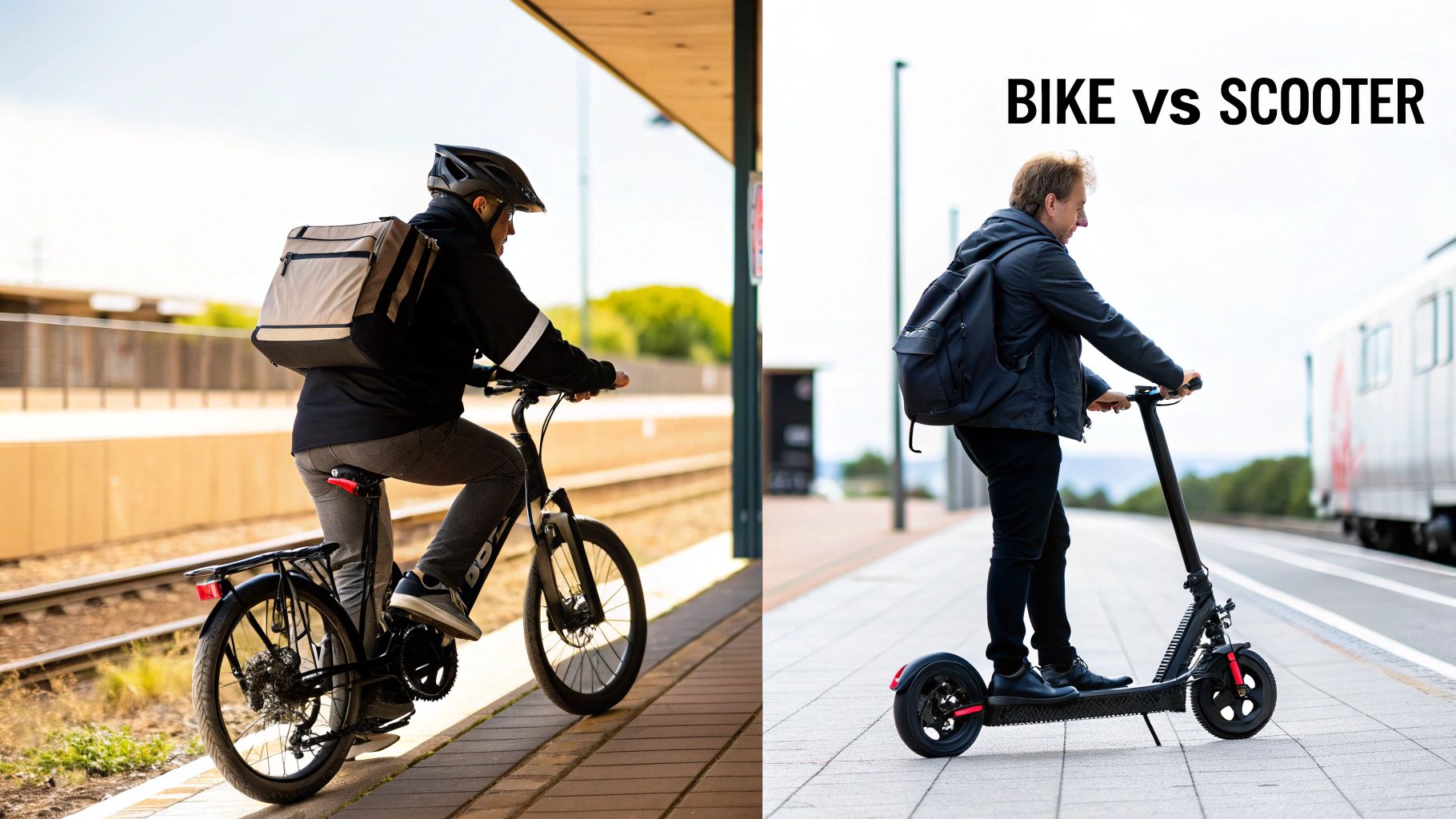
So, you're ready to ditch the bus pass or the car keys for a smarter, greener way to get around town. Fantastic. The big question now is, which two-wheeled electric ride is right for you? It’s a classic showdown: the dependable e-bike versus the nimble e-scooter. Let's break it down to help you find the perfect partner for your daily journey.
Before we get into the nitty-gritty, here’s a quick-and-dirty comparison of the most important factors, especially if you're riding in Australia or the US.
Quick Look: E-Bike vs E-Scooter Key Differentiators
| Feature | Electric Bike | Electric Scooter |
|---|---|---|
| Legal Status (Aus/US) | Generally legal on public roads & bike paths (state/local laws vary). | Legal in many cities, but rules on speed, helmets & where to ride differ greatly. |
| Typical Range | 30-80+ km. Easily handles long commutes and weekend adventures. | 15-40 km. Perfect for quick hops and linking up with public transport. |
| Riding Experience | An active ride. The pedal-assist means you’re still getting a workout. | A passive ride. Just stand and go with the throttle—no sweat required. |
| Portability | Heavier and bulkier. A real pain to haul onto a crowded train or bus. | Lightweight, often foldable. A commuter's dream for carrying and stashing. |
| Cargo Capacity | Excellent. You can load it up with panniers for groceries and gear. | Minimal. Whatever you can comfortably fit into a backpack is your limit. |
| Fitness Benefit | High. You're still cycling, just with a helpful electric boost. | Pretty much zero. It's all motor, no muscle. |
This table gives you the high-level view, but the devil is in the details of your daily routine. Don't forget that the right accessories can make or break your commute. If you’re leaning towards an e-bike, for example, staying hydrated is key, so checking out the best water bottles for biking is a smart move.
To really dig into how these rides handle the daily grind, take a look at our in-depth guide on electric bikes for urban commuting.
Range and Hill Climbing: Where the Real Differences Show
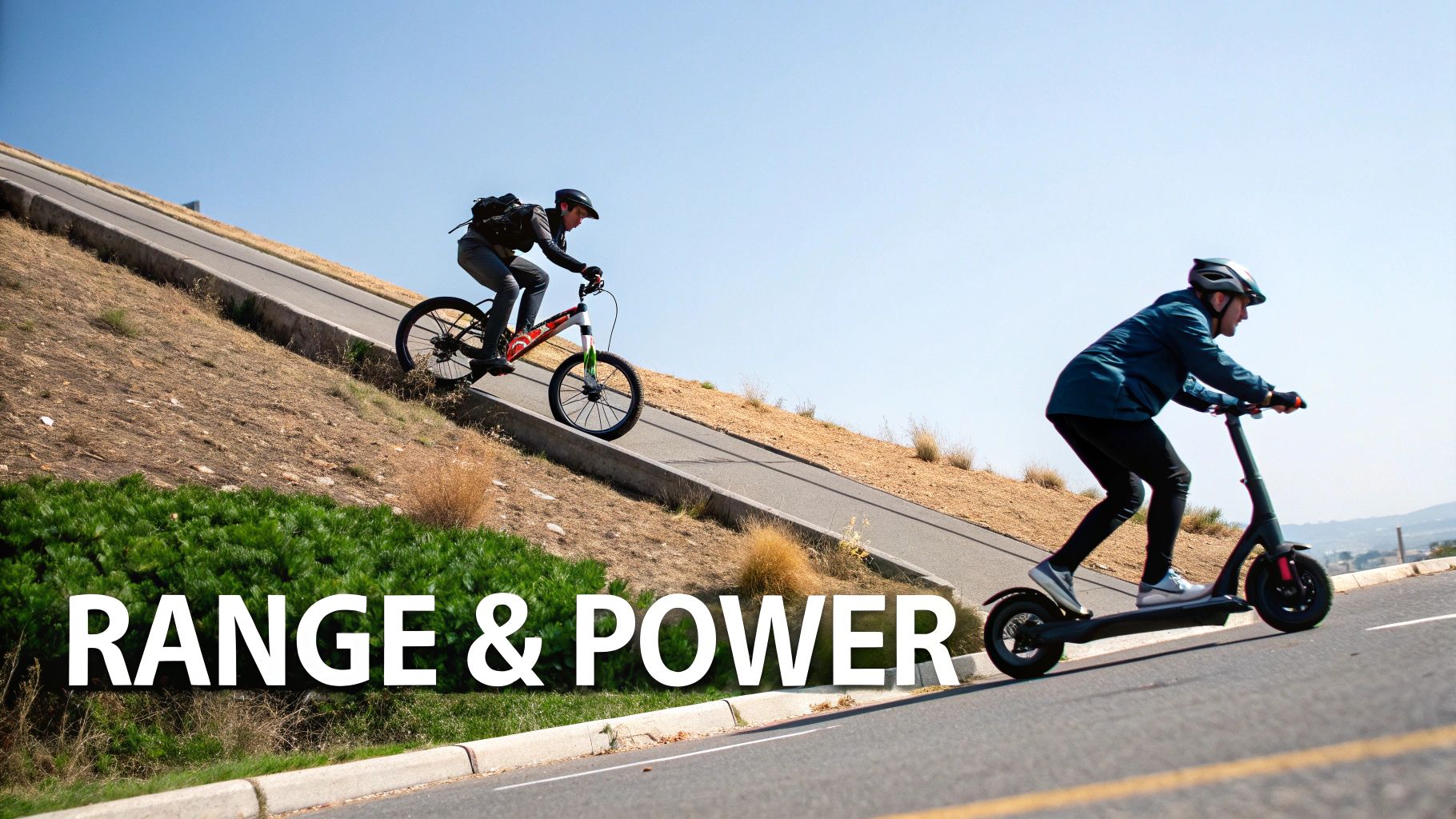
Alright, let's get into the nitty-gritty. When you're trying to decide between an e-bike and an e-scooter, it often boils down to performance—how far can it take you, and can it handle that killer hill on your commute? This is where their personalities really diverge. It’s not just about the battery size on the spec sheet; it's about how that power translates to the actual road beneath you.
The secret weapon for an e-bike is its pedal-assist system. Plain and simple. By chipping in with your own leg power, you can stretch the battery life way beyond its advertised limits. That standard 65 km battery can easily become a 100 km adventure machine. An e-scooter, however, is all motor, all the time. Its range is what it is—a fixed number that you can’t really nudge higher.
What “Range” Actually Means on the Street
First off, let's be real: the range advertised on the box is a "best-case scenario" number. Your weight, the terrain, and even a strong headwind will absolutely impact how far you can go. But the core difference in how you power them gives e-bikes a huge leg up for longer rides.
- Electric Bike Range: You’re typically looking at a range from 30 to over 100 km. This makes them a fantastic choice for a serious daily commute, long weekend joyrides, or running errands all over town without constantly checking the battery indicator.
- Electric Scooter Range: Scooters are built for shorter, zippier trips, usually giving you between 15 to 40 km. They are the undisputed champs of that "last mile" problem—getting you from home to the train station or for quick dashes across a downtown core. If you want to squeeze every last drop of juice out of your battery, check out our guide on how to maximize your electric scooter's range.
For the kind of urban riding our customers do, e-bikes from brands like ELEGLIDE and ENGWE just offer more freedom. With battery tech improving by around 15% in 2023 alone, e-bikes are solidifying their spot as the go-to for daily travel, effortlessly blending real-world performance with an eco-friendly ride.
Tackling Hills: The Power Divide
Nothing puts a motor to the test like a steep hill. This is another area where the fundamental design of an e-bike gives it a serious advantage over most scooters. That combination of human and electric power is a true game-changer.
When you hit an incline on an e-bike, you can just shift to a lower gear and keep pedaling. Your effort supplements the motor, so it doesn't have to strain, overheat, or guzzle the battery. This teamwork lets you conquer hills that would leave many e-scooters wheezing.
An electric scooter has to fight gravity with nothing but its motor's raw torque. While some high-end, dual-motor beasts can handle surprisingly steep grades, your average commuter scooter is going to slow down dramatically, and some might just give up entirely.
Here's a simple way to think about it: an e-bike is like an all-terrain vehicle for the city, ready for whatever the landscape throws at it. An e-scooter is more of a sprinter, built for speed and agility on flat, predictable ground.
So, take a hard look at your daily route. If it’s riddled with hills, an e-bike is almost certainly the more practical and enjoyable choice.
Getting to Grips with US and Australian E-Scooter and E-Bike Laws
When you're trying to decide between an electric bike and an electric scooter, local laws aren't just a minor detail—they can be a deciding factor. Unlike the more uniform rules in Europe, the legal landscape in the United States and Australia is a real patchwork, with laws changing from state to state and even city to city.
The good news is that both e-bikes and e-scooters are broadly accepted as great urban transport options. The key is understanding the specific rules for where you plan to ride.
The Green Light For E-Bikes
In the United States, a 3-class system for e-bikes is widely adopted, making it fairly clear what's allowed.
- Class 1: Pedal-assist only, with a top speed of 20 mph (32 km/h).
- Class 2: Throttle-assisted, with a top speed of 20 mph (32 km/h).
-
Class 3: Pedal-assist only, with a top speed of 28 mph (45 km/h).
Most states allow Class 1 and 2 e-bikes wherever regular bikes can go. Class 3 bikes sometimes have more restrictions, like age limits and exclusion from multi-use paths.
In Australia, the rules are more uniform nationally. An e-bike must have a motor of no more than 250 watts and the power must cut out at 25 km/h (15.5 mph). If it meets these rules, it's treated like a regular bicycle—no license or registration needed.
This legal clarity makes an e-bike a super practical choice in both countries. You can buy one and hit the road legally the same day, no red tape involved.
Navigating the Maze of E-Scooter Rules
For e-scooters, it's a bit more of a "wild west" scenario. In the US, there is no federal law, so every state and city makes its own rules. Some cities, like Portland and Denver, have fully embraced them with clear guidelines on speed limits and where you can ride. Others have stricter rules or outright bans. You absolutely must check your local city and state department of transportation websites.
Australia is seeing a similar trend. States like Queensland, Victoria, and Western Australia have legalised private e-scooters through ongoing trials, but with specific rules on speed (usually 25 km/h on paths and lower in pedestrian areas), helmet use, and age. However, in states like New South Wales, riding a private e-scooter on public roads or paths remains illegal outside of specific trial areas.
Key Takeaway: In both the US and Australia, compliant e-bikes generally offer more go-anywhere legal freedom. E-scooters are becoming more accepted, but you have a greater responsibility to research and follow your specific local laws to avoid fines.
This is the single biggest differentiator in the electric bike versus electric scooter debate for US and Australian buyers. You can get the full rundown in our detailed guide to UK electric scooter laws, which can give you an idea of the types of regulations that might apply in your area.
A Realistic Look at Total Ownership Costs
The price tag is only page one. To really get a grip on the e-bike vs. e-scooter debate, you have to look at what it costs to own one for a few years. While scooters often look like the cheaper date upfront, you'd be surprised how much the long-term costs can level the playing field.
Let’s get real about the financial commitment, moving past that initial buzz of the purchase and looking at everything from day-to-day running costs to the inevitable replacement parts.
The Initial Investment
Your first spend is your biggest, and it can swing wildly depending on what you're after. Both e-bikes and e-scooters have everything from basic, get-the-job-done models to high-performance machines that'll make your wallet wince.
Generally speaking, an e-scooter will be the lighter hit on your bank account right away. You can find a decent, reliable scooter for your daily commute for under $500 USD / $750 AUD. A comparable e-bike? You're often starting closer to the $800 USD / $1,200 AUD mark. That initial price gap is a huge reason so many people jump on the scooter train first.
But it's not always that simple. Once you start looking at premium, long-range scooters, the prices can easily creep into mid-range e-bike territory. The key is to compare apples to apples—look at models with similar battery power and build quality, not just the type of vehicle.
Long-Term Running and Maintenance Costs
Here's the good news: once you're out there riding, the day-to-day running costs for both are dirt cheap. We’re talking cents to charge the battery each day, which is a tiny fraction of a bus pass or a tank of fuel. This is where both options absolutely smash traditional transport for saving money.
Where things start to diverge is in the garage. E-bikes share most of their DNA with regular push bikes. That means parts like chains, brake pads, and gears are everywhere, and any decent bike shop can fix them. This easy access to parts and expertise helps keep repair costs from getting out of hand.
E-scooters can be a bit more of a black box. Their specialised components and sealed electronics often require a specialist. Finding a local shop that knows your specific brand can be tough, which can lead to higher service bills and more time off the road.
An e-scooter might have fewer moving parts to worry about day-to-day (goodbye, greasy chain!), but if a major electronic part like the controller dies, it's often a much pricier and more complex fix than a typical e-bike repair.
The single biggest future expense for both is the battery. After about 3-5 years or 500-1,000 charge cycles, that lithium-ion battery will start to feel tired. A replacement is a major purchase, often setting you back $200-$500 USD / $300-$750 AUD, or even more. You absolutely have to factor this into your long-term budget, no matter which ride you choose.
Estimated Total Cost of Ownership Over 3 Years
To put some real numbers on this, let's map out the estimated costs for a solid mid-range model of each over three years. This gives a much clearer picture of how the total cost adds up over time (in USD).
| Cost Factor | Electric Bike (Mid-Range) | Electric Scooter (Mid-Range) |
|---|---|---|
| Initial Purchase | $1,200 | $600 |
| Annual Maintenance | $75 (Tune-ups, chain, etc.) | $40 (Brake checks, tires) |
| 3-Year Maintenance Total | $225 | $120 |
| Potential Replacements | Tires ($60), Brake Pads ($30) | Solid Tires ($80), Brakes ($25) |
| Total After 3 Years | $1,515 | $825 |
As you can see, the e-scooter holds a pretty significant cost advantage even after three years of use. That much lower initial price is doing most of the heavy lifting. The real decision then becomes whether the added range, versatility, and legal freedom of an e-bike is worth that extra investment for your specific needs.
Which Ride Actually Fits Your Daily Lifestyle?
Specs and stats are great on paper, but the real question is how a new ride will actually fit into your life. When you get past the performance numbers, the decision between an electric bike and an electric scooter really comes down to the practical stuff: portability, storage, comfort, and what you need it to do for you every day.
This is where the electric scooter really shines. For a certain kind of commuter, its design is just brilliant. If your daily trip involves jumping on a train or a bus, the scooter’s lightweight, foldable frame is a total game-changer. You can fold it up in seconds, carry it on, and slide it under a seat. It's the perfect sidekick for a commute that mixes different types of transport.
The same goes for anyone living in a flat or apartment. Let's be honest, finding a spot for a full-sized e-bike can be a real headache. A scooter, on the other hand, folds down neatly and can live in a hallway closet or under your desk at work. That grab-and-go simplicity is its superpower.
The Multimodal Commuter vs. The Urban Errand Runner
To really nail down the difference, let’s imagine two typical riders.
-
The Multimodal Commuter: Meet Sarah. She lives in a suburb of Sydney and catches the train into the city. Her daily journey is a 1.5 km ride from her house to the station, and then another 1.5 km from the train to her office. For her, an electric scooter is the clear winner. Sarah needs something she can easily carry onto a crowded train during rush hour without a second thought. An e-bike would just be too big and awkward.
-
The Urban Errand-Runner: Now here's Mark. He works from home in Austin, Texas but uses his ride for pretty much everything else—grocery runs, trips to the gym, and meeting up with friends across town. His rides are often a few miles long and he usually needs to carry stuff. For Mark, an electric bike makes way more sense. The ability to add panniers is a huge plus. He can load up on groceries or toss in his gym bag and laptop without lugging around a sweaty backpack. Plus, the e-bike's bigger wheels and solid frame make for a much smoother, more stable ride over bumpy city streets.
Comfort, Utility, and Long-Term Practicality
While a scooter is the undisputed king of portability, an e-bike wins the crown for comfort and all-around utility. Those larger wheels just soak up bumps and potholes, the seated riding position is way less tiring on longer trips, and the power to carry a serious amount of cargo makes it a genuine car replacement for many. This is a huge point in the electric bike versus electric scooter debate; one is about pure convenience, the other is about true capability.
You can think of it like this: An e-scooter is built to solve the "last mile" problem. An e-bike is built to handle the entire journey, errands and all.
For commuters aged 16-65, this means e-bikes from our collection at Punk Ride—like those from HITWAY or DUOTTS—are fantastic, reliable options for longer trips where you need endurance and space to carry things. While government incentives are helping both grow in popularity, e-bikes often have an edge because they integrate health benefits and sustainability right into your daily routine. You can find more data on the growing global e-bike market on statista.com.
And if you do go with an e-bike, don't forget you can take it with you on bigger adventures. Figuring out specialized e-bike carrier options for your car is key for those weekend getaways. It’s all about picking a ride that doesn't just get you from point A to B, but actually makes your life better.
So, Which One Is Right for You?
After digging into the details, it’s time to make the final call. There’s no single "best" answer in the e-bike vs. e-scooter debate, but there’s definitely a perfect choice for your life. It really just comes down to what kind of rider you are.
I find it helps to think in terms of two common rider profiles. See which one sounds more like you, and you'll know exactly which ride will make your life easier, not more complicated.
The Last-Mile Dasher
Do you live in a city apartment and use the train or bus for most of your commute? Are you just trying to crush that annoying one-mile gap from the station to the office? If you need something you can grab, go, and carry anywhere, the e-scooter is your champion.
Its biggest advantage is just how portable it is. You can fold it up, carry it onto a crowded bus, tuck it neatly under your desk, or stash it in a tiny closet without a second thought. For zipping through a busy downtown, especially where rental scooters are already everywhere, it’s the perfect tool. Nothing beats it for pure "get up and go" convenience.
The All-Round Urban Explorer
Are you looking for one ride to handle everything—your daily commute, weekend grocery runs, and maybe a relaxing cruise through the park? Do you prioritize comfort on longer trips and need to carry more than what fits in a backpack? If you want a versatile machine that can do it all, the electric bike is the clear winner.
An e-bike just feels more stable and comfortable, especially over bumpy roads, thanks to its bigger wheels and a proper seat. The ability to add racks and panniers turns it into a genuine car replacement for running errands. It gives you the freedom to go further, get a bit of exercise if you want, and conquer hills without showing up to work sweaty. It's a real investment in a more flexible, capable way to get around.
This quick decision tree can help you visualize where you fit.
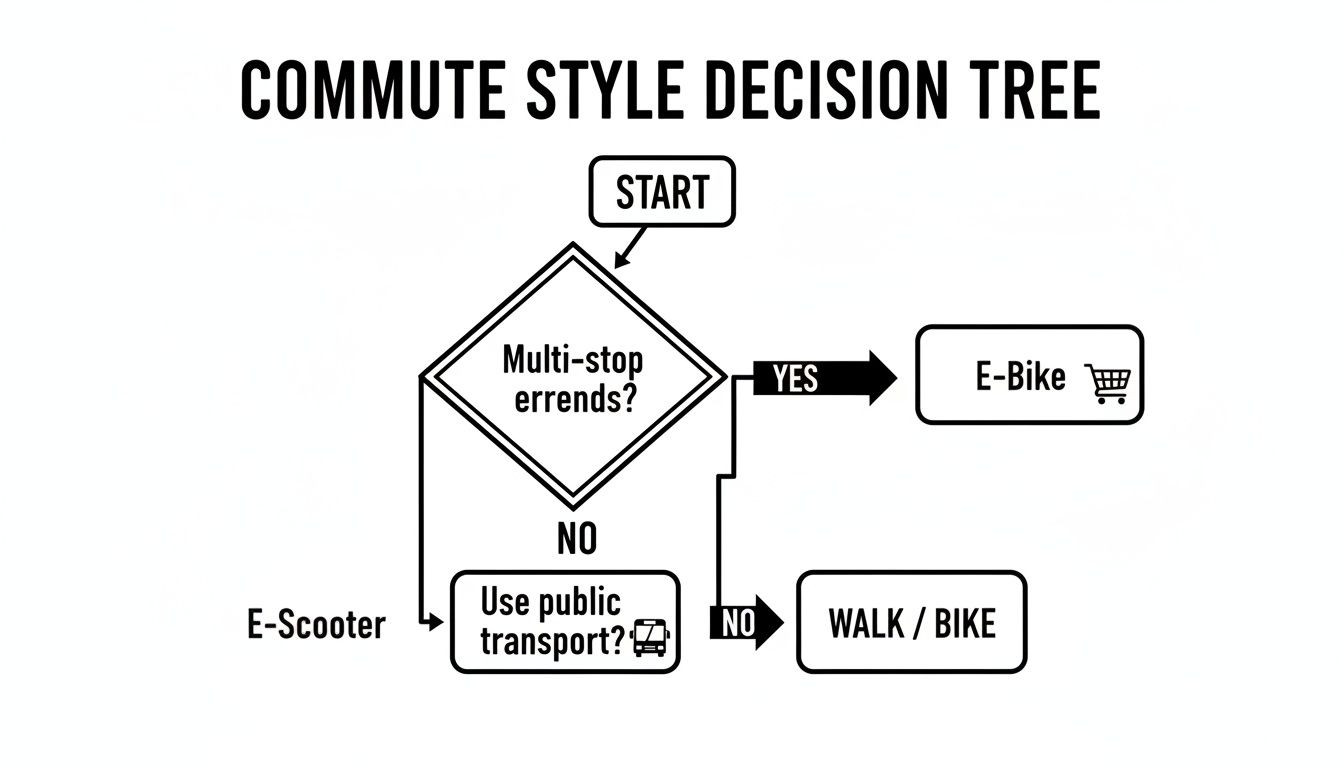
As you can see, it really boils down to an e-bike's all-around utility versus an e-scooter's perfect partnership with public transport.
The bottom line is a simple trade-off: E-scooters offer unbeatable portability for short hops, while e-bikes deliver superior range, comfort, and carrying capacity for just about everything else.
The market trends seem to agree. Driven by city living and green initiatives, the e-bike market is projected to grow by a 14.40% compound annual rate, hitting USD 193.23 billion by 2034. For Punk Ride customers in Florida, the UK, or Germany, brands like ISCOOTER and EVERCROSS are making some fantastic e-bikes that are perfect for commuters tired of high gas prices. You can read more about the booming e-bike market on fortunebusinessinsights.com. This massive growth really speaks to the e-bike's power as a complete transportation solution.
Got Questions? We've Got Answers.
Still wrestling with the e-bike vs. e-scooter decision? Totally normal. Sometimes it’s the little details that matter most. Here are the straight-up answers to the questions we hear all the time from riders trying to pick their perfect set of wheels.
Let's clear the air so you can choose with confidence.
If I Want To Get Fit, Which One Is Better?
Hands down, the e-bike. No contest here.
The whole point of an e-bike's pedal-assist is to help you, not do all the work for you. You're still pushing the pedals and getting your heart rate up, making it a brilliant way to sneak a workout into your daily commute.
An e-scooter, on the other hand, is all motor. You just stand there and go. It’s great for getting from A to B without breaking a sweat, but it offers zero fitness benefits. If exercise is even a small part of the equation for you, an e-bike is the only real answer.
What's The Deal With Maintenance?
E-scooters are generally a bit simpler to look after. For the most part, you’re just keeping an eye on tire pressure and making sure your brakes feel sharp. With fewer moving parts like chains and gears, there’s just less that can go wrong day-to-day.
E-bikes are built more like their non-electric cousins, so they need a little more love. You'll have to keep the chain lubed, maybe tweak the gears now and then, and check on the brake pads. The big one for both, though, is the battery. Expect to replace it after about 3-5 years of solid use.
Here's the bottom line: An e-scooter is often less intimidating for a total beginner to maintain. But, since e-bikes share so many parts with regular bicycles, any bike shop on any corner can easily handle repairs.
Can I Ride These Things In The Rain?
You can, but you need to be smart about it. Most quality e-bikes and e-scooters are built to be water-resistant, meaning they can handle a light drizzle or a splash from a puddle just fine. Look for the IP (Ingress Protection) rating on the model you’re considering.
What you can't do is treat them like a submarine. Heavy downpours or riding through deep water is a surefire way to fry the battery and electronics. Always check the manufacturer's specific guidelines, and when the weather turns nasty, ride with extra caution.
Ready to find the ride that just gets you? Punk Ride has a handpicked lineup of the best electric bikes and scooters out there. Whether you’re looking to own the city streets or just conquer that last mile to the office, we’ve got your back. Explore our collection at Punk Ride and start your next adventure today!
Share:
Your Guide to the Electric Bicycle 500w
Your Ultimate Guide to the Best Step Through Ebike