


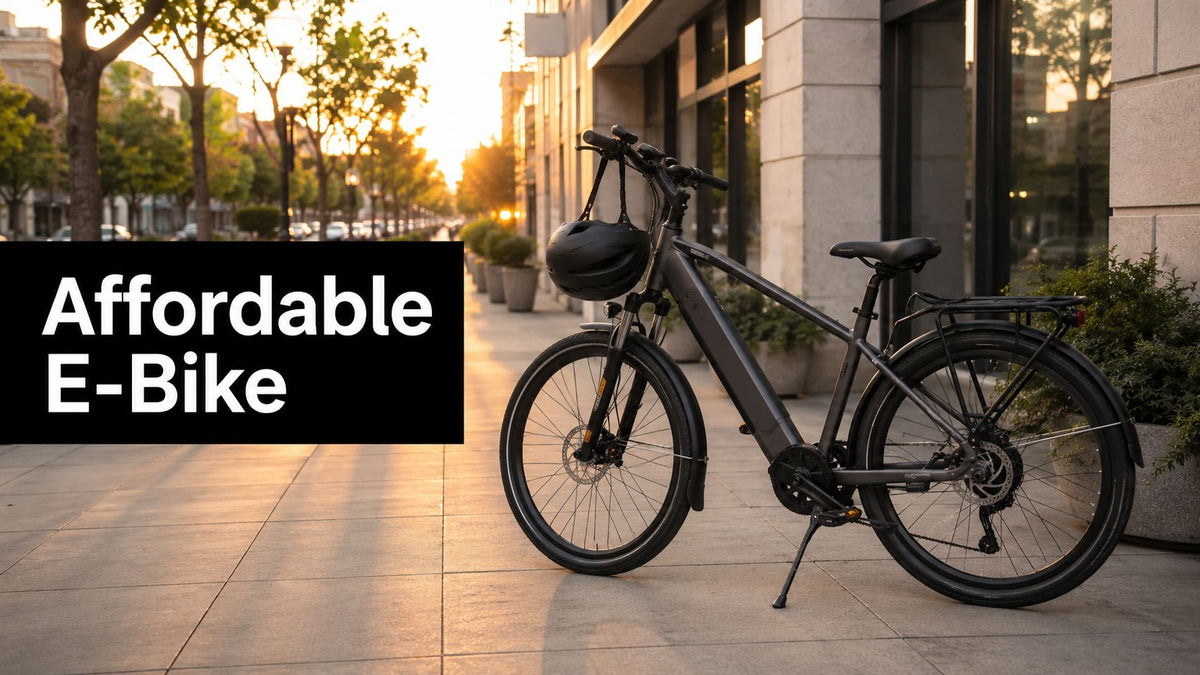
You're outside the station, locking up a bike that cost less than a decent phone. Your helmet is still warm from the morning ride, your shirt is damp from the final hill, and you're already wondering whether the battery will make the trip home. The cheapest electric bike looked sensible online. In daily use, the important question is different: will it remain useful and affordable after the purchase day?
An affordable electric bike for commuting should reduce transport costs without creating a new maintenance headache. That means judging the battery, motor, brakes, legal status, storage demands, warranty, replacement parts, and service support as one package. I'd rather pay more for a dependable commuter than save at checkout and spend the next few years chasing faults.
What Affordable Really Means for a Commuter E-Bike
A low sticker price tells you little about whether an e-bike is affordable. Judge the bike by its total ownership cost, including the purchase price, routine maintenance, insurance, and a possible battery replacement during the time you plan to keep it. Electric bikes have served as practical transport longer than many buyers realise. Ogden Bolton Jr. filed the first electric bicycle patent in 1895, and the global market was estimated at US$69.7 billion in 2025, with projections of US$77.9 billion in 2026 and US$144.3 billion by 2033, according to a 2025 industry forecast from Evelo's history of electric bicycles. That scale supports better parts availability, battery development, and price competition.
For buying purposes, I use three rough tiers:
- Sub-$1,200 entry level: Suitable for flatter routes and basic paved commuting. Expect simpler drivetrains, less polished displays, modest battery provision, and limited dealer support.
- $1,200 to $2,200 core commuter: I'd start looking seriously here. Bikes often provide better braking, smoother assistance, stronger frames, useful accessories, and more convincing warranty coverage.
- $2,200 to $3,000 premium budget: You're paying for refinement, lighter construction, stronger service networks, better integration, and components that can make daily riding less tiring.
A $900 bike with a battery or controller failure in month eight can cost more than its price suggests. Add diagnostic time, replacement parts, insurance, and missed rides. A $1,800 bike that stays dependable for years may produce the lower first-year and three-year cost, even before you value your time and inconvenience.
My buying rule: Pay for the parts you use every day, especially the battery, brakes, frame fit, and local support. Don't pay extra merely for a fashionable logo or oversized motor rating.
Before shopping, calculate your weekly kilometres, inspect the route surface, and decide where the bike will live. Indoor storage, a damp shed, and outdoor covering create different demands. Those answers narrow the right bike faster than endless product-page browsing.
Matching Battery and Motor Power to Your Daily Route
Your battery choice should follow the route you ride, not the range printed on a product page. Build in room for weather, detours, hills, and gradual battery ageing before comparing models.

Start with distance
Measure your round-trip commute in kilometres and multiply it by 1.3. That buffer covers route changes, wind, inefficient riding conditions, and battery degradation. A 15 km round trip therefore gives you a planning target of 19.5 km.
Treat the result as a planning method, not a guarantee. Rider weight, pedalling effort, terrain, temperature, tyre pressure, and assist level all affect consumption. Newurtopia's commuter buying guide associates a 400Wh battery with roughly 20 to 40 miles of range, while stressing that real-world performance varies.
Convert the route into battery capacity
For a flat route, allow roughly 8 to 12 Wh per kilometre. Hilly routes may need 15 to 20 Wh per kilometre. Multiply your buffered distance by the relevant energy range, then choose the nearest practical battery size. Commuter bikes commonly use batteries from 300Wh to 700Wh.
A removable battery earns its place if you live in a flat, store the bike away from a socket, or charge at work. Carrying the battery indoors is far easier than hauling the whole bike upstairs. For many commuters, that daily convenience matters more than a small increase in motor output.
Match the motor to the hills
A 250W hub motor handles gentle urban grades when you maintain steady pedal pressure. Repeated climbs justify a 250W mid-drive motor with a torque sensor. It works through the bike's gearing and responds to how hard you pedal, giving better control on hills. Hub motors keep the layout simpler and often reduce the purchase price, so they remain sensible for flatter routes.
Motor power alone does not determine climbing performance. Gearing, rider effort, total load, gradient, and battery charge all affect the result. Choose the system that matches the hardest part of your regular route rather than paying for a larger rating you rarely use.
Protect the battery's long-term value. Avoid storing it empty, keep it away from extreme heat and moisture, and follow the manufacturer's charger instructions. Most batteries are estimated to last 500 to 1,000 charge cycles, or roughly three to five years for daily commuters, according to the guide's battery guidance. Keeping the charge around the middle when practical can reduce stress, but convenience matters more than chasing a perfect percentage. Include eventual battery replacement in your first-year and three-year ownership budget, especially if the bike will cover a high weekly distance.
Must-Have Features and the Trade-Offs Worth Accepting
The best commuter is not the bike with the longest specification sheet. It's the one that starts cleanly, brakes predictably in rain, carries your work gear, and doesn't punish you every time the road surface changes.
| Feature | Budget Option | Better Option | Impact on Daily Commute |
|---|---|---|---|
| Brakes | Mechanical discs or basic rim brakes | Hydraulic disc brakes | Hydraulics offer stronger, more controlled braking, especially in wet stop-start traffic |
| Gearing | Single speed | Derailleur gearing or an internally geared system | Gears help on rolling routes and reduce strain on climbs |
| Drive system | Chain | Belt drive | Belts stay cleaner and need less routine attention, but cost more and require compatible frames |
| Frame | Diamond frame | Step-through frame | Step-throughs make repeated mounting easier, while diamond frames can feel stiffer and sportier |
| Assistance | Basic cadence sensor | Torque sensor | Torque sensing gives smoother low-speed response and better control at junctions |
| Fork | Rigid fork | Lockable suspension fork | A rigid fork saves weight on smooth roads; suspension helps on broken surfaces but adds mass |
| Lighting | Clip-on lights | Integrated front and rear lights | Integrated lights are harder to forget and better suited to daily use |
I prefer hydraulic discs for riders commuting through wet weather or carrying a heavy bag. Mechanical discs are easier to adjust at home, but they need more frequent cable and pad attention. Rim brakes can work on clean, dry roads, yet they're a compromise once rain, grit, and repeated junction stops become part of the routine.
A single-speed belt drive is excellent for a flat city and riders who value quiet, clean running. On rolling routes, a derailleur gives you more control and lets you keep a comfortable cadence instead of forcing the motor to do everything. Step-through frames suit stop-and-go traffic, work clothes, and riders who don't want to swing a leg over a tall rear rack.
Buy integrated lights, reflective sidewalls, and a smooth torque sensor before paying for decorative extras. I'd also choose a good saddle and ergonomic grips over a premium badge. A suspension fork sounds impressive, but on smooth cycleways it often adds weight without improving the ride enough to justify the penalty.
Before ordering, road-test these details:
- Controls: Decide whether a thumb control feels safer and more precise than a twist throttle.
- Display: Read the screen in direct sunlight while wearing the gloves you'll use.
- Storage: Measure the lift, doorway, stairwell, and charging space.
- Fit: Check reach, saddle height, handlebar position, and easy access to the brakes.
- Practical kit: Confirm that mudguards, rack, kickstand, and lights are included rather than optional.
Beyond the Sticker Price: What Commuter E-Bike Ownership Really Costs
A commuter e-bike that looks affordable at checkout can cost more over its first year than expected. Electricity is usually a minor expense. Maintenance, security, insurance, accessories, and a future battery can determine whether the purchase delivers value.
A 2026 commuter e-bike cost analysis places typical upfront prices at US$1,500 to US$2,800, annual charging for a 10-mile daily commute at about US$8 to US$10, and annual maintenance around US$100 to US$200. It estimates first-year savings of US$900 to US$1,500, followed by US$1,000 to US$3,000 or more in later years compared with car ownership. Use those figures as a comparison, not a promise. Your route, local labour rates, security needs, and insurance choice will change the result.
Independent results from E-Bike Study put electricity at about $0.22 per 100 miles in one multi-bike study, with riders charging every 28 miles on average. Battery size, electricity tariff, riding style, hills, weather, and load all affect your actual bill.
A practical ownership model
For a hypothetical 15 km round-trip commuter, map the distance across your working pattern, then allow for detours and poor-weather trips. Estimate electricity from the battery's watt-hours and your local tariff. Add annual servicing, brake pads, tyres, drivetrain wear, a proper lock, panniers, lights, and insurance if you choose it.
The battery deserves its own line in the spreadsheet. Ask the seller for the exact replacement price before ordering, check whether the pack is readily available, and include that cost in your later ownership years. A low purchase price is poor value if replacement support is vague or the battery is difficult to source.
| Cost Category | Budget E-Bike | Mid-Range E-Bike | Premium E-Bike |
|---|---|---|---|
| Purchase price | Lowest initial outlay | Higher upfront cost | Highest upfront cost |
| Electricity | Usually a small running expense | Usually a small running expense | Usually a small running expense |
| Maintenance | More frequent adjustment may be needed | Moderate, with better components | Often lower friction, but specialist parts can cost more |
| Insurance | Optional, depending on needs | Worth pricing before purchase | More important as replacement value rises |
| Battery replacement | May arrive sooner if the pack or support is weak | Easier to plan when the battery is documented | Expensive, but premium support may simplify replacement |
| Service access | Online support or independent shops | Broader dealer and workshop options | Strongest support when purchased through an established network |
Calculate both the first-year total and the three-year total, then divide each by the years you expect to ride. That cost-per-year figure gives a clearer value comparison than two sticker prices alone.
Understanding E-Bike Laws in the UK, EU, and Australia
A bike that looks like a normal commuter can still be illegal on public roads. Check its classification before buying, especially if the seller imports it across borders.
In the UK, a road-legal Electrically Assisted Pedal Cycle, or EAPC, requires pedal assistance, a maximum continuous motor power of 250W, and assistance that stops at 15.5 mph, or 25 km/h. Bikes meeting those conditions do not need registration, insurance, or a licence, according to UK e-bike legal guidance reported by ZAG Daily. A throttle-equipped or faster model may fall outside the EAPC category and face separate requirements.
Across the EU, conventional pedelecs generally follow EN 15194 and Regulation (EU) No 168/2013. Their continuous motor power is no higher than 250W, and assistance stops at 25 km/h while pedalling, as outlined in this EU e-bike legal overview. National rules can still differ for throttles, helmets, rider age, lighting, and permitted riding areas.
Australia is working toward closer harmonisation around EN 15194. NRMA on Australian e-bike sales and regulation describes a framework centred on a 250W continuous motor limit, a 25 km/h pedal-assist cutoff, and a 6 km/h throttle limit. State and territory rules still decide requirements for paths, footpaths, helmets, and equipment.

Before riding an imported bike, request the conformity declaration and inspect its type-approval or compliance label. A non-compliant model can cause warranty problems, insurance disputes, and enforcement risk. For the category boundary, read this moped versus e-bike comparison.
The following video offers another visual explanation of the category differences:
Why the Cheapest Option Rarely Wins Long-Term
A low-priced e-bike may look sensible for a daily commute, then become expensive once repairs, downtime, and replacement parts enter the budget. Weak components create a chain of costs, downtime, and safety compromises. Judge the purchase by its first-year and three-year ownership cost, not the checkout price.
Bargain models often rely on poorly documented battery cells, generic controllers, basic sensors, and braking systems that demand more attention in heavy urban use. A controller that cuts power under load makes hills frustrating. Brakes needing frequent adjustment mean workshop bills, lost commuting time, or equipment you do not fully trust.
The cost pattern is predictable:
- Weak braking: More adjustments and earlier pad or rotor replacement.
- Basic drivetrain: More work on chain wear, shifting, and lubrication.
- Poor battery sealing: Greater concern when rain is part of the commute.
- Thin support network: Longer waits and more difficult searches for compatible parts.
- Vague specifications: Uncertainty about range, warranty exclusions, and battery replacement cost.
A growing e-bike market gives buyers more choice, but it also places poorly supported imports beside established commuter products. Industry history shows how quickly the category has expanded, so inspect the company's support record rather than assuming a low price reflects efficient manufacturing. Include routine servicing, likely battery replacement, and insurance in your ownership model.

Before buying, request the battery price, warranty exclusions, service rates, and parts availability in writing. Compare the initial price with expected first-year spending, then test whether the three-year total still beats a better-supported model. A cheaper bike delivers poor value when repairs and unavailable parts keep it off the road.
Your Shortlist and Next Steps Before You Buy
Reduce the choice to two or three bikes and score them against the same route. Don't compare one model by price, another by advertised range, and a third by motor power. That method guarantees confusion.
Use this checklist:
- Price and legality: Confirm the motor, assistance cutoff, throttle arrangement, and regional compliance.
- Route range: Use the battery calculation above, then keep a reserve for wind, hills, and detours.
- Hill performance: Test the steepest climb on your route, not a flat car park.
- Weight and storage: Lift the bike, remove the battery, and check your building access.
- Stopping power: Test braking from normal commuting speed, including on a damp surface where safe.
- Ownership support: Confirm warranty coverage, service location, replacement battery price, returns, and assembly requirements.
Reject any model with vague battery specifications, implausible range language, unfamiliar proprietary parts, or no clear route to service. A short test ride should include junction stops, rough pavement, hills, wind exposure, and the load you'll carry to work.

Punk Ride LLC offers commuter-focused electric bikes and scooters, including models with pedal assist, foldable frames, suspension, and high-capacity lithium batteries, with warehouses in the UK and Germany alongside its Florida headquarters. Visit Punk Ride LLC to compare available urban e-bikes, then request the exact warranty and replacement-battery details before choosing your commuter.
Share:
Hybrid Electric Bike Guide: What It Is and Who It's For
High Torque Electric Bike: What It Means and Why It Matters