


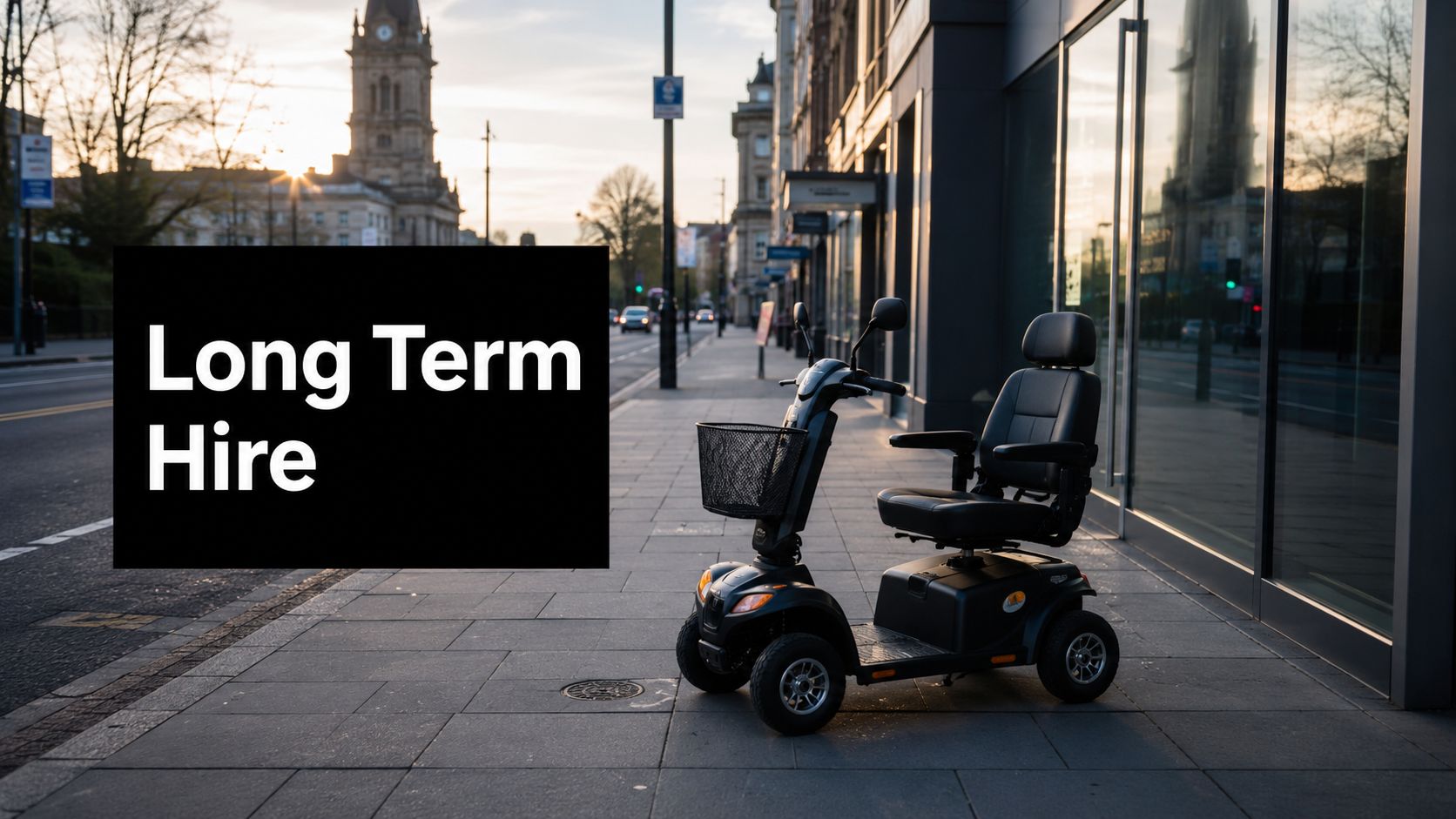
You're trying to keep moving across the city without buying a scooter outright, and that usually starts with a very practical question. How do you get something reliable for weeks or months, without getting trapped in a contract that's awkward, expensive, or hard to manage?
That's where long term mobility scooter hire makes sense for a lot of urban commuters, older adults, and people dealing with changing mobility needs. It sits between a one-off rental and full ownership, which means you get the convenience of a scooter without the commitment of buying, storing, and maintaining one yourself. If you're also thinking about broader city transport choices, the context around urban mobility helps frame why flexible hire is becoming a practical fit for modern commuting.
Introduction to Long Term Hire
A commuter doesn't usually wake up wanting paperwork. They want something that gets them from home to station, clinic, shop, or office without turning every trip into a planning exercise. Long term hire works for that kind of life because it gives you access to a scooter for an extended period, while keeping the decision reversible if your needs change.
The key shift is simple. Short-term rental is built for temporary use, while long-term hire is built for repeated, routine access. That matters when your scooter stops being a holiday accessory and starts becoming part of your weekday rhythm. For people who aren't ready to buy, or who don't want to absorb repair bills and storage hassles, hire can be the cleaner option.
There's also a market reason this model has gained traction. The broader mobility scooter rental space is no longer tiny, with the global mobility scooter rental for travelers segment reaching USD 1.24 billion in 2024 and projected to reach USD 2.93 billion by 2033 at a 9.8% CAGR (Dataintelo market estimate). That doesn't just signal travel demand. It shows that fleet-based scooter access is becoming a normal service pattern, which is exactly the infrastructure long-term users rely on.
Understanding the Key Concepts
Long term hire is easiest to understand if you compare it to car leasing. You don't own the vehicle, but you get regular use, a defined agreement, and a provider that keeps the fleet moving. In scooter terms, that means the company absorbs the headaches of stocking units, rotating them, and keeping them serviceable, while you pay for access instead of ownership.
What changes when the hire period gets longer
A short rental is like borrowing a tool for the weekend. A long hire is more like having that tool assigned to your daily routine. The provider has to think about fleet utilization, which is the practical idea of keeping scooters out in the field and earning revenue instead of sitting idle in storage. That's why extended hire often comes with more structured terms, maintenance support, and delivery rules.
The category is bigger than many people assume. A peer-reviewed study cited an estimate of 350,000 mobility scooters in use in the UK, while another study reported annual sales of around 80,000 units per year and a user base of 300,000 to 350,000 at the time of publication (PMC study on UK mobility scooter use). That kind of installed base explains why long term hire isn't some niche side service. It's built on a mature user market with familiar servicing channels.

The terms that matter most
Two phrases show up again and again. Minimum hire period means the shortest length of time a provider will rent for under that deal. Fleet utilization is the provider's internal balancing act, keeping enough units available while avoiding unused stock. If you understand those two ideas, most of the pricing and service logic starts to make sense.
Practical rule: if the scooter is going to be used most days, the real comparison isn't just price per day. It's access, support, and how much admin the provider takes off your plate.
The wider rental market supports that logic. A separate scooter rental estimate places the broader market at USD 3.90 billion in 2026, with growth to USD 11.31 billion by 2033 at a 16.6% CAGR (market estimate). You don't need to read that as a tourism story alone. It's a sign that scooter access is being managed as a scalable service, not a one-off convenience.
Typical Contract Terms and Costs
Long term scooter pricing usually rewards commitment, but not in a perfectly linear way. A weekly rate isn't just seven day rates added together, because the provider's real cost changes once a scooter stays assigned to one user for longer. That's why long hire often uses a decreasing-rate structure, where the longer you commit, the lower the effective daily cost becomes.
Castlepoint Shopmobility gives a useful public example of how that looks in practice. Its long-loan schedule lists 1 week £60, 2 weeks £120, 3 weeks £170, and 1 month £200, plus a separate £22 delivery/collection charge for hotel or local delivery during Mon to Fri working hours (Castlepoint Shopmobility long-loan schedule). That's helpful because it shows the shape of the market, not just a single headline price.
What often sits outside the headline rate
One common mistake is to compare only the rental fee. In reality, the total can change once delivery windows, deposits, or location-based fees appear. Adapt A Home's London hire page lists pricing from £95 per week, with no deposit required, and says the price includes delivery, collection, and a full demonstration. It also notes that extra charges may apply for airport delivery, congestion zones, and out-of-hours requests (Adapt A Home mobility scooter hire).
That's the hidden-cost lesson in one sentence. A scooter may look affordable until the practical logistics get added. For a commuter, those extras matter because they can turn a decent weekly rate into a messy total if you live or work outside a provider's normal route.
Here's a simple way to compare quotes before you commit.
| Duration | Price | Delivery Fee |
|---|---|---|
| 1 week | £60 | £22 for local or hotel delivery during Mon to Fri hours |
| 2 weeks | £120 | £22 for local or hotel delivery during Mon to Fri hours |
| 3 weeks | £170 | £22 for local or hotel delivery during Mon to Fri hours |
| 1 month | £200 | £22 for local or hotel delivery during Mon to Fri hours |
If you're comparing contracts across devices or transport support, a useful parallel is rental reimbursement coverage, because it reminds you to ask what's reimbursable and what isn't before you sign anything.
Some offers look simple until you ask about delivery hours, deposits, and collection rules. That's where the real price usually hides.
A smaller but important market detail is that older UK studies placed annual scooter sales at about 80,000 units and the wider mobility equipment sector around £500 million annually (PMC study). Those figures matter because they explain why providers can support long-term contracts at all, there's already a large servicing and replacement ecosystem behind the scenes.
Managing Delivery Maintenance and Insurance
The easiest part of long-term hire is choosing the scooter. The harder part is living with it for months. That's where delivery method, servicing responsibility, charging access, and insurance details matter much more than the brochure ever suggests.

Delivery and access are part of the product
Some providers work through depots, others bring the scooter to your door. Depot-based collection can be more restrictive, but it may also keep costs lower. Doorstep delivery is more convenient, especially if you're managing stairs, limited transport, or a tight recovery schedule.
The practical issue is that delivery isn't always open-ended. Public information on hire operations shows that collection and return can be tied to opening hours, weekday windows, and limited access times. That matters because a scooter is only useful if the handover fits your schedule and your building access rules, not just the provider's calendar.
Maintenance sounds simple until the battery gets involved
Many listings say maintenance is included, but that phrase can hide a lot of operational detail. Who responds when the scooter stops charging properly? Who checks wear on tyres or brakes? What happens if the battery degrades halfway through a long hire?
Those are not edge cases. They're the questions that determine whether the scooter stays usable or turns into a recurring headache. If you live in an apartment, charging logistics matter too, especially if the scooter has to be parked near a socket, carried through shared spaces, or charged in a way that doesn't block access routes.
Practical rule: before you accept delivery, ask who handles repairs, how fast replacements are issued, and whether the scooter is swapped out or collected for service.
For insurance, don't assume the hire fee covers everything. You want to know whether the agreement includes third-party liability, accidental damage, and theft protection, because those are the exposures that can turn a simple rental into an expensive dispute. If you're checking scooter-related cover more broadly, electric scooter insurance is a useful reminder of the policy questions that matter before you commit.
A public critique from Qube OCA is especially useful here, because it points out that existing content often leaves out who handles repairs, battery degradation, indoor charging logistics, and depot access constraints (Qube OCA shop mobility page). That omission is exactly why long-term users need to ask better questions upfront.
Comparing Hire versus Purchase
The hire-or-buy decision gets confusing because people keep comparing the wrong things. They compare the scooter's sticker price to a rental fee, then stop there. That misses storage, servicing, replacement risk, and the fact that long-term hire is really a service contract, not just a product access fee.
What hire gives you, and what it doesn't
Hiring makes sense when flexibility matters more than ownership. If your mobility needs may change, or you're unsure which model fits your routine, hiring keeps the exit door open. It also offloads a chunk of maintenance responsibility, which is often the hidden burden people underestimate.
Buying makes sense when the scooter becomes a permanent part of life and you want full control over it. You can choose accessories, store it where you want, and use it without asking permission from a provider. The trade-off is obvious. You own the repair problem too.
The hard part is break-even logic, and that's where a lot of guides stay vague. A review of hire-or-buy content notes that existing guides rarely quantify when long-term rental becomes more expensive than ownership or compare hidden costs clearly (Felgains hire-or-buy guide). That's a real gap, because the right answer depends on duration, deposits, maintenance, and how often you use the scooter.
A simple decision frame
Ask yourself three questions.
- How predictable is your need? If it's uncertain, hire is usually easier to step into.
- Can you handle servicing and storage? If not, buying creates more overhead than it first appears.
- How long will you use it most days? The longer the period, the more ownership starts to look logical, especially once hire fees stack up.
There's also a funding angle for people comparing mobility equipment against other transport choices. If you're weighing financing-style decisions in another market, e-bike financing options in Canada offer a useful example of how structured monthly payments can change the affordability conversation.

The decision often comes down to freedom versus certainty. Hire gives you certainty about support and flexibility about commitment. Buy gives you certainty about ownership and flexibility about use, but only after you absorb the upfront cost and ongoing maintenance burden.
How to Choose a Hire Provider
For long-term users, the best provider is rarely the cheapest one on day one. The best provider is the one that can keep the scooter working, get it to you without friction, and answer questions fast when something goes wrong. That matters more in urban travel, where missed handovers and delayed repairs can disrupt the whole week.
Start with network density
If a provider has broad coverage, the hire is easier to live with. Scootaround says it rents mobility scooters in more than 2,500 locations across North America and Europe, which is a good benchmark for network density because it reduces delivery friction and supports maintenance rotation for longer rentals (Scootaround locations). In plain terms, more locations usually means fewer handoff problems and better unit availability.
That's a useful principle for UK and EU users too. Dense coverage matters because long-term hire isn't just about getting a scooter once. It's about whether the provider can service, swap, or collect it again without turning every support request into a logistical puzzle.
Then check the contract, not the sales copy
Look for the terms that decide how painless the hire really is.
- Delivery and collection rules: Ask where they deliver, when they deliver, and whether there are out-of-hours charges.
- Maintenance responsibility: Confirm whether repairs, replacements, and battery issues are covered.
- Model specifics: Make sure you know the exact brand and model, not just “standard scooter.”
- Flexibility: Ask whether the contract can be extended, shortened, or changed if your mobility needs shift.
- Support response: Find out what happens if the scooter breaks on a weekend or during a trip.
If you want a broader view of equipment comparison before you commit, the compare electric scooter guide is a helpful reminder that specs only matter when they match real use.
Punk Ride's lineup includes brands such as ISCOOTER, AOVO, DUOTTS, HITWAY, RCB, COLORWAY, KOOLUX, HIDOES, IENYRID, DRIVETRON, CYSUM, MINIWALKER, ONESPORT, OOTD, RUITOO, EVERCROSS, ELEGLIDE, KIXIN, MANGOSTEEN, MOTORAD, ENGWE, PIXAR, TOUROLL, and others, which shows how much variety users face when comparing ride options. Even if you're not buying from a catalog like that, the lesson is the same. Model differences matter, and vague descriptions are rarely enough.
Essential Renter Checklist
Before you sign, slow down and verify the details that cause most long-term headaches later.
- Contract length: Confirm the minimum hire period and any extension rules, because a “long-term” deal can still have strict limits.
- Exact model and condition: Ask for the brand, model, and whether the scooter is new, refurbished, or swapped from existing stock.
- Battery and charging terms: Check how charging works, whether a charger is included, and what happens if battery performance drops.
- Insurance coverage: Verify what's covered for damage, theft, and liability, not just what's mentioned in a brochure.
- Deposit and refund terms: Make sure you understand when money is returned and what can be deducted.
- Maintenance contacts: Get a direct phone number or email for repairs and breakdown reporting.
- Depot or delivery hours: Confirm when the scooter can be collected, dropped off, or swapped.
- Emergency procedure: Ask what happens if the scooter fails while you're out, because that's when support matters most.
Each of those checks protects you from a different kind of surprise. If the provider can't answer one of them clearly, that's a warning sign.
Simple test: if you can't explain the total hire arrangement to someone else in one minute, you probably don't understand the contract well enough yet.
The goal isn't to overcomplicate the decision. It's to make sure the scooter works for your life, not just for the provider's booking system. A good hire should feel boring in the best way, because the process behind it is organized, transparent, and easy to repeat.
Final Summary and FAQs
Long term hire works best when you want mobility without the burden of ownership. It's especially useful if your needs may change, if you'd rather not handle repairs, or if you want a clear monthly-style access model instead of a purchase decision that locks you in. The main trick is reading the contract like a logistics document, not just a price sheet.
Can I swap models mid-hire period? Sometimes, yes, but only if the provider allows it. Ask before signing, because flexibility isn't guaranteed.
What happens if I need to pause my hire? That depends on the contract. Some providers may have pause rules or minimum billing periods, while others won't.
Are there EU funding or NHS reimbursement options for UK users? These can exist in some cases, but they depend on local eligibility and provider arrangements, so you need to check the specific scheme rather than assume coverage.
If you want the cleanest outcome, focus on three things. Clear pricing, service responsibility, and delivery that fits your real life. Get those right, and long term hire becomes a practical mobility solution instead of a stressful compromise.
If you're ready to compare models, contracts, and availability with a sharper eye, visit Punk Ride LLC and use this guide as your checklist before you commit.
Share:
Master Your Bike Axle Nut: Selection & Install
What Is Class 3 Ebike: Your 2026 Guide to Speed & Laws