


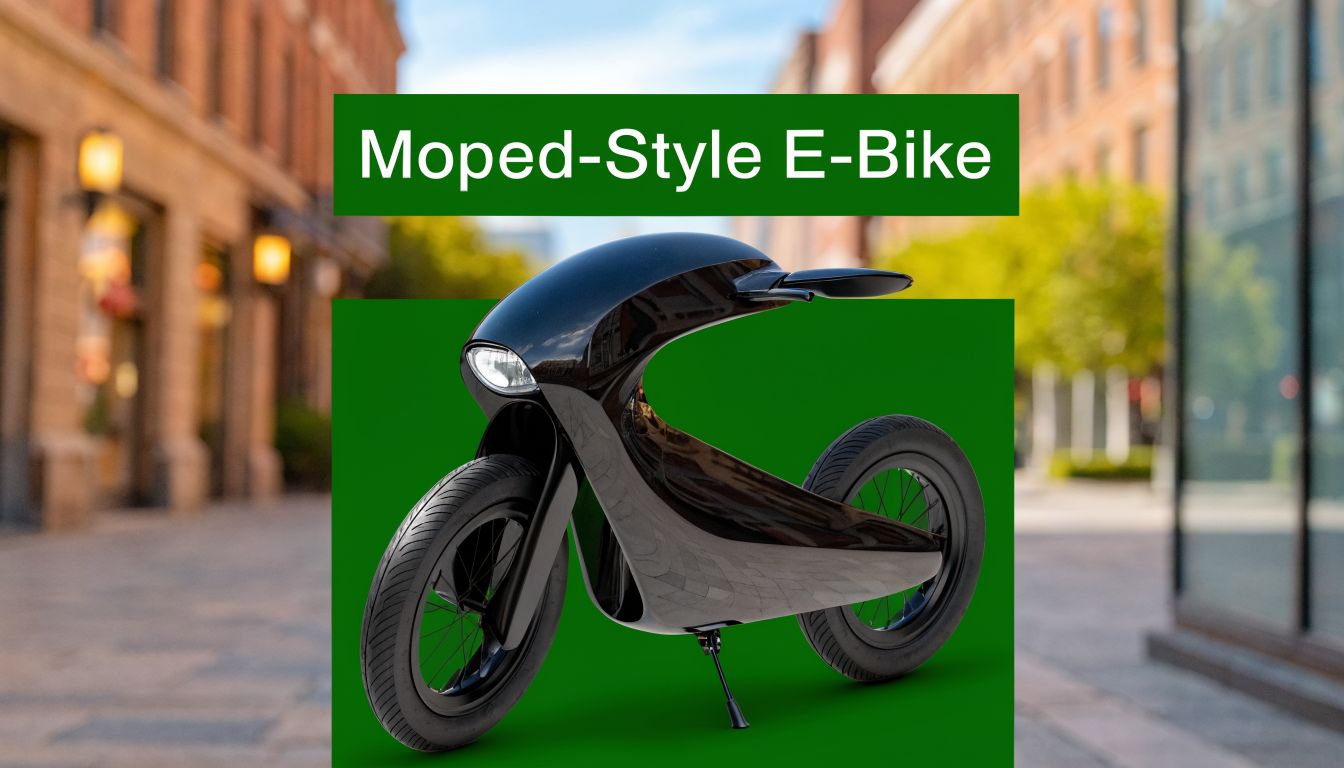
You're probably looking at one of these bikes for the same reason most riders do. A normal commuter e-bike feels a bit too bicycle-like for the roads you ride, but a petrol moped brings cost, paperwork, noise, and a whole different ownership headache. The electric bike moped style sits right in that gap.
It looks tougher, rides lower, and usually feels more planted than a skinny-tyre city e-bike. But this category also creates more confusion than almost anything else in personal electric transport, especially once throttles, motor power, and UK or EU rules enter the conversation.
What Is an Electric Bike Moped Style and Why Are They Everywhere
A moped-style electric bike is usually easy to spot before you read a single spec line. Long bench seat. Chunkier frame. Fat tyres. Lower-slung stance. Often a headlight setup and overall shape that nods more toward a mini motorbike than a traditional bicycle.

That design isn't just for show. Riders choose this format because it feels solid under them, especially in rough city streets, broken tarmac, canal paths, and mixed-use urban routes where a twitchy little scooter can feel nervous. The seating position is usually more relaxed, and the bike often gives you a stronger sense of road presence.
The category has also moved well beyond novelty status. Consumer interest in moped-style e-bikes surged 340% since 2024, with sales growing by over 40% year-over-year in 2025, according to Victrip's market commentary on the rise of moped-style e-bikes. That kind of momentum explains why you're seeing them in more city centres, more social feeds, and more shop windows.
Why riders are drawn to them
Some buyers want comfort. Others want style. A lot want both.
Three practical reasons keep coming up:
- More stability: Fat tyres and a heavier chassis often feel calmer on poor surfaces.
- More confidence: The motorcycle-like stance appeals to riders who never felt at home on a standard bicycle frame.
- More utility: The long seat and stronger platform often suit short urban errands, casual leisure rides, and mixed commuting.
Practical rule: If a rider says, “I want something that feels more substantial than a bike but less committed than a motorbike,” they're usually describing the electric bike moped style.
Why they fit city life so well
Urban transport has become awkward. Trains are crowded, parking is expensive, and short car trips make less sense than they used to. Moped-style e-bikes work because they match how people move around town. They cover moderate distances, deal better with stop-start traffic, and don't ask the rider to fully buy into motorcycle ownership.
They also scratch an emotional itch. Let's be honest. Plenty of people want a ride that feels fun before it feels sensible. This category manages both when it's chosen properly and used legally.
Not a Scooter Not a Moped So What Is It
The easiest way to understand the electric bike moped style is to compare it with the two machines people confuse it with most. The first is the e-scooter. The second is the petrol moped.
Both comparisons matter because the riding experience, storage needs, and legal assumptions are different.

Where it beats an e-scooter
An e-scooter wins on portability. That's about it for many riders.
A moped-style e-bike usually gives you a proper seated ride, bigger tyres, better bump absorption, and stronger confidence over potholes, painted road lines, and rough curb cuts. If you commute in ordinary clothes or carry a bag, that matters. If you ride in rain or over poor surfaces, it matters even more.
Scooters are handy when you need to fold and carry the machine into a flat or office. They're less appealing when your route includes bad road surfaces, longer distances, or regular traffic interaction.
Where it differs from a gas moped
A petrol moped feels more like a motor vehicle because it is one. It comes with the noise, refuelling, engine servicing, and legal structure that go with that. A moped-style e-bike can look similar from a distance, but ownership often feels much closer to an e-bike than to a motorbike, assuming the model stays within the relevant legal framework.
That's the big fork in the road. Some models stay near bicycle rules. Others drift toward moped territory once power, speed, or throttle setup crosses local thresholds.
For a broader side-by-side look at category overlap, this guide on electric bike vs moped differences is useful if you're still deciding where you sit.
Moped-Style E-Bike vs. E-Scooter vs. Gas Moped
| Feature | Moped-Style E-Bike | E-Scooter | Gas Moped |
|---|---|---|---|
| Riding position | Seated, relaxed, more planted | Standing, compact | Seated, motor-vehicle feel |
| Tyres and road feel | Usually larger and more stable | Smaller wheels, less forgiving | Stable, built for road use |
| Portability | Poor to moderate | Strong | Poor |
| Storage at home | Needs floor space | Easier in tight flats | Needs dedicated space |
| Maintenance style | Bike and electrical components | Scooter and electrical components | Engine, fuel, and mechanical systems |
| Style appeal | Between bike and mini moto | Functional and compact | Traditional motor moped look |
| Typical ownership feel | Bicycle-adjacent | Last-mile transport | Motor vehicle ownership |
A lot of buyers don't want the smallest thing possible. They want the ride that feels least compromised once they're actually on the road.
The moped-style e-bike suits that buyer. It's less portable than a scooter and less formal than a petrol moped. That middle ground is exactly why it has taken off.
Navigating the Legal Labyrinth US vs UK and EU Rules
You buy a moped-style e-bike online, it arrives looking road-ready, and the first problem is not the battery or brakes. It is the paperwork you never knew you needed.
I see this all the time with imported bikes and marketplace listings. A seller labels something an e-bike because it has pedals. The law may treat that same machine as a moped, or refuse it outright for public-road use, once throttle behavior, motor rating, or assisted speed falls outside local rules.
How the US class system works
In the US, the first question is usually class, then state or city rules layered on top. The three-class model used across many states is straightforward on paper: Class 1 is pedal assist only up to 20 mph, Class 2 allows a throttle up to 20 mph, and Class 3 is pedal assist up to 28 mph. PeopleForBikes explains the framework clearly in its state e-bike law tracker.
That still leaves room for costly mistakes. A moped-style frame does not decide legality. The actual street-legal setup does. I tell buyers to confirm how the bike is delivered, not how it looks in photos. A bike sold with a throttle, higher assisted speed, or an off-road mode may fit one state's e-bike rules and fall outside another's.
Why UK and EU rules catch buyers out faster
The UK and EU start from a different baseline. The common road-legal bicycle standard is the pedelec. That means pedal assistance, a lower continuous rated motor output, and a cut-off at a lower assisted speed than many US buyers are used to. The UK government's electric bike rules page sets out the basic test.
This is the part many product pages gloss over. In the US, a throttle can still fit a recognised e-bike class. In the UK and much of the EU, throttle use is much tighter, and once a bike sits outside pedelec rules, you are often no longer dealing with bicycle law at all. You may be in moped territory, with registration, insurance, licensing, type approval, helmet rules, and restrictions on where the bike can be used.
Pedals do not make a bike legally simple. Configuration does.
The practical difference that matters most
Here is the comparison buyers need before they click checkout:
| Legal issue | US approach | UK and EU approach |
|---|---|---|
| Starting point | E-bike class system, then state-specific rules | Pedelec rules first |
| Throttle treatment | Commonly allowed in Class 2, subject to local law | Often restricted or excluded from standard road-legal bicycle status |
| Power limit focus | Depends on state definition and bike class | Much stricter for road-legal bicycle status |
| What triggers reclassification | Speed, throttle setup, local vehicle code | Throttle behavior, power rating, assisted speed, approval status |
| Common buyer mistake | Assuming all states treat a class label the same way | Assuming any bike sold as an e-bike is road legal |
That difference changes what a safe purchase looks like. In the US, buyers usually ask, “What class is it in my state?” In the UK or EU, the better question is, “Does this bike remain a road-legal pedelec, or has it crossed into moped rules?”
Questions to put to any seller
Ask these before you pay:
- Which market is this exact configuration intended for: US, UK, EU, or private land only?
- Does the throttle work from a standstill, or only under specific conditions?
- What is the continuous rated motor output for road use?
- At what speed does motor assistance cut off?
- If it falls outside pedelec rules, what registration or licensing does that trigger?
For UK buyers, the licensing side catches people by surprise. If the bike is really closer to a moped in legal terms, the Flex Electric guide to motorcycle licences is a practical place to check what that means before you spend a penny.
If you want a broader plain-English check on category legality, Punk Ride also covers whether electric mopeds are road legal.
The buying rule that saves the most grief
Treat legality as part of the product spec. Ask for the compliance details in writing. A “moped-style e-bike” describes the shape and riding position. It does not tell you which rules apply on your street.
Key Features and Performance Specs to Evaluate
Most spec sheets are cluttered. Riders end up staring at motor wattage, battery figures, brake names, and tyre sizes without knowing what any of it will feel like on Tuesday morning when they're late for work and climbing a hill.
Start with the parts that change the ride the most.

Motor power that matters in real life
For this category, motor output isn't just about top-end bragging rights. It changes how the bike gets moving, how it handles hills, and how stressed it feels with a heavier rider or load.
Moped-style e-bikes often feature high-torque 750W to 1500W motors, which improves acceleration and hill-climbing compared with standard 250W to 500W commuter e-bike motors, according to Victrip's moped-style e-bike buying guide.
That translates into simple real-world differences:
- Lower-power commuter setups: Fine on flatter routes and lighter loads.
- 750W-class systems: A sweet spot for riders dealing with hills, stop-start traffic, or a larger frame.
- 1000W and above: Better for stronger launch feel or rougher use, but legal suitability becomes much more important.
A weak bike on paper can still feel fine on a smooth flat cycle path. It falls apart when the route gets steep, windy, or crowded.
Battery figures you can actually use
A lot of buyers focus on voltage because it sounds technical. Range usually depends more on the whole system and how you ride than on one spec in isolation. For moped-style bikes, battery size matters because these machines are heavier and often encourage more throttle use, where legal.
What works in practice is matching battery size to your routine, not to a fantasy weekend ride. If your round trip is short and you charge at home, you don't need to chase the biggest battery available. If you ride longer urban loops, carry cargo, or don't want range anxiety in cold weather, bigger capacity starts making more sense.
Workshop note: Range claims mean less than route honesty. Hills, rider weight, tyre pressure, and throttle use can change the day more than the brochure does.
Brakes, tyres, and suspension
At this stage, many buyers make poor trade-offs. They overspend on motor power and underspend on stopping and control.
Look hard at these:
- Brakes: Hydraulic disc brakes usually give better modulation and less hand fatigue than mechanical discs, especially on heavier bikes.
- Tyres: Fat tyres aren't just a style cue. They can add comfort and confidence on rough surfaces, though they may feel slower and heavier to pedal unassisted.
- Suspension: Useful if your city roads are cracked, patched, or lined with speed cushions. Less essential if your route is consistently smooth.
Frame and seating layout
Long bench seats look cool, but they also affect fit. Some riders love the open position and easy step-over feel. Others discover they can't get ideal pedalling extension because the seating geometry prioritises style and relaxed cruising over efficient cadence.
That's why test rides matter. A bike can be mechanically solid and still be the wrong shape for your knees, back, or daily route.
The Good The Bad and The Bulky Pros and Cons for Commuters
The best thing about the electric bike moped style is also the thing that causes the most buyer regret. It feels substantial. That's great on the road. It's less great when you need to carry it through a gate, lift it up steps, or wedge it into a hallway.

Where these bikes shine
For urban riders, comfort is a big part of the appeal. The seat is usually more forgiving than a standard bike saddle, and the riding position tends to feel calmer and more relaxed. Many riders also like the extra road presence. Drivers notice a larger silhouette more readily than a slim commuter bike.
Then there's practicality. The longer seat and sturdier frame often make these bikes better for carrying a bag, lock, or small bits of daily gear. Some riders also prefer the way the bike feels at lower speeds in traffic. It can seem less twitchy and more confidence-inspiring.
Where owners get caught out
Storage is the first hard truth. These aren't ideal if you live up three flights of stairs or need to lift your bike often. A compact folding e-bike or scooter can be annoying to ride but easy to live with. A moped-style bike often flips that equation.
The second issue is attention. They look distinctive, and that can be good or bad. Riders love the visual appeal. Thieves may notice it too. So might neighbours, building managers, or local police if the bike looks more moped than bicycle.
The right buyer thinks about storage before colour, and theft risk before accessories.
A straightforward trade-off list
- Comfort wins: Better seating and a more planted ride make daily use easier for many riders.
- Bulk costs you: Tight flats, shared hallways, and stair access can turn ownership into a chore.
- Style has consequences: A striking bike draws interest. That includes the wrong kind.
- Road feel improves: Heavier builds often feel steadier, especially on rough urban surfaces.
If your route is rough, your storage is easy, and you want a bike with character, this format makes sense. If you need to carry the machine regularly, it usually doesn't.
How to Choose the Right Model for Your City Life
You finish work, step outside, and the bike has to do three jobs at once. It needs to get you home without draining the battery halfway up the last hill, fit where you store it, and stay on the right side of the law in your market. That is the buying test.
Start with the legal version of the bike you can use where you live. In the US, many moped-style e-bikes are sold in Class 2 or Class 3 form. In the UK and much of the EU, the standard road-legal pedelec rule set is tighter, especially on throttle use and continuous rated power. I see buyers get this wrong when they shop international listings. A bike that looks perfect on a US site can arrive as something that needs registration, insurance, or cannot be used as a normal e-bike at all in the UK or EU.
Match the bike to your actual week
Ignore the fantasy version of your commute. Buy for the boring Tuesday.
If your riding is mostly short urban trips on flat roads, a moderate motor and sensible battery usually make more sense than chasing top-end numbers. If your route includes steep grades, rough cut-throughs, stop-start traffic, or a heavy backpack every day, put torque, brake quality, and battery support near the top of the list. Published range figures are only a starting point. Rider weight, temperature, hills, tyre pressure, and throttle use can change the result fast.
Storage matters just as much as performance. A long, heavy bike is fine if it rolls into a ground-floor hallway or secure shed. It becomes a bad purchase if you need to wrestle it through a narrow door or carry it upstairs. I have talked plenty of customers out of bigger bikes for exactly that reason.
The four questions that narrow the field fast
-
Where will it live every day?
Measure the door, lift, gate, and storage spot before you order. -
What kind of riding fills most of your week?
Five miles on flat streets calls for a different setup than a hilly outer-city commute. -
Is the bike legal in your market as sold?
Check the class, throttle setup, assisted speed, and motor rating. Do not assume US, UK, and EU rules line up. -
Who will fix it when something fails?
Controllers, displays, brake sensors, and battery mounts are where cheap imports become expensive.
Buy support, not just specs
A lot of new riders compare only motor watts, battery size, and price. That misses the part that decides whether the bike is still usable a year later. Look for spare parts, a clear warranty, and a shop or service network that will work on the bike.
Brands such as ENGWE and DUOTTS are examples buyers often see in this category. If you are comparing smaller urban machines rather than full moped-style e-bikes, Punk Ride LLC also offers the Punk Rider Pro, which is an electric scooter rather than a moped-style e-bike, so it fits a different job.
A practical commuter setup also includes the basics you carry every day. A lock, weather layer, charger plan, and water matter more than cosmetic extras. For hydration on daily rides, compact reusable bottles for eco-conscious commuters are easier to live with than bulky bottles rattling around in a bag.
What usually works best
- Short city hops: Keep the bike light enough to handle, legally straightforward, and easy to park.
- Hilly or rough routes: Spend more on brakes, tyres, and motor response before spending on styling.
- Daily longer commutes: Put battery quality, dealer support, and replacement part availability ahead of raw speed.
- New riders: Budget for safety kit early, including a proper helmet for ebike riders, not after the first scare.
The right model is the one you will still want to ride in rain, traffic, and a bad mood. That is usually a better buying standard than any spec sheet.
Essential Safety and Maintenance for Your New Ride
A moped-style e-bike can feel so stable that new owners get overconfident. That's the first thing to avoid. These bikes are heavier, often quicker off the line, and less forgiving if you brake late into a wet junction.
Ride it like a heavy electric vehicle
Helmet first. No debate there. If you're still choosing one, this guide to the best helmet for ebike riders is a sensible place to start.
Then sort visibility. Use your lights even in daytime gloom, especially in UK and northern European weather where drivers often see late. Reflective details on a jacket, bag, or helmet help more than riders think because they break up your outline and catch attention at junctions.
Your basic maintenance routine
You don't need workshop skills to keep one of these bikes healthy. You do need consistency.
- Check tyre pressure: Soft tyres hurt range, handling, and puncture resistance.
- Look at brake feel: If lever pull gets spongy or weak, don't ignore it.
- Keep the chain clean: Dirt and neglect wear drivetrains quickly.
- Inspect lights and fasteners: Heavy bikes vibrate. Bolts can loosen over time.
A five-minute pre-ride check prevents more trouble than most accessory upgrades ever will.
Battery habits that save headaches
Battery care doesn't need to be obsessive. It needs to be sensible. Charge with the correct charger, avoid careless exposure to extreme heat or damp, and don't treat the battery like an afterthought because it's the most expensive part to replace.
For everyday commuting, practical kit helps too. A secure lock, weatherproof bag, and something easy to carry for hydration all make the ride easier. If you want compact carry options, these reusable bottles for eco-conscious commuters fit the kind of daily city setup many riders build around their e-bike or scooter.
Handling advice for the first week
Take the first few rides slowly. Practise low-speed turns, braking distance, and mounting or dismounting with the bike loaded. A moped-style e-bike often feels easy in a straight line, but its extra bulk shows up in tight manoeuvres and sudden stops.
New owners who respect that learning curve usually settle in quickly. The ones who don't tend to scare themselves in the first week.
Is a Moped-Style E-Bike Your Ticket to Urban Freedom
The electric bike moped style makes a lot of sense for the right rider. It offers comfort, presence, and a more substantial road feel than many standard e-bikes or scooters. It can turn a dull urban trip into something you thoroughly enjoy.
It also asks for honesty. These bikes are bulkier, harder to store, and more legally complicated than their styling suggests, especially if you're buying in the UK or EU from listings aimed at the US market.
The smart move is simple. Match the bike to your route, your storage, and your local rules. If the machine fits all three, a moped-style e-bike can be one of the most satisfying urban transport choices you'll make. Ride smart, ride safe, and buy the version that works in your real life, not just the one that looks good on a screen.
If you're comparing urban electric rides and want a realistic shortlist instead of marketing noise, Punk Ride LLC is a useful place to browse different categories side by side, especially if you're weighing e-bikes against scooters and want something that fits your commute, storage, and local road rules.
Share:
Installing Tires on Rims: Your E-Bike & Scooter Guide
Riding a Scooter in the Winter: 2026 E-Scooter Guide