


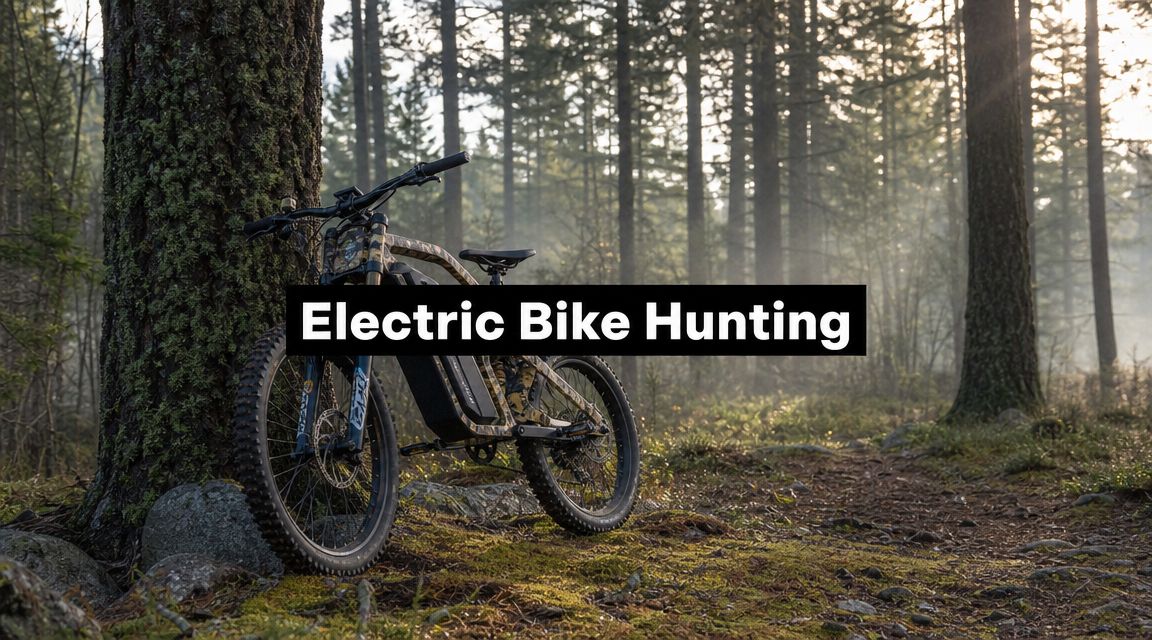
The usual start to a hunt is familiar. You're up well before daylight, pulling on damp boots, shouldering more weight than you'd like, and doing the quiet math in your head about distance, wind, and whether the walk in is going to burn too much energy before first light.
Then there's the other version. You load the bike the night before, roll out in the dark with a dim front light, and cover the same access route with less sweat, less noise than an ATV, and a lot more control over how fresh you are when you start the hunt. That's why electric bike hunting has caught on with serious hunters. It's not about replacing woodsmanship. It's about arriving with more gas in the tank and using access more intelligently.
That broader shift isn't just anecdotal. E-bikes have become a major category in their own right, with global sales reaching about 36.5 million units in 2022 and projections cited in 2024 putting the market on a path to roughly 77.3 million units by 2030 according to Strategic Market Research's e-bike statistics roundup. That matters because hunting bikes are riding the same wave of better batteries, stronger frames, and more specialized setups.
The New Edge in the Backcountry
A long walk before dawn has its place. Sometimes it's still the right move. But there's a clear difference between arriving at a ridge breathing hard with a sweaty back, and arriving there with your legs warm but your lungs steady.

For scouting, access, and retrieval, an e-bike changes the day in practical ways. You can stash the bike short of your final setup, cover logging roads or two-track, and save your climb for the part of the hunt that matters. Hunters who use them well don't treat them like a shortcut. They treat them like a pack frame or good boots. It's a tool that helps you do more of the hard part where it counts.
Where the advantage shows up
Three situations stand out fast in practice:
- Long approach routes: Old roads, ranch tracks, and legal access corridors stop feeling like dead miles.
- Evening exits: Riding out after dark is a lot different from stumbling back under a heavy pack.
- Recovery work: A bike and trailer can turn a punishing drag into a manageable haul if the terrain and rules allow it.
Practical rule: If the bike saves your legs for glassing, stalking, or hauling, it's doing its job. If it pushes you into sloppy route choices or legal gray areas, it's not helping.
Why hunters keep using them
The first benefit people notice is speed over low-value ground. The second is fatigue reduction. The third is that an e-bike gives you options on the way out, which is often the part people underestimate.
Electric bike hunting works best when you stop thinking of the bike as the center of the hunt. It's the support system. You still need route discipline, wind awareness, and a backup plan for when conditions turn rougher than expected.
What Makes an E-Bike a True Hunting Tool
A commuter e-bike can handle pavement, bike paths, and the occasional gravel lane. A hunting bike has a different job. It has to stay composed on loose surfaces, carry awkward gear, and keep traction when the trail gets soft, rutted, or steep.
Most buyers across the broader market still prefer pedal-assist setups. One source puts pedal-assisted electric bicycles at 88.36% of the global e-bike market, which fits what hunters tend to use as well, because pedal-assist keeps the ride feeling closer to a regular bike while still extending range and reducing effort, as noted in Himiway's e-bike market facts.
The difference between a hunting rig and a casual e-bike
A true hunting setup usually has some combination of:
- Fat tires: Better flotation and grip on mixed ground
- A sturdier frame: Built to carry gear without feeling sketchy
- Rack and trailer compatibility: Important for hauling more than water and a jacket
- Low-speed control: More useful in the woods than a flashy top-end number
- A quieter, more planted ride: Because rough access routes expose every weakness fast
A hunting bike doesn't need to look tactical to work well. It needs to carry weight without wandering, stop cleanly on descents, and stay predictable when the trail surface changes.
The three real advantages
Stealth that's actually useful
The bike won't make you invisible, and plenty of hunters oversell this point. But compared with louder motorized access, an e-bike lets you move into position with less disturbance. That matters on access roads, field edges, and the sort of routes where noise travels before daylight.
Less scent spread on the way in
Walking a long route means more time brushing vegetation, more sweat, and more ground contact before you ever start hunting in earnest. An e-bike can reduce some of that human footprint on the approach, especially when you're using open tracks rather than weaving through cover.
Better energy management
This is the biggest one. Hunters make poor choices when they start the day already taxed. An e-bike doesn't hunt for you, but it can keep your legs fresher for climbing, stalking, or dragging meat later.
A good hunting e-bike is like a boot that rolls. It doesn't create skill, but it helps you spend your effort in the right place.
Staying Legal on Public and Private Land
A lot of hunting e-bike advice gets lazy here. It says “check local laws” and leaves it at that. That's not enough, especially in the US where public-land access can change by district, route type, and local management decisions.

The first thing to understand is simple. Land status matters more than your opinion about whether an e-bike “feels like a bicycle.” On some ground, that distinction works in your favor. On other ground, it doesn't.
Why district-level checks matter
BLM guidance discussed by ElkShape says Class 1, 2, and 3 e-bikes may be allowed where bicycles are allowed, but local managers can still restrict use based on conditions, which means practical access can vary by district rather than by state alone. That's the key point in ElkShape's breakdown of hunting e-bike access.
That local discretion is where hunters get tripped up. A statewide summary might make things look simple. The actual unit, ranger district, or management area may be stricter.
For a useful starting point, use a broad legal reference like this state-by-state electric bike laws guide. Then narrow down from there with the office that manages the exact ground you plan to ride.
A practical legality workflow
Use this order. It saves time and cuts down on assumptions.
-
Identify the land type
Is it private ground, state land, BLM, National Forest, wildlife area, or mixed ownership? Don't treat these as interchangeable. -
Confirm the route, not just the unit
A legal e-bike in one access corridor doesn't make every spur, trail, or closure area legal. -
Verify your bike class
Know whether your bike is Class 1, 2, or 3 before you call anyone. If you can't answer that clearly, you're not ready to ask for a ruling. -
Contact the local office directly
Ranger district offices, land managers, and local wildlife staff can usually tell you more than a statewide PDF can. -
Save what you find
Keep screenshots, emails, or regulation notes on your phone. If rules are confusing on the ground, documentation helps.
Public land versus private land
Private land is often simpler, but it isn't a free-for-all. You still need the landowner's permission, and local hunting rules still apply. Ask directly whether e-bike access is allowed and whether there are restrictions on roads, fields, gates, or wet-weather travel.
On public land, the mistake I see most often is assuming that if a mountain bike can go there, an e-bike can too. Sometimes yes. Sometimes absolutely not. If a manager restricts use because of trail conflict, resource concerns, or local conditions, that's the rule that counts.
Quiet access can create more conflict, not less. The farther hunters can slip in without much noise, the more important it becomes to know exactly where that access is legal.
Decoding the Specs of a Great Hunting E-Bike
A spec sheet looks great at the kitchen table. It gets honest fast when you are three miles up a logging road, carrying camp, and trying to climb a washed-out grade without burning half your battery before daylight.

For a quick visual on motor layout and why it affects handling and climbing, this video is worth a watch.
Torque matters more than top speed
Hunters tend to focus on wattage because it is easy to compare. In the field, torque and power delivery matter more. Himiway's hunting e-bike collection notes highlight the common range of 750W to 1000W motors and about 96Nm of torque, which lines up with what many hunting-focused bikes are built around.
That matters because hunting rides are rarely fast and smooth. They are slow climbs, rutted two-tracks, creek crossings, and starts from a dead stop with a loaded rack. A bike that pulls cleanly at low speed is more useful than one that posts a bigger top-speed number on flat ground.
Hub motor or mid-drive
Both layouts kill the myth that there is one perfect answer.
| Motor type | What it does well | Where it gives up ground |
|---|---|---|
| Hub motor | Lower cost, simpler system, good for steady access roads and moderate terrain | Less efficient on long steep climbs, can feel rear-heavy, harder to manage when traction gets poor |
| Mid-drive | Uses the bike's gears well, climbs better, keeps weight more centered, usually feels more controlled under load | Higher price, more drivetrain wear, more reason to stay on top of chain and cassette maintenance |
I have found mid-drives make more sense for broken terrain, repeated climbing, and hauling real weight. Hub motors can still work well if your route is mostly ranch roads, dry two-track, or shorter runs to a stand. The trade-off is simple. Mid-drives usually perform better where hunting gets harder. Hub motors usually cost less to get into.
Range claims need a hunting filter
Buyers often misinterpret advertised range. It is usually based on favorable conditions, lighter riders, lower assist, and a lot less gear than hunters carry.
Lectric's e-bike cargo and payload guide explains that rider weight and cargo directly affect performance and battery use, and Bosch's range guidance shows how terrain, assist level, tire pressure, wind, and temperature can swing real distance in a big way. That matches real hunting use. Add cold weather, soft ground, climbing, a rifle or bow, extra layers, and sometimes a trailer, and range drops fast.
Use a conservative plan:
- Heavy rider plus gear: expect less range than the label suggests
- Mud, sand, snow, or loose rock: battery drains faster
- High assist all morning: distance shrinks fast
- Packing meat or towing on the way out: the return trip costs more than the ride in
A second battery can solve part of the problem, but it also adds cost, weight, and one more item to manage in camp. Good storage and charging habits matter too. If you want the maintenance side spelled out clearly, this essential guide for battery care is worth reading.
Load capacity is more than a catalog number
Weight ratings deserve a closer look than many buyers give them. Total system load usually includes the rider, clothing, pack, weapon, water, tools, and anything on racks or in a trailer hitch setup. If you are a bigger rider or you hunt cold conditions with bulky gear, you can get close to the limit without realizing it.
That is one reason rack design and frame stiffness matter so much. A bike might have enough motor, but if the rear rack flexes, the frame bags rattle, or the mounting points are poorly placed, the whole setup gets louder and less stable. For ideas on carrying gear without turning the bike into a rolling noise problem, this roundup of practical electric bike accessories covers the basics well.
The boring specs usually decide whether the bike works
Motor and battery numbers get the attention. Brakes, tires, gearing, and fit decide whether the bike is useful on a hunt.
- Brakes: Hydraulic brakes hold up better on long descents with weight on the bike.
- Tires: Width, tread, and casing affect traction, puncture resistance, and rolling noise.
- Gearing: Lower gearing helps on slow loaded climbs, especially with a mid-drive.
- Wheel and frame strength: More important than flashy features if you ride rough roads or haul meat.
- Fit and suspension: A bike that beats you up wastes energy and hurts control by the end of the day.
The best hunting e-bike is the one that still climbs predictably, stops straight, and carries weight without drama after the route turns rough. That matters more than the biggest number in the brochure.
Essential Accessories and Bike Modifications
The first time a bike setup really gets tested is not in the garage. It is in the dark, on rough two-track, with cold fingers and a load that keeps shifting every time the rear wheel drops into a rut. A stock e-bike can handle the ride in. A hunting setup has to stay quiet, carry weight without getting sloppy, and let you fix small problems before they end the morning.
Carrying gear without creating noise
Most accessory mistakes come from adding storage without thinking about movement. Gear that rides well on pavement can turn into a rattle trap on washboards, rocks, and sidehill turns. Hard cases knock. Loose straps slap the frame. Bags with weak mounting points start to sway once the trail gets rough.
Start with the items you use during the ride, not the full pile you bring on a hunt. Keep tools, pump, tube, and rain layer on the bike. Keep optics and fragile gear protected. Put dense weight low and centered if possible.
A few add-ons usually earn their place:
- A secure rear rack system: Good for layers, tools, and compact field gear
- Waterproof panniers: Better than stuffing everything into one backpack
- A trailer for heavy hauling: Useful for retrieval, but only if the route supports it
- Frame or top-tube bags: Handy for small items you need without unloading the bike
For examples of bags, lights, and practical add-ons that work for real riding, this roundup of practical electric bike accessories is a useful place to compare options.
Match accessories to your payload reality
Many hunters often overbuild the bike. The rack says it can carry weight. The trailer adds more capacity. Then a weapon mount, extra battery, dry bag, heavy lock, and cold-weather layers all pile on. The bike still moves, but it does not ride the same.
Manufacturers publish payload ratings and range estimates under controlled assumptions. In the field, both numbers tighten up fast once you add a heavy rider, steep climbs, soft ground, low temperatures, or a trailer. Bosch explains that cargo, tire pressure, terrain, wind, temperature, and assist level all affect real-world e-bike range, which is exactly why hunt planning has to be conservative rather than brochure-driven. Public-land access rules can force longer detours too, so legal route choice and range planning are tied together more than many riders expect. Hunters who want a broader view of machine choice across rough country can compare that idea with these terrain mastery electric vehicles.
The practical rule is simple. Add accessories only if they solve a real problem on your route.
A trailer helps on retrieval day, but it adds drag and takes room to turn around on tight gates or narrow trail cuts. A large rear bag carries plenty of gear, but too much weight high and behind the axle makes the bike wander on climbs and feel light in the front end. Extra lights help for pre-dawn access, but every powered item adds one more battery or connection to check before you leave the truck.
Small modifications that pay off
The best upgrades are usually the boring ones. They reduce mechanical problems, cut noise, and make the bike easier to live with when conditions turn bad.
- Tire sealant: Cheap insurance against ride-ending punctures
- A better saddle or grips: Long access rides expose weak contact points
- Reliable front and rear lights: Important for legal, safe movement before dawn or after dark
- Quiet strap management: Tape, sleeves, and proper tie-downs stop rattles before they start
- A compact repair kit: Tube, pump, multitool, and basic chain help belong on the bike
I also like simple protection mods. Frame tape in rub points, padded contact areas where gear touches metal, and better pedals all make more difference than flashy bolt-ons. If a modification makes the bike louder, heavier, or harder to service in the field, it needs a very good reason to stay on.
Stealthy Approaches and Game Retrieval Tactics
The cleanest way to use an e-bike for hunting is to separate travel from the final hunt. Ride the access. Walk the last part. Hunt normally.
That approach keeps the bike in its lane. It gets you farther in with less fatigue, but it doesn't push you into noisy, rushed, or clumsy movement where precision matters most.
A good morning approach
Start with your quietest ride settings, not your fastest. Lower assist levels usually feel smoother, keep the bike calmer, and make it easier to pick clean lines around loose rock, sticks, and washouts.
When the route gets close to where animals may hear or see you, stage the bike and finish on foot. Pick a parking spot that's out of sight, stable, and easy to find in the dark on the way back. If the bike is hard to secure or awkward to hide, you parked too late.
Shut the hunt-bike relationship off before it starts hurting the hunt. The bike gets you close. It shouldn't force the final approach.
Retrieval takes more judgment than people expect
While electric bike hunting can shine, hunters also overestimate what a bike can do. A clean access route with moderate grade and a balanced trailer is one thing. Sidehill deadfall, deep mud, and sharp switchbacks are another.
A few field rules help:
- Walk difficult sections: Pride has flipped a lot of loaded bikes.
- Keep the load low and centered: Bad weight placement ruins handling.
- Do one clean trip rather than two sloppy ones: But only if the route supports it.
- Brake early on descents: A loaded bike builds momentum faster than anticipated.
If you want a broader look at how electric rigs handle rough access and off-road use, this overview of terrain mastery electric vehicles adds some useful perspective.
Battery discipline on hunt day
Good battery management starts before the ride. Charge fully, keep the battery protected from weather, and resist the urge to ride high assist all morning just because it feels easy.
On longer days, I'd rather arrive with extra battery than gamble on squeezing out one more spur road or drainage. Once the bike turns into a heavy push machine, the whole advantage disappears.
Carry a basic repair and survival loadout with the bike, not buried in camp. If you flat, lose a chain, or need to walk out, that small kit stops a bad inconvenience from becoming a much longer day.
Your Pre-Hunt E-Bike Checklist
The hunters who get the most from e-bikes usually aren't the ones with the most expensive setup. They're the ones who stay disciplined before the truck ever leaves the driveway.

Run through this list every time:
Legal and route checks
- Confirm the exact access rules: Not just the state, the district and the route.
- Verify your bike class: Don't guess.
- Review entry and exit plans: Especially if weather or light conditions change.
Mechanical checks
- Charge the battery fully: Then confirm it's mounting securely. For extra planning around charge habits and battery longevity, this guide on electric bike battery life is worth reading.
- Inspect tires and wheels: Look for cuts, embedded debris, and pressure problems.
- Test both brakes: Do it before you load the bike.
- Check chain, gears, and fasteners: Small noises become big problems away from the truck.
Gear and recovery checks
- Secure every strap and mount: Shake the bike and listen for rattles.
- Pack repair basics: Tube, pump, multitool, and first aid.
- Plan retrieval realistically: Don't assume the bike can do more than the route allows.
- Carry light and communication backup: Night comes fast when a ride out gets delayed.
The bike should reduce uncertainty, not add to it. If something feels borderline at the truck, it'll feel worse miles in.
Electric bike hunting works best when you use the machine for access, not ego. Stay inside the rules, build around real range instead of advertised range, and set the bike up to carry what you need without making the ride unstable. Do that, and it becomes one of the most useful tools a modern hunter can bring into the field.
If you're exploring e-bikes with a practical eye for daily use, weekend access, and durable electric mobility, Punk Ride LLC is a solid place to browse a wide range of electric rides and compare options without the usual hype.
Share:
Your Winter E Bike Commute: A UK & EU Guide
Electric Bike Tire Replacement: A Complete DIY Guide