


A distance divided by a speed is not your commute. It is only the rolling part, and it is usually the part that looks best on paper. Lights, a hill, a headwind, locking up, and the walk from the rack all sit outside that sum, and they are what decide whether you are early or late.
Would you still call the car faster if the clock kept running while you hunted for a parking space? In a lot of US and Australian cities, that extra walk is the whole gap. The figure worth planning around is door to door, on your route, checked across five working days before you drop the other mode.
Typical Commute Times at Real Speeds
How long will the ride take? Read the moving time first, then add everything the table leaves out.
| Distance | At 15 km/h | At 20 km/h | At 25 km/h |
|---|---|---|---|
| 5 km | 20 min | 15 min | 12 min |
| 10 km | 40 min | 30 min | 24 min |
| 15 km | 60 min | 45 min | 36 min |
| 20 km | 80 min | 60 min | 48 min |
What those minutes include
Every cell is moving time for one way. Stops, locking, and parking are not in there. 15 km/h fits busy streets with a junction every block. 20 km/h is a fair cruising pace for a pedal-assist bike in mixed town traffic. 25 km/h suits quiet cycle paths and flatter roads.
That top column is also a common pedal-assist ceiling across Europe and the UK, where the motor normally stops adding speed around 25 km/h. Anything faster is a downhill or unassisted pedalling, so treat 25 km/h as the practical cap on an ordinary commute. Worth knowing if you compare a European-spec bike with what you ride in the US or Australia.
A 10 km trip at 20 km/h is 30 minutes before a single red light. Stretch it to 15 km and the same pace gives 45 minutes of rolling time, already a serious slice of the morning if the route is stop-start.
Short trips are the normal case
In 2024, a study of 19 real-world e-bike commuters in Norway reported a mean one-way commute duration of 10 minutes, published in Frontiers in Sports and Active Living in 2025. A lot of daily rides are short enough to fit a normal morning, not a training session.
Practical rule: Ride your own route once at a normal pace and see which row you land nearest. That row is your benchmark. The table is not a promise.
For the assist ceiling and what changes it, the guide on how fast electric bikes can actually go covers it well. Then ride the route back and forth a few times at the hour you would leave, because a single best-day average is the number that lies to you.
Terrain, Assist Level and Fitness Change the Clock
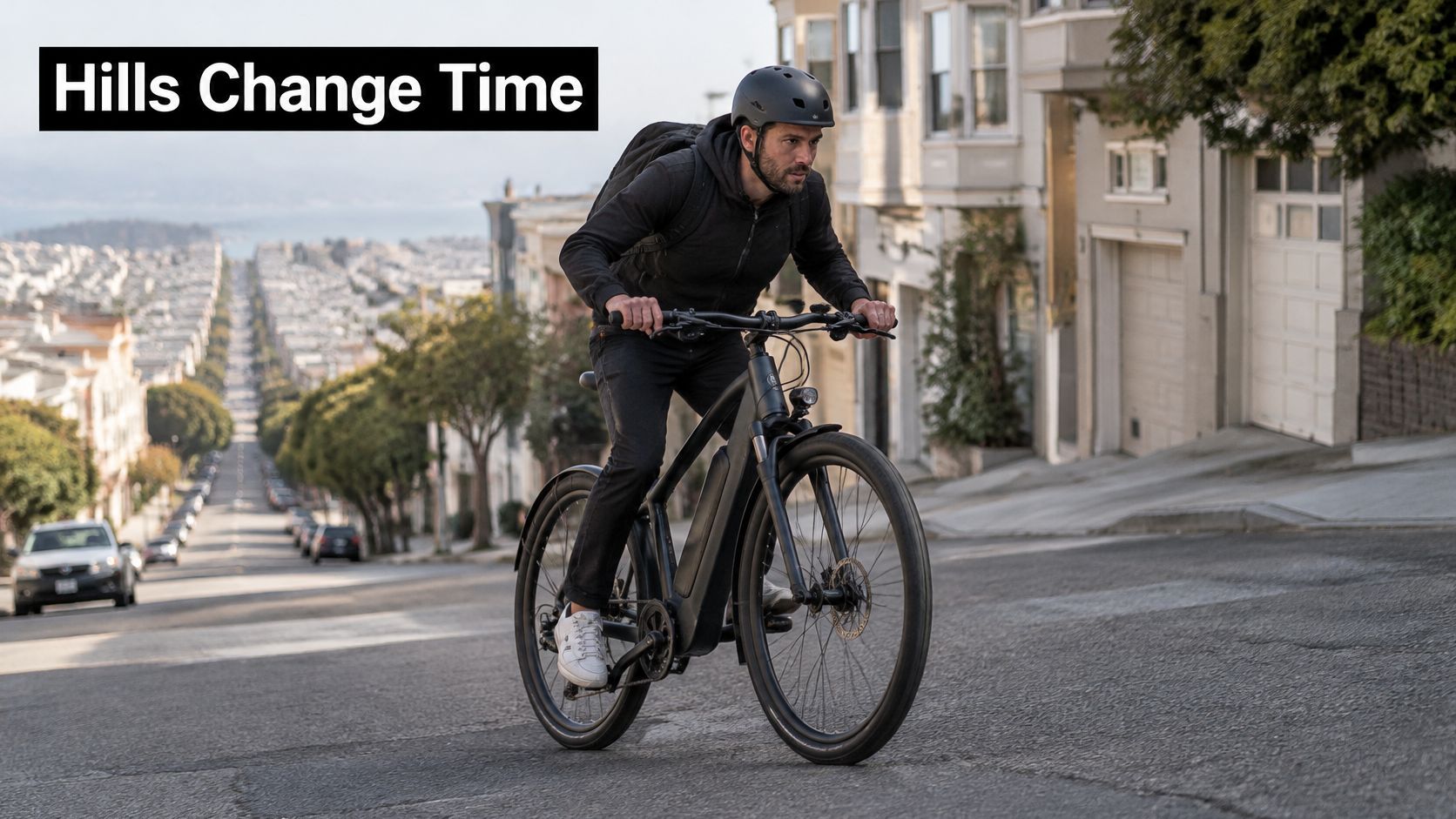
Hills move the clock more than an extra kilometre of flat road. On a controlled hilly work route, median riding time was 18.8 minutes by e-bike versus 26.3 minutes by conventional bicycle, about 29% faster. On a flat route the times were 20.0 versus 23.8 minutes, about 16% faster. Across both routes the median was 19.9 minutes on the e-bike and 25.1 minutes on a conventional bike, about 21% faster overall, in controlled route testing published in the International Journal of Behavioral Nutrition and Physical Activity.
| Route | E-bike | Conventional bicycle | E-bike advantage |
|---|---|---|---|
| Hilly work route | 18.8 min | 26.3 min | about 29% faster |
| Flat route | 20.0 min | 23.8 min | about 16% faster |
| Both routes combined | 19.9 min | 25.1 min | about 21% faster |
Gradient predicts the saving better than distance does. The motor offsets gravity on the climb, so you hold speed instead of grinding. A flat kilometre barely changes the gap. A steep block can.
Match the assist to the hill
Stay in a low, eco-style setting on the flats so you are not burning charge for speed you already have. Step the assist up for climbs and into a headwind, then drop it again once the road levels. One mode for the whole trip either wastes battery or makes you slow on the one hill that matters.
The same testing found lower exercise intensity on the e-bike. You can ride on consecutive days without arriving wrung out, which is what makes a commute stick in a humid Florida summer or a windy Melbourne morning.
Minutes that are not the hill
- Traffic lights: Count the junctions you wait at, not every light you roll through on green.
- Junction queues: Leave a gap in the estimate for the one intersection that always stacks up at your departure time.
- Headwinds: They cut speed the way a slope does. If the forecast is into your face, ride a notch more assist rather than arriving late.
- Cold weather: Batteries give up energy less willingly, and you dress slower. Leave earlier on the first cold week.
- Tyre pressure: Soft tyres add drag you pay for twice, outbound and home. Set pressure before the ride, not after you notice the bike feels heavy.
How to Work Out Your Own Commute Time
Build the estimate in five steps, then check it on the road. The point is a number you can miss by a few minutes, not a fantasy average.
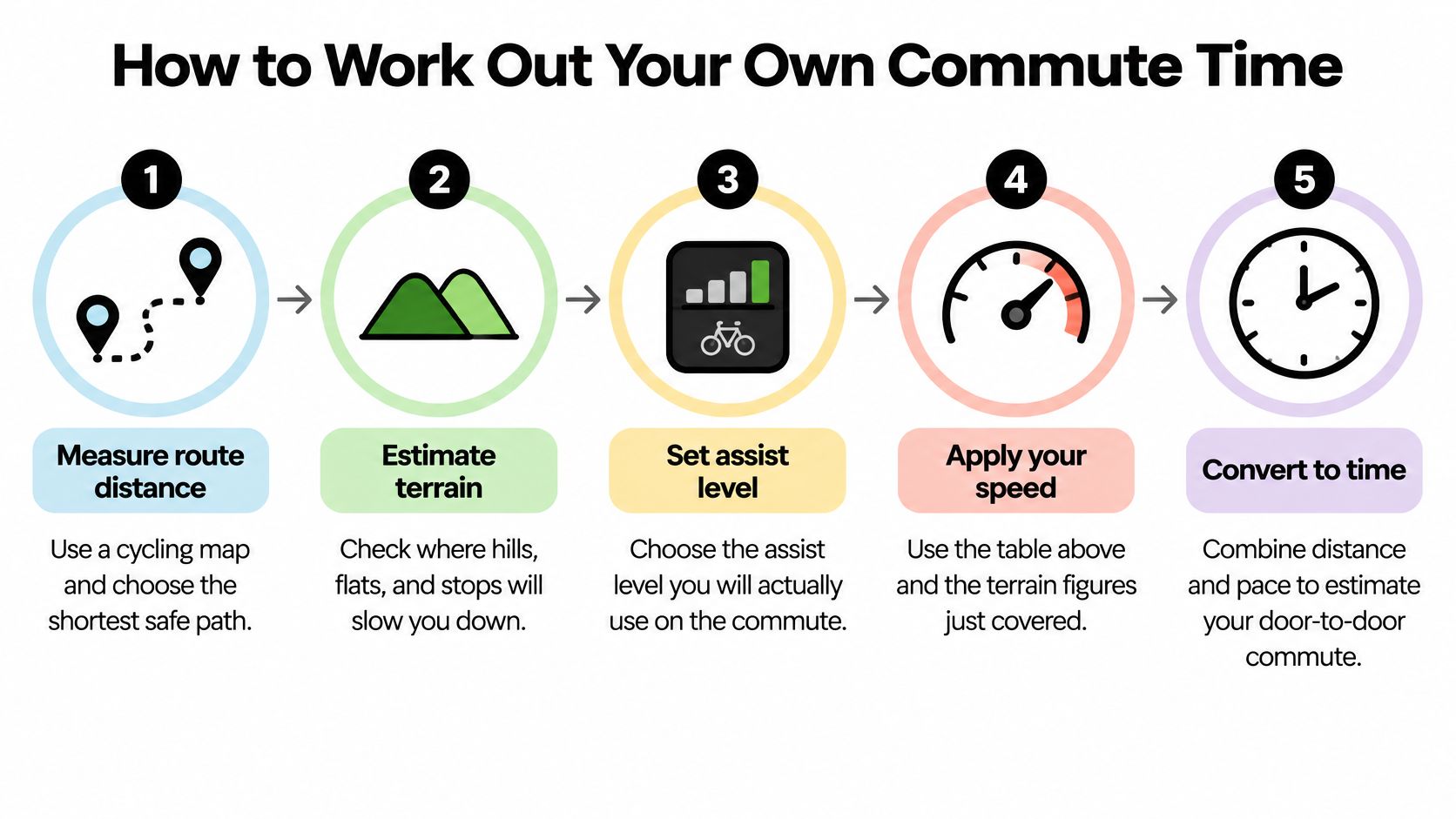
- Measure route distance. Use a cycling map and pick the shortest safe path, not the driving line. Stay on cycle lanes where they exist. A car-optimised route often puts you on roads you will not enjoy at commuting hour.
- Pick a base speed. Use 15 km/h for busy streets with lots of junctions, 20 km/h for typical mixed traffic, and 25 km/h only on quiet, flat cycle paths. If you are unsure, take the slower row. Optimism is what makes people late.
- Add stop time. Allow about one minute for each signalled junction you expect to wait at, plus about two minutes for securing the bike, changing, and parking at the end. A rack in a basement is not the same as a hoop by the door.
- Adjust for terrain. On a hilly route, benchmark a conventional-bike time and cut it by about 29 percent. On a flat route the gain is about 16 percent. Then add time for a long steep climb that an average hides. One sustained grade can erase a neat percentage.
- Add a buffer. Put about ten percent on top for weather, headwinds, and peak-hour congestion. That buffer is the difference between a plan and a hope.
A 10 km example you can copy
Say the route is 10 km, mostly flat, mixed traffic. At 20 km/h the moving time is 30 minutes. Two junctions you usually wait at, plus parking, add about 4 minutes, so you are at 34. Ten percent on top lands near 37 minutes door to door.
A route with few junctions usually lands close to that kind of sum. A busy centre often runs five to ten minutes over, which a five-day test will show. Write the estimate down before you ride. If you invent it after a good day, you will remember the good day.
Range vs Distance and the Return Trip
The common mistake is matching the advertised range to the one-way distance and calling it done. You still have to get home. Hills, headwinds, cold, and high assist all pull real range under the headline figure, sometimes by a lot on the same battery.
A UK government rapid evidence assessment found that e-cycle use is more likely than car or public-transport use for journeys shorter than 15 km. That is exactly the band where a weak return plan hurts, because people swap the car for the bike. The same logic holds for a suburb-to-downtown hop in the US or a cross-town ride in Australia. Under that kind of distance, the bike is a substitute, not a weekend toy, so the battery has to survive a bad day.
A round trip, not a brochure
Take a 12 km commute each way at 20 km/h. Moving time is about 36 minutes one way. The round trip is 24 km and about 72 minutes of riding, before stops. If the label says the battery "does" 40 km, you do not have 16 km of comfort. You have whatever is left after wind, a hill, and a detour to the pharmacy.
Keep about 20 to 30 percent in reserve for the ride home and an unexpected detour. Check that reserve on a cold or windy day, not only on a mild afternoon when the motor feels generous. Summer numbers lie in January and in a southern winter just the same.
If the display is already low when you lock up at work, the commute is not proven. It is borrowed from tomorrow's headwind.
Where the charge actually happens
You need one honest answer before you rely on the bike for work.
- A socket at the workplace: Confirm you are allowed to use it, and that the bike or the battery can sit there securely.
- No socket: Carry a charger only if there is a permitted place to plug in. A charger in the bag does nothing in a lobby with no outlet.
- A midweek top-up: Plan the day you charge, not "sometime if it gets low." Low usually arrives on the ride you cannot skip.
For a plain look at what range claims leave out, see how far electric bikes go. I would not buy a bigger battery until you have logged one cold round trip on the bike you already have.
E-Bike Versus Car and Bus Door to Door
A car that looks quicker on the map can still lose at the front door, once parking and the walk in join the count.
| Mode | Average distance | Average time |
|---|---|---|
| E-bike | 14.1 km | 46 min |
| Car | 24.0 km | 29.7 min |
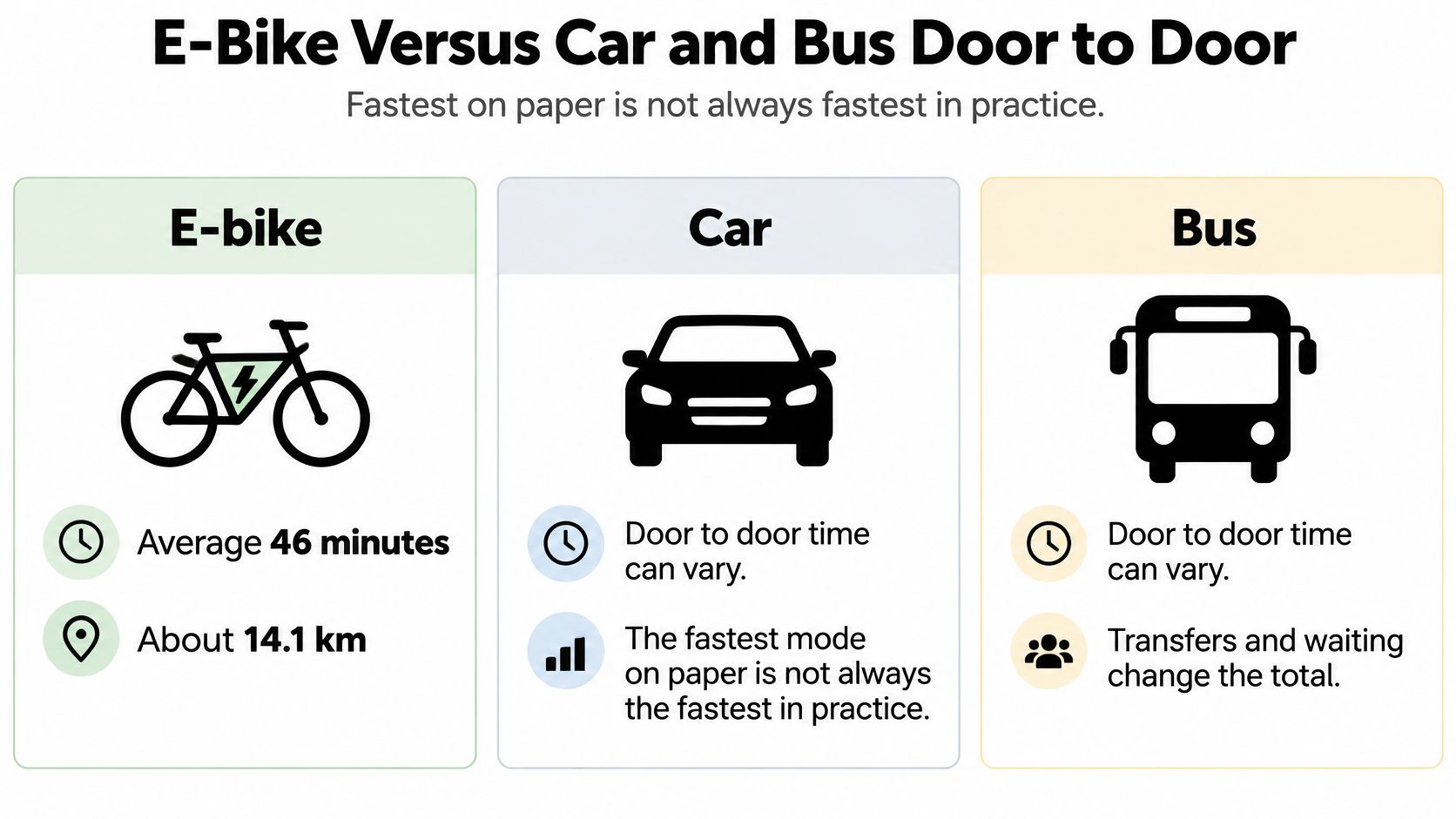
A GPS study of e-bike commuters in the Netherlands, published via the University of Groningen, recorded average e-bike commutes of about 14.1 km in about 46 minutes, against car commutes of about 24.0 km in about 29.7 minutes. Bus journeys took about as long as the e-bike, and the bus figure already bundles in waiting and transfers that a bike never pays. The car clock also stops at arrival. Hunting for a space and walking in from the car park sit outside it, and those minutes are exactly where a "faster" drive gives back its lead.
Riders still switched. In UK e-cycle trials reported by the Department for Transport, e-cycles made up 73% of commute trips after six months while car use fell to 24%, with the strongest shift on journeys up to 20 km. Commuters were choosing the trip that arrived on time over the trip that promised the smallest number.
A 10 km morning
A 10 km trip at 20 km/h is about 30 minutes of riding, and the walk from your front door to the saddle is measured in seconds. A car on the same corridor needs the driving time plus the parking search plus the walk from the space. A bus can match the e-bike's clock on a direct route and still fall behind the moment it adds a stop pattern or a transfer. I would take a five-minute deficit to the car if it buys a predictable arrival every day.
The number that matters is your own door-to-door. Time the e-bike and your current mode on the same street at the same hour, then read the side-by-side case for an electric bike versus a car with real figures in hand.
Pick a Commute Plan You Can Test This Week
Commit to the e-bike if three things are true at once. The five-day average door-to-door time sits inside your estimate. It beats your car or bus once parking and walking are counted. The ride home still leaves at least 20 percent in the battery.
Run the week like a test, not a vibe
- Ride the full round trip on five working days, at the hour you would leave.
- Record door-to-door time each day, including locking and parking. A pretty moving-time app is not the score.
- Set that five-day average next to your step-by-step estimate and next to your timed car or bus trip.
- Note the battery left on the return. Mark any day that needed a detour, a charge, or a non-electric ride home.
- Decide if the route fits your time budget and your reserve. One golden morning does not count.
If the range test leaves no margin, the fix is a larger battery, not a shorter commute you will not keep. Compare capacity before you buy.
Our electric scooters and bikes are zero-emission transportation, and the e-bike range covers Adult Bikes, City & Commuter Bikes, Folding Bikes, Fat Tyre Bikes, Off-Road Bikes and Cargo Bikes. The DUOTTS C29 Electric Bike comes with a single battery or a dual battery configuration, which is the practical fork when a five-day log shows the single pack is tight on the way home.
The figure that matters is the five-day average door-to-door time. That is the number you put in the calendar, not the best ride of the week.
Punk Ride LLC sells commuter electric bikes and scooters for the everyday door-to-door trip, with pedal assist and battery choices you can match to a round trip you have timed. Once your five-day average and your return reserve are written down, use them to pick a bike instead of a brochure range. Visit Punk Ride LLC and line a commuter model up against the route you just tested.
Share:
Tire Electric Scooter Guide: Solid vs Pneumatic Explained