


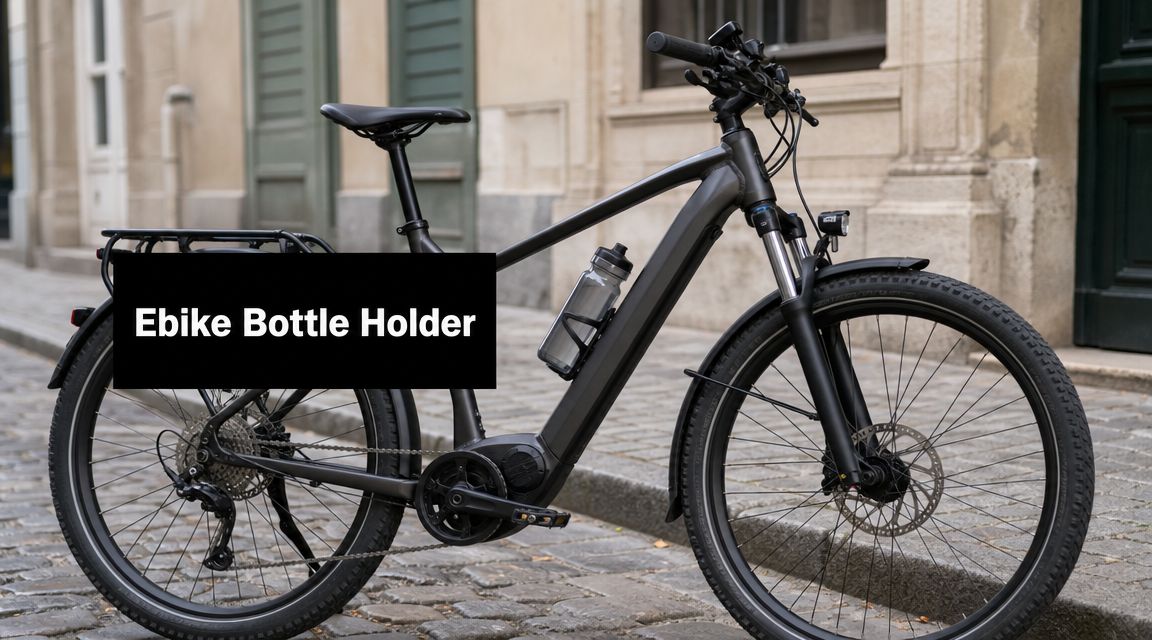
You know the moment. You hit a pothole near a bus lane, hear one sharp clack behind you, and realise your bottle has just launched itself onto wet tarmac. On a normal bike that's annoying. On an ebike in London, Berlin, Amsterdam, or Manchester traffic, it's a proper nuisance.
That's why an ebike water bottle holder deserves more thought than most riders give it. The problem usually isn't whether a cage exists for your bike. It's whether your frame leaves enough room to use it, whether the mount can cope with vibration, and whether you can reach the bottle without fighting a battery, display cable, or overloaded cockpit.
A lot of commuting advice still assumes a simple diamond frame and a standard bottle. Modern ebikes don't play that nicely. Step-through frames, chunky down tubes, integrated batteries, and folding designs change the whole decision. If you're still weighing up the practical side of daily ebike use, this look at whether electric bikes are worth it is useful background, because accessories and day-to-day fit matter more than spec sheets once you start riding every day.
Why Staying Hydrated On Your Ebike Is Trickier Than It Looks
The classic bottle cage seems solved. Most bike frames, including ebikes, use the familiar two-bolt mount with 64 mm spacing, and HOVSCO says that layout is compatible with about 95% of bike frames in the wider bike market, which is why standard cages are so common on conventional bikes and ebikes alike (HOVSCO on bottle cage compatibility).
The catch is that compatibility on paper isn't the same as usability on the road. An ebike can have the right bosses and still be awkward. The battery may block the bottle. The frame triangle may be tiny. A step-through may give you nowhere sensible to mount a cage at all.
For UK and EU commuters, that gets worse once the road surface joins in. Cobblestones, patched asphalt, tram track crossings, dropped kerbs, and potholes all add repeated shock. What looked secure in the hallway can rattle loose before the next set of lights.
Where riders get caught out
The usual mistakes are simple:
- Assuming any standard cage will do: It might bolt on, but that doesn't mean your bottle clears the battery.
- Ignoring access: If you have to wrestle the bottle upward into a cramped frame, you won't use it.
- Treating the holder like decoration: On an ebike, it takes more vibration than many riders expect.
A bottle cage that works on a calm canal path can fail quickly on a rough city commute.
That's the issue. The holder isn't a niche ebike invention. It's a mature bike accessory adapted to newer frames, messier layouts, and rougher daily use.
The Four Main Types of Ebike Bottle Holders Explained
Not every ebike needs the same solution. Some riders have clear access to standard frame bosses. Others have a battery where the bottle ought to be. Folding bike riders often need to get creative.

If you're sorting out a full commuting setup, not just hydration, this roundup of electric bike accessories helps put bottle holders in context alongside lights, locks, and luggage.
Frame-mounted cages
This is the old standard. The cage bolts straight to the frame and, when the bike layout allows it, it's still the cleanest option.
It suits commuters with accessible bosses on the downtube or seat tube and enough room to remove the bottle cleanly. It also keeps weight close to the middle of the bike, which usually feels more natural than hanging a bottle off the bars.
What doesn't work so well is a cramped frame. If your battery blocks the upper half of the bottle, the mount may technically fit while remaining useless in practice.
Handlebar holders
These clamp to the bars or near the stem. They're common on step-through bikes and city ebikes with limited frame space.
The biggest advantage is access. At a red light or slow roll, the bottle is right there. The downside is clutter. In a typical UK or EU commuter cockpit, you may already have a bell, display, light, phone mount, and cable runs competing for space.
For heavier bottles, this setup can also feel fussy. The front end gets busier, and on rough streets a weak clamp will reveal itself quickly.
Seatpost or saddle-rail holders
These shift the bottle to the rear of the bike. You see them more often on longer-distance setups, but they can work on some ebikes too.
They keep the bars tidy and avoid battery interference. The trade-off is reach. Pulling a bottle from behind the saddle is less natural in city traffic, and if you use a rear rack, child seat, or big panniers, the space may already be spoken for.
Strap-on and adapter-based mounts
Clamp-on, velcro, or strap-based systems are common choices for many ebike riders. They solve the problem that standard advice often ignores: lots of modern ebikes either lack usable bosses or have frame shapes that make them irrelevant.
Treeline Review notes a broad and mature bottle holder market, including premium and everyday options, and highlights demand around holders that fit 20–28 oz insulated bottles plus side-entry, dual-stack, and top-tube-friendly styles for trickier bikes (Treeline Review bottle holder guide).
Practical rule: If your frame is unusual, don't start by forcing a normal cage into the wrong place. Start by choosing the mount style that matches the frame.
Ebike bottle holder mount types compared
| Mount Type | Best For | Pros | Cons |
|---|---|---|---|
| Frame-mounted cage | Bikes with accessible threaded bosses | Clean look, stable feel, simple install | Often blocked by battery or tight frame space |
| Handlebar holder | Step-through commuters, easy-access setups | Very easy to reach, works without frame bosses | Can crowd the cockpit and feel less tidy |
| Seatpost or saddle mount | Riders who want the frame and bars clear | Frees up front space, avoids battery interference | Harder to reach, can clash with racks or bags |
| Adapter-based mount | Folding ebikes, odd frames, oversized tubes | Flexible placement, solves awkward geometry | Needs careful fitting to stop slipping or rotating |
Matching a Holder to Your Unique Ebike Frame
Buying the holder first and checking the bike second is how people end up with a drawer full of nearly useful parts. Start with the frame.

Check the bike in this order
-
Look for threaded bosses
Don't just spot them and move on. Check whether a bottle fits there and still comes out. -
Check battery clearance
Integrated batteries are the usual problem. You need room not only for the cage, but also for your hand and the bottle's path in and out. -
Measure the mounting area
For clamp-on or strap-on holders, tube shape matters. Some ebike tubes are broad, flattened, or awkwardly angled, and not every clamp sits securely on them. -
Turn the bars and inspect moving parts
A handlebar or head-tube-mounted bottle can interfere with cables, displays, or folding mechanisms.
The awkward bikes need different thinking
Folding ebikes are the prime example. Owner discussions on Electric Bike Review show riders regularly asking for options on screwless frames and recommending velcro or strap-based cages that can clamp almost anywhere, which highlights the gap between standard bike advice and actual ebike fit problems (Electric Bike Review forum discussion on folding ebike bottle holders).
That matches what many city riders run into. A folding commuter may have a hinge where a normal cage should go, a battery tucked into the frame, and very little spare tube length. In that case, a strap-on mount on a clear frame section or a cockpit-based holder often makes more sense than pretending it's a normal hybrid bike.
What usually works by bike style
- Step-through commuter: Handlebar or strap-on mount tends to be easier than chasing a frame solution.
- Folding ebike: Strap-based or compact clamp-on systems are usually the realistic choices.
- Chunky hardtail or trekking ebike: Standard bosses can work well if the battery doesn't block access.
- Cargo or utility bike: Convenience matters. You want something you can grab without twisting around bags, rails, or child seats.
A good ebike water bottle holder starts with honesty about the frame you own. If you're still deciding between models, this guide on how to choose an ebike is worth reading before accessory shopping, because frame design affects far more than ride feel.
Why Material and Durability Matter On City Streets
A bottle holder isn't just carrying water. On an ebike, it's dealing with repeated vibration, road buzz, and the occasional hit from rough surfaces. That matters more than many riders think.
Wikipedia's bottle cage overview is useful here because it frames the holder as a vibration-load component. On ebikes, motor assistance tends to increase average speed and impact energy over the same route, so clamp security and bottle retention become the main engineering concern. The same reference also notes common materials such as plastic, aluminium, stainless steel, titanium, and carbon fibre (Wikipedia on bottle cages and materials).

What the common materials feel like in real use
Plastic cages are fine when they're well made and the bottle is light. They're cheap, they don't rust, and they often grip standard cycling bottles well enough. The weak point is long-term confidence on rough roads with a heavier bottle.
Aluminium is the commuter sweet spot for a lot of riders. It's stiff enough to hold shape, durable enough for regular use, and if the fit is slightly off, it's often easier to tweak than a rigid plastic design. That's why many riders trust it for daily use on mixed urban surfaces.
Stainless steel and titanium have their place, especially if you want corrosion resistance and long service life. Carbon fibre can be brilliant on the right bike, but for everyday commuting it's often more fuss and cost than is commonly needed.
Why bottle size changes the equation
Bottle choice matters as much as cage material. A mainstream ebike accessory listing shows one rotating nylon-plastic holder with 7 cm × 15 cm dimensions and a stated load capacity of 0.1 kg, which is a clear hint that some cup-style holders are meant for small drink containers rather than full-size bottles. The same source contrasts that kind of light holder with 6061 aluminium as a common higher-rigidity option (Kingbull water bottle holder product page).
That's the bit many buyers miss. If you ride with a compact coffee flask or small bottle on smoother roads, a lighter holder may be enough. If you're carrying a full insulated bottle on cobbles, the holder needs more structure.
If your bottle is heavy enough that you notice it in your hand, treat the cage as a load-bearing part, not a cosmetic add-on.
If you're still deciding what bottle material you prefer for commuting, this ultimate guide to water bottles is a useful companion read because bottle weight, shape, and insulation all affect how demanding the holder setup becomes.
Your Step-by-Step Ebike Bottle Holder Installation Guide
You notice a bad bottle mount on the first rough commute. Hit a set of cobbles, drop off a kerb, or fold the bike in a hurry at the station, and a cage that felt fine indoors starts twisting, rattling, or firing the bottle onto the road.
A tidy install prevents most of that.

Installing on standard frame bosses
If your ebike has bottle bosses in a usable spot, this is still the cleanest setup. On many UK and EU commuter ebikes, though, the battery or motor wiring leaves less room than a normal bike, so test access before you tighten anything.
-
Remove the old bolts and check the threads
Back both bolts out first. If they feel gritty or resistant, clean the threads before fitting the cage. A bolt should start by hand. If it does not, stop there. -
Offer up the cage with the bottle nearby
Line up both holes and thread each bolt in a few turns only. Keep the bottle next to the frame while you do it, especially on step-throughs and bikes with chunky down-tube batteries. A cage can fit the bosses and still be unusable once the bottle is in place. -
Tighten evenly
Alternate between bolts so the cage sits flat. Firm is enough. Over-tightening can damage threads or distort a lighter cage. -
Check removal angle, not just fit
Pull the bottle out the way you will on the bike, one-handed and from your normal riding side. If your knuckles hit the battery casing or top tube, the install is wrong even if the cage looks straight.
Bigger insulated bottles make this more demanding. The extra bulk and weight put more strain on the cage and make clearance problems show up faster.
Installing clamp-on or strap-on mounts
This matters more for riders on folding ebikes, compact frames, and battery-heavy city bikes with no spare boss space. The mount location makes or breaks the result.
Clean the tube first. Road film, polish, and damp grime reduce grip more than people expect. If the mount comes with a rubber shim, match it to the tube size instead of forcing the strap tight and hoping for the best.
Use this order:
- Choose a section that stays clear in daily use: Check knee clearance, cable movement, battery removal, and folding hinges before fitting the holder.
- Avoid tapered or glossy sections where possible: A straight tube section usually holds better than a flared one.
- Add friction if the surface is slick: A strip of old inner tube or protective tape under the clamp often helps on painted aluminium frames.
- Set the angle with a full bottle inserted: Empty mounts can feel solid, then rotate once a full bottle is inserted.
- Twist-test it by hand: If you can move it with a firm shove in the stand, London potholes or Berlin cobbles will move it on the road.
A short visual walkthrough helps if you prefer to see the process before grabbing tools.
Small workshop habits that prevent big annoyances
Do the first check ride on the roughest surface from your normal commute, not on a smooth cycle path and not in the hallway.
A few habits save time later:
- Recheck the bolts or straps after the first proper ride: New mounts settle.
- Test with the bottle you carry to work: A cycling bidon and a metal flask behave very differently in the same cage.
- Watch for hidden contact points: The bottle may catch the battery, rub a cable housing, or tap the frame only when the bike is moving.
- Check access with panniers or a front bag fitted: Commuter luggage often changes what you can reach cleanly.
If the frame gives you no sensible mounting spot, carry the bottle elsewhere on the bike. Punk Ride sells a waterproof bike saddle bag with an integrated rear bottle pocket, which can suit riders who would rather avoid clamping a holder onto a poor location.
Solving Common Problems Rattles Slips and Ejections
You usually notice a bad bottle setup halfway through the commute. On wet London tarmac, over a kerb drop, or across Berlin cobbles, the cage starts buzzing, the bottle shifts, and then you spend the rest of the ride waiting for it to fire into the road.
On an e-bike, these problems show up sooner because the bike is heavier, speeds stay higher, and many commuter frames force the holder into a compromised position beside a big battery or on a folding frame with very little straight tube to work with.
My bottle rattles constantly
Start with the bottle, not the bolts. A cage that holds a soft cycling bottle well can sound terrible with a metal flask or a wide insulated bottle.
Check three things:
- Bottle shape: Many cages are built around a standard bidon profile. Short, fat bottles and smooth metal flasks often move around more.
- How far the bottle seats: On compact step-throughs and some battery-heavy frames, the bottle can catch early and sit a few millimetres proud.
- Cage tension: Metal cages can sometimes be bent in slightly by hand. Do it in small amounts. Too much and daily use becomes awkward.
If the noise only starts on rough surfaces, the fit is close but not close enough. That is common on UK and EU commuter bikes where road surfaces are patchy and vibration never really stops.
My strap-on holder keeps slipping down
A slipping strap mount usually means poor contact with the frame tube. Smooth paint, oversized down tubes, and tapered frame shapes make that worse.
Clean the tube properly first. Road film and polish reduce grip more than riders expect. Then refit the holder with the rubber shim aligned flat, not bunched at one edge, and pull the straps tight in the riding position rather than with the bike hanging awkwardly in a stand.
If it still creeps, the location is the problem. Move it to a straighter section of tube or stop using that tube altogether. On many folding e-bikes, especially the ones common in dense cities, a luggage-mounted or saddle-mounted solution lasts longer than trying to force a strap mount onto a frame shape that gives it nothing to bite into.
My bottle still pops out on big bumps
That points to retention, access, or both. Plenty of bottles eject because the rider never gets them fully seated after a traffic light sip, especially when the battery leaves very little hand room.
A few patterns come up often:
- Top-entry cages on cramped frames: The bottle goes in at a slight angle and never clicks home.
- Heavy bottles in light-retention cages: Fine on a smooth cycle path, poor on bricks, potholes, and tram crossings.
- Low mounting on a busy commuter bike: Front bag straps, cable housing, or a lock mount can knock the bottle loose.
Side-entry cages fix a lot of these cases because they let you load the bottle cleanly even when the frame triangle is half occupied by the battery. If ejections keep happening, switch to a cage with stronger retention or move the bottle off the main triangle entirely. That often works better than endlessly tightening the same setup.
One more practical point. Group riders who all carry the same bottle shape usually have fewer fit issues, which is one reason setups built around standard bidons are easier to live with. If you need a reference for that kind of bottle format, see custom branded team water bottles.
Quick checks before you buy another holder
Do these before replacing parts:
- Mark the current position with tape: If the mount has moved after a week, you will see it immediately.
- Test with your actual work bottle full: Weight changes everything.
- Watch your reinsertion at a stop: If the bottle is awkward to return one-handed, it will eventually go in badly.
- Listen for the first noise: A light rattle is often the warning before a full ejection.
Most bottle holder problems are fit problems. Fix the contact point, the bottle shape, or the mounting location, and the ride usually goes quiet.
Final Thoughts Your Perfect Ebike Hydration Strategy
The right answer is rarely “buy the most expensive cage.” It's simpler than that. Match your bike, your bottle, and your route.
If you ride a conventional trekking ebike with clear frame bosses and smooth access, a solid frame-mounted cage is usually the cleanest choice. If you ride a folding commuter, a step-through, or anything with a battery eating the frame triangle, start with flexible mounting options instead. And if your daily route includes rough brick, potholes, kerb ramps, and tram crossings, choose for retention first and neat looks second.
That's the part many generic guides miss. On an ebike, hydration setup is part of the bike's daily usability. A holder that's easy to reach, doesn't interfere with the battery, and stays put over rough roads matters more than a pretty product photo.
If you ride with a club, school side, or commuter group and want everyone carrying the same style of bottle, these custom branded team water bottles are worth a look as a practical reference for group setups, especially when you want bottles that are easy to identify at a glance.
Get the fit right once, test it on your roughest route, and you won't think about it again. That's exactly what you want from an ebike water bottle holder.
Punk Ride LLC offers electric rides and urban mobility gear for riders across the UK, Germany, the EU, the US, and beyond. If you're building a practical commuting setup around your ebike, have a look at Punk Ride LLC for accessories and everyday ride solutions that fit real city use.
Share:
Electric Scooter Mirrors: A UK & EU Rider's Guide for 2026
Electric Bike Giveaway Your Ultimate Guide for 2026
1 comment
I would sponsor you on my Instagram and also pay off my eviction but I’m an un sure how to enter.