


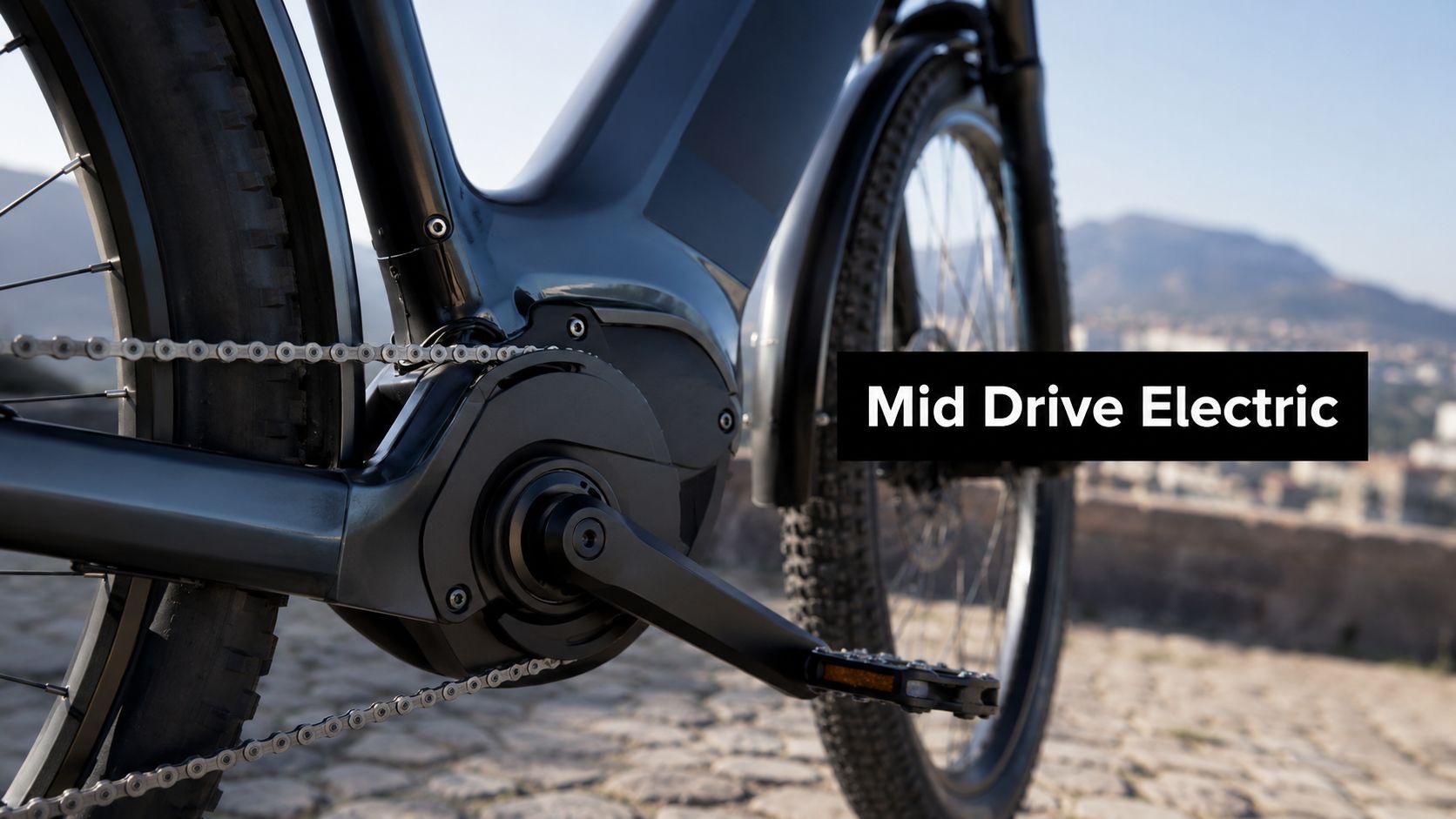
Most buying guides treat a mid drive electric bike as the automatic upgrade over a hub motor. That advice is convenient, but it leaves out the bill that arrives later. A mid-drive can transform steep climbs, loaded starts, and mixed terrain, yet it also sends motor torque through the chain, cassette, chainring, and derailleur. On a mostly flat commute, you may pay for climbing performance you rarely use while accepting more drivetrain maintenance.
The sensible question isn't “Which motor is better?” It's “Where does the motor's advantage earn its keep?” Mid-drive systems have become a foundational architecture in premium and performance-focused e-bikes. Market reporting placed them at roughly 61.3% to 66.3% of global e-bike drive-unit revenue across 2024 and 2025 estimates, while another report said 62% of new e-bikes sold globally in 2024 used mid-drive motors, rising to 78% in Europe (Market Growth Reports). Popularity proves that the design works. It doesn't prove that it suits every route.
Why Mid Drive Is Not Automatically the Best Choice
A mid-drive earns its premium when your route repeatedly includes steep gradients, heavy cargo, loose surfaces, or frequent speed changes. Mounted at the crankset, it works through the bicycle's gears, allowing the rear wheel to receive more usable torque across changing conditions. That mechanical advantage is difficult for a typical hub motor to match on demanding terrain.
The same layout also creates the main ownership trade-off. Your legs already load the chain and gears, while the motor adds force to that path. Hard starts and low-cadence climbs put extra stress on the chain, cassette, chainring, and derailleur. Increased transmission wear is a recognised mid-drive compromise, especially when high torque combines with repeated climbs (technical discussion in IJSRSET).
The premium only makes sense on the right route
A hub motor drives the wheel without sending motor force through the chain and cassette. That suits flat urban riding, errands, and lightly loaded commuting, where predictable assistance and lower motor-driven drivetrain wear may matter more than climbing response. Hub systems still need wheel, spoke, wiring, and tyre service, but those parts absorb the motor's working load instead.
Flat routes also reduce the practical efficiency advantage of mid-drive systems. Their clearest gains appear on steep terrain, while range differences can be small during ordinary flat commuting (Bike EV's comparison guide). For a paved, level, lightly loaded commute, a hub motor may provide the better long-term value. You avoid paying for climbing performance you rarely use and may face fewer drivetrain replacement costs.
The premium should solve a recurring problem, not just add an impressive specification.
Mechanic's filter: Buy mid-drive for regular hills, cargo, or demanding surfaces. If those conditions do not challenge your current bike, a simpler hub system may offer the better ownership experience.
Mid-drive remains a strong choice for riders who can use its gearing and torque. The rest of the bike matters too, including the sensor system, gear range, drivetrain quality, service support, and legal classification. Judge the complete system against your route, not the motor badge alone.
How a Mid Drive Electric Bike Works
A mid-drive motor sits around the bottom bracket, where the crank arms attach to the frame. Rather than turning the wheel directly, it turns the crankset, sending motor power through much the same route as your own pedalling.

The motor works like a second set of legs. Your legs push the pedals, the motor adds force at the crank, the chain carries the combined effort to the cassette, and the cassette turns the rear wheel. The selected gear determines how easily the system turns against resistance.
Power flow in plain terms
- The battery supplies electrical energy. The controller determines how much current reaches the motor according to the assistance setting and sensor input.
- The motor turns the crank. It contributes rotational force where your pedal force enters the bicycle, rather than pushing the rear wheel.
- The chain transfers that force. The chainring, chain, cassette, and derailleur all become part of the motor's working system.
- The gears change the mechanical advantage. A lower gear makes climbing easier and allows the motor to spin more effectively at slower road speeds. A higher gear suits faster riding on flatter ground.
- The rear wheel receives the output. The drivetrain converts motor and rider effort into forward movement, then the wheel turns.
That gearing relationship gives a mid-drive its hill advantage. The motor can stay closer to a useful operating speed while the bicycle climbs slowly. An experimental efficiency-map study found that chain transmission efficiency can vary from 70% to 98%, depending on chain tension (E3S Web of Conferences). Choose an appropriate gear, keep your cadence moving, and avoid forcing a large gear at walking pace. On flat routes, that same chain path still adds drivetrain work and wear, so the gearing advantage may not justify a higher purchase or replacement cost.
Why sensors change the feel
A torque sensor measures how hard you're pressing and adjusts assistance to match. That produces a more connected response than a basic cadence-only system, which mainly detects whether the cranks are turning. A well-tuned torque-sensor mid-drive feels like stronger legs, rather than a wheel pushing independently.
Motor placement also affects handling. Keeping the heavy motor low and central generally creates a more balanced bicycle than placing substantial motor mass in one wheel. You notice that balance when steering slowly, lifting the bike, carrying it through a doorway, or riding uneven ground.
Mid Drive vs Hub Motors on Hills and Flat Routes
Route profile should decide the motor type. A mid-drive is strongest where the bicycle must climb slowly, carry weight, and respond to changing resistance. A hub motor is often perfectly competent when the road stays level and the rider values direct, uncomplicated assistance.
| Riding situation | Mid-drive | Hub motor |
|---|---|---|
| Steep climbs | Uses the bicycle's gears for leverage and efficient motor speed | Drives at one wheel ratio and may struggle more as speed falls |
| Rolling terrain | Responds well to frequent gear and gradient changes | Works adequately when climbs are short or moderate |
| City stop-start | Torque sensing can feel natural, but shifting discipline still matters | Direct wheel drive offers simple starts and low drivetrain stress |
| Long flat commutes | Often offers little practical efficiency advantage over a well-matched hub system | Simple cruising can make strong financial sense |

On a steep road, a mid-drive lets you shift down before the gradient overwhelms the system. The motor can continue turning through the drivetrain while the rear wheel receives increased mechanical advantage. A hub motor has no bicycle gearing between the motor and the wheel, so it can't make the same adjustment through the cassette.
That doesn't mean every hub motor fails on hills. A properly matched hub bike can handle moderate inclines, especially within its rated load. The issue appears on sustained or steep climbs, where low wheel speed and high resistance place more demand on the motor and battery.
A flat route can make a mid-drive feel like an expensive solution to a problem you don't have.
The ride feel differs, too. A torque-sensor mid-drive responds to your effort and usually feels integrated with pedalling. A hub motor can feel like a steady push from the wheel, which some riders prefer for relaxed commuting and quick starts. Sensor quality and controller tuning matter, so don't judge solely by motor location.
For route-specific hill advice, compare the practical guidance in this guide to the best electric bikes for hills. Riders planning an urban day out may also find top-rated small group LA tours useful for understanding how stop-start city riding, gradients, and mixed surfaces affect a bicycle choice.
On long, flat commutes, battery capacity, tyre choice, wind, rider weight, and assist level can matter more than motor category. The more demanding your terrain becomes, the more the mid-drive's gearing advantage justifies its complexity.
The Maintenance Cost of Mid Drive Systems
A mid-drive can cost more to maintain than its purchase page suggests because motor torque passes through the chain, cassette, and chainring. A hub motor leaves those parts closer to normal bicycle duty, while a mid-drive loads them during powered starts, acceleration, and climbs.
The chain usually gives the first warning. As it stretches, shifting becomes less precise and wear spreads to the cassette and chainring. Continue riding on a worn chain and a replacement may skip instead of seating cleanly. Poor adjustment, bent parts, and shifting under heavy pressure can also shorten derailleur and jockey-wheel life.
What wears out
| Component | Mid-drive interval | Hub motor interval | Relative cost |
|---|---|---|---|
| Chain | Earlier replacement under high-torque use, inspect regularly | Closer to conventional bicycle wear | Lower part cost, but more frequent on mid-drive |
| Cassette | Replace when worn or when a new chain skips | Usually lasts longer under comparable use | Moderate |
| Chainring | Inspect with chain and cassette | Normal bicycle wear | Moderate |
| Derailleur and jockey wheels | Adjustment and replacement as wear develops | Normal bicycle wear | Moderate to high if damaged |
| Lubricant and cleaning | Frequent attention is important | Still required, but motor torque adds less stress | Low recurring cost |
Replacement timing depends on mileage, weather, chain cleanliness, rider weight, torque settings, and shifting technique. A fixed service interval or a universal multi-year ownership cost would ignore those variables. The practical rule is clear: high-torque climbing and neglected lubrication shorten component life, while replacing the chain in time helps protect the more expensive cassette and chainring.
Use an e-bike-rated chain when the manufacturer specifies one. Match the lubricant to the weather, then wipe off abrasive grime instead of applying fresh oil over dirt. Shift before the steepest section, ease pedal pressure during the shift, and maintain a reasonably high cadence rather than grinding slowly in a large gear.
Maintenance rule: The cheapest drivetrain part to replace is the one you replace before it damages the next part.
A hub motor still has service costs. Its powered wheel can make puncture repairs, wheel removal, wiring checks, and spoke work more involved. Riders trying to reduce motor-driven chain and cassette wear may still find the hub layout easier to budget for, especially on a flat commute where the mid-drive's gearing advantage contributes less.
Use this practical guide to an electric bike chain for inspection and replacement basics. Then compare those likely service needs with the bike's purchase-price difference. The mid-drive premium can make sense for demanding terrain, but a hub motor may deliver lower drivetrain costs when the route is mostly flat and the priority is predictable commuting.
Legal Power Limits That Change Which Bike You Can Ride
Motor placement doesn't determine legality by itself. Continuous rated power, assisted speed, pedal-assist behaviour, and local classification decide whether a mid-drive can be used like an ordinary bicycle.
In the UK, an electrically assisted pedal cycle must use a motor with a maximum continuous rated power of 250 watts, stop assistance at 15.5 mph, or 25 km/h, and be ridden by someone aged 14 or over. A compliant EAPC doesn't require registration, tax, insurance, or a licence (UK government electric bike rules).
The EU framework follows the same broad pedelec pattern. Pedal assistance, a 250-watt maximum continuous rating, and assistance limited to 25 km/h allow many commuter mid-drives to remain bicycles rather than motor vehicles (BikeRadar's electric-bike laws guide).

Why the same motor causes different outcomes
The United States and Australia don't use one single framework that applies everywhere. Higher-power systems, including 500W, 750W, or 1000W+ mid-drives, can fall outside the low-power bicycle categories used in the UK and EU, depending on the applicable state, territory, road, trail, and vehicle rules (Kirbebike's regional law overview).
That means a 750W mid-drive may be usable in some US contexts but unsuitable for a London or Berlin commute if it doesn't meet the local pedelec definition. A bike that is legal on private land may still be restricted on public roads or cycle paths.
Before buying, ask the seller for the continuous rated power, assisted-speed cutoff, throttle details, conformity information, and intended regional classification. Don't rely on a peak wattage headline. For a broader UK-focused explanation, check whether electric bikes are street legal.
Which Riders Benefit from Mid Drive
The right mid-drive buyer is defined by the route, not a desire for maximum performance. Choose it when regular riding creates a problem that motor-assisted gearing solves, and compare that benefit with the drivetrain cost over time.
The hilly cargo hauler
Parents carrying children up steep streets, tradespeople hauling tools, and riders pulling trailers benefit from central weight, torque-sensitive assistance, and the ability to shift down before a climb. Extra load matters most when starting uphill. A mid-drive can keep the motor working through the bike's gears instead of asking one fixed reduction to handle every gradient.
The mixed-terrain commuter
A commuter moving between pavement, rolling paths, and changing gradients can use the system's main advantage on most trips. Frequent gear changes keep the motor in a useful range, while balanced weight helps on uneven surfaces. The trade-off is faster wear on the chain, cassette, and chainring, so the added drivetrain care needs to fit the budget and maintenance routine.
The flat-city commuter
Level pavement, light cargo, and predictable stops weaken the case for a mid-drive. A hub motor can provide enough assistance while keeping motor force out of the chain and cassette, often reducing long-term drivetrain expense. A torque-sensor mid-drive may feel refined, but its climbing ability can remain unused on a flat commute. Paying for that unused capability makes sense only if future routes or heavier loads are likely.
The rural and trail rider
Long rural rides with repeated rises suit a mid-drive because gearing can change as the terrain changes. Technical trails also reward controlled low-speed torque. A hub bike remains suitable for gravel, dirt roads, and flatter mixed surfaces when simple operation and lower drivetrain stress matter more than climbing response.
Choose the motor for the hardest part of your normal week, not the most exciting ride you might take once in a while.
Local service support should influence the decision. A mid-drive makes more sense when replacement parts are available and the owner will clean, lubricate, and inspect the drivetrain. Riders who dislike shifting, maintenance, or specialist service may get better everyday value from a simpler hub system. For a mostly flat commute, spend the premium only when its control, load handling, or future flexibility will be used.
A Practical Buying Checklist for Mid Drive Electric Bikes
A product page can make a mid-drive look simple. Your checklist should be more demanding.
Start with the route
Map the steepest regular climb, not just the average journey. Ask whether you'll carry cargo, start on gradients, ride loose surfaces, or make repeated stop-start trips. Those conditions determine whether the motor's gear-driven advantage will earn its premium.
Check torque and rated power together
Torque affects low-speed climbing feel, while wattage alone doesn't describe how the system behaves. In the UK and EU, confirm that the bike's 250W continuous rating and 25 km/h assistance limit fit pedelec rules. In the US and Australia, check the applicable local category instead of assuming a higher-power mid-drive is road legal.
Match the battery to the ride
Look for battery capacity in watt-hours, then judge it against terrain, rider and cargo weight, assist level, weather, and charging access. Don't accept a dramatic range promise without knowing the test conditions. A smaller battery on a flat route may be more practical than a heavier battery selected for climbs you never ride.
Inspect the drivetrain
Ask whether the chain, cassette, chainring, derailleur, and wheels are rated for e-bike torque. A seller who can't identify the drivetrain parts or explain replacement support is giving you a warning. Check whether the bike uses a chain or belt, and understand that a belt changes maintenance requirements but doesn't remove the need for correct tension and service.
Test the sensor response
A torque sensor should add support as your effort rises, without an abrupt surge. Try starting slowly, shifting under moderate pressure, and climbing at low speed. If the system feels jerky in a car park, it won't become refined on your commute.
Verify support before payment
Confirm warranty terms, diagnostic support, spare-parts availability, and whether local shops work on that motor system. Mid-drive repairs can require more specialised knowledge than ordinary bicycle work, so service access belongs in the buying decision.

The right mid drive electric bike isn't the one with the largest headline torque or battery figure. It's the one whose legal class, gearing, service network, and drivetrain quality match your route and your willingness to maintain it.
Punk Ride LLC offers a curated range of electric rides for urban mobility, including mid-drive options such as the Eleglide C1 and ENGWE L20 3.0 Pro listed with torque-focused specifications. Visit Punk Ride LLC to compare available bikes and choose a setup that fits your terrain, local rules, and long-term maintenance budget.
Share:
Best Electric Bike for Short Female Riders in 2026
LED Lights for Scooters: A Complete Guide for 2026