


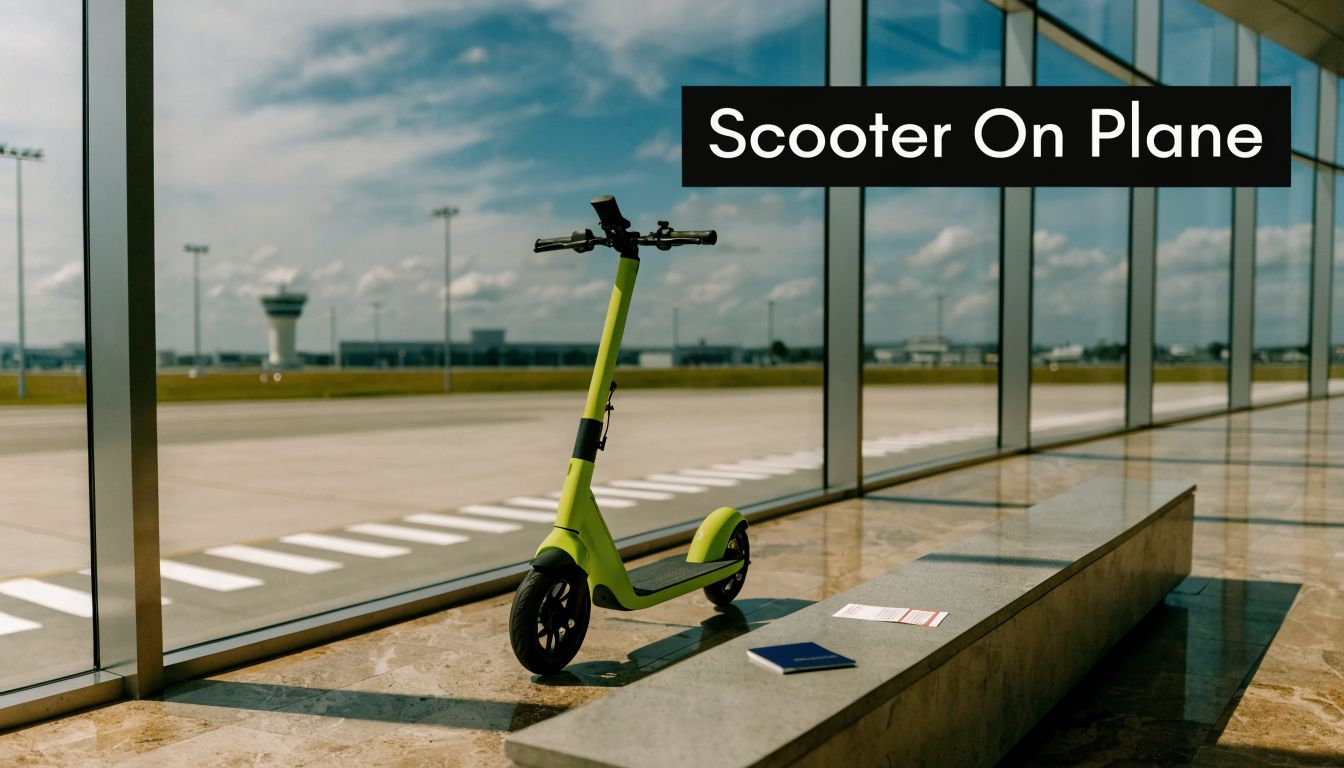
TL;DR: Recreational electric scooters are rarely allowed on planes. Under FAA and IATA battery rules, batteries under 100 Wh may be allowed in carry-on without approval, 101 to 160 Wh usually need airline approval, and anything over 160 Wh is banned from both carry-on and checked baggage, which rules out many adult e-scooters. Medical mobility scooters are treated differently, with more flexible rules and battery allowances that can go up to 300 Wh under certain conditions.
You’ve booked the flight. You’ve mapped the cafés, bike lanes, and waterfront paths. Then one practical question knocks the wind out of the plan: can you take a scooter on a plane?
If you ride an e-scooter around London, Berlin, Los Angeles, or Sydney, the question feels simple. It’s your transport. It folds. It fits in the boot. Why shouldn’t it fly too?
Airlines, unfortunately, don’t look at scooters the way riders do. They look at them the way safety teams do. That’s why two devices that seem almost identical at the airport can be treated completely differently. A compact recreational e-scooter might be refused at check-in, while a medical mobility scooter goes through with assistance and no baggage fee.
That difference confuses a lot of travellers. It also causes some ugly surprises at the terminal.
Your Dream Trip and Your E-Scooter Dilemma
A lot of trips start with the same little fantasy. You land in Lisbon, fold out your scooter, and cruise uphill without sweating through your shirt. Or you touch down in California and skip the car hire queue because your ride is already with you.
Then you search the airline policy and hit a wall of phrases like “lithium-ion restrictions,” “operator approval,” and “hazardous materials.” Suddenly the question isn’t just can you take a scooter on a plane. It’s whether anyone at the airport will even let you through with it.
The frustrating part is that the answer isn’t a clean yes or no. It depends on what kind of scooter you have, whether the battery comes out, how large that battery is, and whether the airline treats the device as a recreational ride or a medical aid.
Why people get tripped up
Most travellers assume a folded scooter is just another bulky item. Airlines don’t. For them, the frame is often the easy part. The battery is the primary issue.
A second source of confusion is seeing “scooter” used in two very different ways:
- Recreational electric scooters like commuter and urban models
- Medical mobility scooters used as assistive devices
Those categories live under different rules. Mixing them up is one of the fastest ways to misread an airline policy.
A scooter that looks airport-friendly can still be non-compliant if its battery rating breaks the airline’s limit.
If you’re flying within the UK or EU, this gets even murkier because airport security rules, airline terms, and local destination laws don’t always line up neatly. The same is true for US and Australian carriers, where one airline may allow a battery under certain conditions and another may reject the whole device outright.
The good news is that once you understand the battery rule, the rest of the puzzle gets much easier.
The Real Reason Airlines Scrutinize Your Scooter
You can roll up to the airport with a scooter that looks compact, tidy, and perfectly travel-friendly, then still get stopped at check-in. The reason is usually not the frame. It is the battery, and more specifically, the fire risk tied to lithium-ion cells in flight.
That point matters because airline rules can feel picky until you understand what crews are trying to prevent. A battery fire on the ground is serious. A battery fire in a cabin or cargo hold is a very different problem. Staff have limited space, limited time, and strict procedures, so airlines build their scooter rules around the part most likely to create danger.

Watt-hours in plain English
Watt-hours, or Wh, measure how much energy a battery can store. A simple comparison is a fuel tank. A larger tank holds more fuel. A higher Wh battery holds more stored energy.
For airlines, that number is not a minor spec buried in a manual. It is one of the first things that decides whether a device may fly, may fly only with approval, or may not fly at all.
Here is the practical rule many airlines build from international dangerous goods standards:
- Under 100 Wh is the easiest category
- 101 to 160 Wh often needs airline approval
- Over 160 Wh is usually not accepted for normal passenger baggage
That is why two scooters that look almost identical at the gate can be treated completely differently. The difference is not cosmetic. It is the amount of energy packed inside the battery.
Why recreational scooters run into trouble
A lot of adult commuter scooters are designed for useful range, not air travel. That usually means a battery large enough to power longer rides, steeper hills, and faster acceleration. Great for daily riding. Bad for airline compliance.
In plain terms, many recreational e-scooters carry more battery than airlines are comfortable having on a passenger aircraft. Even if the scooter folds neatly, the battery can still push it outside the allowed range.
There is also a second layer of confusion. Travelers often see the word "scooter" and assume one rule applies to all of them. It does not. Recreational e-scooters are usually treated as consumer electronics with lithium battery limits. Medical mobility scooters are handled under a different set of accessibility and safety rules, which is why their path is often much more flexible.
That split causes plenty of mix-ups, especially for travelers already trying to work out whether electric scooters are street legal where they ride. Ground rules and flight rules are separate issues. A scooter can be legal to use at your destination and still be refused by an airline because of the battery.
The battery is only half the test
Even a removable battery does not automatically solve the problem. The airline may still need the battery terminals protected, the battery packed correctly, and the scooter frame accepted as checked luggage under that carrier's own size and weight rules.
Those baggage limits vary by airline, so it is safer to treat them as airline-specific rather than assume one standard measurement will apply everywhere. In other words, "it folds" is not the same as "it flies."
A quick screening test looks like this:
| Question | Why it matters |
|---|---|
| Is the battery removable? | If it cannot be removed, a non-compliant battery may block the whole scooter from flying |
| What is the Wh rating? | This number often decides whether the battery is allowed, restricted, or prohibited |
| Will the airline accept the frame as baggage? | A compliant battery does not guarantee the scooter body will be accepted |
Once you see the logic, the rules stop looking random. Airlines are not focusing on scooters because scooters are unusual. They are focusing on high-energy lithium batteries because that is the part that can turn a routine flight into a safety incident.
Navigating The Maze of Airline Scooter Policies
If airline rules were only about one global battery limit, booking a flight with a scooter would be straightforward. Real trips are messier because each airline adds its own layer of rules on top of the baseline safety standards.
That is why two airlines can look at the same scooter and reach different answers. One may review the battery size, ask whether it can be removed, and decide case by case. Another may refuse recreational e-scooters outright because staff are trained to treat them as high-risk consumer devices with lithium batteries, not as assistive equipment.
A good way to read airline policy is to sort it into three buckets:
- Flat ban: The airline does not accept recreational e-scooters as checked or carry-on baggage.
- Conditional review: The airline may consider the scooter if the battery is removable, properly protected, and within its stated lithium-battery rules.
- Freight or cargo only: The scooter is not accepted as normal passenger baggage and may need to be shipped separately.
That last category catches people off guard. Your scooter might be legal to ride at your destination and still be refused at the airport. If you want to check both parts of the trip, this guide on whether electric scooters are street legal helps with the road-use side.
Why airline answers vary so much
The inconsistency is frustrating, but it is not random. Airlines write their own dangerous-goods procedures, train staff differently, and draw different lines between a recreational scooter and a medical mobility device.
British Airways, for example, states that e-scooters and e-unicycles are forbidden because of their lithium batteries on its restricted-items page. Lufthansa lists small lithium battery vehicles such as e-scooters as prohibited in passenger transport. Qantas separates some battery-powered mobility devices from recreational devices and may require other battery-powered equipment to travel under freight rules depending on the battery and device type. You can compare the medical side of that distinction in this comprehensive guide to airline-approved mobility scooters.
The practical lesson is simple. Do not rely on a forum post, a retailer FAQ, or a rule from your last trip. Check the exact airline carrying you on the exact route you are flying.
Electric Scooter Policies for Major Airlines
| Airline | Policy on Recreational E-Scooters | Key Restriction |
|---|---|---|
| British Airways | No | Prohibited as battery-powered recreational transport devices |
| Lufthansa | No | Prohibited as small lithium battery vehicles |
| Qantas | Conditional, often not standard passenger baggage | Battery and device type may trigger freight handling instead of normal baggage |
| United Airlines | No in many recreational scooter cases | Battery-powered recreational scooters may be refused |
| JetBlue | No in many recreational scooter cases | Recreational scooter acceptance is highly restricted |
| American Airlines | Conditional | Approval depends on battery setup and device classification |
| Delta | Conditional in some cases | Acceptance can depend on removable battery details and size limits |
| Southwest | Conditional in some cases | Battery configuration and baggage rules may affect acceptance |
The paperwork that helps
If an airline offers case-by-case review, documents can turn a vague phone answer into a clear decision.
Bring a small folder, printed or on your phone, with:
- Battery spec sheet: voltage, amp-hours, and watt-hours
- User manual page: the section showing whether the battery is removable
- Battery test or compliance paperwork: including UN 38.3 if the manufacturer provides it
- Device details: make, model, dimensions, and weight
Watt-hours confuse a lot of travellers. The easiest way to read it is as the battery’s total energy size, much like the size of a fuel tank. Airlines care because larger lithium batteries can feed a hotter, harder-to-control fire if something goes wrong.
A calm check-in often starts long before the airport. Email the airline’s special assistance or dangerous-goods team, send the spec sheet, and ask for a written reply. That written confirmation will not override every airport decision, but it gives staff something concrete to review instead of guessing at the desk.
The Big Exception Medical Mobility Scooters
A lot of airport confusion starts here. Two battery-powered scooters can look similar at the curb, then fall under completely different rules at check-in.
A medical mobility scooter is usually treated as an assistive device. A recreational e-scooter is usually treated as consumer transport gear. That distinction matters because airlines are balancing two different priorities at once. One is safety, especially battery fire risk. The other is disability access.
That is why mobility scooters often get more flexibility. Regulators and airlines generally make room for devices a passenger relies on to move through the airport, board the aircraft, and manage the trip with dignity. Recreational scooters do not get that same protection, even if they also run on batteries.

Why the rules are looser
The battery rules do not disappear for mobility aids. The fire concern is still real. Lithium batteries can enter thermal runaway, which is the chain reaction airlines worry about because it can create intense heat and smoke.
What changes is how the risk is managed.
With a medical mobility scooter, airline staff may arrange gate delivery, battery removal, protected handling, and special assistance instead of treating the device like an ordinary checked item. The FAA’s PackSafe guidance for battery-powered wheelchairs and mobility aids explains that these devices can be carried under specific conditions, including rules for removing and protecting certain lithium-ion batteries. The U.S. Department of Transportation also explains in its Air Carrier Access Act guidance on wheelchairs and assistive devices that assistive devices are handled differently from standard baggage.
What usually changes in practice
If you are flying with a mobility scooter, the airline will often want details before travel, but the conversation is different from the one you get with a commuter scooter. Staff are usually trying to work out how to carry it safely, not whether they recognize it as a permitted category at all.
That often means:
- You contact special assistance early. Share the make, model, weight, and battery type.
- The battery may need to come out. This depends on the battery design and the airline’s handling process.
- Spare lithium batteries usually stay in the cabin. They are not normally packed loose in checked baggage.
- Airport staff may gate-check and return the device. That is common for mobility aids.
For a traveller, the easiest comparison is this: a recreational scooter is judged like optional gear with a large battery attached. A mobility scooter is judged like a wheelchair system that must be carried safely.
If you are helping a parent or relative choose a model for air travel, this comprehensive guide to airline-approved mobility scooters is useful because it focuses on the airline-facing details people actually need, such as battery style, turning radius, and transport-friendly design. It also helps to review how to fold a scooter for travel and storage so the device is easier for both you and airline staff to handle.
Do not try to re-label a recreational scooter
This is the part travellers sometimes get wrong.
Owning a scooter and needing help on a trip does not automatically make that scooter a mobility aid in the airline’s system. If the product is sold and used as a recreational or commuting e-scooter, airline staff will usually evaluate it under those stricter battery and acceptance rules.
United’s restricted items page and JetBlue’s mobility aids and assistive devices page show this split clearly. Medical mobility devices are addressed through accessibility procedures, while battery-powered recreational devices face tighter limits or may be refused.
That is the key idea to keep straight. The exception exists because the passenger needs the device for access, and the airline has a duty to accommodate that need while still controlling battery risk. Recreational scooters sit outside that access category, so the rules are much harder.
How to Prepare a Compliant Scooter for Your Flight
If your scooter has a small removable battery and your airline says yes, preparation becomes the whole game. A smooth airport experience depends entirely on this.
Most problems happen because travellers know the scooter folds, but they don’t know the battery specs, can’t remove the pack quickly, or show up without any paperwork. Airline staff then have to make a call under time pressure, and that usually doesn’t favour the passenger.

Step one starts at home
Before you even think about the airport, check four things:
-
Find the battery label
Look for the watt-hour rating directly on the battery or in the user manual. -
Confirm the battery comes out cleanly
If removing it requires tools, practice in advance. -
Read your airline’s exact wording
“Lithium battery allowed” doesn’t automatically mean “electric scooter allowed.” -
Prepare proof
Save a digital manual, battery spec sheet, and product page screenshot if available.
If your scooter folds awkwardly, rehearse that too. A lot of compact models feel easy at home and suddenly become clumsy when you’re standing in a queue with a cabin bag. This guide on how to fold a scooter is worth reviewing if you want the process to feel automatic.
How to pack it without drama
Once the battery is removed, you’re usually dealing with two separate travel items: the battery in carry-on and the scooter frame as checked luggage or gate-checked equipment, depending on the airline’s instruction.
Use a simple packing checklist:
- Battery in carry-on: Keep it protected and easy to inspect
- Terminals covered if needed: This helps prevent accidental contact
- Frame secured: Fold and lock it so it won’t open in transit
- Loose accessories removed: Chargers, mounts, lights, and bags should be packed separately
- Name and contact label attached: Put it on the frame and any travel case
For travellers working with a medical device rather than a recreational scooter, this complete guide on how to transport a mobility scooter adds useful handling and loading tips that overlap with airport prep.
What to have ready at check-in
Keep these items where you can reach them quickly:
| Item | Why staff may ask for it |
|---|---|
| Battery spec sheet | To verify voltage, amp-hours, and watt-hours |
| Manual excerpt | To confirm removal method and battery type |
| Airline approval email | To avoid a desk dispute |
| Contact details on the scooter | To identify and return the device correctly |
A quick visual guide can help if you’re still unsure about the physical handling side of the process:
The easiest mistake to avoid
Don’t rely on the call centre summary alone. Get written approval when approval is required.
Airport staff work from operational rules, not vague reassurances. If your booking notes don’t clearly say your battery and device have been reviewed, you may end up starting the conversation from zero at the worst possible moment.
Smart Alternatives When Your Scooter Can't Fly
You’re a week out from your trip. Bags are half packed. Then the airline comes back with the answer you were hoping not to hear. Your recreational scooter is not approved.
At that point, the smartest question changes. Stop asking how to force the scooter onto the flight. Ask how you’ll stay mobile after you land, with the least stress, cost, and risk.
That shift matters because airline battery rules exist for a reason. A large lithium battery is treated as a fire risk in the aircraft system, not as a convenience item. Recreational scooters get caught by those rules far more often than medical mobility aids, which usually follow a separate process because they are treated as assistive devices. If your scooter falls into the recreational category, backup plans are often the better travel move.

Option one: ship it ahead
Shipping works best for longer stays in one place, especially if you already know you’ll ride often and want your own setup waiting for you.
Typical shipping prices vary a lot by box size, carrier, insurance, and distance, so it’s better to compare live quotes than trust a single flat estimate. Services such as the UPS shipping cost calculator and FedEx rate tools give a more realistic starting point than a generic blog number.
Pros:
- You keep your own familiar scooter
- You avoid check-in arguments at the airport
- It can make sense for work trips or long temporary stays
Cons:
- Delivery timing has to line up with your arrival
- Damage is still possible in transit
- International shipments can trigger customs fees, VAT, or import checks
If you go this route, review how to store lithium batteries safely before shipping or extended travel, especially if the battery will be removed, packed separately, or left unused for a while.
Option two: rent after you arrive
Renting is often the lowest-friction option. You land, pick up a scooter or use local micromobility, and skip the airline battery problem completely.
Costs vary by city and provider, so use local booking pages rather than broad estimates. For example, Lime’s pricing page and local mobility hire listings on platforms such as Cloud of Goods show how quickly rates can differ by destination and trip length.
You may not get your favorite model. You usually get a much calmer airport day.
Option three: buy locally for a longer stay
This only works in a narrow set of cases, but it can be practical if you’ll be in one city for weeks or months.
The catch is legality. Local road rules can matter as much as airline rules. Across much of Europe, 25 km/h is a common maximum design or assisted speed for consumer e-scooters used on public roads, but the exact rule depends on the country and city. The European Commission’s road safety overview for personal mobility devices is a good starting point before you assume your home scooter, or a newly bought one, will be legal where you’re going.
A scooter that feels normal at home can be too fast, too heavy, or not allowed on local streets.
A quick way to choose
| Trip type | Usually the best fallback |
|---|---|
| Short city break | Rent locally |
| Long stay in one place | Compare shipping with local purchase |
| Multi-city trip | Use rentals or local micromobility |
| International route with customs uncertainty | Leave your recreational scooter at home |
One last point clears up a common mix-up. If you rely on a medical mobility scooter, don’t assume this section applies in the same way. Airlines often have a different approval path for medical devices because the purpose of travel access is different. For recreational scooters, though, a backup option is often the practical answer.
Your Pre-Flight E-Scooter Travel Checklist
If you want one screen-friendly list to check before leaving for the airport, use this.
The go or no-go checks
- Check the battery’s Wh rating: If you don’t know this number, stop and find it before doing anything else.
- Confirm the battery is removable: If it isn’t removable, many travel options disappear fast.
- Read the exact airline policy: Don’t trust a forum summary or a generic travel blog.
- Check both directions: Outbound and return carriers may not match.
The approval and packing checks
- Get airline approval in writing when needed: A phone note is weaker than an email confirmation.
- Carry battery documents: Keep the spec sheet and manual handy.
- Pack the battery in carry-on if permitted: Never assume it can go in the hold.
- Prepare the frame separately: Fold it, secure loose parts, and label it.
The destination checks
- Check local scooter laws: Your scooter might arrive legally but be awkward or restricted once you land.
- Review battery storage basics before travel: This guide on how to store lithium batteries safely is a helpful refresher if your battery will be removed and handled more than usual.
- Have a backup plan: Know your rental or shipping option before airport day.
- Arrive early: If staff need to inspect the device, extra time helps.
If you can’t explain your battery setup in one calm sentence at check-in, you’re not ready yet.
That sounds strict, but it’s a good test. Clarity saves time.
Frequently Asked Questions About Flying With Scooters
Do the same rules apply to kids’ electric scooters
If the scooter uses a lithium-ion battery, the battery rules still matter. The fact that the scooter is smaller doesn’t automatically make it airline-compliant. What matters is the battery size, whether it can be removed, and whether the airline allows recreational scooters at all.
What happens if I show up with a non-compliant scooter
The most likely outcome is refusal at check-in or the bag drop. Staff may deny transport of the battery, the scooter, or both. That can leave you scrambling to store, ship, or abandon the device, which is exactly why checking in advance matters.
Can I put the battery in checked baggage instead
For lithium-ion scooter batteries, that’s generally not the safe assumption to make. Where a battery is allowed, airlines commonly want it handled under carry-on rules, especially when removed from the scooter. Always follow the carrier’s exact written policy.
Can I buy a smaller battery just for travel
Sometimes, in theory. In practice, compatibility is the problem.
A travel-sized battery has to work safely with your scooter’s electronics, mounting system, and charging setup. If the brand doesn’t support that configuration, trying to improvise it for one trip isn’t wise.
What about customs after I land
This gets overlooked. Even if your outbound flight works, non-medical e-scooters can still run into import issues, local use restrictions, or VAT charges at the destination. That matters more on international trips than domestic ones, especially in cities with tight local scooter rules.
Is a folding scooter always easier to fly with
Easier to handle, yes. Easier to approve, not necessarily.
Folding helps with storage and transport logistics. It does not solve a battery compliance problem. A beautifully compact scooter with an oversized battery can still be a hard no.
Are mobility scooters always accepted
They’re usually treated much more favourably than recreational scooters, but “always” is too strong. Airlines still need battery details, handling information, and often advance notice. If the device is medically necessary, the path is much better, but preparation still matters.
What’s the safest mindset for planning
Assume nothing. Verify everything.
Check the battery label, check the airline policy, and check the destination law. That approach sounds less glamorous than spontaneous travel, but it’s how you avoid an expensive airport surprise.
If you’re choosing your next ride with real-world travel in mind, Punk Ride LLC is worth a look. They focus on modern urban mobility and carry a wide range of electric scooters and bikes across the US, UK, and Germany, which makes them a useful starting point when you want to compare practical commuter options before your next trip.
Share:
Discover the Benefits of Commuting with Electric Bikes & Scooters
Essential Accessories for Safe and Stylish Electric Riding