


You're scrolling through listings late at night, coffee gone cold, and two bikes look perfect. Same chunky tires, similar price, both promise an easy commute. Then you notice one says Class 1 and the other just says pedal-assist, and you're not sure if that difference matters or if it's marketing fluff. It matters, and it's the first thing worth checking before you fall for a color or a discount.
Why Class 1 Status Changes the Buying Decision
Two bikes sit side by side in a shop. Both have a battery on the frame, a small display, and pedals you can turn. A salesperson says both will get you to work without arriving drenched in sweat, and both might.
The difference shows up when you ride them. On the first bike, you push the pedals and the motor joins in. You stop pedaling at a red light and the help stops too. On the second bike, you twist a grip and the bike pulls away while your feet stay still. That second bike isn't necessarily worse, but it isn't behaving like a US Class 1 model.
In the United States, a Class 1 e-bike must provide motor assistance only while the rider is pedaling and stop assisting when the bicycle reaches 20 mph, as explained in the Bureau of Land Management e-bike FAQ on Class 1 definitions. That's a rule about behavior, not looks, brand, or frame style.
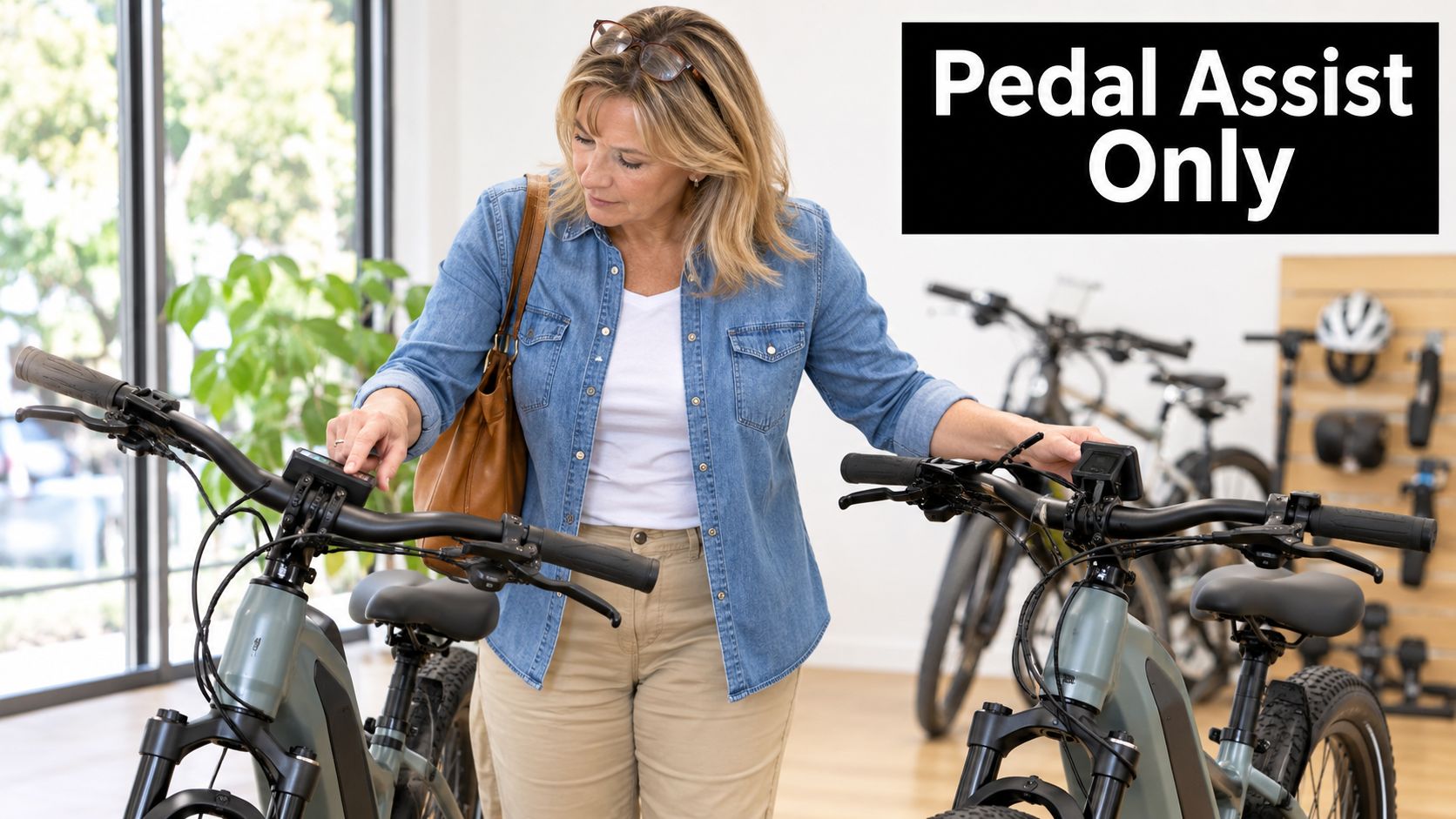
What that changes for you
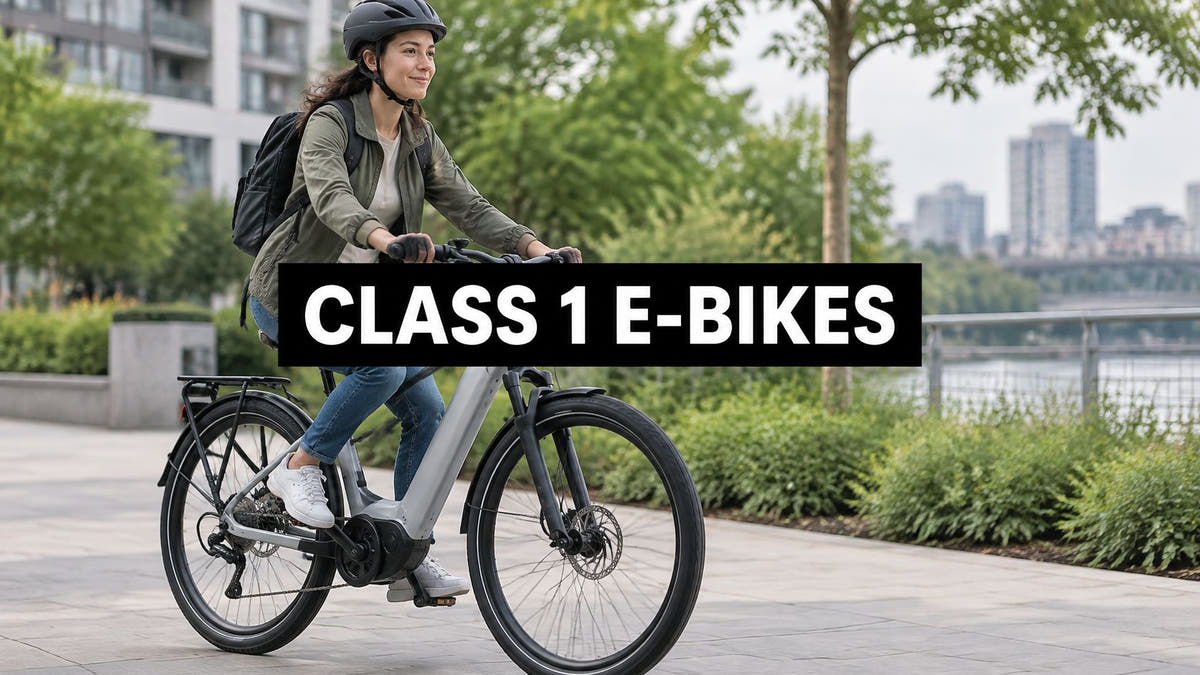
If you want a bike that still feels like a bike, Class 1 Ebikes for Sale listings are where you start. You're the engine, the motor is a helper. If you want to rest your legs and let a throttle carry you, you're shopping in a different category, even if the photos look identical.
It also affects where you can ride. Parks, paths, and land managers often write rules around how a motor behaves, not around paint or wheel size. A bike that only helps when you pedal fits more easily into places designed for conventional bicycles, though you still need to check local signs.
Practical rule: Judge a Class 1 claim by what happens at the pedals and at the speed cutoff, not by the headline on the listing.
This way of thinking travels, but the labels don't stay identical. The US uses class language, Great Britain uses Electrically Assisted Pedal Cycle rules, the EU uses its own pedal-cycle exemption, and Australia has its own national and state framework. The shopping habit stays the same everywhere. Ask how the motor starts, when it stops, and whether you must pedal to keep it going, then compare range, price, and style after you've answered those three questions.
What Makes an E-Bike Class 1
Think of a regular bicycle first. You push the pedals, the chain moves, the wheels turn. Nobody else is helping. Now imagine a friend running beside you, giving the bike a steady push, but only while you're pedaling. The moment you stop pedaling, your friend stops pushing. That's the Class 1 idea in plain language.
The flow below shows that sequence, from your legs doing the work to the electronics deciding when help is allowed.
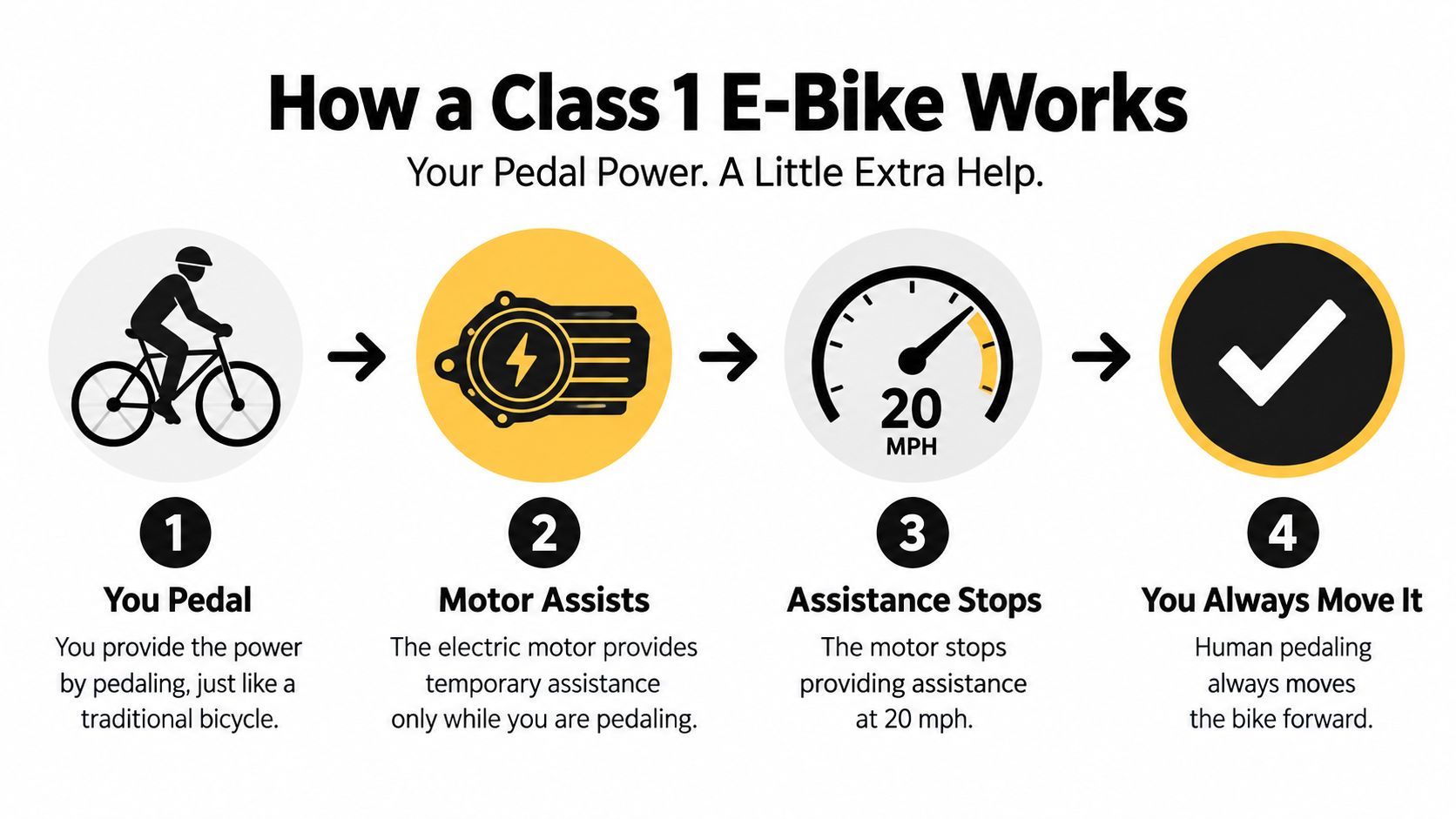
The chain of events on every ride
First, a sensor notices you're pedaling. Some bikes sense how fast the cranks turn, others sense how hard you're pressing. Second, the controller tells the motor to add power. Third, when you reach the cutoff speed, the controller removes that power. You can keep pedaling faster under your own effort, but the motor won't push you beyond its limit.
That sensor choice changes how the bike feels. A bike that responds to pressure often feels smoother at junctions because help builds as you press harder. A bike that responds mainly to crank movement can feel a touch delayed when you start, then steadier once you're moving. Neither feel tells you the class by itself. The class comes from whether pedaling is required and where assistance ends.
The short video below is useful if you want to see pedal input and motor response together before you test ride anything in person.
In the US framework, four checks travel together. The widely used US Class 1 framework requires fully operable pedals, motor assistance only while pedaling, assistance to stop at 20 mph, and a motor rated below 750 watts under the specified testing conditions, as summarized in the Consumer Product Safety Commission bicycle standards summary.
That last point trips people up. A big watt number on a listing doesn't prove a bike is strong on your hill, and a smaller number doesn't prove it's weak. Wattage is a rating boundary for classification. How the bike climbs depends on gearing, controller tuning, your weight, and how hard you pedal.
- Pedals must work: You should be able to propel the bike by pedaling, not just spin decorative cranks.
- Help follows pedaling: Stop pedaling on a test ride and the push should fade.
- Help ends at the cutoff: Ride toward the limit on a safe stretch and feel assistance taper rather than surge.
If a listing says electric bicycle or pedal-assist but won't state those points clearly, you don't have a verified Class 1 bike yet. You have a claim waiting for proof.
How Class 1 E-Bikes Compare With Other Classes
Classes confuse people because they sound like quality grades. They're not. A Class 1 bike isn't a beginner bike and a higher class number doesn't mean a better bike. The numbers describe how the motor is allowed to join in.
The comparison visual puts the three US categories side by side so you can spot the dividing lines, which are throttle access and assisted speed.
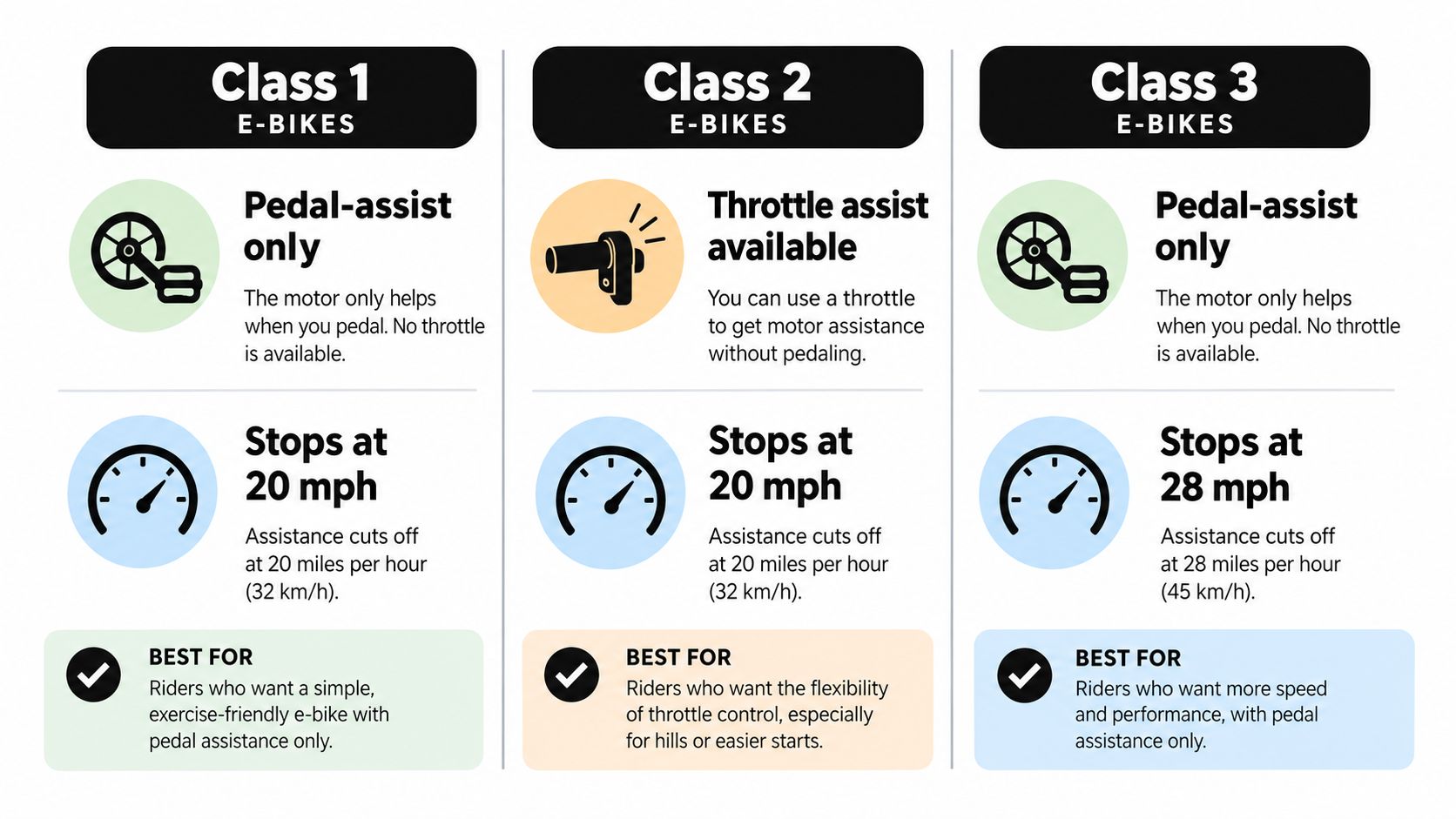
The moment help starts
Class 1 is the simplest bargain. You pedal, you get help. You coast, you don't. There's no riding throttle to carry you through a tired moment, which some riders love because the bike never surprises them, and some riders dislike because hill starts still demand a good first push.
Class 2 keeps pedal assistance but adds a throttle. That means the motor can move you without pedaling, within its permitted assisted speed. For a rider with sore knees, heavy shopping, or lots of stop-start junctions, that can be useful. For a rider who wants access to paths that restrict throttles, it can be a problem.
Class 3 returns to pedal-only help but allows assistance to a higher speed under the US framework. It suits longer road commutes where keeping pace matters. It can also face tighter restrictions on shared paths, because speed changes how other path users experience you.
Don't ask which class wins. Ask which behavior matches the hardest moment on your regular route.
Where listings mislead
Watch for bikes sold as Class 1 that ship with a throttle in the box, or with a menu setting that lifts the assisted speed. The seller might say you don't have to use those features. Classification usually cares about what the bike can do in its current configuration, not what you promise to avoid.
Also watch for imported language. A seller in another market may use Class 1 loosely to mean any pedal-assist bike. In Great Britain and the EU, the legal test uses different power and speed boundaries, so a US class label doesn't automatically translate into legal status there.
If you're torn, test the start. Ride away from a stop on a slight incline, try a slow turn, then stop pedaling mid-block. You'll learn more in two minutes about whether you want pedal-only help than you will from an hour of comparing photos of Class 1 Ebikes for Sale online.
Legal Limits Across US UK and EU Markets
Where you live changes what counts as a legal pedal-assist bike. This is an educational overview, not legal advice for your street, trail, or train. Check current local rules before you buy, and again before you ride somewhere new.
United States
Federal low-speed e-bike rules set the outer technical boundary around operable pedals, motor rating, and motor-only speed under specified test conditions. States, cities, parks, and trail managers can add their own conditions on top of that. That's why a bike can be welcome on a road and a paved rail trail, yet restricted on a natural-surface trail in the same county.
Don't rely on a map app to settle access. Posted signs, park pages, and land-manager rules control the ride in front of you. If you plan to use federal land, a university campus, or a transit system, check that operator separately.
Great Britain
Great Britain doesn't use the US class badge as its legal test. A bike is treated as an Electrically Assisted Pedal Cycle, or EAPC, only when it has pedals capable of propelling it, uses a motor with no more than 250 watts of continuous rated power, and cuts assistance at 15.5 mph, according to the UK government electric bike rules for EAPCs.
A compliant EAPC doesn't need registration, vehicle tax, insurance, or a driving licence, and riders must be at least 14 years old, per that same UK government guidance. The cycle must also display the manufacturer and continuous rated power. Miss those limits and the machine can be treated as a motor vehicle, with registration, insurance, taxation, licensing, and helmet consequences.
Two details catch import buyers. London's transport authority notes that any walk-assist function must cut out at 3.7 mph, as set out in Transport for London e-bike safety guidance. A US-style bike that feels tame in Florida can therefore fall outside EAPC treatment in London because its power, cutoff, or walk mode doesn't match.
European Union
Under Regulation (EU) No. 168/2013, the pedal-cycle exemption covers an auxiliary motor with maximum continuous rated power no more than 250 watts, assistance that stops when pedaling stops, and output cut off before 25 km/h, as stated in the EU regulation text on pedal cycles with auxiliary motors. Output must also progressively reduce before that cutoff, which is why many European bikes feel like they ease off rather than switch off abruptly.
Member states and cities can still shape where and how you ride. Treat the EU threshold as the product boundary, then check national road rules, local path rules, and any registration or equipment duties that apply where you'll use the bike.
Australia
If you're buying for Australia, don't import a US or UK assumption and hope it fits. Verify current national requirements and the rules in your state or territory before purchase or use, including how pedal assistance, throttles, and motor output are treated. A seller who serves the Australian market should be able to point you to the documentation for the exact configuration being sold there.
Check Compliance Before You Buy
A polished title isn't evidence. You need the seller to describe behavior in writing, in words you can compare with the rules where you live. If answers stay vague, that's useful information too.
The checklist visual turns that idea into five prompts you can copy into an email before you pay.
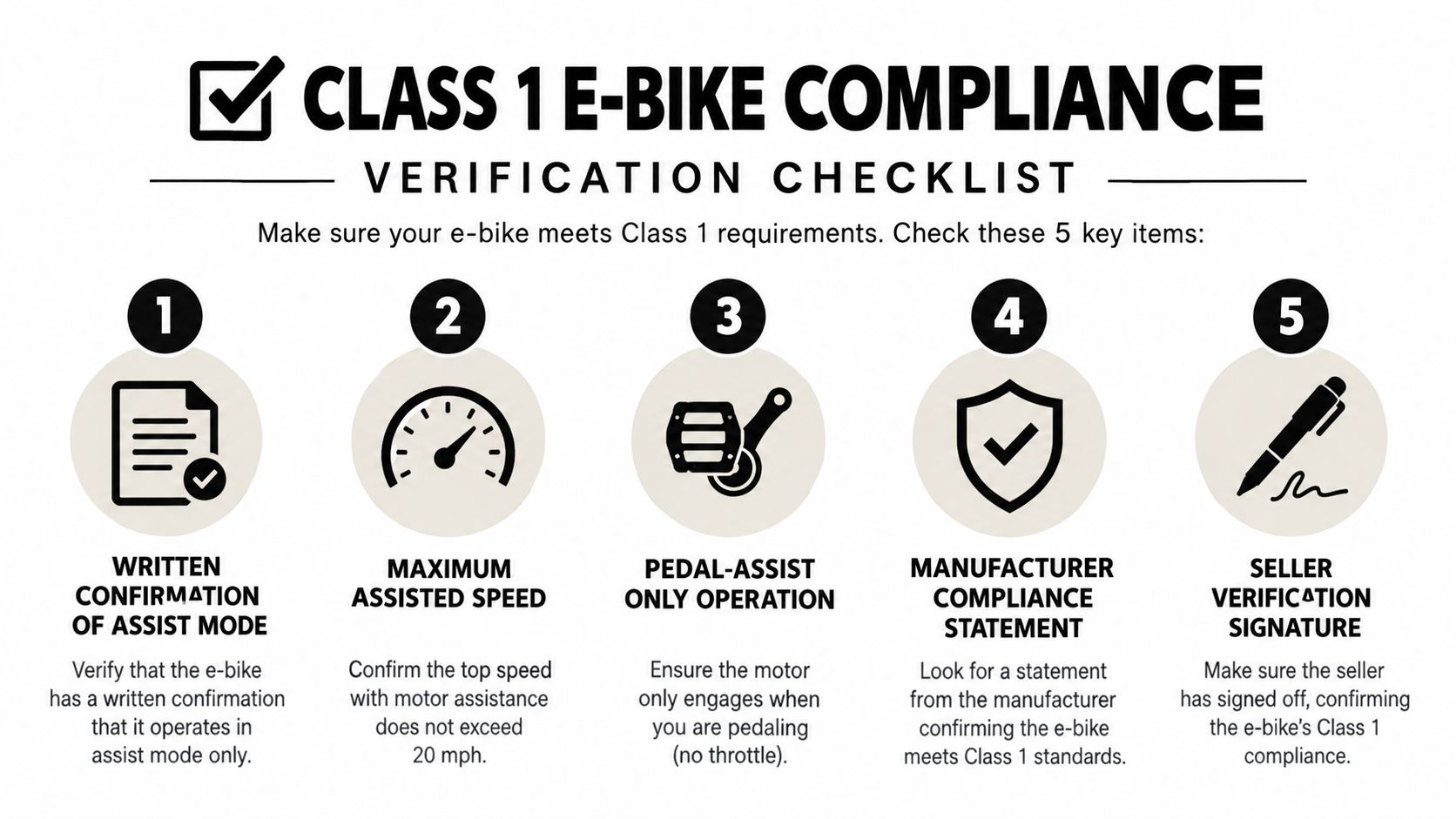
Questions to send the seller
- Assist mode in writing: Does the motor assist only while I pedal in the configuration you'll ship to me?
- Maximum assisted speed: At what speed does assistance stop, and can that limit be changed in a menu?
- Pedal operation: Can the pedals propel the bike without motor help?
- Motor rating: What's the continuous rated power, and where is it printed on the bike or documents?
- Selectable modes: Is there a throttle, walk assist, or off-road mode, and how does each one behave?
- Regional paperwork: Which market was this exact build made for, and what compliance statement comes with it?
Modes matter more than many shoppers expect. UK guidance says an off-road mode that allows propulsion above 15.5 mph does not comply with EAPC rules, while a Twist and Go e-bike that can move without pedaling requires approval unless specific permitted conditions apply. A hidden setting can therefore undo an otherwise tidy sales claim, especially on an imported bike.
Paperwork to keep before money moves
Ask for the manufacturer's specification sheet, battery and charger details, warranty terms, and a clear returns policy. Check whether there's any recall information for the model or battery, and save screenshots of the listing exactly as it appeared when you ordered.
If you're also considering second-hand options while comparing new Class 1 Ebikes for Sale, use a structured inspection list to avoid overpaying on a used bike and apply the same assist and cutoff questions to the seller. A used bike may have been modified, fitted with a different controller, or paired with a replacement battery that changes the original setup.
Seller test: If a listing can't explain how the machine behaves when you start pedaling, stop pedaling, and reach the cutoff, treat the Class 1 claim as unverified.
Pay attention to small evasions. Phrases like road legal style, Class 1 mode available, or can be restricted aren't the same as a statement that the bike, as delivered, matches your region's test. Ask for the delivered configuration, not a possible configuration.
Match Class 1 E-Bikes to Real Riding Journeys
Start with your Tuesday, not with a catalog. Where do you go, what do you carry, and where will the bike sleep at night? Those answers narrow the field faster than any headline range figure.
Not everyone buys an e-bike mainly to commute. A 2025 YouGov survey of 1,212 US adults found that 21% of e-bike users reported commuting or running errands and 10% reported work-related tasks, as reported in the YouGov survey on US e-bike use. Leisure, fitness, and occasional short trips are normal reasons to buy, and they point to different bikes.
Five journeys, five different priorities
For a flat urban commute, smooth starts and predictable assistance matter more than brute climbing ability. You'll value lights, mudguards, a rack, and a battery you can charge without drama at home or work.
For a hilly route, test the lowest gear and the way assistance responds when you're already tired. A Class 1 bike still asks you to pedal, so gearing that lets you spin comfortably uphill can matter more than a flashy display. If you can't test your actual hill, find a similar slope near the shop.
For mixed transit, weight and size move to the front of the queue. You'll lift the bike onto a train, carry it up stairs, or wheel it into a small hallway. A lighter bike you can handle every day can beat a longer-range bike you dread moving. If you're weighing a bike against a scooter for that last stretch, an e-scooter comparison for mixed urban journeys helps you think through carrying, storage, and trip length before you commit.
For leisure riding, comfort and path access lead. Check saddle, handlebar height, tire grip for your usual surface, and whether your favorite trail allows the class you're buying. For occasional errands, be honest about cargo. A backpack works for bread and milk, but regular shopping asks for a rack, basket, or panniers that don't heel-strike when you pedal.
A simple fit routine before you buy
Map your longest regular round trip, then add a detour. Note hills, headwind exposure, cold mornings, and stop-start traffic, because all of them change how much battery you'll use compared with a gentle test loop. Don't treat a manufacturer's maximum range as a promise for your route in winter with shopping on board.
Decide where the bike will live and charge. Measure the doorway, lift, and storage corner. Try carrying the bike a short distance if stairs are part of your life. Then test ride for pedal response, braking confidence, and low-speed balance, not just straight-line speed.
The right Class 1 bike is the one that fits the journey you'll repeat when you're busy, tired, and carrying something awkward. That standard is less glamorous than a launch video, but it's the one you'll live with.
Safety Ownership Costs and the Final Choice
Here's the assumption worth challenging. A Class 1 label describes how assistance works. It does not certify that the battery is safe, that the charger is correct, or that the bike will suit your body and your building.
Battery safety is a separate investigation. UK government research published in December 2024 reported almost 200 lithium-ion battery fires involving e-bikes or e-scooters in 2023 and 10 fatalities, according to the UK government e-bike battery safety research announcement. That doesn't mean every model carries identical risk. It means documentation matters more than a reassuring adjective.
Battery checks you can actually do
Ask how you'll identify the battery-management system, whether the charger supplied is the manufacturer-specified charger for that battery, and whether the battery case is sealed or tamper resistant. Ask how to check recall information, and whether replacement batteries must come from the original manufacturer or an approved source.
Separate a complete bike from a conversion kit or a loose replacement battery in your mind. They can look similar in photos, but the documentation, compatibility checks, and support route may be very different. If a seller can't tell you which charger belongs with which battery, pause.
Think through charging where you live. Apartment rules, a hot garage, a cold shed, and long storage between rides all change what careful ownership looks like. Read the manufacturer's charging and storage instructions before the first charge, and don't improvise with a charger that merely fits the plug.
Costs beyond the sticker
Ownership cost isn't only the purchase price. Budget attention for routine maintenance, brake and tire wear, secure parking, a good lock, possible insurance where relevant, and eventual battery replacement. You don't need a spreadsheet with invented prices. You need to ask the seller what wear parts and replacement batteries are available, how warranty support works, and who services the electrical system locally.
A cheaper bike that nobody near you will service can become expensive in time and frustration. A pricier bike that fits your stairs, your route, and your charging spot can be the calmer buy. Neither conclusion comes from the class label alone.
Your final checklist
- Region first: The delivered configuration matches the rules where you'll ride.
- Behavior verified: Pedaling starts assistance, stopping pedaling ends it, and the cutoff is stated in writing.
- Journey tested: Distance, hills, cargo, carrying, and storage fit your real routine.
- Battery documented: Charger compatibility, management safeguards, recalls, and storage guidance are clear.
- Support confirmed: Warranty, service, parts, and replacement battery routes are named before you pay.
Buy the behavior, the fit, and the paperwork, in that order. When those three line up, Class 1 Ebikes for Sale stops being a confusing search phrase and becomes a practical shortlist you can defend to yourself six months later.
Browse the electric bikes and commuter rides at Punk Ride LLC with your pedaling, cutoff, and battery checklist in hand, then compare the delivered configuration against the rules where you'll ride. Pick the model that fits your route, your storage space, and your charging routine, not just the listing headline.
Share:
Scooter Tire Repair Kit: What to Carry and Why