


Most electric scooter batteries last roughly 2 to 5 years, depending on use, because lithium-ion packs typically deliver 500 to 1,000 full charge cycles before noticeable range loss sets in. A lightly used scooter may last longer on the calendar, while a heavily ridden commuter or delivery scooter can reach that wear point sooner.
You notice the change on an ordinary morning. The scooter powers on, the display looks normal, and yet you start wondering whether the battery will get you to work and back without an anxious glance at the range meter. That worry usually begins before the pack has “failed.” Battery ageing is gradual. The useful question isn't only how long the battery keeps working, but when it stops giving you enough dependable range for your daily trips.
What Daily Commuters Actually Experience
A commuter leaves with a full battery, climbs hills through traffic, and reaches the office with less range than expected. The display still looks normal. On the return trip, the percentage drops faster whenever the throttle works hard. The battery has not suddenly failed, yet the scooter no longer feels dependable.
For regular riders, a useful calendar estimate is roughly 2 to 5 years. Charging frequency, riding conditions, pack quality, and discharge depth all affect the result. Guidance for lithium-ion scooter batteries commonly places service life between 300 and 1,000 full charge cycles, while other guidance uses 500 to 1,000 cycles before capacity falls below about 80% of new (battery life guidance for electric scooters, cycle-life guidance for scooter batteries).
A rider who uses only part of the pack each day builds equivalent full cycles slowly. Long commutes, steep hills, heavy loads, and regular rides from nearly empty use that allowance faster. As a result, two scooters bought around the same time can feel very different. One may still deliver steady range, while another reaches the charger well before the rider expects.
How range loss becomes a replacement decision
A battery's age matters less than whether it still covers the route with a comfortable margin. Many guides place the practical end of useful service at 70% to 80% of original capacity. At that point, the lost range is noticeable, and voltage sag, the temporary drop in voltage under load, becomes easier to feel (battery capacity and useful-life benchmark).
The same capacity loss affects scooters differently. If a daily route uses only a small portion of the original range, the pack may remain convenient. If the route already consumes most of it, a modest decline can create an extra charging stop or leave little reserve for hills and delays.
Entry-level packs may show this decline sooner when their cells or battery-management system are less durable. A mid-range commuter pack can remain useful longer with moderate riding, while a premium pack may provide steadier performance. None is protected from heat, deep discharge, or poor storage.
Check a guide to electric scooter range before blaming the battery alone. Hills, tyre pressure, rider weight, weather, and speed can reduce range even when the pack remains healthy. Compare the scooter's performance on a familiar route under similar conditions, then judge whether the lost range is persistent.
Understanding Cycle Life and Calendar Life
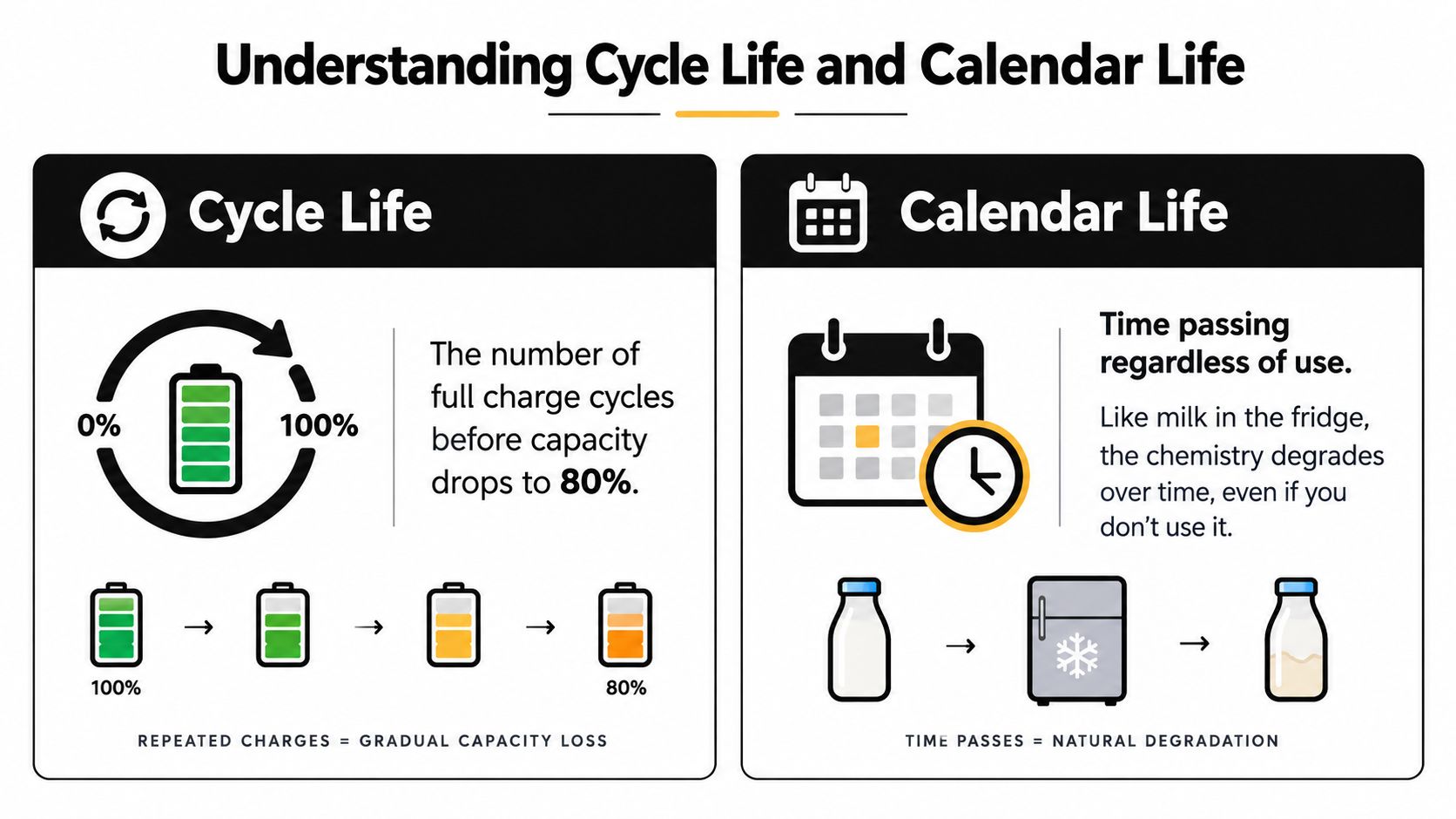
Cycle life means how many equivalent full charges a battery can deliver before its capacity falls significantly. Using half the battery today and half tomorrow counts as roughly one full cycle, even though the charger was connected twice.
Calendar life is the simple passage of time. A battery can lose capacity while sitting unused because its internal chemistry continues to change. Think of milk in the fridge. Drinking it slowly doesn't stop it ageing, and leaving it untouched doesn't keep it fresh forever. A scooter stored for a year still needs sensible care, while a heavily ridden scooter may use up its cycle life through miles rather than birthdays.
Turning cycles into a riding pattern
A typical 500 to 1,000 cycle rating can translate into several years for a commuter who uses partial charges. The same rating may be reached more quickly by a rider who drains and recharges the pack repeatedly. The important distinction is equivalent full cycles, not the number of times you plug in.
The useful-life line is practical rather than absolute. Around 70% to 80% of original capacity, many riders decide the battery no longer meets their normal range needs, even though the scooter still turns on and moves (useful-life threshold and cycle explanation). A seasonal rider may take much longer to reach that point than someone commuting throughout the week.
For readers comparing ownership decisions across energy products, DLG Electrical's guide to 2026 solar battery costs provides useful background on why cycle count and calendar age both matter. The same basic distinction helps you judge a scooter pack more sensibly.
The battery management system, or BMS, monitors cell voltage and temperature and helps control charging and discharging. A plain-language explanation of an e-bike battery management system is useful because the same protective idea applies to many scooter packs.
The Six Factors That Quietly Shorten Battery Life
Battery lifespan rarely comes down to one bad evening. It's usually the result of repeated conditions that make the cells work harder than necessary.
| Factor | How It Damages the Battery | One-Line Verdict |
|---|---|---|
| Cell chemistry | Different cells tolerate heat, load, and repeated cycling differently. | Chemistry sets the ceiling. |
| Charging habits | Frequent deep discharges, unsuitable chargers, and unnecessary full charges add stress. | Charge gently and consistently. |
| Temperature | Heat accelerates degradation, while cold temporarily reduces performance and increases voltage sag. | Heat is the silent enemy. |
| Mechanical load | Hills, heavy riders, low tyres, and aggressive acceleration demand more current. | Load turns range loss into heat. |
| Storage state | Leaving a pack empty or fully charged for long periods adds avoidable chemical stress. | Off-season storage still counts. |
| Build quality | Cell matching, connections, enclosure design, and BMS quality affect reliability. | A sound pack protects every other habit. |
What each factor looks like in real use
Chemistry quality matters before you even switch the scooter on. Two packs with the same advertised voltage can have different cell quality, internal resistance, and ability to handle repeated loads. That difference often appears as earlier voltage sag on hills or faster range loss.
Charging habits matter because riders tend to repeat them every day. Plugging in after every short trip isn't automatically harmful, but regularly running the battery nearly empty and immediately charging it full gives the pack a harder routine than moderate partial use.
Temperature needs attention in both directions. A scooter left in a hot car or charged immediately after a demanding ride can hold more heat than the rider realises. Cold weather may not permanently damage a healthy pack by itself, but it can make the scooter feel weaker and reduce available range until the cells warm.
Mechanical load includes more than rider weight. Hills, headwinds, soft tyres, frequent full-throttle starts, and extra cargo all increase current demand. A battery that seems “old” may partly be struggling against conditions that have changed around it.
Storage is where seasonal riders often lose ground. A scooter left unused should be kept in a cool, dry place with a moderate charge, not abandoned at empty or left sitting fully charged for months. Finally, build quality determines how well the BMS, cells, wiring, and enclosure cope with everyday use.
If you only change three things, choose cool charging, moderate charge levels, and proper storage. Those habits are inexpensive, repeatable, and easier to maintain than trying to control every variable on every ride.
Battery Chemistry Compared and Why It Matters
Battery chemistry shapes the trade-off between weight, range, durability, and cost. Most commuter scooters use lithium-ion cells, commonly NMC or NCA, because they store substantial energy without making a folding scooter too heavy.
LiFePO4, also called lithium iron phosphate or LFP, prioritizes stability and repeated cycling. Its cells usually need more space for comparable usable energy. Older lead-acid and NiMH packs are heavier and less practical for portable scooters, though they still appear in some low-cost or toy-grade products.
| Chemistry | Typical Cycle Life | Weight | Best Use Case |
|---|---|---|---|
| NMC or NCA lithium-ion | Common scooter ratings sit around 500 to 1,000 full cycles | Lower for a given range | Everyday commuter and performance scooters |
| LiFePO4 or LFP | Often selected where repeated cycling and thermal stability matter more than compact size | Heavier for comparable energy | Larger, heavier-duty or fleet-style applications |
| Lead-acid or NiMH | Older pack technology with less favourable portability and energy storage | Heavy | Toy-grade or legacy low-cost scooters |
Cycle counts describe laboratory-style full use. Your daily experience is the range that remains after months of riding. A pack may still power the scooter while delivering noticeably less distance. For many riders, the meaningful replacement point arrives when usable capacity falls toward roughly 70% to 80% of its original level, not when a cycle counter reaches a particular figure.
NMC and NCA usually provide the best range-to-weight compromise. They fit more easily into a deck or stem and keep the scooter manageable when folded. If you choose either chemistry, look for a documented BMS balancing function. Balancing helps the BMS keep individual cells at similar charge levels, which supports consistent pack performance. Avoid storing an NMC or NCA scooter at full charge in heat.
LFP can suit repeated use and harsher conditions, but expect about 20% more weight for the same watt-hours. Check that the deck can accommodate its larger enclosure before buying. LFP still requires a compatible charging and storage setup.
Lead-acid is generally a poor match for a modern commuter seeking a light machine. It adds weight and leaves less room for useful range. For practical maintenance and replacement considerations in warm climates, Singapore battery replacement advice offers a consumer-focused reference. Choose chemistry by the range you need, the weight you can carry, and how the pack's capacity loss will feel in everyday trips.
Charging Habits and Storage That Actually Help
The easiest way to shorten a battery's life is to treat every ride as a reason to leave it full, hot, or nearly empty. A commuter returns from a hill-heavy trip, plugs in immediately, leaves the scooter in a warm car trunk overnight, and tops it to 100% every evening “just in case.” Each choice is understandable. Together, they create a tougher environment for the cells.
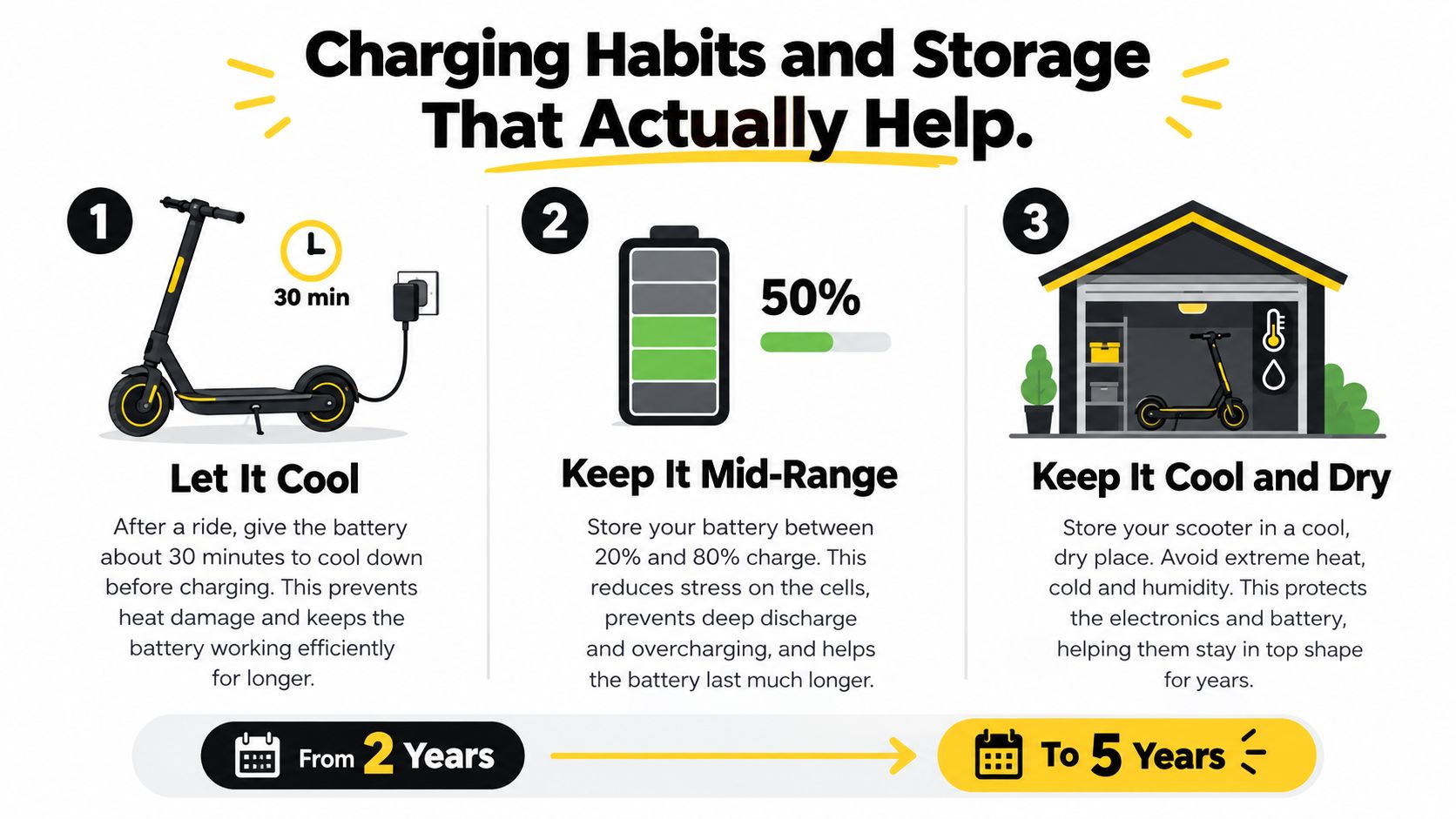
Let the pack cool after a demanding ride before charging. Use the original charger or a reputable replacement designed for the scooter's voltage, connector, and BMS. A charger that fits physically isn't automatically electrically compatible.
A calmer daily charging routine
For daily use, many riders aim for a 20% to 80% charge window rather than filling the battery after every short trip. On a 36 V, 15 Ah pack, a practical upper voltage is around 41 V instead of 42 V, but only when the scooter or charger supports that setting. Don't manually substitute a charger or alter wiring to force a different limit.
Partial charging reduces the depth of each cycle. It doesn't mean you should panic if a long trip requires a full charge. It means full charging should serve a purpose, such as a longer planned journey, rather than becoming an automatic overnight habit.
Storage without guesswork
Store the scooter in a cool, dry place, ideally around 15°C to 25°C when practical. For a long winter layup, leave the battery around 50% charged, check it periodically according to the manufacturer's instructions, and keep it away from damp sheds, radiators, and direct sun.
Practical rule: A cool charging spot, moderate top-ups, and unplugging when charging is complete will do more than an elaborate routine you won't follow.
The cheapest wins are consistent ones. Avoid charging a hot pack, don't leave a full battery sitting unnecessarily, and use the right charger. For a longer seasonal shutdown, follow this guide on how to store lithium batteries safely.
Warning Signs Your Battery Is on Its Way Out
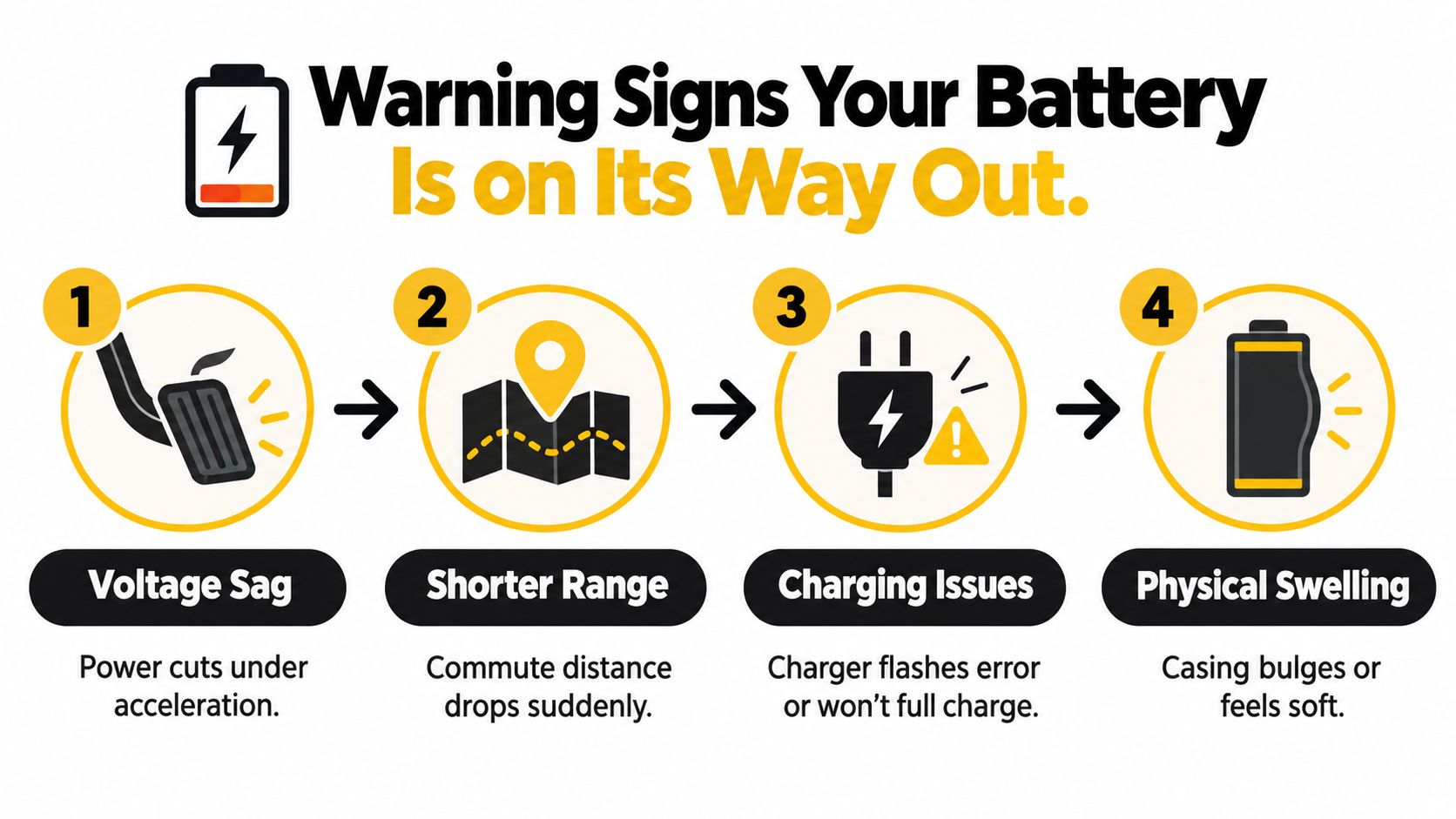
A scooter can still turn on while its battery is losing strength. You may notice the change first on a familiar hill: the motor feels weaker, the displayed voltage drops sharply under throttle, then rises again when you ease off. That temporary drop is voltage sag, a sign that the pack struggles to deliver current under load.
Range is often the clearest day-to-day warning. The display may show a full charge, yet the scooter covers fewer streets before the percentage falls. Compare rides on the same route and under similar conditions. Cold weather, hills, tyre pressure, and speed can all shorten range without proving that the battery has failed.
Symptoms that deserve attention
Error codes, low-voltage warnings, unusually long charging, or a percentage that drops quickly after unplugging can point to an aging pack. They can also come from the charger, controller, connectors, or BMS, the battery management system. A technician can separate cell wear from an electrical fault before you pay for a replacement.
Physical changes require faster action. Swelling, unusual heat, a sweet chemical smell, or sudden shutoffs on hills mean you should stop riding and stop charging. Do not try to nurse a visibly damaged pack home.
A simple check can show whether the change is real. Let the switched-off scooter rest, then use a suitable voltmeter and compare its reading with the pack's nominal voltage. Follow that with a timed test on a familiar route. Compare the distance with the scooter's original real-world result, not its optimistic marketing range. This check indicates performance; it does not diagnose or repair the battery.
Use the timed range test as the practical measure. If the same route now delivers 20% to 30% less distance than it did when the scooter was new, the pack has reached the end-of-service point described earlier, even if it still powers the scooter (capacity-loss benchmark). At that stage, the question is whether the remaining range still covers your commute safely and comfortably.
For a visual demonstration of common symptoms, watch this battery warning overview:
Replacement Safety Standards and Responsible Recycling
A replacement battery must match more than the scooter's plug. Confirm the original system's voltage, physical dimensions, connector layout, capacity, charger, and mounting points. The BMS, or battery management system, must also communicate with the scooter and enforce suitable charging and discharge limits. A mismatched pack can leave the scooter unreliable or damage its controller and motor.
Before buying, check:
- Voltage matching: Use the voltage specified for the scooter. A higher-voltage pack can damage the controller and motor.
- Capacity suitability: Confirm that the replacement fits the wiring, enclosure, charger, and mounting points.
- BMS compatibility: Check that its protection settings suit the scooter's charging and discharge limits.
- Connector condition: Inspect existing connectors for corrosion, heat damage, looseness, or melted plastic.
- Cell documentation: Avoid anonymous packs without meaningful safety documents or a traceable manufacturer.
UK government guidance says lithium-ion batteries for e-bikes and conversion kits should include safety mechanisms, such as a BMS or equivalent protection, to help prevent thermal runaway during normal use and reasonably foreseeable misuse (UK lithium-ion battery safety guidance). Apply the same safety question when assessing a replacement pack for a related micromobility product.
EU battery rules cover batteries used in e-bikes, e-mopeds, and e-scooters. The European Commission states that battery passport requirements will apply to those categories when the batteries are placed on the EU market (European Commission battery passport information).
| Region | Key Standard | Replaces or Recycles Via | Effective Date |
|---|---|---|---|
| EU | Battery rules covering e-bikes, e-mopeds, and e-scooters, including battery passport requirements | Approved collection and recycling channels | Requirements apply according to EU market-placement rules |
| UK | Government lithium-ion safety guidance requiring protective mechanisms for relevant e-bike batteries | Retailer, local authority, or specialist battery channels | Guidance applies to covered products |
| New South Wales, Australia | AS/NZS 60335.2.114:2023, UL 2271:2018, or UL 2271:2023 for covered products | Approved battery and e-micromobility recycling channels | Current NSW guidance schedules acceptance of UL 2271:2018 until 1 February 2027, with UL 2271:2023 required thereafter. Check the NSW requirements for the latest effective date before purchasing |
Never place a lithium battery in a kerbside bin. Keep a damaged pack away from flammable materials, and contact the manufacturer, retailer, municipal hazardous-waste service, or specialist battery recycler for instructions. Retailer take-back schemes and certified collection points may be available, but confirm acceptance before transporting a swollen or damaged pack.
Quick Wins Checklist and Common Questions Answered
Save this list with your scooter's paperwork:
- Stay moderate: Keep everyday charging near the 20% to 80% range when your scooter supports it.
- Park in shade: Avoid direct sun and hot enclosed spaces.
- Charge at room temperature: Let a hot pack cool before connecting the charger.
- Unplug when full: Don't leave a fully charged scooter connected without a reason.
- Start smoothly: Avoid repeated full-throttle launches and unnecessary high-load riding.
- Store for winter: Leave the battery around half charged in a cool, dry place.
- Inspect monthly: Look for swelling, damaged casing, heat marks, or loose connections.
- Log range: Record performance periodically on a familiar route under similar conditions.
Common questions riders ask
How can I tell the battery age from its serial number?
There isn't a universal serial-number format across scooter brands. Ask the manufacturer or dealer to decode the pack number, then compare that information with purchase records, service history, charge data, and observed range.
Is it safe to mix old and new cells?
Not as a casual repair. Cells with different age, capacity, internal resistance, or charge state can behave unevenly and place extra stress on the pack. Use a qualified battery technician or replace the complete compatible pack.
Can I ride home with a swollen battery?
No. Swelling is a stop-use warning. Turn the scooter off, don't charge it, keep people and combustible materials away, and contact the manufacturer or a qualified battery service.
What does replacement cost in 2025?
The verified information available here doesn't provide a reliable 2025 replacement price, so don't trust a generic figure. Ask for a model-specific quote that includes the pack, installation, BMS compatibility, disposal, and warranty.
The 2 to 5 year range isn't a countdown carved into the scooter. Your charging routine, storage conditions, load, and response to early warning signs influence how much useful range the pack delivers.
Punk Ride LLC offers a curated selection of electric scooters and e-bikes from brands including ISCOOTER, AOVO, DUOTTS, HITWAY, RCB, and ENGWE, with warehouses in the UK and Germany and headquarters in Florida. Visit Punk Ride LLC to compare urban mobility options and find a scooter whose battery, range, and support fit the way you ride.
Share:
Best Electric Bikes for Winter Riding
Comfortable Commuter Bike: How to Choose the Right One