


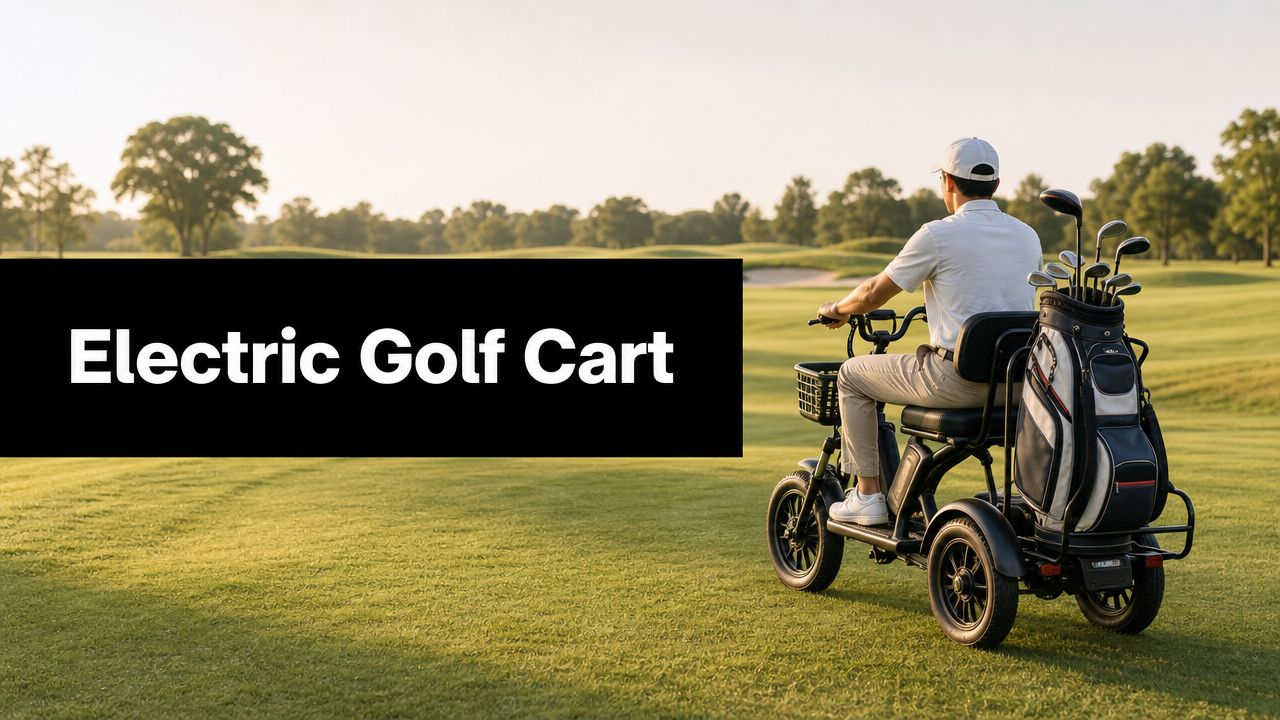
You know the moment. Your drive finishes on one side of the hole, your partner's ball ends up on the other, and the “convenient” shared cart turns into a slow shuttle service for two different rounds.
An electric bike golf cart appeals to golfers for a simple reason. It promises independence without asking you to walk every yard. You ride your own line, keep your own pace, and spend less time waiting while someone else chooses a club or heads back for a forgotten wedge.
What makes these hybrids interesting is the practical side, not the brochure language. Can a bike-style cart hold a full bag without feeling tippy? Does it stay stable on slopes and damp turf? Will your course allow it, and will other players see it as smart or awkward? Those are the questions that decide whether this is a clever idea or a real replacement for a standard golf cart.
The broader market has been moving toward battery-powered golf transport, as noted earlier in the article, but the trend only matters if the ride works on actual courses with actual golfers. A good electric bike golf cart needs to do more than look fun in product photos. It needs to carry clubs securely, stop and start without drama, respect course etiquette, and leave you feeling like you sped up the round instead of adding one more gadget to manage.
That real-world test is where these machines either make sense or don't.
Tired of Waiting for the Golf Cart?
A normal cart round goes like this. You and your buddy tee off. His drive lands center fairway. Yours leaks into the right rough. The cart path bends left first, then loops back. He grabs two clubs, you grab three, someone forgets the rangefinder, and by the time you finally stand over your shot, the rhythm is gone.
An electric bike golf cart fixes that in the most obvious way possible. It turns one shared vehicle into one rider, one bag, one line to your ball.
What the round feels like
The first thing one notices isn't top speed. It's flow.
You hit, hop on, roll out, stop near your ball, take your shot, and move again. There's less waiting for someone else to choose a club. Less “I'll drop you off and circle back.” Less standing beside a cart path watching another player sort out their wedge choice.
That changes the round more than the brochure language ever does.
You don't feel like you're operating a cart. You feel like you're moving through the course on your own schedule.
For golfers who already like walking, this can feel like the middle ground they didn't know they wanted. You still get fresh air and more movement than a standard cart round, but you cut out a lot of the slow trudging between distant shots.
Who usually likes this setup most
An electric bike golf cart tends to make the most sense for a few kinds of players:
- The fast player: You hate waiting on shared-cart logistics more than almost anything.
- The walker who's getting selective: You still enjoy being out on the course, but carrying or pushing for a full round doesn't always sound fun.
- The twilight golfer: You want to squeeze in holes efficiently without turning the round into a race.
- The gadget-minded golfer: You like gear, but only when it solves a real problem.
It's not for everyone. If your favorite part of the round is riding side by side and chatting between shots, a solo ride changes that social rhythm. But if your main frustration is wasted time between shots, this category starts to make a lot of sense.
What Exactly Is an Electric Bike Golf Cart
An electric bike golf cart is a one-person golf vehicle built to carry you and your clubs around the course with less bulk than a standard cart and more support than walking.
That sounds simple, but the feel is different from both options. You are not stepping into a shared cart with a dashboard and storage tray. You are also not balancing a golf bag on a regular e-bike and hoping it behaves. A true golf model is shaped around the stop-start rhythm of a round.

The simple definition
A good plain-English definition is this: it is a seated electric ride designed for golf first.
That usually means a few specific things working together:
- a single-rider frame
- electric pedal assist, throttle, or both
- a dedicated golf bag mount
- wider tires for turf and uneven ground
- a layout that makes frequent mounting and dismounting easier
The last point matters more than spec sheets make it seem. On the course, you are getting on and off constantly. You ride 40 yards, stop, grab a club, park without blocking anyone, hit, then move again. A golf-ready frame has to make that routine feel natural instead of clumsy.
What makes it different from a normal e-bike
A standard fat-tire e-bike can carry stuff. That does not make it a golf cart replacement.
The difference is in how the weight is handled. A golf bag is tall, uneven, and full of shifting weight. Put it in the wrong spot and the ride feels top-heavy, especially when you turn, stop on a slope, or roll off a path onto turf. A purpose-built electric bike golf cart usually puts more thought into bag position, low-speed balance, kickstand stability, and the way the bike sits when parked beside your ball.
Here's the practical breakdown:
| Ride type | Main purpose | What it does well | What it usually lacks for golf |
|---|---|---|---|
| Standard e-bike | General transport | Road and path riding | Stable club carrying and golf-specific parking layout |
| Electric bike golf cart | Personal course mobility | Solo movement with clubs and golf gear | Passenger space and large-cart storage |
| Traditional golf cart | Two-person course transport | Comfort, shared riding, extra storage | One-rider freedom and tighter personal movement |
The easiest comparison is this. A regular e-bike carries cargo as an add-on. An electric bike golf cart treats your clubs like part of the vehicle.
What using one actually feels like
It feels closer to using a push cart that happens to ride itself than to driving a mini car.
You stay more connected to the ground and the shape of the course. You notice side slopes. You notice whether your bag is mounted low and steady or high and wobbly. You also start caring about little golf details that full cart reviews often skip, like whether your wedges knock together over bumps, whether the bike stands securely while you putt, and whether there is room for a water bottle, rangefinder, and small extras like your secret weapon for a cooler round.
That is why this category can be confusing at first. The word "bike" makes some golfers picture speed. The word "cart" makes them picture comfort and storage. In practice, it sits between those two ideas. You get more independence than a shared cart, but you give up some carrying capacity and some of that parked-like-a-bench stability a regular cart gives you.
Why golfers are paying attention to them
Part of the appeal is simple. Golfers are already comfortable with electric course transport, as noted earlier in the article. So a smaller solo machine no longer feels strange. It feels like a targeted tool for a certain kind of round.
The better manufacturers understand that golf use is not just "riding on grass." It is carrying clubs without upsetting balance, turning cleanly near tees, parking without chewing up turf, and keeping pace without annoying the group behind you. Those practical details decide whether an electric bike golf cart is a clever idea or just a novelty.
Plain-English version: an electric bike golf cart is a solo golf ride built around clubs, turf, and repeated stop-and-go use, not just a bike with a rack attached.
Can It Really Replace Your Golf Cart
The hype needs a reality check.
Can an electric bike golf cart replace a standard golf cart? Sometimes. But only if you're the right kind of golfer, on the right kind of course, with the right kind of expectations.
A lot of product pages talk about speed, range, and convenience. The harder questions are the ones golfers ask after the novelty wears off.
Club storage is the first deal-breaker
A normal cart makes club storage easy. You strap the bag in, toss in a jacket, maybe carry drinks and a few extra bits, and you're done.
On a golf bike, bag carrying has to be stable, not just possible.
If the bag mount sits too high, the ride can feel top-heavy. If the clubs shift on bumpy turf, you'll notice it immediately in turns. If the setup rattles every time you cross a rough patch, the round starts to feel like equipment management instead of golf.
That's why the best question isn't “Can it carry clubs?” Most can. The better question is “Can it carry my clubs without making the ride awkward?”
Wet turf and side slopes tell the truth
Many rides feel fine on flat dry ground. Golf courses aren't flat dry ground all day.
Wet patches, soft turf, cart-path edges, side-hill lies, and uneven transitions are where a golf bike either feels controlled or sketchy. A heavier bag can exaggerate balance issues. Wide tires help, but they don't erase poor weight distribution.
A test ride on perfect pavement tells you almost nothing about how the bike will feel crossing damp fairway grass with a full bag.
If your local course gets soft in the morning, or has a lot of side slopes, you need to think less like a shopper and more like a rider. How easy is it to put a foot down? How steady is the bike when parking on uneven ground? Can you push it a few feet by hand without it fighting you?
Course etiquette matters as much as the hardware
The best electric bike golf cart in the world still depends on one simple thing: your course has to allow it.
That's one reason this category is often better framed as a personal mobility tool than a full golf cart replacement. As noted in Addmotor's look at electric golf bikes, most coverage skips the practical application questions like club storage, balance on wet turf, and course acceptance. That's the heart of it. A golf bike may be brilliant for a player who already prefers walking and wants faster transitions. It may be a poor fit for someone expecting a one-for-one replacement for a two-seat cart.
There are also small etiquette details that matter:
- Keep it moving lightly: Don't spin tires or cut across sensitive areas.
- Park thoughtfully: Set it down where it won't block players, bags, or foot traffic.
- Be realistic about pace: Faster transport doesn't give you a license to ride ahead into unsafe areas.
- Carry your essentials smartly: If you're using extra accessories, something like your secret weapon for a cooler round makes more sense when it integrates cleanly with your bag setup instead of adding clutter to the frame.
Who should buy one, and who probably shouldn't
It's a strong fit if you:
- like walking but want less dead time
- usually play solo or don't mind solo transport
- play on a course that's open to personal electric rides
- care more about independence than passenger capacity
It's a weak fit if you:
- want to ride with a partner the whole round
- need lots of extra cargo space
- play mostly on courses with strict cart-style rules
- expect the same planted feel as a four-wheel vehicle
For the right golfer, it can replace a cart often enough to justify owning one. For everyone else, it's better seen as a fresh category with its own strengths.
Key Tech Specs to Evaluate Before You Buy
The spec sheet matters, but only if you translate it into golf use. A number doesn't help much until you connect it to hills, turf, stopping distance, and how annoying the bike becomes after the tenth mount and dismount.
Start with the two specs buyers obsess over most: motor power and speed.

Motor power and speed
For golf-specific electric bikes, the key tradeoff is power versus course-friendly behavior.
One golf e-bike guide describes a 48V 750W setup with a top speed of 20 mph, while another example lists a 2000W motor, 25 mph top speed, and up to 60-mile range, according to this golf e-bike guide from VTUVIA. In plain language, the stronger motor can help on hills and with a loaded bag, but it may push the ride closer to speed ranges that feel less appropriate on many courses.
That's why many golfers should treat huge wattage with caution. More power sounds fun. On turf, around greens, and near other players, a calmer setup is often the smarter choice.
Here's a quick overview:
- Lower-speed golf-friendly setups: Better if you want predictable course behavior and less drama.
- Higher-power setups: Better for steep terrain and heavier loads, but you need to be more careful about rule compliance and rider discipline.
The specs that affect your round most
A golf bike isn't judged by one number. It's judged by how all the parts work together.
After you've seen one in motion, these are the details worth checking closely:
- Frame shape: A low step-through frame makes repeated stops easier. That matters on every hole.
- Tire width and tread: Look for wide tires that spread weight and feel stable on mixed turf.
- Brakes: Smooth, predictable stopping beats grabby brakes on grass.
- Bag mount design: Integrated and low-mounted is usually better than a tall add-on rack.
- Seat comfort: You won't be seated for an hour nonstop, but awkward saddle shape gets old fast.
- Parking stability: The stand or parking setup should feel secure when the course isn't perfectly level.
Don't buy for commute logic alone
Some e-bikes look great online because they're built for roads first. Golf puts different stress on a bike.
You're not mostly cruising in a straight line. You're doing lots of short moves, low-speed turns, stop-start riding, and loading one side of the bike with clubs. If you want a broader framework for sorting useful specs from flashy ones, this guide on how to choose an ebike is a useful companion when comparing golf-friendly models to general-purpose e-bikes.
Buying rule: choose the machine that feels easy to live with for 18 holes, not the one that wins a spec-sheet argument.
Staying Safe and Legal in the USA
Course rules come first. Street rules come second. A lot of buyers get that backwards.
An electric bike golf cart might feel like a casual recreational ride, but once you use it around roads, private communities, or neighborhood connectors, classification starts to matter.
On-course safety that keeps you welcome
Golf-course safety is mostly about behavior.
Ride at a pace that fits the space. Slow down near tees, greens, bridges, and maintenance areas. Keep clear of wet or restricted zones. Don't assume a bike can go everywhere a cart can. Some clubs care less about the vehicle type than how gently the rider treats the course.
A few habits go a long way:
- Approach greens early and carefully: Turf is most sensitive where everyone gathers.
- Use smooth throttle inputs: Sudden bursts feel worse on grass than they do on pavement.
- Dismount before awkward crossings: A short walk across a sketchy patch beats forcing the bike through it.
- Ask before your round: Starter staff can often tell you quickly where these rides are allowed.
Where USA law can get confusing
In the United States, electric golf carts often connect to low-speed vehicle rules, especially once people want to use them beyond the course.
Georgia gives a clean example. The state defines a low-speed vehicle as four-wheeled, capable of traveling more than 20 mph but not more than 25 mph in one mile, with capacity for not more than eight persons, according to Georgia's low-speed vehicle code. Most golf e-bikes are two-wheeled, so they aren't the same thing. But the legal framework still helps buyers understand why some golf-cart-like vehicles can operate in limited public-road settings while others can't.
That's the practical takeaway. Don't assume that because a ride works on a course, it's automatically fine in a neighborhood lane or gated community road.
A smart pre-ride legal check
If you plan to use your ride anywhere beyond private golf property, check three things:
-
Vehicle type
Is it being treated like an e-bike, a golf cart, or something closer to an LSV? -
Local access rules
Private communities often have their own internal standards. -
State-level requirements
Equipment, speed, and access rules can vary, so a state-by-state reference like this electric bike laws by state guide can help you narrow down what applies before you roll out.
If you're unsure, ask the course manager for on-property rules and your local authority for road-use rules. That's less exciting than guessing, but much cheaper.
Finding Your Perfect Golf Ride at Punk Ride
Shopping gets easier once you stop searching for “golf bike” as a magic category and start looking for golf-friendly traits.
A lot of suitable options won't be labeled specifically for golf. They'll have the frame style, tire setup, and carrying potential that make them workable on a course.

What to scan for on product pages
When you're browsing, don't start with color or headline claims. Start with shape.
A golf-friendly candidate usually looks promising if it has:
- a stable frame, ideally easy to mount and dismount
- fat or wide tires for better turf manners
- enough rear structure to support accessories or bag-carrying solutions
- a riding posture that feels controlled at low speed
For example, brands like ENGWE often stand out for fat-tire setups that can make mixed ground feel more planted. Some CYSUM models may appeal if you prefer a sturdier-looking frame and a more utility-oriented build. That doesn't automatically make either one a dedicated golf machine. It just means they may be worth shortlisting if your course allows adapted e-bikes.
Use filters like a golfer, not a commuter
The fastest way to narrow the field is to filter with your actual round in mind.
Try evaluating options in this order:
| Filter | Why it matters for golf |
|---|---|
| Frame style | Easier remounting saves effort all round |
| Tire type | Wider tires usually feel calmer on turf |
| Motor category | Enough power for hills, but not absurdly overbuilt |
| Accessory compatibility | Bag mounts and utility add-ons matter more than speed bragging |
| Overall layout | Stable, low-stress handling beats flashy design |
If you're comparing several bikes in one place, this electric bike buying guide is a practical way to keep your shortlist grounded in fit, use case, and features instead of impulse.
The smart way to shortlist
Here's a simple approach that works:
- Pick three models max: More than that and every spec starts to blur together.
- Reject the obvious mismatches fast: If the frame looks awkward with a golf bag, move on.
- Favor control over hype: A calm, usable bike is better than a powerful one that feels clumsy on grass.
- Think about storage at home too: If it's a pain to load, store, or charge, you'll ride it less.
One useful shopping mindset is to treat the bike as a platform. You're not only buying the motor and battery. You're buying the frame, balance, and practicality that let you build a golf-ready setup without fighting the bike every round.
Your Final Buying and Maintenance Checklist

The last check is simple. Ask yourself whether this ride makes a round easier from the first tee to the moment you put it back in the garage.
That means looking past the headline specs and focusing on the little realities golfers feel every round. Does the bag stay planted when you cross a side slope? Can you step on and off without feeling tippy? Will your course treat it like a welcome pace-of-play tool or like a headache for the staff?
Buying checklist
- Course approval comes first: Call the pro shop and ask whether they allow this style of ride, where it can go, and whether there are bag, tire, or speed expectations.
- Check bag balance with real clubs: A rack can look fine empty and feel awkward once you load a full set. You want the weight low and secure, not swaying behind you like a shopping cart with one bad wheel.
- Test slow turns, not just straight lines: A crucial test on a course is creeping around paths, turf edges, and uneven lies while carrying clubs.
- Make remounting easy on yourself: After ten or twelve holes, an awkward step-over frame gets old fast. Comfort matters more on hole fourteen than in the parking lot.
- Keep speed in perspective: Golf rewards calm control. A machine that feels settled on grass is usually the better pick than one that only looks exciting on paper.
- Plan home charging carefully: If you need a dedicated garage outlet, guidance on EV charger installation can help you think through safe home charging setups.
Maintenance checklist
Golf use creates its own kind of wear. Moisture clings to the frame in the morning, sand works into moving parts, and the repeated stop-start pattern puts extra attention on brakes, racks, and mounts.
Keep the routine boring and consistent:
- Battery care: Charge on a regular schedule and store the bike in a dry, moderate space.
- Tire pressure: Check it often. Pressure affects stability, comfort, and how gently the bike rolls across turf.
- Brake check: Squeeze both brakes before each round. Wet paths and downhill approaches reveal weak braking fast.
- Rack and bag mount inspection: Look for looseness, rubbing, or shifting points. Club weight adds side load that a normal commuter setup may never see.
- Quick cleanup after play: Wipe off grass, sand, and moisture before they build up around the drivetrain and hardware.
One good rule helps here. If a loose mount or weak brake would annoy you on the first hole, fix it before the next round instead of hoping it stays quiet.
If you remember one thing, remember this. Buy an electric bike golf cart only if it fits your course, carries your clubs without drama, and still feels stable after a full round. That is the standard for replacing a traditional cart, not how clever it looks online.
If you're comparing golf-friendly e-bikes and want a practical starting point, Punk Ride LLC carries a range of electric bikes from brands such as ENGWE and CYSUM, which can help you shortlist models with the frame styles, tire setups, and utility features that matter for course use.
Share:
Electric Bike Pump: Your 2026 Guide for US & AU Riders
Electric Scooter Racing: Pro Events & 2026 Starter Guide