


A UK or EU pedal-assist electric bike may receive motor help only up to 25 km/h (15.5 mph) from a 250 W continuous motor, while US Class 3 pedal-assist bikes stop assisting at 28 mph. Those figures set the ceiling for what counts as a road-legal bicycle in each region, rather than a mechanical cap on how fast the wheels can spin.
Here's the question most shoppers miss when they hunt for the fastest legal electric bike: why can a 100% road-legal UK commuter hit 22 mph down a steep hill, while a shiny listing bragging about a "20 mph top speed" could get seized on a London high street?
Because e-bike law doesn't care about your maximum coasting speed. Regulators care about the assistance cut-off point, the exact speed where the motor switches off and leaves the work to your legs. Pedal faster than that line on your own, and you're still riding a bicycle. Let the motor keep pushing past it, and the same frame turns into an unregistered moped overnight.
Fastest Legal Speed in Each Market at a Glance
If you ride in Britain or mainland Europe, two numbers decide whether your bike stays in the standard cycle lane. The UK Government EAPC information sheet sets the threshold at a 250 W maximum continuous rated motor output and an assistance cut-off at 15.5 mph (25 km/h), matching the standard European pedelec rule. That is the fastest assisted speed an ordinary, licence-free electric bike can legally reach across most of Europe.
Europe does have a faster class called the speed pedelec, which assists riders up to 45 km/h (28 mph). According to a California Assembly Transportation Committee analysis, European speed pedelecs are generally treated more like mopeds than bicycles, meaning they typically bring type approval, registration, insurance, and licensing rules that change from country to country. The same report notes that US riders generally follow a three-class framework where Class 1 and Class 2 bikes cap assistance at 20 mph and Class 3 pedal-assist models cap out at 28 mph.
Down under, public-road rules mirror Europe closely. Under Queensland Government electric bicycle rules, a legal public-use e-bike must stick to a 250 W continuous motor, stop pedal assistance at 25 km/h, cap starting-assist throttle help at 6 km/h, carry an EN 15194 compliance label, and stay at or below 12 km/h on footpaths.
Fastest Legal Assisted Speed by Market
Find your riding region in the first column, then check the motor ceiling and cut-off speed side by side.
| Market | Motor limit | Assistance cut-off | Fastest legal assisted speed | Notes |
|---|---|---|---|---|
| UK pedal-assist (EAPC) | 250 W continuous | 25 km/h | 15.5 mph | No registration, vehicle tax, compulsory insurance or driving licence |
| EU pedelec | 250 W continuous | 25 km/h | 15.5 mph | Standard pedelec category, most EU countries |
| EU speed pedelec | Set by moped type approval | 45 km/h | 28 mph | Treated as a moped; type approval, registration and insurance apply |
| US Class 1 and 2 | Under 750 W | 20 mph (32 km/h) | 20 mph | Federal low-speed limit, motor-only test |
| US Class 3 | Under 750 W | 28 mph (45 km/h) | 28 mph | Pedals required; state and trail rules can be stricter |
| Australia public road | 250 W continuous | 25 km/h | 15.5 mph | Throttle help limited to 6 km/h in several states |
Why Top Speed Listings Mislead Buyers
This table gives you the legal ceiling for each major market, yet online product pages rarely speak this clearly. Many overseas listings shout a bold "top speed" figure in the headline without stating whether that number is a governed motor cut-off, an unrestricted off-road mode, or a downhill estimate.
A slower bike on paper often beats a faster one door to door anyway. When a commuter bike stays inside the local cycle class, you can roll straight onto bike lanes, canal towpaths, and shortcuts closed to mopeds. If a listing quotes a flashy top speed and never mentions a motor cut-off figure, treat that omission as a bright red warning flag rather than a spec you can trust.
The Three Rules That Set Legal E-Bike Speed
Think of your e-bike motor like a lifeguard on a set shift. While you're inside the flags, the lifeguard has your back and makes the swim easier. Cross the buoy line, and the lifeguard clocks off. You're still free to swim as fast as your arms will carry you, you just aren't getting any help.
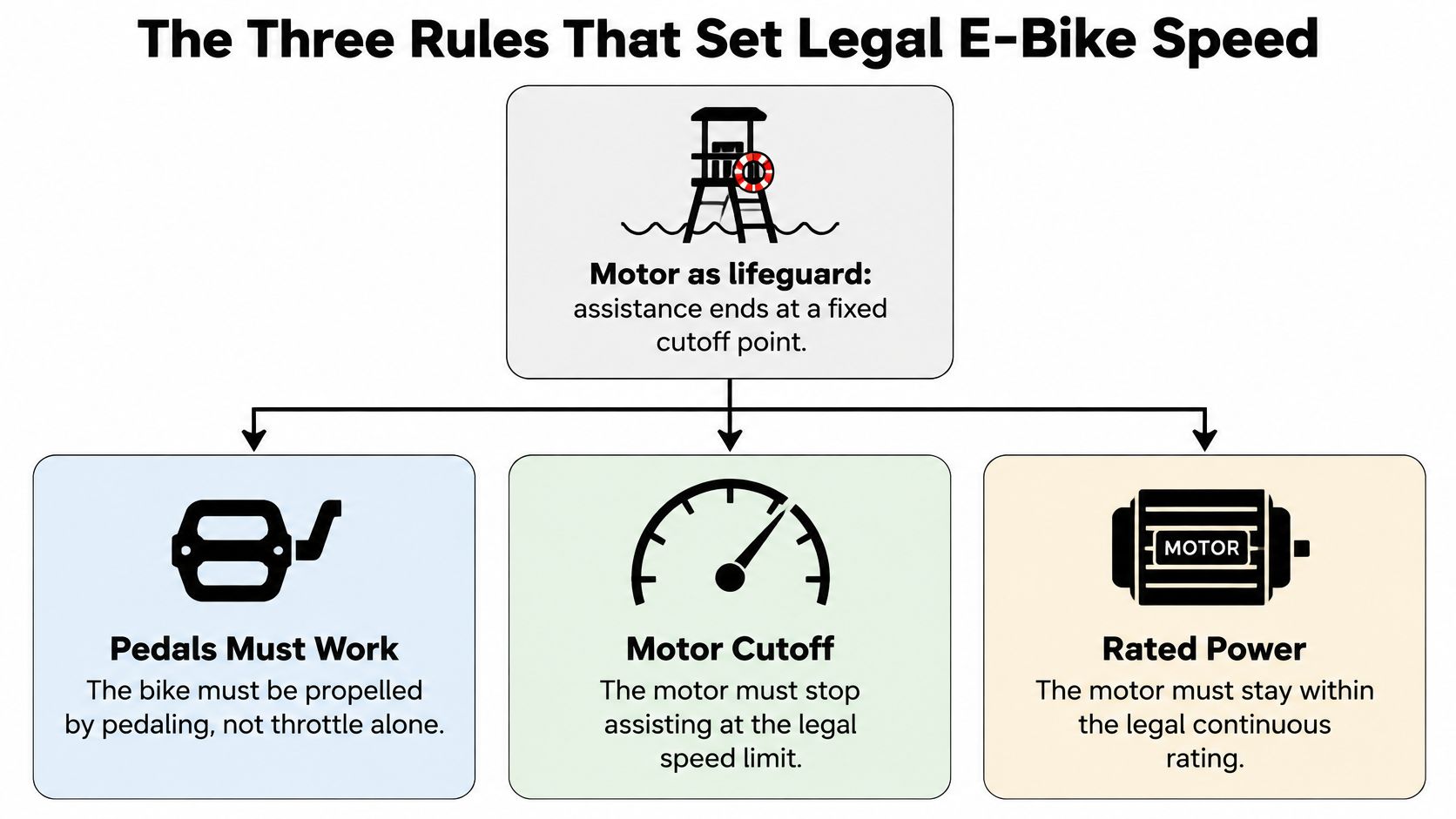
In Great Britain, the UK Government's electric bike rules spell out three clear boundaries that keep an Electrically Assisted Pedal Cycle (EAPC) inside the ordinary bicycle category. Break any one of them, and the bike steps outside standard cycle law.
How the Three Boundaries Work on the Road
Say you roll out of your driveway on a weekday commute with a hub-drive commuter bike. Three technical rules decide whether the police view that bike as a pushbike or an untaxed motor vehicle:
- Working pedals come first: Your pedals must propel the bike forward. Bolt decorative cranks onto a heavy frame driven purely by a twist grip, and it stops counting as a bicycle. If you want to see how twist grips change classification across regions, our breakdown of how a throttle-assisted electric bike is treated explains where throttles cross the line.
- Continuous motor power stays capped: The motor's maximum continuous rated power cannot exceed 250 W. Shoppers often panic when they spot "500 W peak" on a spec sheet, yet peak output during a short hill sprint doesn't set the legal rating. What matters is the continuous figure stamped by the manufacturer.
- Motor help cuts cleanly at 15.5 mph: Once your speed sensor reads 15.5 mph (25 km/h), the controller must stop feeding current to the motor, even if you keep spinning the cranks. Nothing locks the brakes. You can still push to 19 mph on a flat tail-wind stretch or coast faster downhill, because human legs and gravity aren't restricted by motor rules.
Shop-floor rule: An EAPC isn't banned from travelling faster than 15.5 mph. The motor is banned from helping you do it.
What Compliance Buys a UK Rider
Staying inside those three lines keeps everyday riding wonderfully simple. A compliant EAPC in Great Britain needs no vehicle registration, no vehicle tax, no compulsory insurance, and no driving licence. The one personal requirement is age: riders must be at least 14 years old.
Once motor assistance carries on past 15.5 mph, those exemptions disappear. The bike moves outside ordinary EAPC rules and can trigger full motor-vehicle obligations, including licensing, insurance, and tax. Beyond speed and wattage, equipment laws also differ from place to place, so checking a practical guide to helmet and lighting rules for e-bikes from Rider 18 is smart habit before riding in an unfamiliar territory.
If you're unsure whether a used bike or fresh import shuts off when it should, run a quick flat-ground road test. We've laid out the exact step-by-step cut-off checks further down so you can verify your controller before your first public ride.
Why the Same Bike Is Legal in One Country and Not Another
Treat an e-bike's legal status like a passport. A valid stamp gets you smoothly across one border, while the exact same document gets you turned back at the next desk. A single frame, battery, and hub motor can qualify as an ordinary bicycle in Florida and count as an illegal unregistered moped in Manchester.
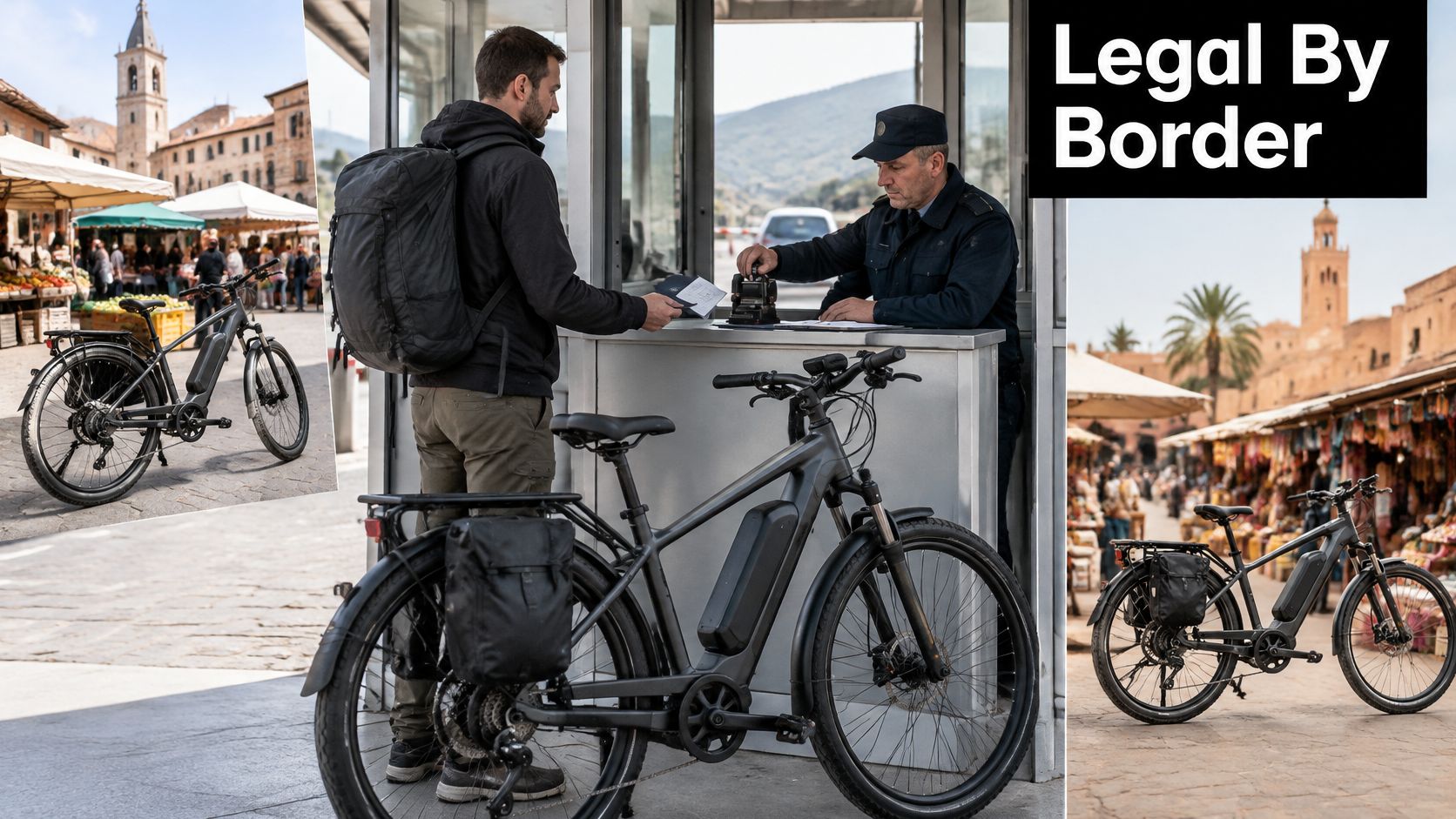
This mismatch happens because lawmakers on opposite sides of the Atlantic wrote completely different tests. Four structural differences separate US e-bike rules from the UK and European framework.
Four Rules That Split US and European Bikes
- Nearly triple the motor ceiling: Under federal statute 15 U.S.C. 2085, a US low-speed electric bicycle may carry an electric motor rated below 750 W (1 horsepower) and still be classified as a consumer product rather than a motor vehicle. That ceiling sits nearly three times higher than the 250 W continuous limit across Britain and the EU.
- A motor-only speed test with a set rider weight: The CPSC bicycle FAQ explains that the federal definition enacted on December 4, 2002 tests speed on a paved, level surface using a 170-pound operator powered strictly by the motor, capping that motor-only run below 20 mph (about 32 km/h). British and European rules don't test motor-only speed or rider weight at all, they cut pedal assistance at 25 km/h regardless of who sits in the saddle.
- Class 3 speed versus moped paperwork: According to a Congressional Research Service report, the fastest broadly recognised legal US e-bike tier is Class 3, where pedal assistance runs up to 28 mph (45 km/h) with operable pedals, a motor under 750 W, and a speedometer where required. Ship that identical Class 3 bike to Germany or France, and it lands straight in the speed pedelec or moped bucket, triggering the kind of strict component and type-approval hurdles motor riders deal with under European exhaust homologation rules outlined by Sixrace.
- State and city speed caps override the brochure: Federal product rules don't guarantee universal road access. Many US states regulate e-bike speeds between 20 and 28 mph, and individual cities tighten things further. For example, City of Orlando safety guidance permits Florida street-legal Class 3 pedal assistance up to 28 mph below 750 W, whereas New York City Department of Transportation guidance caps Class 3 classification at 25 mph and enforces a 15 mph citywide operating speed limit for e-bikes.
What This Means When Buying Online
Say a commuter in Bristol spots a gleaming 750 W commuter bike reviewed by an American YouTuber as "100% street legal at 28 mph." The reviewer isn't lying for their own hometown. Yet the moment that bike rolls off a UK kerb, its motor rating is nearly three times too high and its cut-off is nearly double the British cycle limit.
Before you click buy on any cross-border listing, confirm which regional spec sits in the box. Our broader guide on whether electric bikes are street legal walks through how road, path, and trail rules shift by location. Always verify the market compliance label and your own council or state rules first, rather than taking a global headline speed at face value.
How to Check a Fast E-Bike's Legal Speed Before You Buy
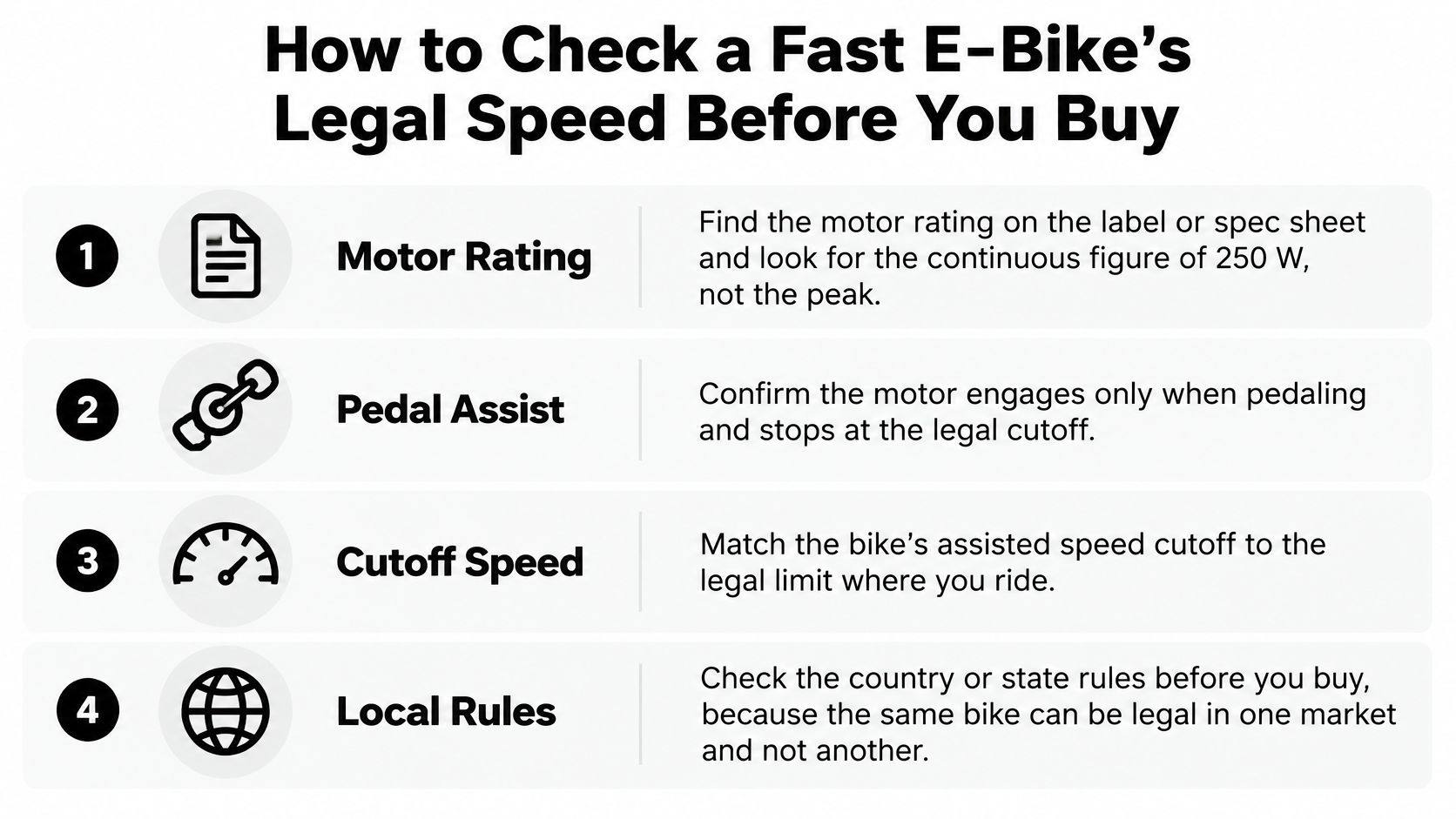
Marketing copy loves big numbers. Firmware manuals and stamped motor casings tell the truth. Whether you're standing in a bike shop, scrolling a product page, or inspecting a second-hand e-bike on someone's driveway, run these eight checks before money changes hands.
Spec Sheet and Hardware Checks
- Read the continuous motor stamp, not the peak claim: Look directly on the hub shell, mid-drive casing, or technical spec sheet for the continuous rated wattage, because peak output figures don't determine whether the bike satisfies local cycle limits.
- Verify the cut-off speed in the owner's manual: Product banners often quote unrestricted test speeds, so open the PDF manual and confirm the controller stops assisting at the legal ceiling, such as the 25 km/h (about 15.5 mph) European EPAC threshold noted in the CPSC comparative bicycle standards report.
- Check for a genuine compliance label: Inspect the frame near the bottom bracket or seat tube for a permanent EN compliance sticker and ask the seller for a declaration of conformity, since missing labels are a classic sign of a grey-market import.
- Pedal the bike with the battery switched off: Spin the cranks for twenty yards with zero electrical power to confirm the chain, cassette, and freewheel drive the rear wheel cleanly, because non-working pedals instantly disqualify an e-bike from bicycle status.
If a seller refuses to let you see the display's speed-limit menu or the motor casing stamp, walk away and keep your wallet shut.
Road Test and Firmware Checks
- Run a flat-ground cut-off test: Find a level, quiet stretch of tarmac, select the highest assist level, and accelerate smoothly while watching the display. You should feel a clean, unmistakable drop in motor push right at your region's legal threshold as your legs take over.
- Test the throttle and walk-assist button: Press the thumb lever or walk-mode button without turning the pedals. Under 2025 New South Wales e-bike FAQs, compliant bikes stop motor assistance at 25 km/h and cut throttle or walk-assist functions at 6 km/h, mirroring standard European walk-assist behaviour; a twist throttle that rockets you up to cruising speed without pedalling is an immediate red flag outside US Class 2 zones.
- Inspect display and app speed settings: Open the companion phone app or controller settings (common on Bafang and KT displays) to verify nobody has raised the speed ceiling or spoofed the wheel circumference setting. A modified bike can be illegal on public roads even if it left the factory fully compliant.
- Cross-check your exact commute route: Look up local path, canal towpath, and trail bylaws for every stretch you plan to ride, because parks and city councils frequently enforce lower speed limits than national vehicle law allows.
If a bike fails even one of these eight checks, keep it off public roads until the controller, hardware, or paperwork is put right.
Why Speed Changes Your Stopping Distance and Risk
Chasing an extra 8 or 10 mph sounds harmless when you're comparing spec sheets on a sofa. Out on damp asphalt with a delivery van edging out of a side street, the physics gets unforgiving fast.
According to independent electric bicycle injury research on Europe PMC, kinetic energy rises with the square of velocity, which means a rider and bike travelling at 28 mph carry roughly 1.96 times the kinetic energy of the exact same setup at 20 mph. Reaction distance stretches out at the same time. Before your fingers even squeeze the brake levers, one second of reaction time eats up 41 feet at 28 mph, compared with 29 feet at 20 mph.
That same Europe PMC paper links speeds above 25 km/h to greater injury risk because longer braking distances, tighter reaction windows, and harder impact forces stack together. Real-world crash figures tell a matching story. A 2025 e-bike injury study published in Traffic Injury Prevention found that among e-bike cases with recorded speed, 39.6% of serious injuries involved speeds of at least 20 mph, compared with 57.5% for mopeds. The study also points to tightening local controls, citing California proposals for 15- and 20-mph path limits and Maryland data showing e-micromobility crashes climbing from 10% of non-motorist crashes in 2024 to 17% in 2025.
How Speed Changes Reaction Distance and Energy
Comparing the three main legal cut-off speeds side by side shows why regulators draw the line where they do.
| Speed | Reaction distance per second (ft) | Kinetic energy vs 20 mph | Typical legal context |
|---|---|---|---|
| 15.5 mph (25 km/h) | 23 | 0.60 | UK and EU pedal-assist limit |
| 20 mph (32 km/h) | 29 | 1.00 | US Class 1 and 2 limit |
| 28 mph (45 km/h) | 41 | 1.96 | US Class 3 and EU speed pedelec limit |
Notice that jumping from the UK/EU pedal-assist limit to the Class 3 and speed pedelec threshold more than triples your collision energy. Your brakes have to shed every bit of that energy as heat.
Hardware That Actually Matters Near Top Legal Speed
When you shop near the upper edge of legal assistance, raw motor wattage matters far less than the parts keeping you upright and controlled:
- Hydraulic or well-adjusted disc brakes: Rim brakes and spongy budget cables fade quickly on a heavy e-bike. Keep rotors clean, pads fresh, and calipers centred; if your pads start howling or chattering under hard stops, our troubleshooting guide to fixing bike brake squeal helps you restore clean bite before it costs you stopping distance.
- Load-rated tyres and a stiff frame: High-speed stability depends on sidewalls that don't squirm in corners and a fork that tracks straight under heavy front braking.
- Bright integrated lights and an accurate speed readout: Cars misjudge how quickly an e-bike closes the gap at junctions, so daytime running lights and a clear speedometer earn their keep every ride.
Everyday Conditions That Stretch Your Braking Zone
Dry, flat test-track numbers vanish the moment real commuting kicks in. Loaded panniers or a heavy rucksack add momentum your rotors must absorb. Wet tarmac, painted white lines, and under-inflated tyres cut grip right when you need maximum friction.
Long downhill stretches create a sneaky secondary hazard: brake heat. Dragging your brakes continuously down a steep gradient cooks pads and boils tired fluid, stretching stopping distances right before the roundabout at the bottom. Legal never automatically equals safe at full tilt. The fastest ride worth owning is one whose brakes, tyres, and rider skill stay comfortably ahead of the speedometer.
Pick a Legal Speed Class Before You Shop
Most buyers shop backwards. They fall in love with a chunky frame or a huge advertised speed, then scramble to figure out whether they can legally ride it to work. Flip that order around, pick your legal class first, and shopping gets ten times easier.
Match Your Riding Style to the Right Class
UK and EU city commuters on bike lanes and shared paths: Stick with a compliant 250 W pedal-assist bike cut off at 25 km/h. You skip registration, plates, and compulsory insurance, and you keep full access to protected cycle lanes and park cut-throughs that beat gridlocked traffic. As a concrete benchmark from our own UK range, we offer the DUOTTS C29 Max 250W Electric Bike at a sale price of £909.00, showing you don't need to spend a fortune to get a proper legal commuter built around local rules.
Riders craving higher speed on open A-roads or long rural commutes: You face an honest fork in the road. Either embrace the 15.5 mph assist ceiling and build leg fitness with taller gearing to pedal faster on the flats, or step up deliberately to a speed pedelec. Taking the speed pedelec path means budgeting for moped-style paperwork, including type approval, registration, insurance, and the right licence for your country, and accepting that many ordinary cycle paths will be off-limits.
Cross-border shoppers eying US Class 3 models: Pause before importing a 28 mph e-bike into Britain, Europe, or Australia. A machine that cruises legally without plates in several American states can arrive at European customs as an unapproved motor vehicle. Unless you have private land to ride on or a confirmed route to local type approval, buy a regional spec matched to your own roads.
Real-world check: A 15.5 mph pedelec that can legally glide down a three-mile greenway almost always beats a 28 mph speed pedelec stuck behind buses in city traffic.
Three Steps to Complete This Week
- Lock in your market and class: Match your daily route to the market comparison table and decide whether bicycle-lane freedom or open-road pace matters more to your commute.
- Audit two shortlisted manuals: Download the PDF spec sheets for your top two contenders and confirm the continuous motor wattage and exact speed cut-off figure in writing, ignoring bold marketing banners.
- Run the flat-ground test before your first commute: On delivery day or at the shop, complete the motor-off pedal check, walk-assist throttle check, and level-road cut-off test so you know with zero guesswork that your bike stays on the right side of the law.
At Punk Ride LLC, we stock electric bikes and scooters from brands like DUOTTS, ENGWE, HITWAY, and ELEGLIDE, shipping from our US headquarters and our UK and Germany warehouses so riders can match the right regional spec to their local roads. Whether you need a compliant 250 W commuter for European bike lanes or a Class-appropriate build for US streets, browse our latest lineup and model specs at Punk Ride LLC.

Jaga:
Elektritõukeratta läbisõidu kalkulaator: kuidas seda kasutada