


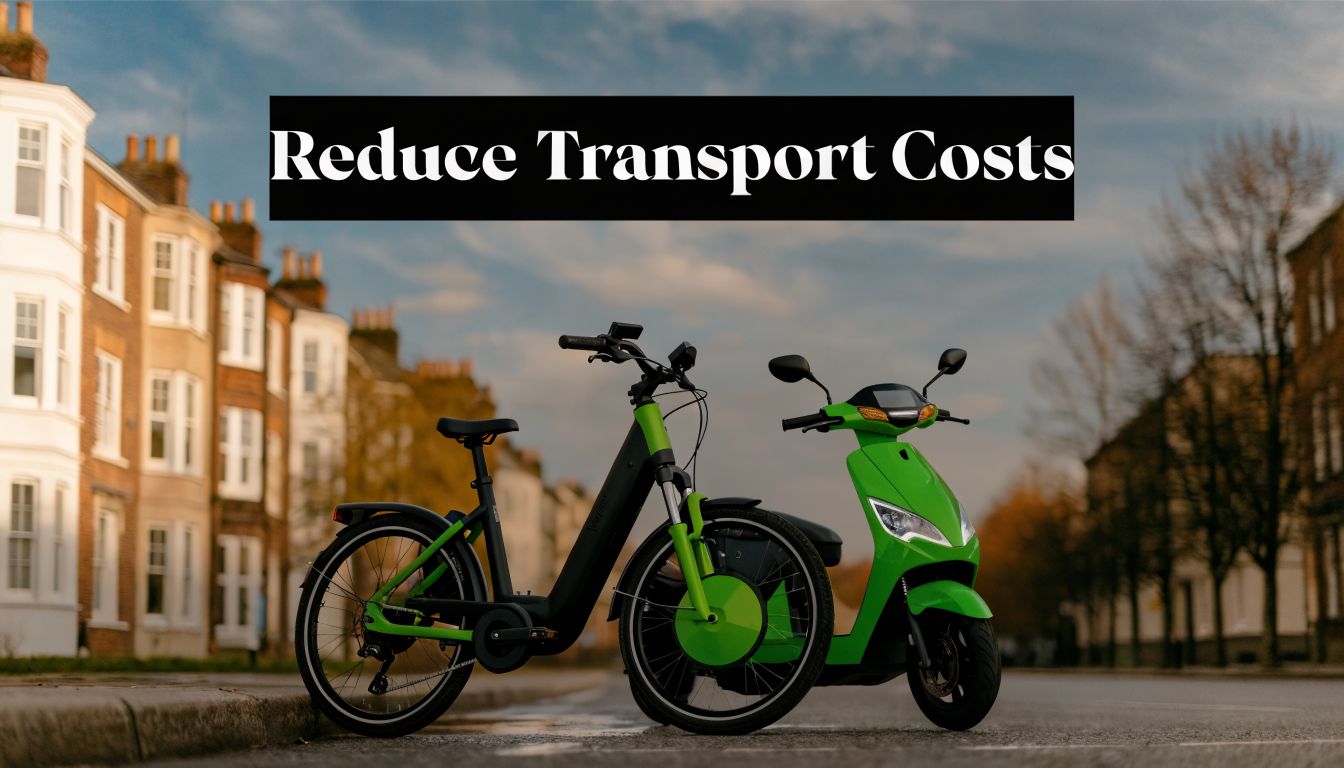
The leak usually isn’t dramatic. It’s a drip. A bit more on petrol. A rail fare that somehow went up again. Parking that turns a quick errand into a paid event. If you run a small business, the same thing shows up in dispatch costs, repeated delivery runs, and vans doing short urban trips they were never efficient at doing.
That’s why how to reduce transportation costs has stopped being a logistics question and become a daily life question. In the UK and across Europe, plenty of urban trips are short, congested, expensive, and badly suited to a car. A decent e-bike or e-scooter changes that equation fast. Not as a lifestyle badge. As a cost tool.
I’ve seen the biggest savings come from people who stop treating transport as a fixed expense and start treating it as a system they can redesign. That might mean replacing a car commute with an ENGWE e-bike, using a compact ISCOOTER for station hops where legal, or reshaping local deliveries around two wheels instead of four. The people who save the most aren’t always the ones with the fanciest gear. They’re the ones who match the ride to the route and keep waste out of the routine.
Your Wallet is Leaking and Transport is to Blame
Monday morning in Manchester. You drive 6 miles into town, spend half an hour in traffic, pay to park, then do the same thing again two days later for a run that could have been handled on two wheels. In London, Birmingham, Bristol, Amsterdam, or Dublin, that pattern drains money because urban transport costs are rarely one big bill. They arrive as small charges that feel routine until you add them up at month end.
For households, the leak is fuel, parking, rail fares, and the odd taxi when the connection falls apart. For a small business, it is worse. Short city trips, missed grouping of jobs, and vehicles used for light loads push the cost of each delivery or callout up fast. I have seen this with trades, florists, and mobile service teams. The van looked busy. The profit on those short runs was thin.
Where the money actually goes
The obvious costs get attention first:
- Fuel or fares: The spend you notice straight away.
- Parking, tolls, and access charges: Common in dense UK and EU city centres.
- Extra runs: One missed item, one failed handoff, one more trip.
The expensive part is often the layer underneath:
- Time lost in congestion: Paid hours disappear while the vehicle stands still.
- Poor vehicle fit: Using a car or van for a light urban trip that an e-bike could handle.
- Admin and coordination: Receipts, mileage claims, rescheduling, and chasing updates.
- Low load efficiency: Half-empty cargo space still costs money to move.
That matters even more if you manage people on the road. Tools that help drive sales team execution can also show where poor scheduling, weak route planning, and avoidable mileage are inflating transport spend.
In the UK and EU, the fix is often less dramatic than people expect. It is not about replacing every trip. It is about taking the short, repetitive, urban journeys away from the most expensive vehicle in the mix. That is why e-rides keep showing up in real cost-cutting plans. A commuter e-bike from ENGWE or Eleglide, a compact option from Punk Ride, or a small urban scooter where local rules allow can cut the cost base for station runs, city errands, and last-mile business trips.
The legal point matters here. UK readers need to separate e-bikes from private e-scooters, because the rules are not the same. Across Europe, the position also varies by country and city. Before buying, compare the route, storage, and legal use case, not just the price tag. A practical starting point is this guide to electric bike vs scooter for commuting.
Transport gets expensive when you pay car-level costs for trips that do not need a car.
Making the Switch from Four Wheels to Two
The right switch isn’t “buy any e-ride and hope.” It’s matching your trip pattern, local rules, and storage setup to the machine.

Start with the route, not the catalogue
Ask three blunt questions:
-
How far is the regular trip?
If your commute crosses a city or includes rough surfaces, an e-bike usually makes more sense than a standing scooter. -
What does the route look like?
Hills, cobbles, wet roads, and poor surfaces push many riders toward an e-bike with larger tyres and a more forgiving ride. -
Where will you store it?
A folding scooter or compact bike solves a problem a full-size model can create.
If your route is hilly or you want a more stable ride in mixed weather, an RCB or ENGWE-style e-bike is often the easier answer. If you’re doing a short, flat hop to the station and need something light to carry indoors, a HITWAY-style compact scooter can be practical.
UK law changes the choice
This is the part generic transport blogs usually skip. In the UK, e-bikes are widely accepted for normal urban use when they meet the relevant rules. Private e-scooters sit in a much messier legal position, and most lawful public-road use has centred on local rental schemes rather than personal scooters.
Across the EU, the picture is broader but still local. E-bikes are generally the simpler and safer legal choice for everyday commuting. E-scooter rules vary by country and city, so checking local requirements before buying is basic self-defence.
Practical rule: If you want the least legal friction in the UK, start with an e-bike.
A simple decision table
| Your real need | Better fit | Why |
|---|---|---|
| Mixed-weather city commute | E-bike | More stable, better carrying options |
| Short station link | E-scooter | Easier to fold and store |
| Hills and longer rides | E-bike | More comfort and control |
| Tight flat storage | E-scooter or folding bike | Less hassle indoors |
If you’re still stuck between the two, this guide on electric bike vs scooter for commuting is useful because it frames the choice around actual use rather than hype.
One more trade-off matters. Two wheels reduce costs well when the trip is local, regular, and urban. They’re weaker when you need to move bulky goods, carry passengers, or cover long motorway-style distances. The cheapest transport setup is often mixed. E-bike for weekday city runs, train for long intercity travel, car share only when the job necessitates it.
Master Your Routes for Maximum Efficiency
It's often assumed the savings come from switching vehicles. Substantial savings come from switching behaviour. The rider who plans well spends less than the rider with the pricier bike and sloppy habits.

Why route choice changes your cost base
A route isn’t just a line on a map. It affects battery draw, stop-start riding, brake wear, and whether you arrive calm or wrung out. Fastest by car often isn’t fastest by e-bike. Shortest also isn’t always cheapest if it includes ugly junctions, steep gradients, or constant restarting.
Businesses using analytics for optimization report 5-7% savings on transport costs, and optimized route planning with real-time monitoring can cut overall transportation expense, as noted by ASCM on transportation cost reduction. On an e-bike or e-scooter, the same logic shows up in simpler ways. Fewer detours, fewer unnecessary climbs, less wasted charge.
What to do in practice
Use route apps, but don’t obey them blindly. In UK and EU cities, local knowledge often beats default map logic.
- Use cycle-first planning: Komoot and Citymapper are good for spotting bike-friendly corridors instead of car-first roads.
- Bias toward smoother routes: A route with better surfaces and fewer forced stops often costs less in battery and maintenance.
- Avoid empty runs: If you’re doing errands or deliveries, stack stops in one loop instead of riding out and back repeatedly.
- Watch time of day: Leaving slightly earlier can mean a cleaner ride through junctions and less stop-start drain.
For readers thinking beyond commuting, the idea sits inside a broader shift toward urban mobility, where the cheapest trip is often the one designed around the city you live in, not the one a sat-nav assumes you should drive.
A flatter, calmer route can beat a shorter, harsher one over a full month of riding.
Multi-stop thinking saves more than speed chasing
If you run a small operation, don’t send yourself or a rider out for one task at a time unless the job is urgent. Group pickups. Batch local drop-offs. Carry what you can safely carry once.
That habit does two things. It cuts repeat travel, and it makes your ride work like a proper transport asset instead of a reactive fallback. In cities where traffic turns every extra mile into friction, that matters more than squeezing out a tiny top-speed gain.
Slash Your Energy and Maintenance Bills
People often switch to an e-bike or scooter and then leave savings on the table through lazy charging and neglect. That’s avoidable. Running costs stay low when you treat the machine like a tool that needs light, regular care.
Charge smarter, not just cheaper
If you’re in the UK, off-peak electricity tariffs can make overnight charging the obvious move. The exact setup depends on your supplier and tariff, so check your own plan instead of assuming every night rate is worthwhile.
Battery care matters more than most new riders think. Heat, damp storage, and constant bad charging habits shorten useful life. A replacement battery is the kind of cost people call “unexpected” even though they spent months inviting it.
A few habits do most of the work:
- Charge in a dry indoor space: Damp sheds and cold corners aren’t doing the battery any favours.
- Avoid treating every ride like a race: Hard acceleration and full-power starts burn energy you don’t need to burn.
- Use the right charger: Off-brand shortcuts can become expensive mistakes.
- Store with some thought: If the ride will sit unused, don’t abandon it filthy and fully drained.
The cheap checks that prevent expensive problems
The lowest-cost maintenance is boring. That’s why it works.
Check tyre pressure. Clean the chain if you ride an e-bike. Keep an eye on brakes. Tighten what loosens. Wipe road grime off before it turns into wear. On scooters, watch folding mechanisms and tyres. On bikes, don’t ignore drivetrain noise and brake rub.
Workshop truth: Most expensive repair jobs start as cheap little signs the rider ignored.
A simple way to view this is:
| Habit | What it saves |
|---|---|
| Correct tyre pressure | Better range, less drag, less tyre wear |
| Clean drivetrain | Smoother pedalling, slower component wear |
| Brake checks | Safer stops, less rotor and pad damage |
| Dry storage | Less corrosion, fewer electrical issues |
For longer-term upkeep, this guide on electric bike battery life is worth reading because battery habits affect the one component riders most want to postpone replacing.
The trade-off is straightforward. DIY checks save money, but only if you do them and know your limit. If your brakes feel wrong or the motor behaviour changes, don’t turn pride into a bigger repair bill.
Access Free Money with UK and EU Incentives
A rider in London buys a £1,800 e-bike for commuting and school runs. Another rider gets the same sort of bike through a salary sacrifice scheme and spreads the cost through payroll with tax advantages attached. The bike is the same. The out-of-pocket cost is not. That gap is why incentives matter more than another week of spec-sheet comparison.

Start with the UK, because plenty of buyers skip the boring money check
The Cycle to Work scheme remains one of the clearest ways to cut the cost of an e-bike if your employer offers it and your chosen model qualifies. The details vary by provider, employer policy, and bike category, so check the current scheme rules before you commit. In practice, that means confirming price limits, whether accessories are included, and whether the bike you want is treated as eligible for commuting use.
For small business owners, the incentive question gets messier but more useful. If you replace short van, taxi, or car trips with an e-bike or cargo bike, you need a clean record of which journeys are business use and which are personal. Receipt Router's guide to mileage is a practical reference for setting that up without creating an accounting headache later.
Across the EU, local rules matter more than broad assumptions
There is no single EU scheme that works the same way everywhere. Actual options tend to sit at city, regional, employer, or national level.
Look for:
- Purchase subsidies for e-bikes or other low-emission transport
- Employer commuter schemes with favourable tax treatment
- Municipal mobility grants tied to congestion or air-quality goals
- Business support for last-mile delivery, especially in dense urban areas
France, Germany, the Netherlands, and parts of Belgium come up often because support is easier to find and urban cycling infrastructure is better established. Even there, the details change fast. One city may support cargo bikes for traders. Another may only support standard pedelecs. A scheme may cover the bike but not the lock, lights, helmet, or second battery.
That last point matters in the UK and EU market because the legal category of the vehicle affects what qualifies. A road-legal commuter e-bike usually fits incentive schemes more easily than a faster or poorly classified machine. If you are comparing urban models from brands such as ENGWE, HITWAY, RCB, ELEGLIDE, and TOUROLL through Punk Ride LLC, check the bike against local rules before you get attached to the deal or the design.
The admin is annoying. The savings can still be worth it.
In real life, incentives are rarely free cash with no effort attached. You may need proof of employment, proof of residence, invoices, serial numbers, or a declaration that the bike will be used for commuting or work trips. Some funds run out. Some employers opt out. Some schemes exclude scooters altogether, which is a common frustration in the UK.
Treat it like any other money-saving task. Spend 20 minutes checking eligibility before you buy. If the scheme works, you cut the purchase cost. If it does not, you avoid building your budget around help that was never available.
The cheapest compliant e-bike is often the one partly paid for by a scheme you nearly ignored.
How to Track Your Savings and See the Win
Monday morning. It is raining in Manchester, the bus is late again, and the old version of you would have spent money without noticing it. A few fares here, parking there, a rushed second trip in the afternoon. If you switched to an e-bike or e-scooter and never measured the difference, those gains stay vague, and vague savings are easy to lose.
Use a simple before-and-after log. A spreadsheet works. A notes app works. What matters is that you compare the old pattern with the new one every month, using the same categories each time.
Old transport costs usually include
- Fuel, rail, bus, or Tube fares
- Parking and tolls
- Insurance, tax, or car-related extras
- Repeat delivery or errand trips
- Time lost from slow transfers or traffic
Your e-ride column usually includes
- Charging
- Tyres, brake pads, and other wear parts
- Locks, lights, helmet, and wet-weather kit
- Occasional servicing
- Battery-related costs over time
If you want help staying consistent, a simple tracker like Econumo for tracking spending is useful because the habit matters more than the app.
Track journeys as well as receipts. This is the part many riders miss.
For my own runs, the biggest savings did not come from electricity. They came from cutting wasted trips. One planned loop for parcels, stock, and a grocery stop beats three separate journeys every time, especially in UK and EU cities where short urban trips are expensive in time as much as money. If you ride a commuter setup from brands often compared through Punk Ride LLC, whether that is ENGWE, HITWAY, RCB, ELEGLIDE, or TOUROLL, note which bike or cargo setup lets you combine jobs that used to require a car, van, or second trip.
Keep four lines in the tracker:
- Trips avoided
- Errands combined into one route
- Routes that regularly cost you time
- Gear that made the trip practical
That last point matters more than people expect. A proper lock, panniers, or decent rain gear can turn an inconvenient ride into a normal one, which means you keep using the bike instead of falling back to the car.
At the end of the month, write a short summary. Note what you spent, what you avoided, and what annoyed you. Be honest about the trade-offs. Maybe the scooter was cheaper but useless for carrying stock. Maybe the e-bike cost more up front but handled a 9 km commute and two shopping stops without drama.
That is how the win becomes real. You stop treating lower transport spend as a nice idea and start seeing it in pounds and euros, month after month.
Share:
Sustainable Living: Embrace Electric Transport Today!
User Experiences: Electric Bike and Scooter Enthusiasts' Tales