


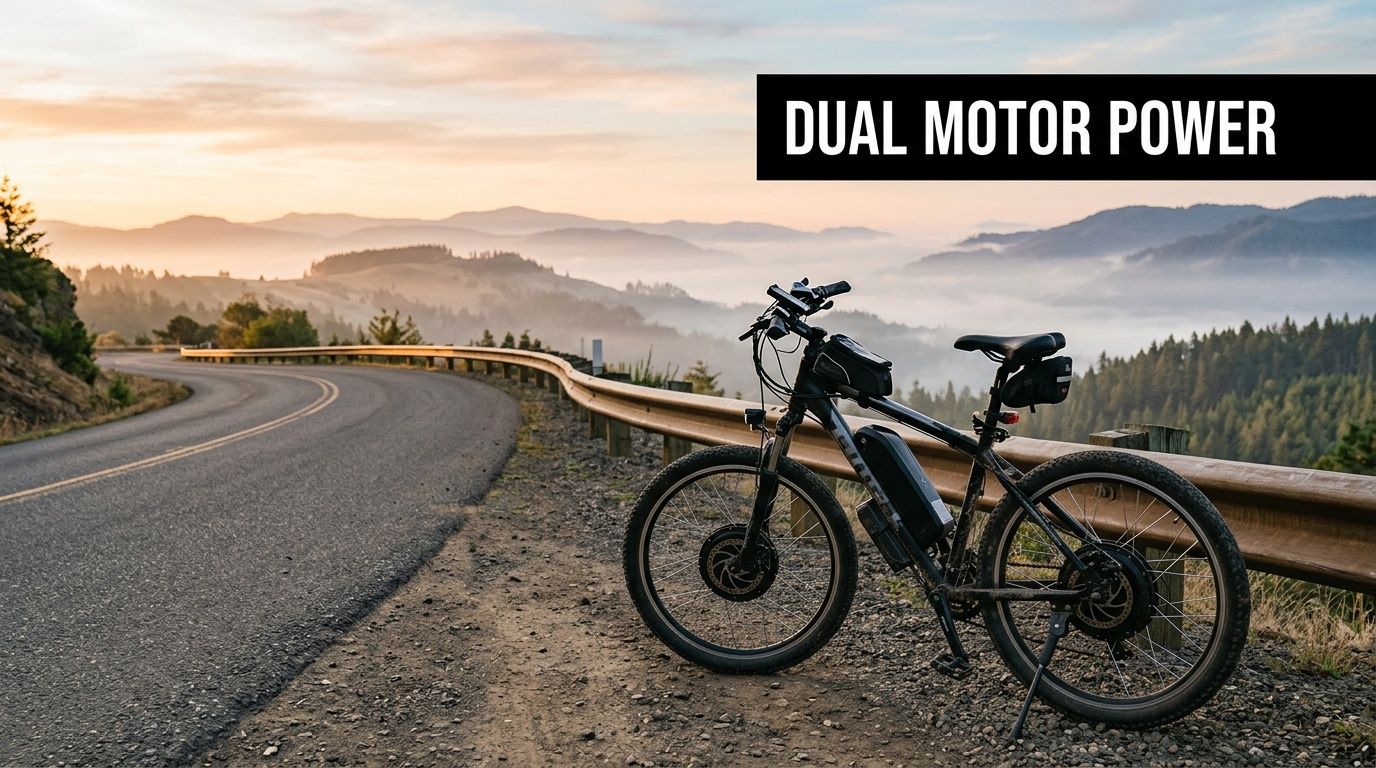
You're probably here because a normal e-bike has already shown you its limits.
Maybe it was a steep lane on the way home. Maybe it was a wet cycle path covered in leaves. Maybe it was a cargo run with a child seat, shopping bags, or work gear that made your bike feel slow and strained. Riders across the UK and EU often hit this point first on hilly commutes, while riders in Australia and the US tend to notice it on longer mixed-surface routes and rougher roads. The question usually sounds simple. Would a dual motor electric bike fix this, or does it just look impressive on a spec sheet?
The answer depends less on marketing and more on ride feel.
A dual motor setup changes the way power reaches the ground. That affects how the bike climbs, how it starts from a stop, how it behaves on slippery surfaces, and how planted it feels when the road turns ugly. It also changes the trade-offs. You get more grip and more shove, but you also get more weight, more complexity, and a bike that feels less featherlight when you're wheeling it into a shed or lifting it onto a rack.
This guide is about what that difference feels like in real life, not just what the brochure says.
Introduction Conquering the Impossible Climb
You're halfway up the steepest part of your commute. The road kicks up, the rain starts, and your rear wheel hits a patch of wet leaves. The motor whines, the bike slows, and suddenly you're putting a foot down and pushing. That's the moment many riders stop caring about fancy display screens and start caring about one thing only. Can this bike get me up the hill without drama?
That's where a dual motor electric bike starts to make sense.
Instead of asking one wheel to do all the work, a dual motor setup drives both. One motor helps pull from the front while the other pushes from the rear. On paper, that sounds technical. On the road, it feels simple. The bike hooks up better, keeps moving more calmly, and gives you a sense that it has reserve power instead of scraping the bottom of the tank.
What changes on the road
The biggest shift isn't just speed. It's confidence.
On a single-motor bike, steep and slick often means compromise. You back off the power to avoid wheelspin, then lose momentum. On a dual motor bike, the load gets shared between both wheels. That can make the climb feel smoother and less frantic, especially if the surface is patchy.
Practical rule: If your hardest rides combine steep gradients, poor weather, and extra load, traction matters just as much as raw motor output.
For riders in the UK and EU, this can matter on damp urban hills, cobbles, canal paths, and rural lanes. For riders in Australia and the US, it often shows up on fire roads, long suburban climbs, and looser gravel surfaces. Different places, same problem. One driven wheel can run out of grip before you run out of courage.
A dual motor electric bike won't suit everyone. But if your current bike struggles exactly when you need help most, it can feel less like a luxury and more like the right tool.
What Exactly Is a Dual Motor Electric Bike
At the simplest level, a dual motor electric bike has two separate motors instead of one. Most commonly, one sits in the front hub and one in the rear hub. Both wheels can receive power, which is why people often compare it to all-wheel drive in a car.
That AWD comparison is useful because it explains the point of the system in everyday language. A normal e-bike usually drives just one wheel. A dual motor bike can drive both, helping the bike grip and move forward more effectively when the road is steep, loose, or slippery.

The three motor layouts riders mix up
A lot of confusion starts here, because e-bike motor types sound similar but ride differently.
- Front-hub motor: The motor sits in the front wheel. It pulls the bike forward. On its own, this layout can feel unusual if power comes in abruptly.
- Rear-hub motor: The motor sits in the back wheel. It pushes the bike along. Many riders find this familiar because it feels closer to being pushed from behind.
- Mid-drive motor: The motor sits near the pedals and drives through the bike's drivetrain. This often gives a more natural pedalling feel, but it isn't the usual layout for a dual motor setup.
If you want a clearer primer on how these systems differ, this guide to electric bike motor types is a handy companion.
How the two motors work together
The motors don't just fire randomly. A controller manages how power gets delivered. On better systems, that delivery feels smooth. You twist the throttle or pedal into assist, and the bike surges forward in a controlled way rather than lurching.
Some bikes also let you switch riding modes. That means you can cruise on one motor when you want a calmer, more efficient ride, then activate both motors when you hit a hill or rough section. That flexibility is a big part of the appeal.
Think of it like having two people carry a heavy sofa up the stairs instead of one. The job gets done with less strain, and the movement feels steadier.
Why this matters in practice
The key benefit isn't just “more power.” It's how the bike puts power down.
On a steep wet road, a single driven wheel can slip before the bike really gets moving. With two powered wheels, the bike has a better chance of maintaining grip and momentum. On rough tracks, the same principle helps the bike feel more composed. On stop-start commutes, it can make pullaways feel stronger and less hesitant.
That's why dual motor bikes attract a very specific kind of rider. Not someone who just wants a flashy spec list, but someone who regularly rides in places where traction, not just speed, decides whether the bike feels capable.
Two Motors vs One A Deep Dive into Performance
Ride a single-motor e-bike up a steep street, then ride a dual-motor bike up the same hill with the same cargo, and the difference shows up fast. One feels like a strong bike working hard. The other feels like a bike with help at both ends, staying calmer as the load and the slope build.
That difference is easier to understand if you stop looking at peak numbers and focus on what the bike feels like in real riding. How cleanly does it pull away from a stop? How much does it squirm on wet pavement? Does it keep moving with confidence when the hill gets ugly?
Single Motor vs Dual Motor E-Bike at a Glance
| Characteristic | Single Motor E-Bike | Dual Motor E-Bike |
|---|---|---|
| Traction | Power goes to one wheel only | Power can go to both wheels |
| Hill climbing feel | Can struggle on steeper, slippery climbs | Feels calmer and stronger on demanding climbs |
| Acceleration | Usually smoother and milder | Feels quicker and more forceful from a stop |
| Handling | Often lighter and more nimble | More planted, sometimes less flickable |
| Weight | Easier to lift and move around | Heavier and bulkier |
| Complexity | Fewer components | More wiring, controls, and parts |
| Battery use | Usually easier on range | Can drain the battery faster when both motors run |
Hill climbing shows the biggest gap
A dual-motor bike usually makes the biggest impression on climbs because hills expose every weakness at once. Gravity fights you. Your speed drops. If the surface is loose or damp, traction gets worse right when you need it most.
With one motor, the bike has to send all of its drive through a single wheel. If that wheel loses grip or starts to bog down, the whole bike feels strained. With two motors, the workload is shared. It works a bit like a four-wheel-drive vehicle compared with two-wheel drive. The total result is not just more shove. It is steadier progress and less drama.
If steep routes are part of your normal riding, these electric bikes for hills show how different setups are built for climbing.
Traction changes the ride more than spec sheets suggest
Many riders expect dual motors to feel faster. What surprises them is how much better the bike can feel on bad surfaces.
On wet tarmac, gravel, hard dirt, or broken pavement, a single driven wheel can spin away some of the bike's effort. A dual-motor setup gives both wheels a job to do, so the bike is less likely to waste energy in one spot. You feel that most clearly when starting uphill or crossing a loose patch at low speed, where momentum is fragile.
The front wheel is no longer only guiding the bike. It is also helping pull you through.
That creates a distinct ride feel. A single-motor bike often feels like it is pushing from one end. A dual-motor bike can feel like it is stretching forward and driving from underneath you at the same time. For some riders, that added grip feels reassuring right away. For others, it takes a few rides to get used to the front wheel contributing power.
Acceleration and handling involve a trade
Dual motors usually make starts feel stronger, especially with cargo, a headwind, or a heavier rider onboard. The bike gets up to speed with less hesitation, and it tends to hold pace more easily when conditions turn against you.
But extra hardware changes the bike's manners too. More motor mass, more wiring, and often a larger battery add weight. You notice that in tight turns, when lifting the bike, and when moving it around a garage or apartment hallway. The handling often feels more settled, but less playful.
A simple analogy helps here. A single-motor e-bike can feel like a nimble hatchback. A dual-motor e-bike feels closer to an all-wheel-drive SUV. The SUV gives you more grip and composure when the road gets rough, but it usually asks you to accept more weight and a less lively feel.
Here's the practical summary:
- Choose single motor if you want lighter handling, simpler maintenance, and a bike that is easier to carry or store.
- Choose dual motor if you care most about climbing confidence, stronger pull from a stop, and better grip on mixed or slippery surfaces.
- Pause before buying if you regularly carry the bike upstairs, load it onto a rack, or need the lightest possible setup for daily use.
A spec sheet tells you what parts are on the bike. The ride tells you whether those parts make your routes easier, calmer, and more controlled.
The Pros and Cons of Going Dual Motor
A dual motor electric bike is a classic trade. You gain capability, but you also take on extra demands. If you look at it through that lens, the decision gets much easier.
Early on, most riders focus on the thrill side. More shove. Better climbing. More grip. That's all real. But the practical side matters just as much once the bike becomes part of your everyday routine.

Why people love them
Some benefits show up the first time you ride. Others only become obvious after a few weeks of commuting, hauling, and riding in poor weather.
- Climbing confidence: The bike feels less strained when the road tilts up and you're carrying extra weight.
- Traction on mixed surfaces: Wet roads, gravel cut-throughs, and rough lanes feel less sketchy when both wheels can drive.
- Punchier starts: Pulling away from lights or junctions feels brisk and controlled.
- Backup value: If one motor or mode is unavailable, the bike may still remain rideable on the other motor, depending on the system.
A lot of riders describe the appeal in one sentence. The bike feels unbothered.
Here's a useful way to think about it. A single-motor e-bike can be excellent within its comfort zone. A dual motor bike stretches that comfort zone further into hills, load carrying, and poor conditions.
Where the downsides show up
The downsides aren't minor. They affect storage, transport, maintenance, and daily convenience.
After the excitement of a test ride, this is what you need to picture:
- More weight: Carrying the bike up steps or manoeuvring it in tight parking areas takes more effort.
- Higher cost: Two motors, a stronger frame, and a larger battery usually push prices up.
- More complexity: There's more wiring, more control logic, and more that may need diagnosis if something feels off.
- Shorter range in power mode: Run both motors aggressively and the battery won't last as long as it would on a similar single-motor setup.
A dual motor e-bike solves hard riding problems. It can also create easy ownership problems if you buy one for the wrong reason.
The decision filter that helps most
Ask yourself two questions.
First, do you regularly ride in situations where a normal e-bike feels under-gunned? Second, are you prepared to tolerate the extra weight and complexity every time the bike isn't moving?
If the answer to the first is yes and the second is also yes, dual motor starts looking sensible. If not, the extra capability can end up sitting there unused while you wrestle with a heavier bike in everyday life.
Who Really Needs a Dual Motor E-Bike
Not every rider needs two motors. Plenty of people are happier on a lighter single-motor bike that's easy to live with. But some riders get such a clear practical benefit from dual motor that it changes what cycling feels possible.
The easiest way to judge it is to see which rider story sounds like your own.
The hill conqueror
This rider doesn't live somewhere flat enough to ignore climbing. Their route includes ramps, valleys, bridges, or long steep drags that punish underpowered bikes. On these rides, the question isn't top speed. It's whether the bike can maintain momentum without feeling like it's begging for mercy.
For commuters in the UK and EU, that might mean old town streets, sharp residential climbs, or wet winter roads. For riders in the US and Australia, it could mean suburban grades or fire-road access routes that just keep rising.

The cargo hauler
This is one of the strongest cases for dual motor.
You might be carrying a child seat, groceries, tools, delivery bags, or work equipment. A heavy load changes everything. Starts are slower, hills feel steeper, and traction gets more important. A dual motor setup helps the bike move off with less fuss and keeps it feeling composed when the rear is heavily loaded.
The all-weather rider
Some people ride when the conditions are ideal. Others ride because they need to get somewhere and weather doesn't get a vote.
If you cycle through rain, slush, rough lanes, muddy cut-throughs, or broken urban surfaces, the extra traction can add a welcome safety margin. It doesn't replace careful riding, but it can make the bike feel less nervous when grip is inconsistent.
If your route regularly includes wet leaves, rough edges, or loose surfaces, the extra front-wheel drive can feel like insurance you use every week.
The power enthusiast
This rider enjoys the sensation. They want a bike that feels urgent when they pull away, strong when the road tilts up, and planted when the terrain gets messy. They don't want a machine that merely copes. They want one that feels overqualified.
That's a valid reason too, provided they understand the compromises that come with it.
Who probably doesn't need one
If your riding is mostly flat, your weather is kind, and you value easy storage over brute capability, a dual motor bike may be excessive. The same goes for riders who constantly lift their bike into flats, train carriages, or car boots. In those situations, lighter often feels better than stronger.
The best use case is simple. A dual motor e-bike suits riders whose routes or loads regularly expose the weak spots of a one-motor machine.
Your Buyer Checklist for a Dual Motor E-Bike
Buying a dual motor electric bike isn't like buying a casual city runabout. Details matter more because the whole system is under greater load. Two motors can make a bike feel brilliant or badly balanced, depending on how the rest of the build supports them.
Use this checklist to separate a capable bike from one that just has an impressive headline.

Start with the core hardware
-
Motor output
Don't stop at the phrase “dual motor.” Two motors can be tuned very differently. What matters is how much usable support the bike delivers and how smoothly it does it. A setup aimed at legal urban riding in the UK or EU may feel very different from one marketed in the US.
-
Battery capacity
Two motors ask more from the battery, especially if the bike runs both at once under load. That makes battery size and battery quality central, not optional. If you want a solid primer on how batteries age and what affects usable performance, read this guide on electric bike battery life.
-
Brakes
Extra speed and extra mass demand serious stopping power. Hydraulic disc brakes are the setup many riders look for because they offer stronger and more controlled braking than cheaper alternatives.
Check the parts people skip
These points often get overlooked in online shopping, even though they shape the ride just as much as the motors.
- Frame strength: A dual motor bike puts more force through the chassis. You want a frame that feels stiff and composed, not one that twists under power.
- Suspension quality: If the bike is meant for rough roads or trails, suspension helps keep the tyres in contact with the ground and the ride under control.
- Motor placement: Front-and-rear hub setups feel different from other layouts. Make sure the handling style matches where you'll ride.
- Control system: A bike that lets you switch between gentler riding and full dual-motor support is easier to live with than one that's always in attack mode.
Buying tip: The best dual motor bike isn't the one with the boldest spec list. It's the one whose frame, battery, brakes, and control tuning all make sense together.
Think about your local rules before you click buy
This matters a lot in the UK and EU. Local road rules can be stricter around motor output and classification, so a bike that looks appealing online may not fit the rules for public-road use in your area. In the US, buyers often have more choice in higher-powered models, but state and local regulations still matter. Australian riders should check state-level requirements carefully too.
One practical extra that's easy to forget
If you'll be riding in poor light, visibility becomes part of the buying decision. That's especially true with faster, heavier bikes that are likely to be used year-round. For riders building out a practical setup, it's worth taking a look at explore Blade Master's outdoor lighting gear for ideas on bike lighting that supports safer riding.
A short test ride checklist
Before buying, ask yourself these questions during a test ride:
- Does the front motor engage smoothly, or does it tug at the bars?
- Does the bike feel balanced in a slow turn?
- Can you easily understand the display and ride modes?
- Do the brakes feel strong enough for the bike's weight?
- Would you be happy moving this bike around when the battery is off?
That last question is the one people forget. It matters more than they expect.
Conclusion Is a Dual Motor E-Bike Your Next Ride
A dual motor electric bike sits at the high-capability end of the e-bike world. It makes hard climbs feel less dramatic, gives you more grip when surfaces turn slippery, and helps loaded bikes move with less strain. For some riders, that changes everything.
But this isn't a free upgrade. You're trading simplicity for capability. You're choosing more power, more traction, and a more planted ride in exchange for extra weight, more parts, and higher day-to-day demands.
That's why the best choice starts with honesty.
If your routes are mostly flat and your riding is calm, a good single-motor bike will probably feel easier to own and just as enjoyable. If your real riding life includes steep roads, cargo, rough weather, or loose terrain, a dual motor setup can be the smarter tool, not just the flashier one.
The right bike is the one that solves your actual problems when the road gets difficult.
If you're comparing e-bikes and want a retailer that focuses on modern urban mobility across the UK, EU, and US markets, Punk Ride LLC is a solid place to start. Their range covers electric rides built for commuting, utility, and everyday performance, which makes it easier to match the bike to the way you ride.
Share:
Scooter Size for Adults: 2026 Buying Guide
Your Guide to an Affordable E Mountain Bike in 2026