You're standing outside with a charged battery, choosing between a bike lane, a busy sidewalk, and a path that would shorten your commute. A scooter weighing less than 100 pounds, with handlebars and an electric motor, may use Colorado roadways without a driver license or registration if its motor-only top speed is no more than 20 mph on a paved, level surface, according to the Colorado Legislative Council's motor-vehicle law summary.
Those limits define the legal category you're relying on. They don't settle where you may ride: cities can restrict particular routes, and a faster or heavier machine needs a different legal check. A state-level permission is a starting point, not a blank check for every road or path.
What Colorado Scooter Laws Actually Allow
A qualifying Colorado electric scooter weighs less than 100 pounds, has handlebars and an electric motor, and cannot exceed 20 mph on motor power alone on a paved, level surface; its rider is exempt from motor-vehicle registration and driver-license requirements under the Colorado Legislative Council's motor-vehicle law summary. That's the ordinary, bicycle-like scooter category, not a catch-all for everything sold with a deck and throttle.
Colorado's legislative change removed electric scooters from the old toy-vehicle category, which generally pointed riders toward sidewalks rather than authorizing roadway use. Qualifying scooters entered the vehicle framework, with the same general rights and duties as riders of electric-assisted bicycles. That matters because a scooter rider on the street isn't a pedestrian traveling faster.
The useful distinction: State law answers what your machine is. Local rules help answer where you can use it.
Two Limits Behind the Permission
First, a heavier or faster machine can fall outside the ordinary electric-scooter definition. It might belong in the separate low-power scooter category, or require another classification entirely. A retailer's product name doesn't settle that question.
Second, cities and counties retain authority over routes and operating conditions, within the state's limits on local regulation. A commuter choosing between the street, bike lane, and sidewalk therefore has to check both the machine and the location.
The practical order is straightforward: establish the scooter's specifications, check its brakes and rider suitability, choose a lawful route, and investigate any local restriction. If the machine falls outside the ordinary category, resolve its classification before treating it like a bicycle.
The Four Numbers That Make a Scooter Legal
Start in the garage, not at the trail entrance. A bathroom scale, the scooter's manual, its display settings, and a tape measure will tell you more than the word commuter on a product page.
The Colorado General Assembly's electric-bicycle and scooter guidance identifies the under-100-pound weight limit, handlebars and electric motor requirements, 20 mph maximum motor-only speed on paved, level ground, and braking capability of 25 feet from 10 mph on dry, level, clean pavement. The table separates the definition checks from the equipment benchmark.
Colorado electric scooter compliance checks
| Check | Qualifying electric scooter | If you miss it |
|---|---|---|
| Weight | Under 100 pounds | 100 pounds or more can leave the category |
| Motor-only top speed | 20 mph maximum on paved level surface | A higher configured speed needs a different legal check |
| Handlebars and electric motor | Both required, and the motor powers the scooter | Missing either fails the definition |
| Braking | Stop within 25 feet from 10 mph on dry level clean pavement | A longer stop fails the equipment benchmark |
| License and registration | Not required | Low-power scooter rules can require both |
Measure the Scooter You Actually Own
Weigh it ready to operate. Install the battery before weighing. If the scooter won't balance safely on a household scale, use a suitable platform scale rather than trying to support part of its weight yourself. Don't substitute shipping weight or the weight of a different battery configuration.
Next, inspect the basic design. It needs handlebars, an electric motor, and propulsion from that motor. These sound obvious, but they distinguish the legal definition from the much broader collection of small electric devices people casually call scooters.
For speed, check the manual, dashboard menus, and any companion app. You're looking for every motor-powered mode the configured scooter makes available, not just the setting you prefer for crowded streets. Don't perform a high-speed experiment in traffic to discover what an unfamiliar machine can do.
A Slow Setting Isn't the Whole Answer
Say a scooter has a gentle commuting setting and a selectable performance setting that exceeds the ordinary scooter ceiling. Choosing the gentle mode for today's ride doesn't establish that the machine satisfies the definition.
Keep the manufacturer's specification sheet and identify the exact model and battery configuration. If the advertised maximum conflicts with the seller's explanation, resolve the discrepancy before riding.
Braking is a separate equipment check. A machine can meet the weight and speed definition yet still have poorly adjusted brakes. Passing the category checks doesn't excuse failing the stopping benchmark, and passing a brake test doesn't turn an otherwise nonqualifying machine into an ordinary electric scooter.
Roads Paths and Sidewalks You Can Use
A qualifying scooter rider generally has the rights and duties of bicycle riders and other vehicle operators, subject to scooter-specific provisions. The Colorado bicycle and electric-scooter operating statute also prohibits riding on a sidewalk, pathway, or crosswalk where an official traffic-control device or local ordinance forbids it, and requires dismounting where applicable signs or local rules say so.
That means neither extreme works: scooters aren't automatically confined to sidewalks, and they aren't automatically welcome on every pedestrian surface.
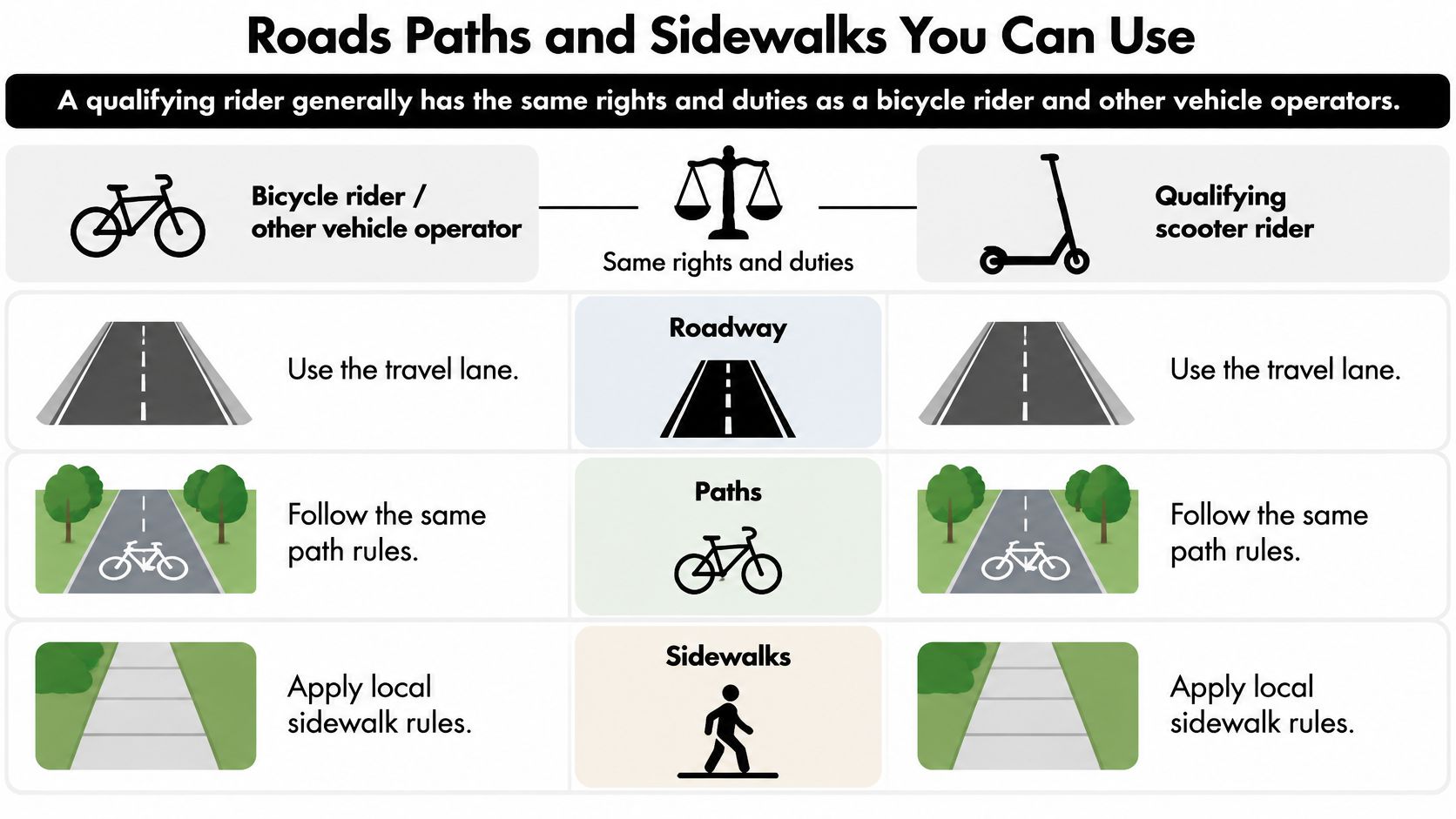
Where a qualifying Colorado e-scooter may travel
| Place | Default rule | What can override it |
|---|---|---|
| Roadway | Allowed following the statewide legal change | Ordinary traffic duties still apply |
| Bike lane | Same general rights and duties as bicycles | Local lane rules and signs |
| Bike or pedestrian path | Generally the same access as conventional bikes | The controlling city or county may prohibit e-scooters |
| Sidewalk | No blanket statewide permission | Banned where a sign or local ordinance says so |
| Crosswalk | Not a free riding zone | Dismount where signage or a local rule requires it |
Roadways and Bike Lanes Require Predictable Riding
On the roadway, ride like someone sharing a transport network, not someone weaving through a pedestrian crowd. Follow signals, yield appropriately, and make your movements understandable to drivers and cyclists.
A bike lane can provide a sensible route, but inspect its condition and its intersections. Parked vehicles, turning traffic, and abrupt lane endings still require attention. Don't jump onto the sidewalk because the next stretch of street feels awkward without checking whether sidewalk riding is permitted.
Plan difficult transitions before reaching them. If a lawful route ends at a pedestrian-only connection, getting off and walking can be the cleanest choice.
Paths and Crosswalks Need Their Own Check
Think of the state's permission like an open corridor in a shared building. You can enter the building, but the manager may still close a particular hallway within their authority.
A path entrance is where you check the sign, not where you assume a bicycle symbol settles every question about electric devices. If the wording is unclear, look up the facility's official rules before committing to the route.
A dismount sign at a crosswalk is concrete: step off and walk the scooter across. Don't interpret a painted crossing as permission to ride through regardless of the posted instruction.
A rental app adds another layer. Its geofence may restrict that fleet's customers, but an app map isn't a substitute for the sign at the path entrance. Plan road or bike-lane travel as your starting point, then verify pedestrian-route access rather than assuming it.
Brakes Lights and Who May Ride
Colorado's brake requirement measures performance, not the brand or style of brake fitted to the deck. The Colorado session law governing scooter equipment requires a bicycle, electric-assisted bicycle, or electric scooter to stop within 25 feet from 10 mph on dry, level, clean pavement.
A disc brake logo doesn't prove compliance. Neither does a showroom demonstration with a different rider, no luggage, and freshly adjusted equipment.
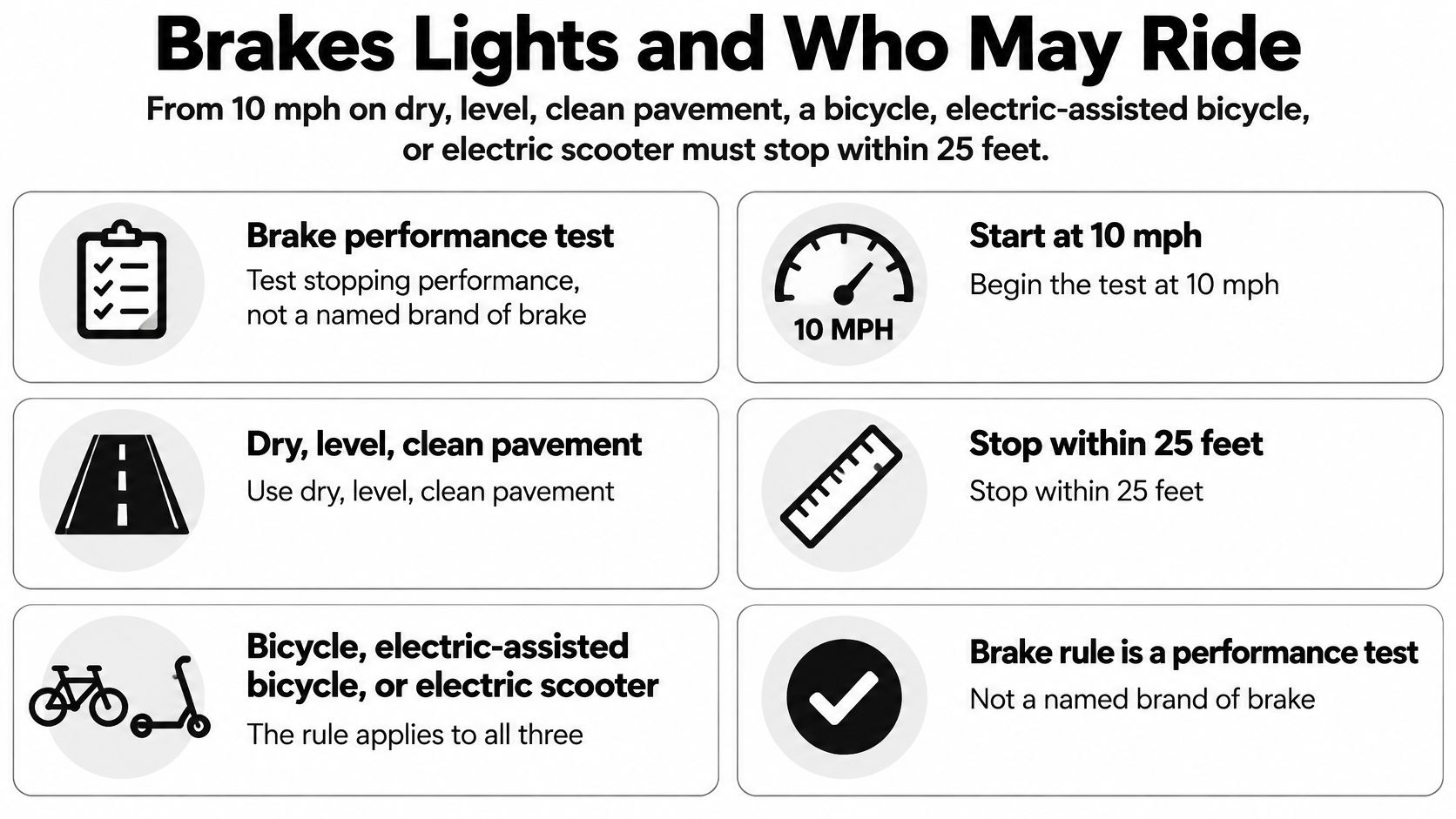
Check the Brakes With Your Normal Load
Use a controlled area away from pedestrians and traffic, with plenty of clear space beyond the measured stopping area. Don't attempt a maximum-effort test if you're unfamiliar with the scooter's braking behavior.
- Prepare the scooter. Install the battery and carry your usual bag securely, without obstructing your stance or the controls. Set pneumatic tires to the manufacturer's recommended pressure.
- Mark the test area. Choose dry, clean, level pavement. Use a tape measure and chalk to mark where braking begins and the stopping-distance boundary.
- Approach steadily. Reach the specified test speed, apply the brakes at the starting mark, and measure where the scooter comes to rest. A helper can observe from a safe position.
- Investigate a poor result. Check soft levers, brake adjustment, tire pressure, load, and battery condition where electronic braking is involved. Have faulty brakes repaired before returning to traffic.
Wet surfaces and slopes change the riding conditions, so a successful dry-ground check isn't a promise of equal performance everywhere.
Test the scooter you ride, with the load you carry. An unloaded demonstration isn't a substitute.
Age Labels Helmets and Visibility
There isn't a statewide minimum-age figure established by the legal materials discussed here for qualifying electric scooters. Don't turn that into an assumption that every child may ride anywhere: manufacturer age guidance, posted local rules, and rental eligibility requirements still need checking.
For helmet questions, the Nares Law Group helmet law guide from Nares Law Group LLC is a useful companion when distinguishing practical protection from category-specific legal obligations. Wear a properly fitted helmet rather than treating the absence of an identified requirement as a safety recommendation.
For evening travel, check your lights before leaving and make sure luggage doesn't cover them. Our guide to LED lights for scooters can help you think through a visible setup, alongside checking the equipment rules that apply to your ride.
How Cities Change the Statewide Rules
Class 1 electric bicycles are the comparison that limits local scooter regulation. Under House Bill 19-1221, which became law in 2019, cities and counties may regulate electric scooters, but their rules may not be more restrictive than the way they regulate Class 1 electric bicycles.
That's a ceiling on local restrictions, not a blank check for riders. The same act removed electric scooters from the toy-vehicle category and authorized roadway use, while preserving local authority within that comparison.
Test the Restriction Against the E-Bike Treatment
Consider a city-controlled trail with a rule prohibiting electric bicycles and electric scooters alike. That's different from a trail rule that welcomes comparable e-bikes but singles out qualifying scooters for exclusion.
The wording matters. A sign saying motorized devices are prohibited can leave riders wondering whether the authority includes e-bikes in that term. Look for the facility's official definitions rather than deciding from the sign's illustration alone.
These hypothetical situations show what to investigate:
- A park road excludes motorized devices, including e-bikes. Check that the rule covers the road you're using and how the authority applies it to qualifying scooters.
- A city trail prohibits e-bikes and scooters together. The parallel treatment is consistent with the comparison riders should be checking.
- A pedestrian mall bans bicycles and motorized devices. A bicycle restriction is a strong reason not to assume scooter access.
- A facility welcomes comparable e-bikes but bans only scooters. That mismatch deserves clarification from the city rather than an assumption that the sign settles the legal question.
These aren't claims about particular towns or ordinance numbers. They're ways to read an unfamiliar restriction without confusing statewide authorization with unrestricted access.
Clarify a Mismatch Without Riding Through It
If a rule appears inconsistent, photograph the sign from a safe location and note the facility name. Ask the responsible parks or transportation department for the current rule and how it treats comparable electric bicycles.
Don't turn a disagreement about statutory authority into a confrontation at a busy entrance. Walking the scooter or selecting another route lets you resolve the question without creating an immediate conflict.
A sign is something to obey or clarify, not something to ignore because your scooter is legal elsewhere.
Shared fleets also have operating conditions of their own. A rental no-ride zone can bind the operator's customers without establishing the rule for every privately owned scooter.
In a new town, use a simple habit: read the sign, identify who controls the facility, and ask whether a Class 1 e-bike would receive the same treatment.
When a Scooter Becomes a Low-Power Vehicle
The surprise often appears in the settings menu. A scooter feels gentle in its everyday mode, but the rider discovers an extra setting that pushes it beyond the ordinary scooter definition.
That isn't merely a question of whether you promise to ride slowly. The machine's actual configured capability matters, and failing the electric-scooter definition doesn't automatically establish which alternative category it belongs to.
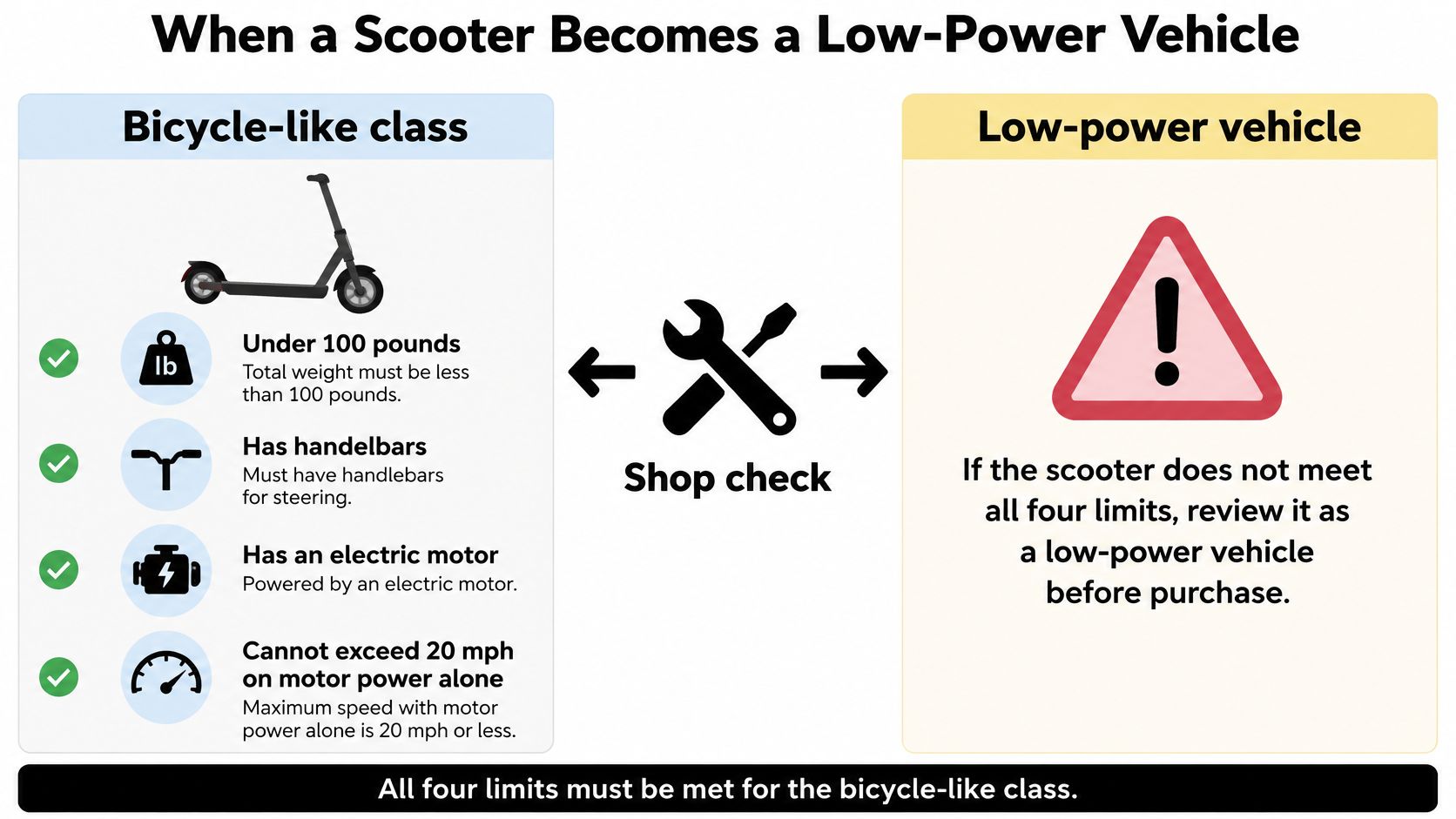
The Category Changes the Paperwork
Colorado's separate low-power scooter framework can involve licensing, registration, insurance, and helmet or eye-protection obligations. It isn't the ordinary scooter category with permission to go faster.
The Colorado Department of Revenue's specialized-vehicle guide set the low-power scooter registration period at 3 years in 2025. For a machine requiring that registration, it's a recurring DMV obligation, not something satisfied permanently by a purchase receipt.
Electric scooter versus low-power scooter
| Requirement | Qualifying electric scooter | Low-power scooter |
|---|---|---|
| Typical trigger | Meets the ordinary scooter weight, design, and motor-only speed definition | Outside that definition, including some heavier or faster machines, subject to classification |
| Driver license | Not required | Can be required |
| Registration | Not required | Can be required, with the recurring period described above |
| Insurance | Confirm coverage separately; a licensing exemption isn't an insurance policy | Insurance can be required |
| Helmet or eye protection | Check applicable local rules and manufacturer guidance | Helmet or eye-protection rules can apply |
A more powerful vehicle might require a classification other than low-power scooter. Don't assume that buying insurance or applying for a decal necessarily makes any performance scooter road-legal.
Ask About the Unlocked Configuration
Before purchasing, identify the exact model, its operating weight, available speed settings, motor specifications, and intended legal classification. Request documentation rather than accepting a broad statement that scooters don't need licenses.
A selectable eco mode isn't the same as a documented configuration that limits the machine's capability. If a rider-accessible setting exceeds the category limit, investigate that configuration before relying on the friendlier rules.
The same caution applies to devices marketed as electric bikes. Pedals, throttles, and marketing names don't make their legal categories interchangeable; our electric bike laws by state guide provides a starting point when comparing those separate frameworks.
For a heavier or faster deck, pause before planning the commute. Use the DMV materials to establish the category, then resolve the applicable license, registration, insurance, and protective-equipment obligations before riding.
Check Your Scooter Before the Next Ride
Make the decision before you're balancing at the curb. Keep the specification sheet, a photo of the model label, and any relevant local route rules somewhere you can retrieve them easily.
These checks turn Colorado scooter laws into a practical pre-ride routine rather than a guess based on what other riders are doing.
Your Pre-Ride Decision
- Confirm operating weight and design. Weigh the scooter with its battery installed and verify that it meets the ordinary category's weight ceiling. Check the handlebars, motor, and propulsion arrangement rather than relying on the product name.
- Review every available speed mode. Check the dashboard, manual, and app settings for motor-only capability on level pavement. If an accessible mode exceeds the category limit, stop treating the low-speed setting as proof of eligibility.
- Check braking with your normal load. Use the controlled stopping method described in the equipment check. Inspect tires as well as brakes; damaged or worn rubber deserves attention before a test, and our scooter tyre replacement guide can help you assess the maintenance job.
- Verify the actual route. Start with a lawful roadway or bike-lane option. Read path entrances, sidewalk restrictions, and crosswalk dismount instructions, then check the controlling authority's rules when the sign leaves a question unanswered.
- Resolve a failed category check. If weight or speed puts the machine outside the ordinary definition, establish its proper classification. Sort out any required driver license, insurance, registration, and protective equipment before using it on public routes.
Separate Route Planning From Legal Eligibility
Battery range answers whether you can finish the trip, not whether the machine may use the route. Our AOVO electric-scooter range figures are manufacturer estimates; actual range varies with rider weight, terrain, temperature, and riding settings.
Leave room in your trip plan for a lawful detour. A closed path can turn the shortest map route into a poor choice, especially if your remaining battery margin is tight.
Passing the machine, braking, rider, and route checks supports the decision to ride under the statewide electric-scooter framework, still subject to the sign and conditions on that block. If a specification or restriction remains unresolved, walk the scooter or choose another way to travel until you've confirmed the answer.
At Punk Ride LLC, we offer commuter, folding, fat tyre, off-road, and performance scooters, including AOVO and AOVOPRO models, alongside electric bikes and other brands. Visit Punk Ride LLC to compare options, and check each model's operating weight and configured speed against Colorado's rules before choosing your ride.