


Buying the biggest battery you can afford isn't the best way to choose a long-range e-bike. Buy the bike that can finish your actual route, with your luggage, your preferred assistance and enough charge left when conditions turn against you. A huge advertised range doesn't answer that question.
For the best electric bike long range options, start with energy consumption, not a manufacturer leaderboard. For UK and European commuters, that means balancing useful battery capacity with manageable weight and local legality. US and Australian buyers need the same practical approach, but must check their own operating rules before comparing imported models.
Why Battery Size Is Not the Whole Story
A bigger battery gives you more stored energy. It doesn't guarantee that one bike will travel farther than another on your commute. Without comparable riding conditions, a maximum-range claim is a poor buying tool.
I'd use this comparison before getting attached to any particular model:
| Buying criterion | What it tells you | What I'd ask the seller |
|---|---|---|
| Battery energy | How much energy the pack nominally stores | Is the capacity stated in watt-hours? |
| Measured consumption | How quickly the bike uses that energy | Was it measured on a route like mine? |
| Test conditions | Whether the distance claim applies to you | What load, terrain and assistance were used? |
| Charging arrangements | Whether the bike fits your routine | Can I remove the battery and charge it indoors? |
| Loaded handling | Whether extended riding is practical | Can I test it with my usual luggage? |
The difference between stored energy and consumption matters. A UK comparative life-cycle assessment of commuting e-bikes reports average consumption of approximately 0.02 kWh per mile, equivalent to about 50 miles per kWh, across electric-only and pedal-assist riding on slightly hilly terrain. Its cited literature also estimates approximately 1.2 kWh per 100 km, or roughly 52 miles per kWh, illustrating an efficiency benchmark rather than a universal distance guarantee.
Compare the whole riding system
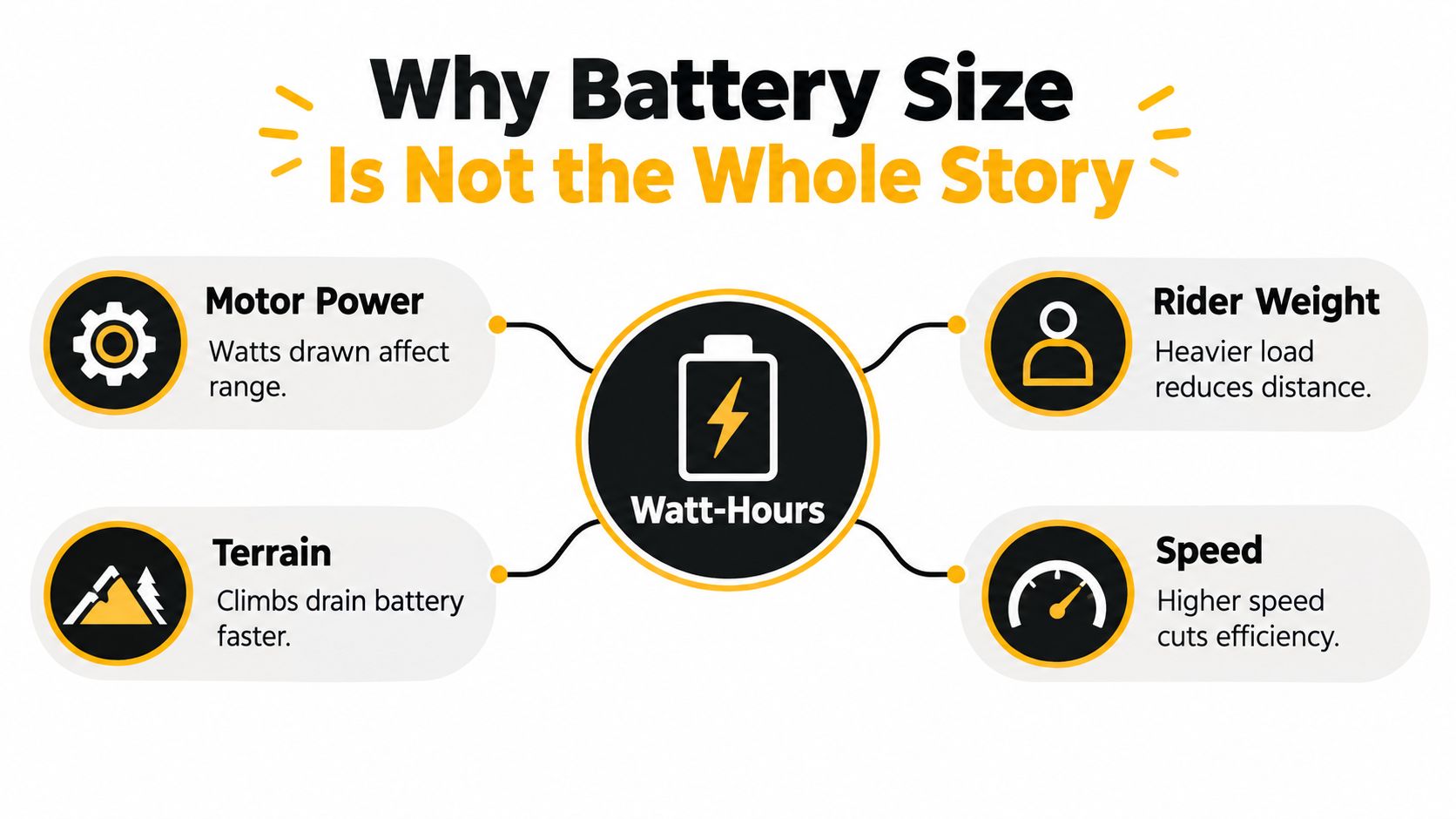
Think of the battery as your energy budget. The rider, bike, route and assistance settings determine how quickly you spend it.
This concept map shows the main relationships to check before trusting a range claim.
A comfortable bike you can pedal willingly may suit your journey better than a cumbersome machine you're always asking the motor to move. That's my buying judgement, not a promise that lighter bikes always win.
Shop-floor rule: Reject a range comparison if the seller can't explain the conditions behind it.
Don't pay extra for battery capacity because it looks impressive. First decide whether the complete bike is suitable for your roads, storage space and riding style. Then establish whether its energy budget is sufficient.
Battery Chemistry and the Watt-Hours Math
Modern long-distance e-biking owes plenty to battery chemistry. Early electric bicycles existed, but carrying enough usable energy was a practical obstacle.
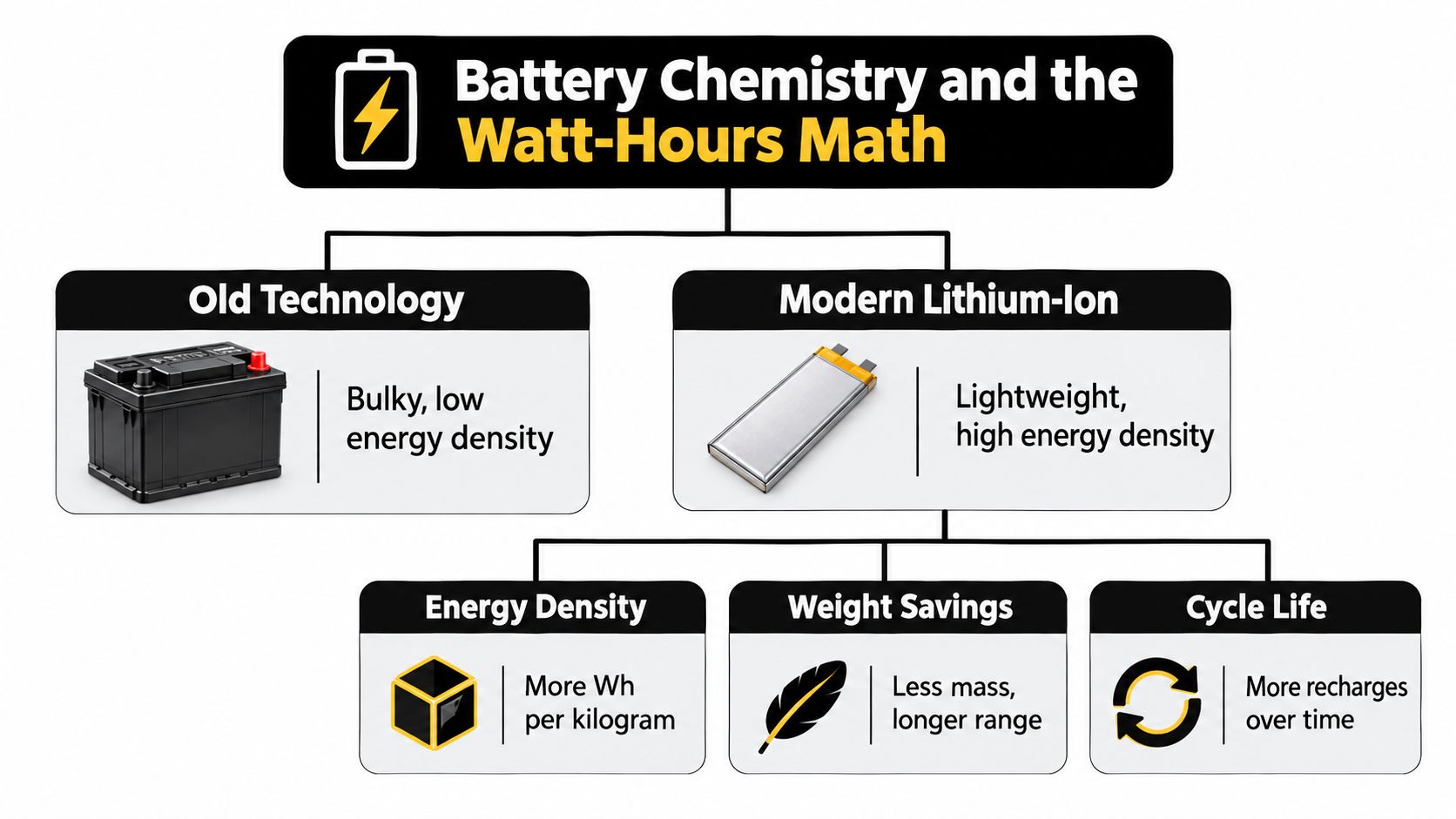
The historical and lifecycle review of electric-bicycle technology describes experimental electric bicycles in the late nineteenth century, followed by commercial concepts using bulky lead-acid batteries with limited range, low efficiency and poor durability. The transition to lithium-ion batteries increased energy density and reduced battery weight, while modern systems combine those packs with brushless DC motors and electronic power controls.
That history explains why I wouldn't assess a battery separately from the bike carrying it. More energy is useful, but packaging, handling and the way the system delivers assistance still matter.
The battery comparison below illustrates the technology change behind practical extended riding.
Turn the specification into usable distance
Use these relationships when reading a listing:
- Nominal battery energy: Multiply volts by amp-hours to obtain watt-hours.
- Estimated distance: Divide battery watt-hours by consumption in watt-hours per mile.
- Comparison discipline: Use the same consumption assumption for each shortlisted bike, then replace that assumption with route-specific measurements.
Long-range battery comparison guidance uses typical consumption of 10–20 Wh per mile, giving a 700 Wh pack a theoretical range of roughly 35–70 miles; it recommends 600 Wh as an extended-commuting baseline and 720 Wh or a dual-battery configuration for frequent 60-mile-class outings. The same guidance warns that independent real-world results can be 30–50% below headline range figures, particularly when marketing tests use favourable conditions.
Treat that broad range as a screening tool, not a booking confirmation for your next ride. The denominator matters just as much as the battery specification, and your journey may fall outside a typical benchmark.
Ask about ownership, not just capacity
Before paying, request the charging time, battery-removal procedure and replacement-pack availability. Ask whether any range extender is manufacturer-approved and whether the stated capacity covers the main pack alone or the complete configuration.
I'd choose a battery I can charge conveniently over a larger one that creates a daily storage problem. A nominally suitable bike becomes a poor purchase if you can't get its battery to a safe charging location.
Real-World Range Factors That Move the Needle
Payload deserves more attention than it gets in buying guides. A demonstration ride without your panniers, shopping or child-carrying equipment doesn't represent the journey you're buying the bike to make.
The instrumented electric-bike experiments and battery-load comparison report 81 Wh over 3.05 km at 23.3 km/h, approximately 26.6 Wh/km or 42.8 Wh/mile, and 108 Wh over 4.07 km at 25.3 km/h, approximately 26.5 Wh/km. A separate battery study discussed in that source recorded 38.69 km with a 60 kg rider, compared with 22.91 km at 100 kg using the same lithium-ion configuration.
Those results aren't a correction factor you can apply to every bike. They demonstrate why demanding test results and gentle promotional runs shouldn't be treated as equivalent.
Real-World Range Impact by Variable
| Variable | Realistic Effect on Range | Why It Happens |
|---|---|---|
| Rider and cargo mass | A heavier load can substantially reduce distance | The system must move more mass, particularly during acceleration and climbing |
| Hills | Expect greater consumption on sustained climbs | The motor contributes energy to gaining elevation |
| Assistance level | Heavy reliance on assistance reduces the distance available | The battery supplies more of the riding effort |
| Average speed | Faster assisted riding can increase consumption | Maintaining the pace requires greater power under demanding conditions |
| Wind | A headwind makes an otherwise familiar route harder | The rider and motor must overcome additional resistance |
| Tyre pressure | Poorly chosen pressure can compromise efficiency | Tyre deformation and rolling behaviour change |
| Cold conditions | Don't assume warm-weather performance will carry over | Battery performance depends on operating conditions |
| Stop-start traffic | Frequent acceleration can make urban riding demanding | The bike repeatedly rebuilds speed |
Don't invent a precise penalty for every row. Without a relevant measurement, a percentage would create false confidence.
Control what you can
I'd start with tyre pressure appropriate to the tyre, load and surface. Then I'd remove unnecessary luggage and choose the lowest assistance setting that still makes the ride comfortable.
Keep enough help for difficult climbs. Struggling along in an unsuitable gear just to protect a range figure isn't the goal, and a bike that discourages you from riding has failed the buying decision.
- Adjustable factors: Assistance, luggage, pace, tyre setup and, sometimes, route choice.
- Conditions to plan around: Your necessary payload, local hills, weather and traffic.
- Evidence to request: A loaded demonstration or a consumption record that resembles your intended use.
For maintenance decisions beyond a single journey, the electric-bike battery life guide is a useful companion to your range assessment. Keep immediate energy consumption separate from the battery's longer-term condition when deciding whether a bike still meets your needs.
Battery Size Versus Motor Power Trade-Offs
Watt-hours describe stored energy. Watts describe power. A motor rating isn't a distance rating, and a more powerful motor doesn't establish that a bike is more efficient.
Nor does a rated-power label tell you the exact electrical draw throughout a ride. The controller, assistance setting and operating conditions matter. Don't calculate range by pretending the motor consumes its labelled power constantly.
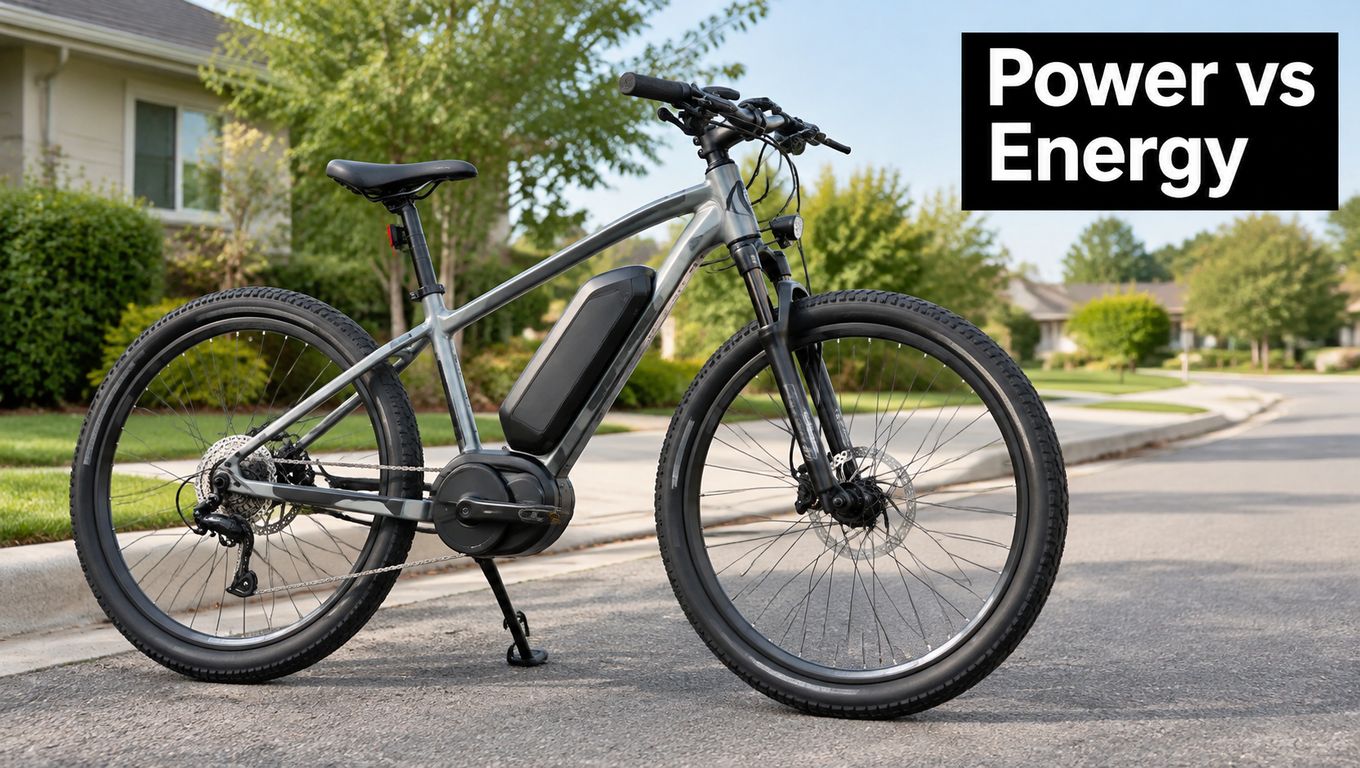
The bike below is a reminder to assess the complete machine, not infer suitability from its appearance.
Choose the architecture for the job
| Configuration | When I'd consider it | What I'd check before buying |
|---|---|---|
| Mid-drive system | Repeated climbing and mixed-terrain riding | Suitable gearing, loaded performance and service arrangements |
| Hub-motor system | A straightforward commuter shortlist | Assistance behaviour and performance on the actual hills |
| Higher-output system | A lawful use case that genuinely needs extra help | Local vehicle classification and measured consumption |
| Dual-battery setup | Longer journeys with limited charging access | Approved compatibility, total capacity and battery placement |
I'd favour a mid-drive shortlist for a heavily loaded, hilly route, but I wouldn't promise that every mid-drive beats every hub motor on range. Compare the bikes under load. The mid-drive electric-bike buying guide can help you assess that option without making motor placement your only criterion.
A dual-battery design is an energy-storage choice, not proof of efficient operation. Ask how the system uses each pack and whether you can remove them independently. Also check whether the extra hardware interferes with luggage or makes the bike awkward to manoeuvre.
Safety evidence belongs in the decision
The UK government's independent PLEV battery-safety research examined real-world evidence and tested batteries and chargers across a broad price range. That makes a useful buying principle clear: marketing specifications alone aren't enough to assess safety or performance.
I'd rather sell you a properly documented system than a bigger battery paired with an unexplained charger.
Request the intended charger, compatibility information and charging instructions. Don't let a seller substitute enthusiasm about motor power for answers about the electrical system.
Building a Defensible Range Estimate for Your Route
Write down the journey before looking at more bikes. Include the return leg, necessary detours and whether charging at your destination is available.
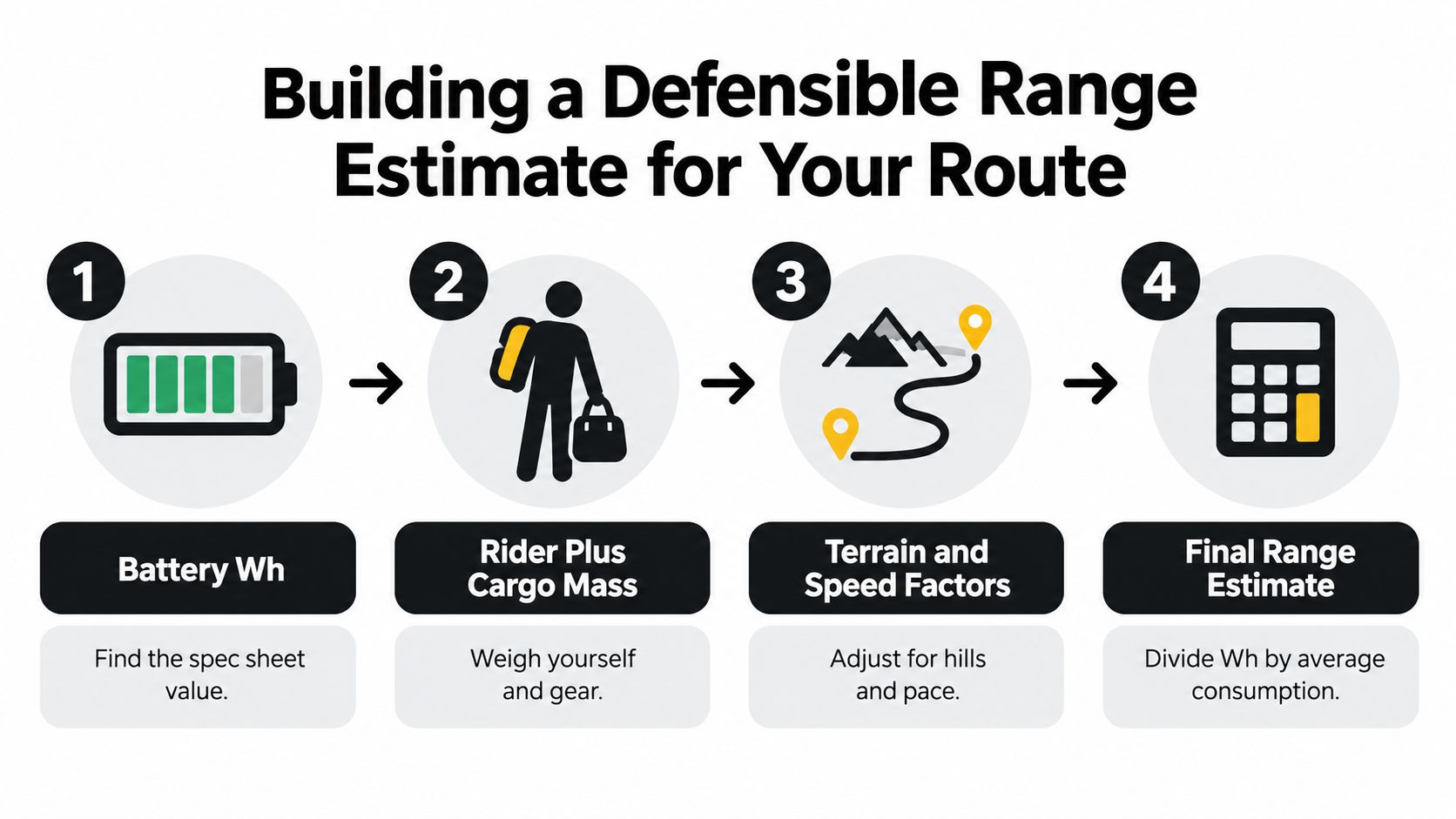
Your comparison record should contain battery Wh, rider-plus-cargo mass, average speed, assist mode, gradient, temperature and measured Wh/km or Wh/mile. Add wind, tyre setup and traffic conditions so you can explain why results differ between rides.
Use this process diagram as a checklist, rather than treating the final calculation as a guarantee.
Use a repeatable route record
Start with the battery calculation already established, then choose consumption evidence that matches your journey. If the seller only supplies a maximum-distance claim, ask for the test method before using it.
On a demonstration ride, use your normal assistance and carry your ordinary gear where the seller permits it. Record electrical energy used if reliable instrumentation is available. A dashboard estimate or a rough battery-bar reading isn't the same as measured consumption.
For a route-specific worksheet, use:
- Required riding energy: Planned distance multiplied by representative measured consumption.
- Available riding energy: Usable battery energy after allowing for your chosen reserve.
- Purchase decision: The available amount must comfortably cover the required amount in the scenario you expect.
Nominal capacity is a starting specification. Don't assume that every labelled watt-hour will always be available for propulsion, especially when assessing an older battery.
Compare scenarios rather than a single optimistic answer
| Route scenario | Evidence I'd use | Buying response |
|---|---|---|
| Flat urban commuting | Normal pace, usual traffic and everyday luggage | Prioritise convenient charging and practical equipment |
| Hilly suburban riding | A representative climb with your intended assistance | Demand loaded hill performance and more energy headroom |
| Cold-weather commuting | Evidence from comparable conditions where available | Keep a larger reserve rather than relying on a summer result |
| Cargo and family journeys | The intended carrying arrangement and load | Assess handling, braking and range together |
| Faster assisted use | Consumption at your intended lawful pace | Don't extrapolate from a gentle demonstration |
Keep a conservative reserve for battery ageing, but don't invent a universal allowance. Ask how the seller assesses battery condition and whether replacement support is available.
The embedded video can complement a practical assessment, but it shouldn't replace route-specific evidence.
If your shortlist only meets the journey under favourable assumptions, it's too tight. Choose more usable capacity, arrange dependable charging or reconsider the route before purchasing.
UK EU US and AU Rules That Shape Long-Range Choices
A bike that can cover your commute isn't automatically a bike you can legally use for it. Establish the vehicle category before comparing performance, particularly with imported throttle-equipped or higher-output models.
For buyers in Great Britain, government EAPC rules require working pedals, maximum continuous rated motor power of no more than 250 W, and assistance cutting out at 15.5 mph (25 km/h); compliant bikes can be ridden from age 14 without a driving licence, registration, vehicle tax or insurance. Bikes exceeding those limits are treated as motor vehicles and may require registration, insurance, taxation, an appropriate licence and a motorcycle helmet.
Long-Range E-Bike Legality at a Glance
| Region | Pedals Required | Motor Power Limit | Assistance Cutoff | Extra Notes |
|---|---|---|---|---|
| Great Britain | Yes | EAPC continuous-power ceiling described above | EAPC riding cutoff described above | Check throttle approval separately |
| EU destination | Verify the applicable bicycle category | Verify destination requirements | Verify destination requirements | Don't treat Great Britain guidance as EU-wide legal confirmation |
| United States | Fully operable pedals under the federal definition | Federal low-speed threshold detailed below | Federal motor-only test detailed below | State and local operating rules still need checking |
| Australia | Pedal behaviour matters under the described specification | Product guidance detailed below | Product guidance detailed below | Confirm requirements where you'll ride |
Throttle operation deserves its own check. Transport for London's e-bike safety guidance states that twist-and-go bikes capable of propulsion without pedalling need vehicle approval, and that walk assistance must cut out at 3.7 mph (6 km/h).
The US federal low-speed electric-bicycle definition covers vehicles with two or three wheels, fully operable pedals, motors rated below 750 W, and motor-only speed below 20 mph on a paved, level surface with a 170-pound rider. It treats qualifying vehicles as consumer products, but that isn't blanket permission to ride everywhere under state or local operating rules.
Australian importer and product-safety guidance describes power-assisted bicycles of up to 250 W, assistance limited to 25 km/h, and assistance stopping when the rider stops pedalling while travelling above 6 km/h. Battery size alone doesn't establish compliance.
Check the destination, not the warehouse
A bike shipped from Germany doesn't become suitable for every European road because of its dispatch location. Ask for documentation for the country where you'll use it, rather than accepting an unsupported UK/EU-legal label.
- Confirm classification: Match the exact model and controller configuration to the applicable category.
- Check operating modes: Include throttle, launch and walking functions.
- Verify access: Check the roads, paths or trails you intend to use.
The street-legal electric-bike guide provides further buying context. For a borderline model, get a clear answer from the relevant authority before paying.
Matching the Right Long-Range E-Bike to Your Life
There isn't a defensible universal winner without knowing the rider and route. I'd rather narrow your purchase to the right type of bike than nominate an impressive machine that doesn't fit your life.
For a daily commuter, choose a removable battery, comfortable fit and equipment that supports ordinary journeys. Use the commuting-capacity baseline already discussed as your starting screen, then demand enough measured range for the return trip. Convenient charging matters more than carrying surplus battery you'll rarely need.
For a weekend leisure rider, I'd put riding position and manageable handling ahead of motor output. You should still enjoy pedalling the bike when you reduce assistance.
Match the equipment to the outing
Outdoor riders also need to distinguish relaxed paved trips from rougher routes. The PADL bike comparison for outdoor trips offers useful context when deciding whether cruiser-style comfort or mountain-bike characteristics better match the outing. Use that distinction to shortlist the chassis before assessing its electrical range.
| Rider | My recommendation | Don't compromise on |
|---|---|---|
| Cargo and family hauler | Consider approved extra capacity after a loaded test | Carrying suitability, stable handling and braking |
| Long-distance tourer | Compare dual-battery arrangements with dependable charging opportunities | Pack availability, comfort and service support |
| Hilly-terrain rider | Shortlist suitable mid-drives and test the climb | Gearing and assistance at the intended load |
| Multimodal commuter | Choose a bike you can actually carry or store | Practical handling, not merely a folding label |
Riding Times GT73, GT73 Pro and Z8 Pro are examples of dual-battery models to investigate, not automatic recommendations for public-road commuting. Confirm the exact specification and legal category before treating any of them as a solution.
Choose the bike that meets your difficult ordinary day, not just your easiest recreational ride.
Make the final decision in layers
Write your priority scenario beside each shortlisted model. Then record the required energy, charging arrangements, jurisdiction constraints and reserve you need for changing conditions and ageing.
If a seller can't supply enough information to complete that comparison, leave the model off your shortlist. An honest gap in the evidence is a reason to investigate, not an invitation to trust the headline.
Punk Ride LLC offers a curated selection of electric bikes and scooters, including dual-battery e-bike options to compare for extended journeys. Visit Punk Ride LLC with your route, loaded rider weight and charging requirements in hand, then check each candidate's battery specification and local legal suitability before ordering.

Share:
How to Install Bike Rack