


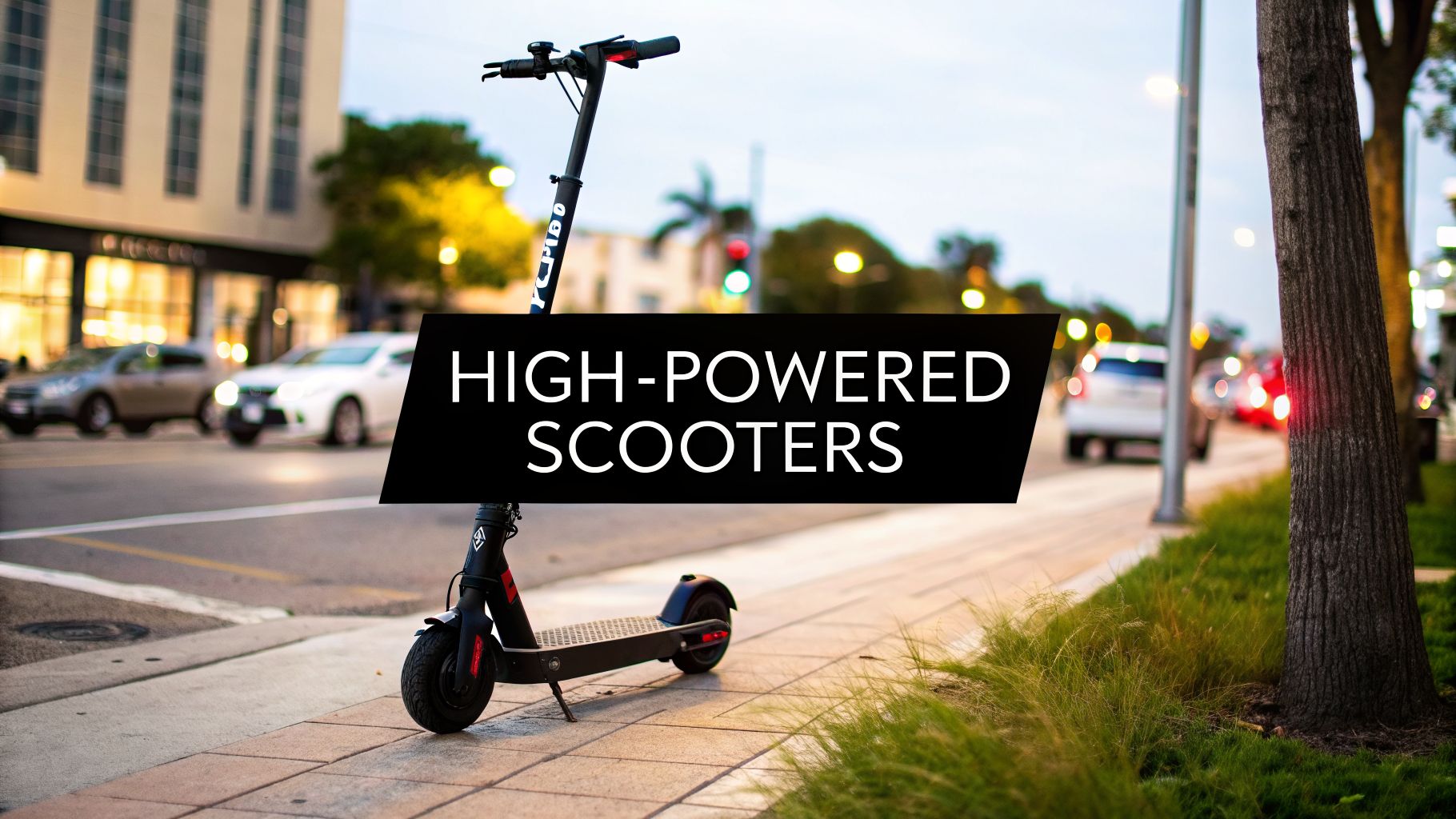
So, you've heard the term "high-powered electric scooter" thrown around. But what does it actually mean? These aren't your average, run-of-the-mill rental scooters. We're talking about serious machines built for performance, delivering heart-pounding acceleration, impressive top speeds, and the raw power to chew up steep hills for breakfast.
Think of it like this: a standard scooter is your dependable daily driver, perfect for a quick, flat trip to the coffee shop. A high-powered scooter is the souped-up sports car of the e-scooter world. Both will get you from A to B, but one is built for an entirely different level of thrill and capability.
The secret sauce that sets these beasts apart comes down to two key ingredients working together: a beefy motor (or two!) and a high-voltage battery.

The Power Duo: Motor and Battery
This is where the real magic happens. High-powered scooters are packed with much more potent motors—often one in each wheel for some serious all-wheel-drive grip—and they're fed by high-voltage batteries. A battery's voltage (V) is a bit like the water pressure in a firehose. The higher the voltage, the more force it uses to blast energy straight to the motor.
While your typical commuter scooter might run on a 36V system, a true high-powered electric scooter almost always starts at 48V and climbs from there. This electrical muscle translates directly into a better ride.
- Mind-Blowing Acceleration: You'll get up to speed in a flash, leaving cars and cyclists in your dust.
- Serious Hill-Climbing Power: Those daunting hills on your commute? They become molehills.
- Higher Top Speeds: Cruising comfortably above 40-50 km/h (where it's legal, of course) is a breeze.
- Heavier Load Capacity: These scooters can easily handle heavier riders and their gear without breaking a sweat.
To see the difference in black and white, here’s a quick breakdown.
Standard vs High Powered Scooters at a Glance
| Feature | Standard Commuter Scooter | High Powered Electric Scooter |
|---|---|---|
| Typical Voltage | 36V | 48V, 52V, 60V, or higher |
| Motor Power | 250W - 500W (Single Motor) | 1000W - 8000W+ (Often Dual Motor) |
| Top Speed | 25-32 km/h (15-20 mph) | 48-96+ km/h (30-60+ mph) |
| Hill Climbing | Struggles on moderate inclines | Conquers steep hills with ease |
| Best For | Short, flat urban commutes | Thrill rides, long commutes, off-road |
As you can see, it's not just a small step up—it's a massive leap in capability.
A Market That's Gaining Speed
It's no surprise that riders are catching on. This awesome blend of raw performance and practicality is fueling a massive surge in popularity. The market for scooters rocking systems over 48V was valued at a whopping USD 2,786.07 million and is expected to grow by an incredible 24.60% every year between 2025 and 2034.
That growth is blowing the lower-voltage categories out of the water. It shows that riders in the UK, EU, US, and Australia are hungry for more capable machines that can handle hilly terrain and longer distances. You can dive deeper into these trends and learn more about the electric scooter market and its impressive growth.
High-powered models are about so much more than just speed. They're a more versatile, robust, and capable way to get around, built to handle tough urban environments while delivering a ride that's genuinely fun.
Getting a grip on these basics is the key. Once you understand why higher voltage and powerful motors matter, you can start to see how the numbers on a spec sheet translate into an amazing experience on the pavement.
The Guts of the Beast: Understanding Scooter Motors and Batteries
The real secret sauce of a high-powered electric scooter is what’s going on under the deck—in its motor and battery system. Think of them as a team. The motor is the brawn, delivering the raw power, while the battery is the endurance, feeding it the juice it needs to perform. Getting your head around this tech is how you'll truly understand what gives these scooters their insane kick.
Let's start with the motors. You're generally looking at two kinds of setups: single motor or dual motor. A single motor scooter, usually driving the rear wheel, is your trusty daily driver. It's efficient, perfect for cruising around town, and it gets the job done reliably. No drama.
But when you jump to a dual motor setup, you're getting into a whole different league. It's like going from front-wheel drive to all-wheel drive. With a motor in both the front and rear wheels, these scooters give you an unbelievable jump in torque and traction. That means you can launch off the line like a rocket, power up hills that would leave other scooters wheezing, and keep a solid grip even when the pavement gets sketchy. If you're curious about the best of the best, check out our guide on the best dual motor electric scooters on the market.
What's the Deal with Motor Wattage?
You'll see numbers like 1000W, 2000W, or even a mind-blowing 5000W on a scooter's spec sheet. That’s the motor's power rating, measured in watts (W). It's a straightforward measure of how good the motor is at turning electricity into pure, grin-inducing motion.
Think of it just like horsepower in a car. Generally, more wattage means:
- Quicker Launches: More watts equals more torque, which gives you that instant burst of speed the second you hit the throttle.
- Hill-Shredding Power: A beefy motor won't bog down on steep inclines; it'll just keep pulling.
- Higher Top Speeds: While other things play a part, you can't hit crazy speeds without a seriously powerful motor.
A lot of people think that if you double the watts, you double the speed. It's not quite that simple. A 2000W scooter won't be twice as fast as a 1000W model, but its acceleration and ability to haul you up a steep hill will feel worlds apart.
Of course, all that power is useless if the energy source can't keep up. That's where the battery comes in.
Batteries: The Fuel and the Firehose
The battery is, without a doubt, the most important piece of the puzzle in a high-powered scooter. Its muscle is measured in two ways: Voltage (V) and Amp Hours (Ah). Once you get these two, you can look at any spec sheet and know exactly what kind of performance to expect.
Voltage (V) is the 'Firehose'
Picture two firehoses. One has a decent trickle of water coming out. The other is blasting water with incredible pressure. Voltage is that 'pressure' in your scooter's electrical system. A higher voltage, like 52V or 60V, shoves energy into the motor with way more force than a standard 36V battery. It’s this aggressive push that unlocks face-melting acceleration and higher top speeds.
Amp Hours (Ah) is the 'Fuel Tank'
So if voltage is the pressure, Amp Hours (Ah) is the size of the gas tank. This number tells you how much energy the battery can actually hold. A bigger Ah rating, like 20Ah or 30Ah, means you’ve got more fuel in the tank, which translates directly to more miles on the road.
Let's break it down simply:
- More Voltage (V): Gives you more raw power, faster acceleration, and a higher top-end speed.
- More Amp Hours (Ah): Gives you a bigger energy reserve, letting you ride much farther on a single charge.
At the end of the day, the truly awesome high-powered scooters nail the balance between a beastly motor and a high-voltage, high-capacity battery. That's the combo that gives you both the thrilling performance you're chasing and the range to actually enjoy it.
How Specs Translate to Real-World Fun
Tech specs are great, but let's be real—numbers on a page don't capture that heart-in-your-stomach feeling when you punch the throttle. What really matters is how that motor wattage and battery voltage feel when the rubber hits the road. It's time to translate the jargon into the actual experience that makes a high-powered electric scooter so damn fun.
These machines are about more than just numbers; they're about the ride itself. That addictive rush of instant acceleration, the confidence of crushing a steep hill—every single part of the experience is cranked up to eleven. The fact that this market is blowing up proves that riders want more than just a simple A-to-B machine. They’re after a thrill.
This demand is completely changing how people get around cities. The global electric scooter market, driven largely by these beastly models, was valued at USD 37.13 billion in 2026 and is on track to hit a staggering USD 63.64 billion by 2032. High-powered scooters are the rockstars here, with their insane acceleration and all-terrain grit taking over the premium end of the market. The trend is undeniable in the EU, which is seeing a blistering 23.92% growth rate. A big reason? Models that hit 40+ km/h are making daily rentals in micromobility hubs go through the roof. You can check out the full research on the electric scooter market's explosive growth if you want to geek out on the data.
Top Speed and Acceleration
Alright, let's get to the good stuff: top speed and acceleration. Top speed is the big, flashy number everyone asks about first. High-end models easily cruise past 50 km/h, and some absolute monsters push past 80 km/h. But the top speed you actually hit isn't just up to the scooter. It's also affected by:
- Rider Weight: Lighter riders will usually squeeze out a few more kilometres per hour than heavier ones.
- Terrain: You’ll fly on smooth, flat pavement. Bumpy roads or grass? Not so much.
- Wind Resistance: A nasty headwind can feel like an invisible wall, slowing you down more than you'd think.
While top speed gets the headlines, acceleration is what you feel. It’s that instant, grin-inducing surge of power when you twist the throttle from a dead stop. A high-powered scooter gives you a satisfying kick that leaves cars and cyclists in your dust at a traffic light. That insane launch comes from the massive torque pumped out by powerful dual motors. For a deeper dive, check out our guide on understanding electric scooter top speed.
Hill Climbing and Range
This is where a high-powered scooter really flexes on its commuter-grade cousins. If you live somewhere with hills, you know the pain of a weak scooter slowing to a pathetic crawl on an incline. A powerful machine, on the other hand, treats steep hills like they're barely there.
The secret to conquering hills is torque, not top speed. Torque is that raw twisting force that gets you going and keeps you climbing. Dual motors and high-voltage batteries team up to deliver massive torque, letting you fly up gradients of 25% or even 30% without breaking a sweat.
Finally, let's talk range. Think of your battery as your scooter’s fuel tank, measured in Amp Hours (Ah). A bigger battery gets you more range, obviously, but how far you actually go can change a lot.
This map shows how a scooter's power really comes together, with motors and batteries working in sync to deliver the performance you crave.

As you can see, true power is about the combination of strong motors (often one for each wheel) and a beefy battery that can deliver the juice.
A few things will always mess with how far you can travel on a single charge:
- Riding Style: If you’re constantly flooring it and riding at top speed, you’ll drain the battery way faster than if you’re cruising smoothly.
- Terrain: Riding up and down hills sucks up a lot more energy than gliding over flat ground.
- Weather: Cold weather is a battery killer. On a frigid day, you can expect your battery's range to drop by up to 20-30%.
Keeping these things in mind helps you get a realistic idea of a scooter's range and ensures you pick a ride that’s ready for your daily adventures.
Choosing the Right Scooter for Your Lifestyle

A high powered electric scooter isn't a one-size-fits-all kind of machine. The same specs that make a scooter perfect for tearing up dirt trails would make it a clumsy, impractical beast for a daily city commute. It's all about matching the machine to your mission.
Once you know what you’ll really be using it for, you can cut through the marketing hype and focus on the features that will actually make your ride better. Let’s break down three common rider profiles to help you find your perfect match.
The Urban Commuter Weaving Through the City
If your daily grind involves zipping through busy streets, dodging potholes, and maybe even hopping on a train, your needs are pretty specific. You don’t need a 95 km/h monster; you need a smart, agile, and reliable workhorse.
For the urban warrior, the priorities are crystal clear:
- Nimble Handling: A slightly lighter frame and responsive steering are your best friends for slicing through traffic and nailing tight corners.
- Decent Suspension: City streets are never as smooth as they look. A quality suspension system will soak up the bumps from cracked pavement and manhole covers, saving your back and knees.
- Reliable Range: You need enough juice to get to work, run a few errands, and get home without constantly checking your battery level. A scooter with a solid 30-50 km real-world range is a great place to start.
- Portability: High-powered scooters are naturally heavier, but some are more manageable than others. If you have to haul it up stairs, look for a model with a solid, easy-to-use folding mechanism.
A dual-motor setup is probably overkill here, but a gutsy single motor (around 1000W) is perfect. It gives you that quick burst of acceleration you need to get ahead of cars when the light turns green.
The Off-Road Adventurer Conquering the Trails
For those of you who see a dirt path as a personal invitation, the rules of the game change completely. An off-road scooter is built for abuse, prioritizing raw power and durability above all else. This isn't about commuting—it's about exploring.
When you're leaving the pavement behind, you'll want a totally different set of tools:
- Dual Motors: This is pretty much non-negotiable. The all-wheel-drive grip from two motors is what you need to claw up steep, uneven hills and stay planted on loose dirt or gravel.
- Long-Travel Suspension: Think beefy, hydraulic shocks that can eat up major hits from rocks, roots, and small jumps. This is what keeps your wheels on the ground and the ride from being bone-jarring.
- Knobby, All-Terrain Tires: You need aggressive tread that can really dig into the earth for maximum grip. These tires are typically wider and way more puncture-resistant than your average street tire.
- Rugged Frame Construction: Look for a scooter built from high-grade aluminum alloy with a reinforced frame. It has to be designed to handle the serious stress of off-road riding.
This type of machine is specialized equipment, purpose-built to deliver an adrenaline rush far from any city street. To dive deeper, you can check out our guide on all-terrain electric scooters.
The Delivery Pro and Power User Going the Distance
For delivery professionals or anyone who practically lives on their scooter, endurance is everything. These riders need a machine that is, first and foremost, a dependable tool built to handle constant, heavy use day in and day out.
A scooter for a power user is a true workhorse. It blends immense battery capacity with bombproof construction, ensuring it can handle a full day's work without faltering.
Key features for this crew include:
- Massive Battery Capacity: Range is the name of the game. You'll be looking for scooters with huge batteries, often 30Ah or more, that can deliver 80+ km on a single charge.
- Durable Construction: Every single part, from the frame to the throttle, has to be built for the long haul to survive the wear and tear of daily, all-day use.
- Comfortable Ergonomics: A wide deck, comfy handlebars, and a top-notch suspension system are essential for reducing fatigue during those long hours on the road.
The rise of these workhorse scooters is changing how we move things around our cities. These machines, often with 2000W+ motors, are slashing delivery times and emissions everywhere. By figuring out your own lifestyle and needs, you can choose a scooter that’s not just powerful, but perfectly powerful for you.
Navigating Safety And E-Scooter Laws
Unleashing the raw power of a high powered electric scooter is an absolute blast, but let's be real—with great power comes great responsibility. Riding one of these beasts is about more than just speed and thrills; it’s about being smart, safe, and staying on the right side of the law.
Before you even think about hitting that throttle, let’s get the essentials sorted.
First up, your gear. This is completely non-negotiable. Think of it as your modern suit of armour. A certified helmet is the absolute bare minimum because, well, your brain is kind of important. I’d also strongly recommend grabbing some gloves, elbow pads, and knee pads. A high-speed fall is no joke, and that extra padding can be the difference between a laugh-it-off scrape and a serious trip to the hospital.
Riding With A Safety-First Mindset
It's not just about what you wear, it's about how you ride. These scooters accelerate way faster than most people expect, so you need to ride predictably and defensively at all times.
- Be Seen: Flick those lights on, even during the day. Rocking some bright clothing helps, too. The more visible you are, the better.
- Ride Defensively: My number one rule? Assume cars can't see you. Keep a safe buffer, watch for sudden stops, and always be ready to react to the unexpected.
- Know Your Limits: Before you dive into busy streets, find an empty car park or a quiet open space. Get a feel for how your scooter handles, how it accelerates, and—most importantly—how it brakes.
Riding a high-powered scooter puts you in a unique position on the road. You’re faster than a pedestrian but more agile than a car. That means you have to be extra aware, constantly communicating your intentions and staying alert to everything happening around you.
Decoding The Legal Maze
Alright, now for the tricky part: the law. The rules for e-scooters are a messy patchwork that changes completely depending on where you are in the EU or UK. What's cool in one country could land you a massive fine just across the border.
It's also why it's good to know who to call if things go wrong. In the event of a crash, you might need help from specialized scooter accident lawyers who understand these specific regulations.
To give you an idea of how much things vary, here’s a quick look at the rules in a few key places.
E-Scooter Legal Snapshot: UK vs Key EU Countries
Here's a simplified table to show you just how different the laws can be.
| Region | Private E-Scooter Use on Public Roads | Key Requirements |
|---|---|---|
| UK | Illegal (except on private land) | Only rental trial scooters are permitted in designated areas. |
| Germany | Legal | Capped at 20 km/h (12.4 mph), insurance is mandatory. |
| France | Legal | Minimum rider age of 12, speed limit of 25 km/h (15.5 mph). |
| Spain | Legal | Speed limit of 25 km/h (15.5 mph), helmet mandatory in many cities. |
The point isn't to bog you down with legal speak, but to make sure you do your homework. A quick search for the latest rules in your city and country is essential to enjoy your ride without any hassle.
Keeping Your Beast in Fighting Shape
A high-powered electric scooter isn't just a toy; it's a serious piece of machinery. Just like a performance car or motorcycle, it needs a little regular TLC to keep it running like a dream. Think of it as a quick pre-flight check before you take off.
Spending just five minutes before a ride to run through a quick checklist is the single best thing you can do for your scooter. It’s not just about protecting your investment—it's a huge part of keeping yourself safe out there.
The 5-Minute Pre-Ride Ritual
Let's be real, the vibrations from a beastly motor and less-than-perfect roads can shake things loose over time. A quick once-over is all it takes to catch a small issue before it becomes a ride-ending (or worse) problem. This isn't about breaking out the full toolkit, just a quick look and feel.
First up, the brakes. Give those levers a good squeeze. You want them to feel firm and bite down with authority. If a lever feels spongy or pulls all the way back to the grip, that’s a red flag. On a machine this fast, your brakes are your best friend—make sure they're ready to do their job.
Next, and this is the one people always forget, check your tires.
- Tire Pressure: Riding on low pressure is a triple whammy. It absolutely murders your range, makes the scooter feel sloppy and unresponsive in turns, and dramatically increases your chance of getting a flat. Keep a small pump with a pressure gauge handy and top them up to the recommended PSI (it's almost always printed right on the side of the tire).
- A Quick Scan: Just give the rubber a quick eyeball. Look for any bits of glass, sharp rocks, or nails that might have hitched a ride.
Seriously, properly inflated tires give you better grip, soak up bumps, and let you squeeze every last drop of juice from your battery. It's a two-minute job that pays massive dividends.
Long-Term Love: Batteries and Bolts
Beyond the daily check-in, a little bit of monthly maintenance goes a long, long way. This is especially true for the heart and soul of your scooter: the battery. A few smart habits will seriously extend its lifespan and keep it delivering peak power.
The secret to a happy battery is simple: avoid extremes. Never leave it sitting completely dead for weeks on end, and don't store it anywhere it's going to freeze or bake in the sun. Just treat it like the sensitive little power plant it is.
Finally, get in the habit of doing a "bolt check" every month or so. The sheer torque and vibration from a high powered electric scooter are experts at loosening screws. Gently go over the key structural points—handlebars, the folding mechanism, and the wheel nuts—and make sure everything is nice and snug. This quick check stops annoying rattles and ensures your ride stays solid and safe, ready for whatever you throw at it.
Got Questions About High-Powered Scooters? We've Got Answers.
Stepping into the world of seriously powerful electric scooters can feel like a big leap. It's totally normal to have a few questions rattling around your head before you commit. We get it. So, let's tackle some of the most common ones we hear, giving you the straight-up answers you need to feel confident about your choice.
Seriously Though, How Fast Are We Talking?
This is always the first thing people ask, and for good reason! Your average, everyday commuter scooter usually taps out around 25 km/h. High-performance models? They're playing a whole different sport. Most of them start at a zippy 50 km/h and can rocket up to 80 km/h or even faster.
Just remember, that top number isn't a guarantee. Your actual speed will always depend on real-world stuff like your weight, the terrain you're on, and even how windy it is. The most important thing is to ride within your own limits and always, always follow your local laws—many places in the UK and EU have pretty tight speed caps.
Are These Things Waterproof? Can I Ride in the Rain?
Most decent electric scooters will have an IP rating, which stands for Ingress Protection. It’s basically a score for how well it keeps out dust and water. A common rating like IP54 means it can handle a splash from a puddle, but it’s definitely not built to survive a monsoon or a dunk in a river.
Think of them as water-resistant, not truly waterproof. Blasting through a heavy downpour is a huge gamble for the delicate electronics inside the battery and motor controllers. If you can, it's always smarter to avoid riding in the wet to keep your scooter happy and healthy.
How Long Am I Stuck Waiting for It to Charge?
This one comes down to two things: how big the battery is (measured in Amp Hours) and how powerful your charger is. A beast of a battery designed for long-haul rides could take anywhere from 8 to 12 hours to go from empty to full with the standard charger that comes in the box.
But you're not always stuck waiting that long. Many brands sell a "fast charger" that can slash that time, sometimes even in half. A pro tip? If your scooter has two charging ports, you can often buy a second standard charger and plug them both in at the same time to get back out there way faster.
So, Is More Power Always the Right Move?
Honestly? No. The best scooter isn't the most powerful one—it's the one that actually fits your life. An 80 km/h off-road monster is an absolute blast on a weekend trail, but it's complete overkill for a 5-kilometre city commute, especially if you have to lug it up a few flights of stairs every day.
Think about what you'll really be doing with it:
- Zipping around the city? You'll want something nimble with a decent range and good suspension to handle potholes.
- Going on long cruises? A huge battery and a comfortable ride should be your top priorities.
- Hitting the trails? Go all-in on dual motors, knobby tires, and heavy-duty suspension.
Matching the power to your purpose is the key. That way, you end up with a scooter you can't wait to ride, not one that feels like a chore.
Ready to find that perfect sweet spot of power and practicality? Punk Ride has a hand-picked lineup of the best electric scooters from the brands that know what they're doing. Check out our collection and find your next ride at https://www.punkride.com.
Share:
E Scooter Insurance Your Complete Guide to Staying Covered
Finding the Best Electric Hybrid Bike for Your Lifestyle