


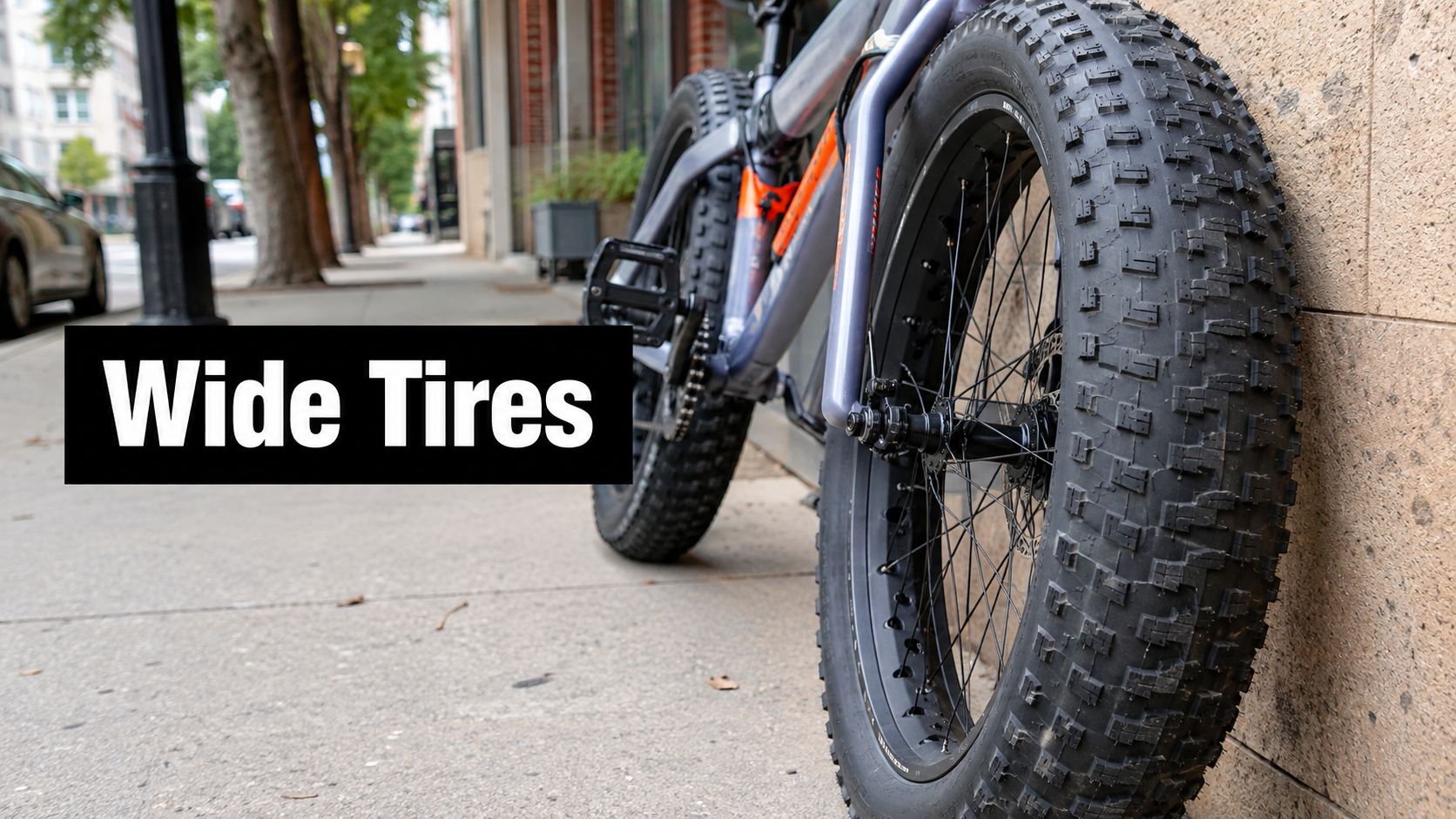
The most popular advice about wide bicycle tires is also the least useful: narrow means fast, wide means slow. That rule only works when you ignore the road, the rim, the pressure, the bike's clearance, the rider's load, and the vibrations being sent through the frame.
For an e-bike or daily commuter, those details matter more than a label on the sidewall. A correctly matched wide tire can make broken pavement easier to manage, improve grip through wet junctions, and reduce the fatigue that turns a manageable commute into an unpleasant one. A poorly matched setup can rub the frame, handle badly, drain more battery than necessary, or cost more to maintain.
The practical question isn't whether wide bicycle tires are universally faster. It's which tire width works with your rims, frame, pressure, motor, cargo, and actual streets.
Why Wide Bicycle Tires Are Changing Urban Riding
The idea that wide bicycle tires are a recent comfort trend doesn't survive a look at cycling history. Balloon tires appeared on cruiser bicycles in the United States in the 1930s, commonly measuring 2.0 to 2.5 inches, or 51 to 64 mm, according to the history and development of bicycle tires. Later categories expanded into plus-size tires around 2.5 to 3.25 inches, or 64 to 83 mm, and fat tires measuring 3.8 inches, or 97 mm, and larger.
That history matters because wide tires have repeatedly solved the same practical problems: limited grip, rough surfaces, soft ground, and rider discomfort. Fatbikes using 3.8 to 5.0 inch tires, or 97 to 127 mm, became useful from the 1980s onward for snow, sand, bogs, and mud. Wide bicycle tires aren't a fashionable departure from efficient cycling. They're a recurring engineering response to difficult surfaces and low-pressure traction.
The road-bike shift
Performance cycling has also moved through wider dimensions than many riders realise. Historical records document early top-end bicycles with 43 mm tires in 1890, roughly comparable to modern gravel widths. Tires around 48 mm were popular on some road bicycles in the 1920s and 1930s. More recently, mainstream road setups moved from 18 to 23 mm toward 25 mm, then 28 mm and 30 mm on endurance and gravel-oriented bikes, as explained in this analysis of how modern tire widths echo older designs.
That change doesn't mean every rider needs a large tire. It means the old assumption has lost its foundation. Modern riders increasingly judge speed by how a complete system behaves over real roads, not by tire width in isolation.
Urban riders feel this especially clearly. City streets include patched asphalt, drain covers, potholes, broken glass, painted lines, kerbs, and frequent braking. An e-bike adds motor assistance and often adds battery weight, luggage, or a rack-mounted load. A tire that absorbs more surface disturbance can help the rider maintain control and momentum, even if its extra mass isn't ideal for every route.
Practical rule: Choose the narrowest tire that comfortably handles your worst regular surface, not the widest tire that happens to fit.
For riders in the UK and EU, this is particularly relevant to commuting through dense urban streets where smooth cycle lanes can sit beside rough road edges. Legal requirements still vary by vehicle type and location, so an e-bike or scooter upgrade should be considered alongside local rules, such as those summarised in this guide to electric scooter laws by state.
The Physics Behind Comfort and Rolling Resistance
A wider tire doesn't automatically create more rolling resistance. Pressure, casing stiffness, tire construction, and surface roughness decide whether the additional width helps or hurts.
On a rough road, a narrow, highly inflated tire can bounce across small irregularities instead of conforming to them. That movement wastes energy and sends vibration into the rider. A wider tire has more air volume, so it can support the same load at a lower pressure without allowing the casing to collapse excessively.

Why the contact patch matters
The important change isn't just that a wide tire touches more road. Under load, a wider tire generally creates a shorter, less deformed contact patch than a narrow tire carrying the same load at an appropriate pressure. That reduces the amount the casing bends as it enters and leaves the contact area.
Casing deformation creates hysteresis losses. In plain terms, some of the energy used to deform the rubber and fabric doesn't return as forward motion. The controlled study cited in the journal research on tire width, rolling resistance, and vibration found that tires measuring 30 mm or wider offered the best balance between low rolling resistance and reduced vibration transmission. It also reported that individually optimised inflation pressures significantly lowered rolling resistance while reducing vibratory loads on the rider.
That last point is the one most quick buying guides miss. Width only helps when pressure suits the rider and the road. Pumping a wide commuter tire to an unnecessarily high pressure can make it harsh, reduce grip over broken surfaces, and remove much of the reason for fitting it.
Smooth roads behave differently
On a completely smooth surface, higher pressure can reduce deformation and rolling resistance. Schwalbe explains this relationship in its technical guide to rolling resistance and tire pressure. Off-road or rough surfaces reverse the practical outcome, because a lower pressure can let the tire follow the ground more efficiently.
That's why a commuter who rides smooth indoor-surface-quality tarmac may prefer a firmer setup, while someone crossing potholes and rough cycle lanes may be faster and more comfortable with a softer tire. The correct pressure is a tuning decision, not a number chosen from the maximum printed on the sidewall.
Checking Frame and Rim Compatibility Before You Buy
Buying the tire first and checking fit later is how riders end up with expensive rubber sitting unused on a workbench. Measure the bike with the current wheel installed, and remember that the mounted width can differ from the nominal size printed on the tire.
Start at the chainstays, especially the narrow area behind the bottom bracket and seat tube. Check both sides, because a wheel may not sit perfectly centred. Move up to the seatstays, including any bridge between them, then inspect the fork legs and crown. Look for clearance around the entire rotating tire, not only at the widest point.

A practical fitment check
Use a ruler or caliper and measure the narrowest gap. The supplied compatibility guide uses more than 6 mm at the chainstay and seatstay areas and more than 2 mm per side at the fork crown as working clearance targets. Treat those figures as a fitment reference, not a guarantee. Mud, wheel flex, manufacturing variation, and a buckled wheel can consume clearance quickly.
Then check the rim. Bicycle Rolling Resistance found that peak performance is typically reached when rim width is about 65% to 75% of the tire's specified width, while a rim between 50% and 80% of tire width remained within 99% of peak rolling-performance conditions, as shown in its rim-width testing. The measurement refers to the rim's relevant internal width, not its external width.
Rim brakes create another physical limit because the tire must pass through the brake arms. Disc brakes usually offer more room at the caliper, but the frame and fork still set the maximum. Fender or mudguard clearance needs separate attention. A tire that fits without guards may rub once a guard, trapped grit, or a small wheel misalignment enters the equation.
The following video demonstrates the kind of clearance and compatibility inspection worth doing before ordering:
For e-bikes, inspect the motor cable routing, torque arm area, rack stays, and any proprietary wheel components. A tire upgrade should never force the wheel out of alignment or place pressure on a cable.
Choosing the Right Width for Your Riding Style
There isn't one ideal width for every urban rider. A fast pavement commuter, a parent carrying cargo, and a rider crossing gravel paths may all use the same e-bike category while needing very different tire behaviour.
The table below gives a practical starting point. It describes use cases rather than declaring a universal winner.
| Use Case | Recommended Width | Best For | Trade-offs |
|---|---|---|---|
| Fast pavement commuting | 28 to 32 mm | Smooth roads, cycle lanes, longer daily rides | Less cushioning and less tolerance for rough edges |
| Mixed-surface commuting | 35 to 42 mm | Pavement, gravel paths, poor cycle lanes | More weight and a less immediate steering feel |
| Comfort-focused city riding | 45 to 55 mm | Broken streets, relaxed riding, stability | Greater rolling mass and possible frame-clearance problems |
| Cargo and heavy-load use | 60 mm and wider | Utility bikes, heavy luggage, demanding surfaces | Extra weight, replacement cost, and stronger fitment constraints |
Match width to the route
A 28 to 32 mm tire suits riders who spend most of their time on paved roads but still want more forgiveness than older narrow road setups offered. It can feel responsive during acceleration and changes direction quickly, which matters in traffic.
For a route that alternates between pavement, canal paths, compact gravel, and damaged asphalt, 35 to 42 mm is often the more useful compromise. The additional air volume can improve control, but the tire may feel slower to spin up, particularly on a heavy e-bike.
A 45 to 55 mm tire makes sense when comfort, stability, and pothole control matter more than a quick steering response. It's also more attractive for riders who don't want to avoid every rough road edge. However, width at this level can expose a frame or rim limitation that a smaller increase wouldn't.
The 60 mm and wider category belongs to genuine utility needs, not just a desire for a softer ride. Cargo, rough surfaces, and high system loads can justify it, but the bike must be designed for the width and the wheel must remain strong and properly aligned.
For a deeper look at mixed-surface sizing, the gravel bike tire guide from SYCLR is a useful reference, especially if your commute includes unpaved links between paved sections. On an e-bike, also consider battery use. A heavier, more aggressively treaded tire can demand more motor assistance during repeated starts, while a smoother casing and appropriate pressure may preserve efficiency.
Dialing in Tire Pressure for Maximum Performance
Pressure is the adjustment that makes a wide tire either useful or disappointing. The same tire can feel fast and planted, or vague and sluggish, depending on rider mass, battery weight, luggage, temperature, casing construction, and road surface.
A practical road-bike guide gives approximate ranges of 60 to 75 psi for 28 mm tires and 45 to 60 psi for 30 to 32 mm tires, as outlined by Competitive Cyclist's rolling-resistance and tire-pressure guide. Those figures are starting points, not universal prescriptions. A heavier rider or a loaded rear rack needs a different setup from a lighter rider on an unloaded bicycle.

Adjust the rear tire first
The rear wheel usually carries more of the rider and bike's combined load. On an e-bike, the battery, motor, rack, panniers, and sometimes a passenger can increase that demand further. Start within the tire maker's safe range, set the rear pressure with the normal commuting load fitted, and then make small adjustments rather than dramatic changes.
For smooth pavement, a firmer pressure can reduce casing movement. For rough urban streets, lower pressure can improve grip and reduce the sharp impacts that reach the rider. Don't lower pressure until the tire feels unstable, folds during hard cornering, or bottoms against the rim over ordinary bumps.
Use a repeatable test
Test the same route after each pressure change. Pay attention to four things:
- Steering: Does the front tire track cleanly, or does it feel vague?
- Impact control: Are potholes and drain covers less violent?
- Grip: Does the tire remain composed over wet paint and rough corners?
- Efficiency: Does the motor seem to work harder during normal riding?
Pressure is a setup tool, not a target to maximise. Start near the middle of a safe range and tune for control, comfort, and stable casing support.
Check pressure regularly with a reliable gauge. A slow leak can make a tire feel comfortable at first and then dangerously soft later in the ride. Tubeless users should also monitor sealant condition and air retention, while tubed systems need careful attention to pinch-flat symptoms.
Real-World Ownership Considerations for E-Bike Riders
Wide bicycle tires change more than ride feel. They affect the amount of energy needed to accelerate, the effort required from the motor, how often punctures interrupt a commute, and how much replacement rubber costs over the life of the bike.
The battery-range effect isn't a fixed penalty. A wide, heavy, knobby tire can add rolling and rotational resistance, especially on smooth roads. A supple wide tire at a suitable pressure may perform better over rough streets than a narrow tire inflated too firmly. Rider weight, wind, speed, stop-start traffic, hills, assistance level, and cargo can all matter more than width alone.
Punk Ride LLC lists a Fat Tire E-Bike collection that includes models with 20 × 4.0 fat tires and 20″ × 4.0″ pneumatic fat tires. That kind of setup can suit riders who prioritise stability, cushioning, and load capability, but it also demands enough frame clearance, suitable rims, and realistic expectations about weight and range.
Puncture protection involves compromise
A commuter has several ways to improve puncture resistance:
- Reinforced tires add protective material, but they can feel heavier and less supple.
- Tire liners create another barrier against sharp debris, though poor installation can introduce friction or rubbing.
- Tubes with suitable protection are simple to repair at the roadside and familiar to most workshops.
- Tubeless systems can seal some small punctures and allow lower pressures, but they require compatible rims, valves, sealant, and periodic maintenance.
Tubeless isn't automatically the right choice for a daily rider. A commuter without access to a pump, sealant, or a reliable repair routine may prefer a well-protected tubed tire. Someone regularly crossing debris-strewn paths may accept the additional maintenance for the extra puncture resilience.
For riders using e-bikes in the United States, legal classification and safety obligations vary by jurisdiction. A resource covering Philadelphia e-bike injury information can provide local context, though it isn't a substitute for checking current regulations where you ride. Riders using scooters alongside bicycles can also compare practical ownership issues in electric scooter reviews for adults.
Replacement cost deserves a place in the decision. A common commuter tire in a moderate width may be easier to source and cheaper to replace than a specialist fat tire, while unusual sizes can create delays when one tire wears out or suffers sidewall damage.
Your Decision Checklist for Choosing Wide Tires
Start with the bike, not the marketing description. Check the manufacturer's maximum tire size, measure the tightest frame and fork gaps, identify the rim's internal width, and confirm whether your brakes and mudguards leave enough room.
Then judge the route. If your commute is mostly smooth pavement and you value quick steering, stay toward the narrower end of a compatible range. If it includes broken asphalt, gravel links, potholes, or heavy daily loads, additional air volume may deliver more usable speed and comfort.
Ask yourself these questions:
- What surface causes the most trouble? Choose for the worst regular section, not the perfect part.
- How much load does the bike carry? Include the battery, rack, panniers, tools, and any passenger.
- How long is the commute? A small comfort improvement becomes more valuable as exposure to vibration increases.
- Can the wheels support the tire properly? Rim width and tubeless compatibility matter as much as frame clearance.
- What maintenance can you handle? Tubes are straightforward to repair, while tubeless systems require more equipment and attention.
- Does the extra weight serve a purpose? If the route is smooth, a large tire may add mass without solving a real problem.
Choose 28 to 32 mm for fast paved commuting, 35 to 42 mm for mixed surfaces, and 45 mm or wider when comfort, stability, or cargo support outweighs quick acceleration. Stay narrower if your current tires already handle the route well and your frame, rims, or budget leave little room for change.
If you're upgrading an e-bike for daily city use, visit Punk Ride LLC to compare urban electric rides and fat-tire models, then match the tire size to your frame, rim, load, and route before you buy. A pressure gauge, clearance check, and realistic battery expectation will do more for the result than simply choosing the widest tire available.
Share:
Best Electric Bike Motor Compared for Hills & Commuting
Best Electric Bike for Short Female Riders in 2026