


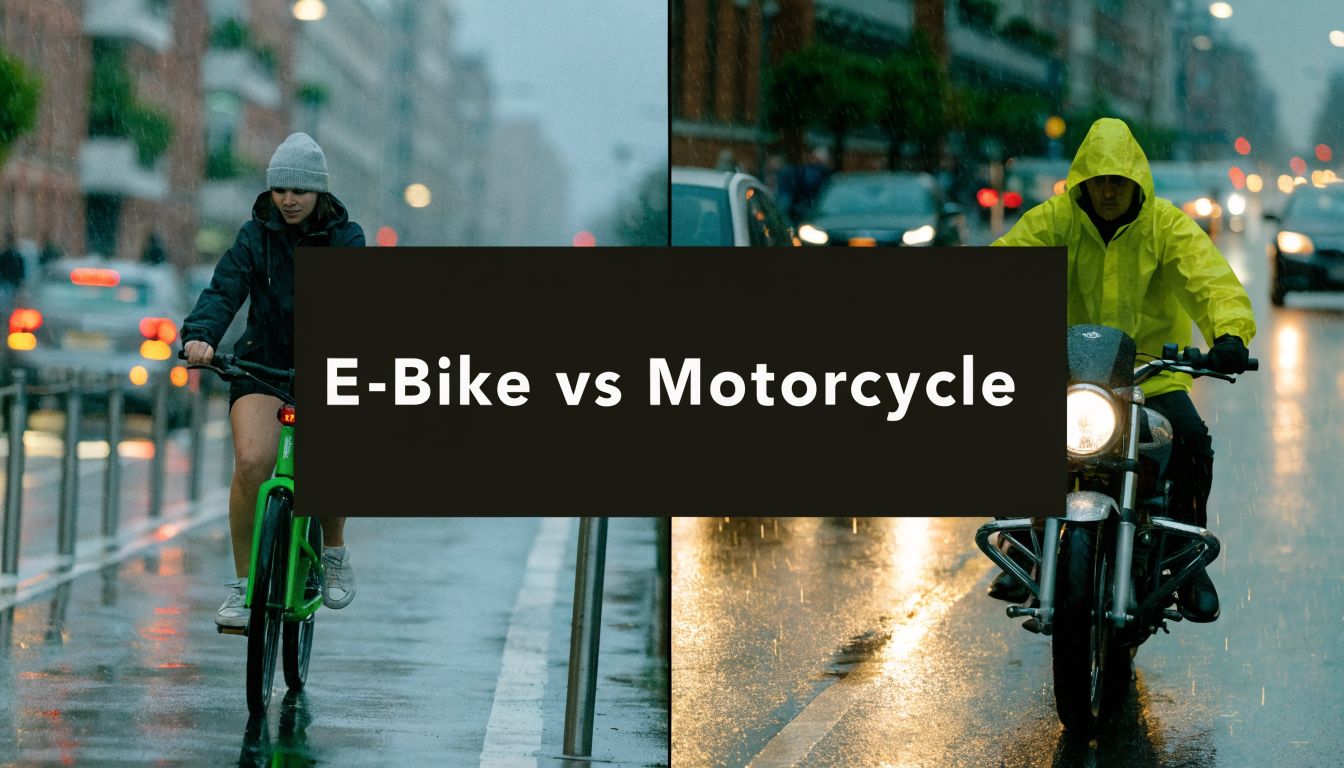
You're probably in the same spot a lot of city commuters hit sooner or later. You're tired of sitting in traffic for trips that should be short, tired of feeding parking meters or garage apps, and tired of arriving already annoyed before the day even starts.
That's usually when two-wheel transport starts looking less like a hobby and more like a practical fix. The choice often comes down to electric bike vs motorcycle. Both can cut commute time. Both can make city travel feel less miserable. Both can also disappoint you if you buy the wrong one for your actual routine.
I've spent enough time around both types of machines to know the marketing usually focuses on the wrong stuff. People obsess over top speed, style, or whether one looks “serious” and the other doesn't. For a daily US city commute, the better question is simpler: Which one is easier to live with five days a week?
That means looking at the whole picture. Not just speed, but parking. Not just range, but charging or fueling. Not just sticker price, but insurance, maintenance, legal access, and how much hassle the thing adds to your week.
Your Escape from Urban Gridlock
A lot of buying decisions start with one bad commute.
You leave home on time. Then traffic bunches up for no obvious reason. You crawl a few blocks, stop at every light, and finally reach work only to circle for parking and pay too much for the privilege. On the way home, it happens again. After a while, the car starts feeling less like freedom and more like a very expensive waiting room.
That's where two different ideas show up.
An electric bike says, “Keep it light. Slip through the city. Use bike lanes where legal. Park fast. Charge at home.” A motorcycle says, “Take the lane. Keep up with traffic. Go farther. Get there with authority.” Both can work. They just solve different problems.
Practical rule: Buy for your worst regular day, not your best weekend fantasy.
If your real life is a short urban commute with traffic, limited parking, and no interest in paperwork or fuel stops, an e-bike starts making a lot of sense. If your route includes faster roads, longer distances, or you want one machine that can handle city duty and out-of-town rides, a motorcycle earns its place.
Here's the quick version before we go deeper:
| Factor | Electric bike | Motorcycle |
|---|---|---|
| Best use | Dense city commuting, short errands, mixed bike-lane travel where legal | Longer commutes, faster roads, highway-capable travel |
| Daily hassle | Low | Medium to high |
| Parking ease | Very easy | Easier than a car, still limited by road rules |
| Fuel or charging | Simple home charging | Gas stops or, for e-motorcycles, longer charging planning |
| License and registration | Often simpler for compliant classes | More paperwork and legal requirements |
| Weather tolerance | Fine for fair weather commuting | Better tool for all-weather, higher-speed travel |
| Fun factor | Nimble, playful, quiet | Faster, more dramatic, more immersive |
The rest comes down to what kind of commute you have and how much friction you're willing to put up with every week.
Speed Power and Riding Feel
Leave a downtown light on an e-bike and the first thing you notice is how little fuss it takes. You press on the pedals or use the throttle, the bike steps forward, and you're up to city speed with almost no drama. For a commute with short blocks, frequent stops, and bike-lane stretches, that easy punch matters more than a heroic top-speed number.
A motorcycle delivers a different kind of response. It has more weight, more force, and more stability once traffic speeds rise. It also asks more from the rider. On a gas bike, that often means clutch work, shifting, heat, and a sharper penalty for sloppy throttle control in stop-and-go traffic. Even on an automatic or electric motorcycle, you feel the size and speed of the machine every time you filter through a tight street or pull into a crowded parking area.

What quick acceleration means in town
For city riding, the useful question is not “How fast will it go?” It's “How easy is it to clear an intersection, merge into a gap, and carry speed without tiring yourself out?”
That is why e-bikes feel better in traffic than their specs suggest. The power shows up right away, and on a good commuter setup it arrives in a controlled way rather than all at once. Sensor tuning matters a lot here. A bike with a well-set torque sensor usually feels smoother and easier to place precisely in traffic than one with a choppy cadence-based setup. If you're comparing commuter models, this guide on torque sensor vs cadence sensor for e-bikes explains why two bikes with similar watt ratings can feel very different on the street.
Electric motorcycles have the same instant-torque character, just with much higher stakes. HappyRun's performance comparison notes that electric motorcycles make peak torque from 0 rpm, which is why they feel so sharp leaving a light. That quick response is fun. It is also something a new rider has to respect, because the line between “quick” and “too much” gets thin fast on a heavier machine.
How each one feels after a week of commuting
An e-bike removes a lot of the irritation from city riding. Hills are easier. Headwinds stop draining your energy. You still get the visibility and agility of a bicycle, but without showing up sweaty or annoyed.
A motorcycle gives you more sensation and more ability in reserve. It feels planted, serious, and satisfying in a way an e-bike usually does not. I like that about motorcycles, especially on faster urban arterials where an e-bike starts to feel out of its depth. But there is a trade-off. On a short weekday commute, the same qualities that make a motorcycle exciting can also make it feel like more machine than you needed.
That difference affects hassle as much as fun. An e-bike invites spontaneous use because the ride feels light and low-pressure. A motorcycle can make the commute more memorable, but it also tends to feel like an event you prepare for.
Where speed stops helping
For a US city commute, extra speed only helps if your route can use it. If your day is mostly lights, congestion, turns, and short hops between neighborhoods, a motorcycle's performance advantage often sits unused. You paid for capability that traffic will not let you enjoy.
Range works the same way. A motorcycle, especially a gas model, usually gives you more freedom for longer rides and less planning between fill-ups. That matters if your commute includes fast roads, unexpected detours, or regular trips well beyond the city core. If not, the simpler machine often wins because it asks less of you day after day.
This is also where ownership reality starts creeping into the riding experience. Big speed is fun. So is instant torque. But for a commuter, performance only counts if you want to live with the insurance, gear, and operating costs that come with it. Anyone pricing the broader vehicle side of that equation can get a rough benchmark from the cost of insuring an electric car before looking at motorcycle insurance quotes in their own ZIP code.
The short version is simple. An e-bike feels nimble, light, and easy to use often. A motorcycle feels stronger, faster, and more involving. For dense city miles, the better ride is usually the one you will keep choosing on an ordinary Tuesday.
Counting the Real Cost of Ownership
Monday morning is where the budget test gets real. One option asks for a helmet, a charger, and maybe a lock. The other can ask for insurance, registration, fuel, service appointments, and gear before the week even starts.
That difference is why sticker price is only the first number to look at. For a city commuter, the better question is simple: what will this machine cost me to keep using, month after month, and how much friction comes with it?

What the monthly reality looks like
A city e-bike usually wins on total ownership cost because it skips whole categories of expense. Charging costs are low. Maintenance is closer to bicycle upkeep than motor-vehicle upkeep. In many places, a compliant e-bike also avoids registration and mandatory insurance, which matters more than people expect.
A motorcycle keeps charging you even on weeks you barely ride. Insurance is often the biggest line item, especially for younger riders, dense ZIP codes, financed bikes, or anything with sport-bike pricing. Then come registration, tags, fuel, consumables, and service. Add decent protective gear and the gap widens fast.
Here's the practical comparison:
| Cost category | Electric bike | Motorcycle |
|---|---|---|
| Upfront purchase | Usually lower entry point for commuting models | Wide range, but road-legal bikes often cost more once ready to ride |
| Insurance | Often optional for compliant e-bikes | Commonly mandatory and significant |
| Energy | Very low | Ongoing gas cost or charging planning for electric motorcycles |
| Maintenance | Chains, tires, brakes, drivetrain basics | Tires, chain, brakes, fluids, engine service on gas bikes |
| Registration and licensing | Often simpler | Usually required |
| Parking | Often cheap or free | Easier than a car, but not friction-free |
Cheap to run is not the same as cheap to own
This part gets glossed over in a lot of comparisons. Energy cost matters, but hassle cost matters too.
An e-bike is usually easier to keep in service because there are fewer systems demanding attention. You still pay for tires, brake pads, chains, cassettes, and eventually a battery. But the ownership rhythm is simpler. Charge it, keep the drivetrain clean, replace wear items, ride.
A motorcycle can be a great commuter, but it behaves like a real vehicle because it is one. Gas bikes need fluids, filters, and more frequent service checkpoints. Electric motorcycles cut some of that work, but they still live in the vehicle world with vehicle-level insurance, registration, and parts pricing. For many urban riders, that admin burden matters almost as much as the dollars.
If you want a broader frame for how insurers price electric vehicles, this breakdown of the cost of insuring an electric car is useful context. For the lighter end of the market, this guide to electric bike insurance cost in Australia and the US gives a practical sense of when extra coverage may be worth paying for.
What works for a commuter budget
For the lowest total cost and the lowest day-to-day hassle, buy the simplest legal machine that covers your route with some margin. In a US city, that often points to an e-bike.
I like motorcycles. I have owned both, and a motorcycle is more exciting on the right road. But for short urban miles, it is easy to buy a machine that costs more to insure, store, maintain, and equip than the commute justifies. The same mistake can happen with a high-speed electric two-wheeler if its classification pushes you into moped or motorcycle rules. The smart buy is the one you will enjoy on Saturday and still appreciate when you are tired, late, and heading home on a wet Tuesday.
License Plates vs Bike Lanes Legal Realities
The legal difference between these two choices is often bigger than the performance difference.
A motorcycle is a motor vehicle. That means license requirements, registration, a plate, and rules that place you firmly in normal traffic. In exchange, you get access to regular roads and the ability to ride at traffic speed where the bike is capable.
An electric bike can be much simpler, but only if it fits your state or local definition of an e-bike.

Why bike-lane access changes the commute
This is the part many first-time buyers miss. A machine that's slower on paper can be faster door to door if it can use infrastructure cars and motorcycles can't.
A compliant e-bike may let you use bike lanes, bike parking, neighborhood cut-throughs, and lower-stress routes where local rules allow it. That can make a cross-city commute less tiring even if the top speed is lower. A motorcycle is quicker in open traffic, but it stays tied to the same road network and parking constraints as other motor vehicles.
If you need a state-by-state refresher before buying, this guide to electric bike laws by state is worth checking because e-bike access rules aren't uniform across the US.
The line is starting to blur for some high-power models
Buyers often get tripped up when some machines are sold with e-bike styling but create moped or motorcycle legal issues depending on power and speed.
One projected example comes from Himiway's review of electric bikes and electric motorcycles, which states that Florida's 2026 HB 123 bill, effective January 2026, would reclassify high-power e-bikes over 750W to require helmets and licenses similar to mopeds. The same source says this shift is increasing interest in Class 2 e-bikes that are 20 mph throttle-limited, partly because they can help riders avoid motorcycle-style insurance costs that can exceed $500 per year.
That's a future-dated regulatory claim, not a current nationwide rule. But it points to the underlying issue. If you buy on power alone without checking classification, you can accidentally buy yourself into more paperwork.
A short explainer helps here:
- Compliant e-bike. Usually the easiest ownership path. Better for riders who want bicycle-style convenience.
- High-power gray-area machine. Often exciting, often legally messy.
- Motorcycle. Clear legal category, more obligations, more capability.
For many city commuters, the sweet spot is boring in the best way. A legal Class 2 or Class 3 e-bike gets you mobility without turning your commute into an admin task.
Here's a useful visual overview before you decide:
A Nuanced Look at Safety and Responsibility
You're heading home after work, traffic is stacked up, a delivery van swings wide, and a car door cracks open near the curb. That kind of low-speed city chaos is where a lot of commuter crashes happen. The choice between an e-bike and a motorcycle changes how hard a mistake hits, but it does not remove the need for judgment.
The practical difference is consequence.
According to Gallivan Law's summary of a UCLA-linked safety study, e-bikes have 115 injuries per million rides, compared with 104 injuries per million motorcycle rides. The same source reports the fatality rate for e-bikes is 19 per 100 million rides, lower than bicycles at 21 and far below motorcycles at 537 per 100 million rides.
That lines up with what many city riders learn the hard way. E-bikes put you into a lot of conflict points. Intersections, turning cars, pedestrians, doors, wet paint, potholes. Motorcycles bring more speed, more mass, and a much bigger penalty when something goes wrong. For a buyer, that matters because the safety question is not only “which one crashes more?” It is also “what kind of crash am I accepting on my daily route?”

The risk profile is different, not simple
An e-bike can make riders casual in a bad way. People hop on in street clothes, skip gloves, skip eye protection, and treat a 20 to 28 mph machine like a toy. In city traffic, that attitude creates its own hassle factor. A minor fall can still mean a wrecked commute, urgent care, time off work, and a bike that needs repair.
A motorcycle usually pushes riders toward more serious habits because the machine feels serious from the start. That can help. It can also create overconfidence if the rider buys for power before building skill.
Earlier in the article, I cited research showing helmet use is lower among e-bike riders than motorcycle riders. That gap matters because head injury risk does not care whether the vehicle is sold in a bike shop or a dealership.
Responsibility follows your choices
Motorcycle riders should budget for training and real protective gear as part of ownership, not as optional add-ons later. E-bike riders should do the same, even if the law in their state asks less of them. That extra spending is part of total cost of ownership, and it is one of the few expenses that can save you money, pain, and downtime at the same time.
Legal exposure matters too. If a serious crash injures someone else, the vehicle's smaller size does not make the situation minor. This article on understanding vehicular manslaughter with electric bikes is worth reading for anyone who still thinks an e-bike is free of real responsibility.
For a city commute, the safer buy is usually the one that matches your habits.
- Choose the vehicle you will ride with discipline. A slower machine does not help much if you ride distracted or underprotected.
- Wear a helmet every trip. Short urban rides are full of sudden-impact scenarios.
- Get training early. A one-day class or skills session costs less than one bad crash.
- Ride to the route. Dense city streets reward awareness and restraint more than top speed.
That is the part marketing skips. Safety is not a spec sheet win. It is the day-to-day result of how much risk, cost, and responsibility you are willing to carry on the way to work.
The Daily Grind Parking Storage and Charging
At this juncture, ownership becomes either easy or irritating.
A motorcycle beats a car for parking in a lot of cities, but it still behaves like a vehicle you have to manage. You need a sensible parking spot, decent theft prevention, and a place to keep it at home. If you live in an apartment without secure parking, that can turn into a constant low-level headache.
An e-bike is much easier to fold into daily life. You can roll it to a bike rack, bring some models into an office, and charge from a normal outlet. For commuters, that convenience often matters more than performance.
What your morning actually feels like
With a motorcycle, the routine often looks like this: gear up, wheel it out, check where you'll park, and make sure you're not leaving it somewhere sketchy for hours. If it's a gas bike, you'll also fit fuel stops into the week. None of that is terrible, but it's still friction.
With an e-bike, you usually just go. For a city trip, that difference is huge. If the battery is charged, you're done. No gas station. No warm-up mindset. No wondering whether the parking situation at your destination will be annoying.
The best commuter is the one you won't talk yourself out of using on a tired Tuesday.
Storage decides more purchases than people admit
Home setup matters. A motorcycle asks for outdoor security or a proper indoor space. An e-bike asks for less room and usually less commitment. That's why they fit apartment life so well.
If secure parking or home storage is your weak point, it helps to think beyond the vehicle itself. Advice like these solutions for secure vehicle storage can help you think through access, locking, and weather exposure before you buy something hard to protect.
For everyday city use, the hassle factor usually breaks like this:
- Parking at work. E-bike wins because it fits bike infrastructure better.
- Storage at home. E-bike wins again unless you already have secure motorcycle space.
- Refueling or charging. E-bike is easier if you can charge overnight.
- Bad-weather readiness. Motorcycle usually handles sustained rough conditions better if the rider is properly equipped.
That's why a lot of people who love motorcycles still end up using e-bikes more often for short urban trips. They're easier to live with.
Which Ride Is Right for You A Decision Framework
It is 8:10 a.m. You are late, the route has three miles of clogged city streets, and parking near work is either expensive or annoying. That is the moment to choose your vehicle. Not on a sunny Saturday test ride.
The right pick depends on what your commute asks from you every weekday. Distance matters. So do road speeds, parking, weather, storage, and how much money and paperwork you are willing to carry year after year. If you judge the purchase by total cost of ownership and daily hassle, the answer usually gets clearer fast.
The pragmatic city commuter
Your trip is short to medium, mostly on city streets, and you care more about showing up on time than making an entrance. You want something cheap to run, easy to park, and simple to keep in service.
Buy an electric bike.
For this rider, the e-bike usually wins on the things that shape real ownership: lower operating costs, fewer legal obligations, easier parking, and less friction around short trips. If your route does not include sustained fast traffic, a motorcycle can turn into extra payment, extra admin, and extra storage trouble for no real commute benefit.
The urban rider who wants speed but hates unnecessary overhead
Some commuters want more snap off the line and a more playful ride, but they still live in a city and do not want every errand to feel like a full vehicle commitment. That is a real middle ground.
Start by looking at a street-legal, commuter-friendly e-bike before assuming you need a motorcycle. Punk Ride LLC carries urban electric models across several categories, which makes it useful for side-by-side comparison if you are weighing practical commuter bikes against more aggressive options from brands like DUOTTS, ENGWE, ELEGLIDE, HITWAY, or KIXIN.
The key is to separate fun from fantasy. Buy the quickest machine you can use comfortably and legally on your normal route. A bike that fits your city and gets used five days a week is a better purchase than a faster machine that becomes a chore.
The all-weather highway rider
Your commute includes faster roads, longer distances, or regular trips beyond the city core. You need stability at higher speeds, stronger carrying capacity, and a machine that feels settled when traffic opens up.
Buy a motorcycle.
The extra cost starts to make sense. A motorcycle asks more from you up front and over time, but it gives you a wider operating range in return. If your route regularly outgrows bike-lane infrastructure or pushes past what an e-bike does comfortably, forcing the e-bike into that job gets old in a hurry.
The rider who needs one final rule
Use this checklist:
- Choose an e-bike if your top priority is low-cost, low-hassle city travel.
- Choose a motorcycle if your commute regularly needs higher speed, longer range, or stronger road presence.
- Pause and check local laws if the machine sits in the gray area between bicycle and motorcycle categories.
One more rule matters. Buy for your weekday life, not your idealized version of yourself.
For a US city commute, the smarter purchase is often the one with fewer recurring costs and fewer daily frictions. That usually points to an electric bike. If your route demands more speed, more distance, and more all-weather capability, the motorcycle still earns its place.
Share:
Unraveling the Tech Behind Electric Bikes and Scooters
Urban E-Bikes for Comfortable City Commuting