


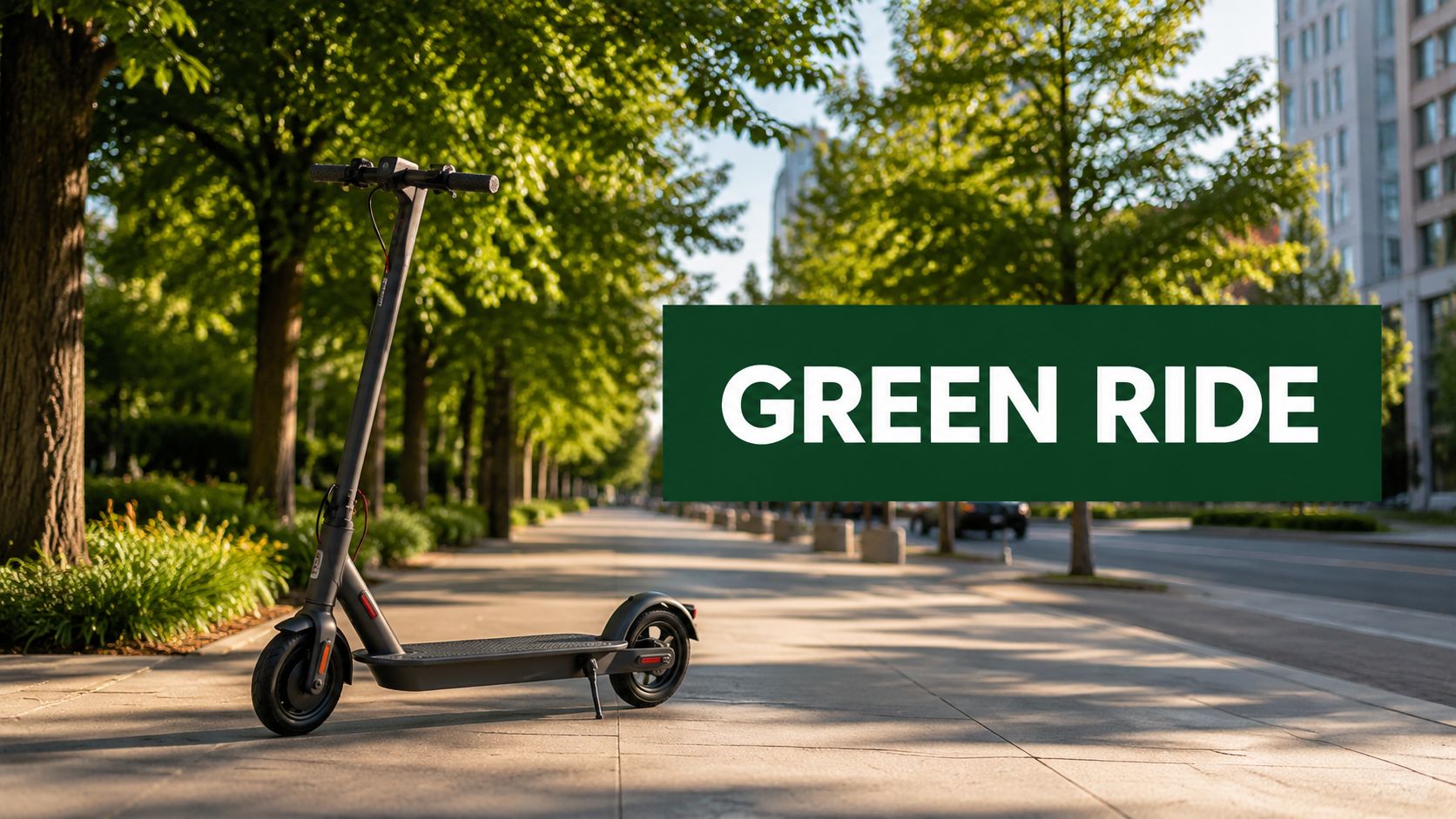
Type “electric scooter green” into a search bar and you'll get two very different ideas mixed together. One is fun and simple: a scooter painted green. The other is harder, and more important: whether the scooter is better for the planet.
Both matter. Style is part of why people love personal electric rides. But colour doesn't tell you much about environmental impact. A glossy green frame can still hide a short-lived battery, poor repairability, or a design that ends up in the bin too soon.
That's where people get tripped up. They hear “zero emissions” and assume the whole story is clean. It isn't. Electric scooters can be a smart low-impact transport choice, but only when you look at the full picture: how they're made, how long they last, how they're charged, and whether they replace car trips.
For riders in the UK and EU, that question matters more every year as urban transport shifts away from car-first habits. The same goes for riders in the US and Australia who want something practical, compact, and less wasteful than short car journeys. If you want the honest version of electric scooter green, start with this rule: the greenest scooter usually isn't the flashiest one. It's the one you'll use often, maintain properly, and keep for years.
Green Scooter Hue or Eco-Friendly You
Plenty of scooters look great in green. Matte olive, bright lime, dark forest tones. No complaints there. A good-looking ride makes you want to use it, and that matters because a scooter parked forever in a hallway isn't helping anyone.

The bigger question is what people mean when they search for electric scooter green. Usually they're after one of these:
- A green-coloured scooter that matches their style
- An eco-friendly scooter that lowers the impact of daily travel
- Both at once, which is the sweet spot
Two meanings of green
The first meaning is visual. Easy. You can spot it in one second.
The second meaning takes a bit more thought. A scooter can feel green because it has no tailpipe. That part is true. But the environmental impact starts long before your first ride and keeps going after the battery's useful life ends.
Simple rule: Green paint is an aesthetic choice. Green transport is a lifecycle choice.
That difference matters because a lot of marketing blends the two together. Brands show leafy city scenes, clean streets, and tidy charging cables. None of that tells you whether the scooter is durable, repairable, or likely to replace a car journey rather than a walk, bike ride, or bus trip.
Where people get confused
The confusion usually starts with one shortcut. People compare scooters only at the moment of use. They think: no fuel, no exhaust, therefore fully green.
That's too narrow. A more useful way to think about it is this:
| Question | What it really asks |
|---|---|
| Is it electric? | What powers it day to day |
| Is it green? | What impact it has across its whole life |
| Is it worth owning? | Whether it lasts long enough to justify making it |
A well-built personal scooter can absolutely be part of a lower-impact routine. It can make short urban trips easier, cut down on car dependence, and fit neatly into daily commuting. The strongest case usually comes from private ownership, long service life, sensible charging, and regular maintenance.
The better question to ask
Instead of asking, “Is this scooter green?” ask, “What kind of use makes this scooter green enough to justify owning?”
That one question cuts through a lot of noise. It points you toward lifespan, battery quality, repair options, and trip replacement. It also helps explain why some shared scooter systems don't look as eco-friendly once you examine the hidden logistics behind them.
The Real Environmental Impact of E-Scooters
A scooter creates a large share of its environmental impact before its first ride. Mining and processing materials, building the battery, manufacturing the frame, and shipping the finished product all happen up front.
A past life-cycle study of shared e-scooters, published in Transportation Research Part D, found that manufacturing and materials were major contributors to total greenhouse-gas emissions across a scooter's life cycle, especially for systems with heavy collection and servicing needs. You can read that analysis here: life-cycle analysis of shared e-scooters.

Why the battery and build matter so much
A scooter works like a reusable bottle. The longer you keep using it, the more that upfront manufacturing impact gets spread across years of trips. If it fails early, the math gets worse fast because you have to replace the whole product sooner.
That is why durability matters environmentally, not just financially. A strong frame, a dependable battery, and replaceable parts give a scooter enough working life to justify the resources used to make it. This is also where private ownership starts to look stronger than the popular shared-scooter story. A personal scooter that is stored carefully, charged properly, and maintained over time usually avoids the rough handling, frequent redistribution, and short service life that have hurt the green claims around many shared fleets.
Range matters for a simpler reason. A scooter has to fit your actual routine. If it cannot cover your usual commute with a safe margin, it turns into an occasional gadget instead of a true car-trip substitute.
Independent testing from Rider Guide shows that real-world range often comes in well below brand claims, which is why published range figures should be treated as best-case numbers rather than daily expectations. That gap can push people toward buying twice. First the under-specced scooter, then the replacement that finally fits the job.
Charging is only as clean as the electricity behind it
Electric scooters have no tailpipe, but charging still has a footprint. The emissions depend on how your local grid generates power. A scooter charged in an area with more renewables, hydro, or nuclear power will usually have a lower operating footprint than the same scooter charged where coal and gas still dominate.
That point gets lost in a lot of green marketing. The scooter itself is only one part of the system. Your charger, your battery health, and your local electricity mix all affect the result.
Battery care matters here too, because a battery that lasts longer avoids an early replacement and the manufacturing impact that comes with it. The same common-sense habits used for other battery-powered gear apply, and this guide for durable medical equipment battery care is a useful example of the basics: charge correctly, avoid extreme temperatures, and do not ignore signs of wear.
Where scooters help most
Scooters deliver the biggest environmental benefit when they replace short car trips. That is the key comparison. If a scooter replaces a walk, a bike ride, or a well-used bus route, the environmental case gets weaker. If it replaces a few miles in a private car, especially repeated local errands or commuting legs, it starts to make much more sense.
That is also why ownership deserves a closer look than sharing. Shared scooters are often presented as the greener symbol of urban transport, but the greener outcome usually comes from a quality personal scooter that lasts, gets repaired, and becomes part of a daily habit. If you want more context on how scooters fit into wider city transport systems, this guide to urban mobility and how cities move people is a helpful place to start.
How to Choose a Genuinely Green Scooter
A greener scooter usually looks a bit boring on a spec sheet at first glance. It's not about hype words. It's about a battery system you can trust, parts you can replace, and a frame that can handle years of use.

Start with battery safety and battery quality
Battery quality sits at the centre of the whole decision. It affects safety, lifespan, reliability, and whether the scooter stays useful long enough to justify its production footprint.
For safety-critical deployment, battery systems should be evaluated against recognized standards such as UL 2271 for light electric vehicle batteries and UL 2272 for personal e-mobility devices, as outlined by UL's guidance on e-mobility device safety. UL also warns that physical damage, swelling, overheating, unusual smells, or hissing and popping can signal thermal runaway risk, and it advises using only manufacturer-approved chargers and batteries.
That may sound technical, but the buying takeaway is straightforward:
- Look for clear battery information rather than vague “high-performance” language
- Check charger compatibility and avoid brands that make replacement support hard to verify
- Treat safety signs seriously if a used scooter shows swelling, overheating, or odd odours
Repairability beats novelty
A scooter that needs replacing because of one failed component isn't a green product. It's a disposable one.
Look closely at practical ownership questions:
- Can you get spare tyres, tubes, brake parts, and chargers?
- Can a worn battery be replaced without making the whole scooter worthless?
- Does the brand support parts for older models?
A durable design often beats a trendy one with sealed components and poor after-sales support. Riders in the UK and EU should pay extra attention here, because long-term service and parts access can matter more than small differences in top-line specs.
Practical buying filter: If you can't picture maintaining it for years, don't call it eco-friendly.
Match battery size to your real trips
Battery size is one of the strongest predictors of everyday usefulness. The Kinetic Green E Luna and Flex specifications give a simple illustration. The E Luna uses a 2.3 kWh Li-ion battery and is specified for 105 km/charge, while the Flex uses a 3.0 kWh battery and is specified for 120 km/charge. More battery capacity can support longer range, but it also adds mass and packaging complexity.
That doesn't mean bigger is always greener. It means the right size is the one that covers your routine without forcing constant deep discharges or pushing you back into the car.
A helpful parallel comes from mobility equipment. Good battery care habits carry across device types, and this guide for durable medical equipment battery care explains the kind of charging and maintenance mindset that helps batteries last longer over time.
For riders comparing categories, this look at eco-friendly electric bikes and their place in low-impact transport can also help clarify when a scooter is the best fit and when an e-bike might be smarter.
Why Owning Is Greener Than Sharing
Shared scooters seem green at first glance. They're electric, compact, and easy to access. For occasional use, they can still be useful. But for frequent commuting, the environmental story gets much shakier.

The hidden problem is logistics. Someone has to collect those scooters, charge them, move them around the city, and put them back where demand is highest. Those support operations often rely on vehicles, labour, and frequent handling that private ownership doesn't require.
The last-mile green paradox
Data cited by North Carolina State University's coverage of e-scooter environmental impact shows that shared scooters have a 15 to 24 month lifecycle and require redistribution logistics that account for over 40% of their total carbon footprint. That changes the picture dramatically.
A private scooter usually follows a much cleaner pattern. One rider owns it, charges it at home, stores it at home, and rides it repeatedly for familiar trips. No nightly collection vans. No citywide reshuffling. Far less handling between uses.
One well-kept scooter can outperform many short-lived shared rides
This doesn't mean shared systems are pointless. They can reduce friction for first-time riders and help some people avoid car trips. But they often struggle with the same issue that hurts many “convenient” products. Heavy use and centralized logistics shorten lifespan and add overhead.
Private ownership flips that model. You have a direct reason to keep tyres inflated, store the scooter properly, charge it sensibly, and fix small problems before they become large ones. That care matters because longevity is where personal ownership starts to look far greener.
Here's a useful visual break before the next point:
Use pattern matters as much as product choice
If you ride to the station, to work, to classes, or for regular errands, ownership often makes more environmental sense than tapping into a shared fleet over and over. The scooter becomes part of your routine, not part of a high-turnover system with built-in transport overhead.
That's especially relevant for people trying to reduce dependence on short car trips. If that's your goal, this read on alternatives to car ownership for everyday urban travel is a useful companion.
A shared scooter can be convenient. A well-maintained personal scooter is usually the better sustainability story.
Finding Your Green Ride at Punk Ride
What does a green scooter shop look like once you strip away the marketing?
It looks less like a wall of headline specs and more like a shortlist of scooters people will keep riding for years. The category has matured, and that gives buyers better options than the old choice between flimsy budget models and heavy machines that feel awkward for everyday use. For a greener outcome, that matters. A scooter only earns its keep if it becomes part of your routine.
At Punk Ride, the goal is simple. Help riders choose a scooter that fits real journeys well enough to replace repeated short car trips and stay useful over time.
A few examples of what to look for
Some riders need a compact urban scooter from brands such as AOVO or RCB. These tend to suit flatter routes, station links, and city errands where easy carrying and storage matter nearly as much as range.
Others need something more substantial from brands such as ENGWE or Evercross. If your route is longer, rougher, or just less forgiving, a more durable frame, a larger battery, and better ride comfort can be the difference between daily use and a scooter that ends up folded in a hallway.
That distinction is easy to miss. Bigger is not automatically greener, and smaller is not automatically greener either. Good fit is greener. A scooter works a bit like a pair of shoes. If it suits the job, you keep using it. If it does not, it gets abandoned long before its materials and battery have delivered much value.
What “good fit” looks like in practice
A useful shopping mindset looks like this:
| Rider need | Greener choice signal |
|---|---|
| Daily short commute | Compact design that's easy to store and charge |
| Mixed urban roads | Stronger build quality and dependable braking |
| Longer regular trips | Battery capacity that covers the route without stress |
| Multi-year ownership | Parts support and a reputation for durability |
Curation matters in this context. The best sustainability choice is rarely the model with the loudest top-speed claim or the biggest number on the product page. It is the scooter that matches your route, your storage situation, and your willingness to maintain it.
That is also why private ownership deserves more credit than it usually gets. Shared fleets often sell the green story, but ownership gives you a reason to choose carefully, look after the machine, and keep it in service. A well-chosen personal scooter can deliver a much better environmental return than a poorly matched scooter that gets replaced early or used only occasionally.
Shipping and availability for UK, EU, and US riders
Practical support matters too. Punk Ride operates with warehouses in the UK and Germany and has its headquarters in Florida, USA, supporting riders across the UK, EU, and US.
That setup helps in a very ordinary but important way. If parts, stock, and customer support are easier to access, long-term ownership becomes more realistic. And long-term ownership is the whole point if you care about the green side of the decision.
If you want a wider view of low-impact travel beyond scooters alone, Litter Caterpillars' eco transport guide is a useful companion read.
Your Guide to Eco-Friendly Riding
The honest version of electric scooter green is simple. It's not about the paint. It's not even just about the motor. It's about whether your scooter helps you travel in a lower-impact way, over a long enough time, to justify making and charging it.
That means three things matter most: buying well, riding often, and maintaining properly.
The habits that make a scooter greener
Start with the easy wins:
- Replace car trips first when the scooter can handle them safely and practically
- Keep tyres properly inflated so the motor and battery don't work harder than needed
- Use the correct charger and charge with care to support battery health over time
- Store it sensibly away from conditions that speed up wear
- Fix small issues early before they turn a repairable scooter into waste
None of those habits are flashy. All of them matter.
A better way to think about green transport
Cycling, walking, public transport, e-bikes, and scooters each have a place. The smartest choice depends on the journey. Scooters work best in that awkward middle zone where walking is too slow, driving is excessive, and parking is a pain.
If you want a broader perspective on low-impact travel choices, Litter Caterpillars' eco transport guide is a useful extra read. It helps place scooters in the wider mix instead of treating them like a miracle solution.
Buy for the commute you actually do, not the fantasy ride you imagine doing once a month.
The takeaway most riders need
If you remember one thing, make it this. A high-quality personal scooter that lasts and replaces regular car trips is usually a stronger environmental choice than a disposable mindset wrapped in green branding.
That's the key shift. You stop thinking like a gadget shopper and start thinking like a long-term rider. Once you do that, the decision gets clearer. Choose durability over novelty, battery quality over hype, and ownership habits over marketing slogans.
If you're ready to choose a ride that fits real urban life, explore Punk Ride LLC for electric scooters, e-bikes, and everyday mobility options selected for riders in the UK, EU, and US who want practical performance with a sharper eye on sustainability.
Share:
Sustainable Urban Mobility: Your Guide to Greener Cities
Electric City Travel: The Ultimate E-Bike & Scooter Guide