


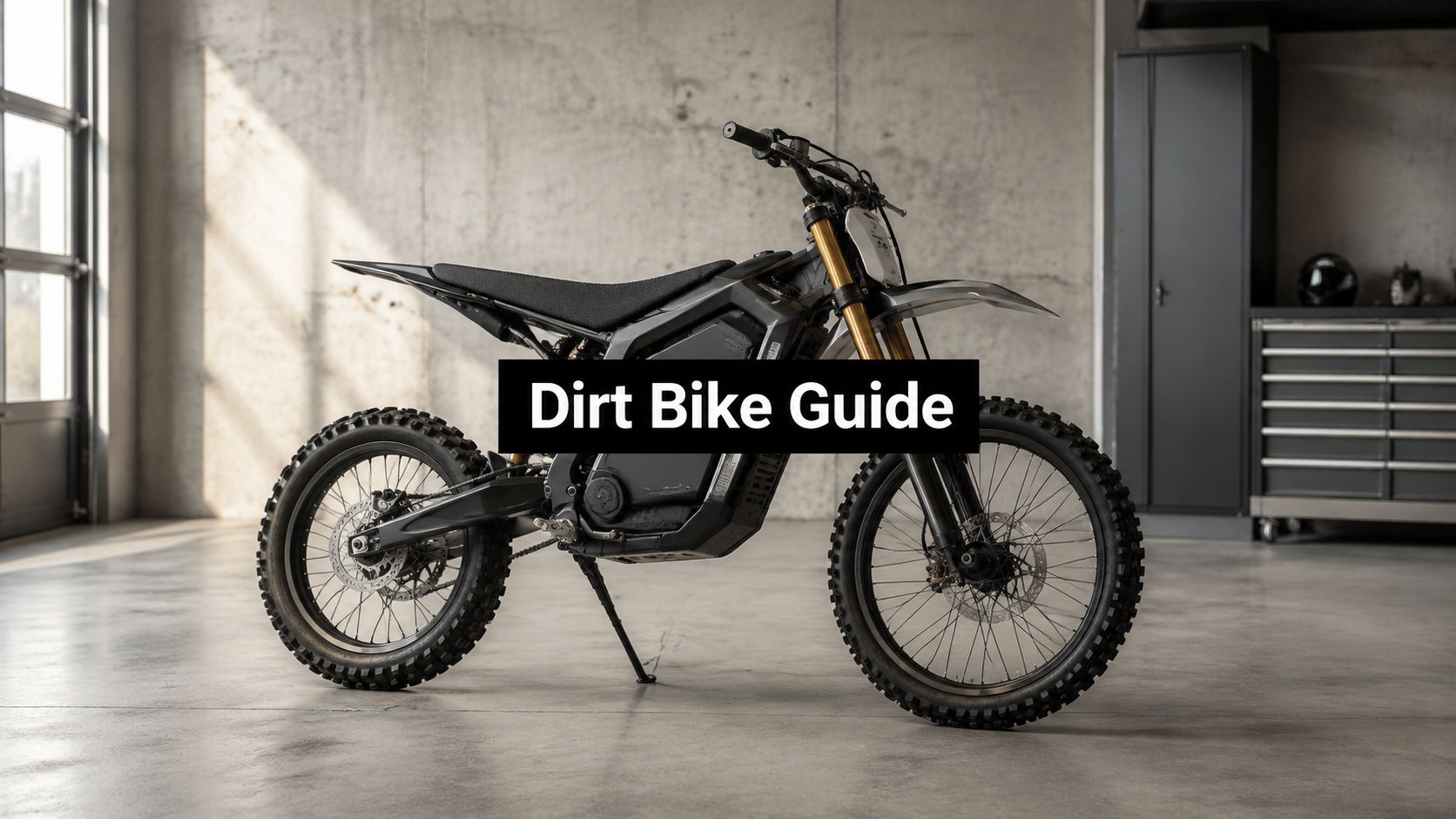
You've probably seen it already. A chunky e-bike with a long seat, fat tires, moto-style plastics, and a stance that makes it look ready for a dirt track. Then the confusion starts. Is it a bicycle, an electric dirt bike, or just a commuter wearing motocross clothes?
That question matters more in the US and Australia than many buyers realize. Local road rules, trail access, licensing, and riding conditions can turn a cool-looking purchase into the wrong machine for your daily life. A bike that looks tough on Instagram might feel awkward in traffic, be unwelcome on bike paths, or be much heavier and taller than you expected.
A lot of riders shop with their eyes first. That's normal. But if a bike looks like a dirt bike, you need to know whether that look is cosmetic, functional, or legally significant.
Why Every E-Bike Suddenly Looks Like a Dirt Bike
Walk through a beach town in California, a suburb in Queensland, or a city street in Florida, and you'll spot the same silhouette over and over. Big side panels. Tall front end. Long bench seat. Chunky tires. Even when the bike is meant for commuting, it's borrowing the visual language of off-road motorcycles.

There's a reason that shape hits so quickly. The classic dirt bike look came from the UK's off-road trials culture in the early 1900s, with trial events dating to 1909 and motocross-style racing spreading in the 1920s. After World War II, brands like Honda, Yamaha, and Suzuki pushed the category toward lighter, more reliable, more powerful bikes, and the sport surged again in the 1970s. That design language was built around lightweight frames, long-travel suspension, and knobby tyres for control on mud, sand, rocks, and other loose surfaces, as described in this history of dirt bike development.
Why the style spreads so easily
For buyers, the message is simple. That silhouette says rugged, capable, and fun. It says this bike can handle potholes, curbs, gravel shortcuts, and rough streets. Even if the machine underneath is closer to an urban e-bike than a motocross bike, the appearance still sells a feeling.
Practical rule: Dirt bike styling tells you what the brand wants you to feel. It does not tell you how the bike is built.
That's where people get tripped up. Two bikes can look nearly the same in photos and behave completely differently on the road. One may be easy to pedal, legal on many bike paths, and comfortable for a short commute. The other may act more like a small electric motorcycle.
The confusion buyers run into
Most shoppers aren't trying to split hairs. They're asking practical questions:
- Can I ride it to work? You want something that fits traffic, parking, and local rules.
- Can I take it on dirt? A few gravel paths and park connectors are very different from actual off-road riding.
- Will it feel manageable? Tall seats, extra mass, and throttle-heavy power delivery can surprise first-time riders.
If you're shopping in the US or Australia, those questions aren't optional. The same aggressive look can sit on top of three very different kinds of machines.
The Three Flavors of Dirt Bike Lookalikes
Most of these bikes fall into three broad groups. Once you see the pattern, listings get easier to decode and marketing photos lose some of their magic.

Stylized urban e-bikes
These are the bikes commonly sought when searching for a bike that looks like a dirt bike. They often have moto-style seats, wide handlebars, chunky tires, and a more aggressive profile than a standard commuter.
They're usually intended for city use, neighborhood riding, and light mixed surfaces. Some still have pedals you will use. Others have pedals that exist mostly to fit into an e-bike-shaped category.
Common signs include:
- Urban-first setup: Lighting, basic racks or mounting points, and a riding position that works for streets.
- Moderate hardware: Suspension and tires that smooth rough pavement but aren't built for repeated hard off-road hits.
- Style-led design: The visual package does a lot of the work.
These can be great if your real life is bike lanes, shortcuts through parks, and rough city pavement.
High-power e-bikes and pit-bike-style machines
This is the fuzzy middle. These bikes blur the line between bicycle and motorcycle. They often have stronger acceleration, throttle-focused riding, and a heavier feel than a regular e-bike.
Some buyers love them because they feel exciting right away. Others buy them expecting a bicycle and end up with something that behaves very differently in traffic, on bike paths, and during low-speed handling.
What stands out here isn't just speed. It's the whole experience. They tend to squat under power, carry their weight differently, and ask more from the rider when turning, braking, or lifting them around.
A lot of buyer regret starts here. The bike looked playful online, but in person it felt bigger, heavier, and more motorcycle-like than expected.
True electric dirt bikes
These are built for actual off-road use. Not “can handle a gravel alley.” Actual rough terrain, repeated impacts, and terrain features that would quickly expose a style-first bike.
They're usually the least practical option for casual city use unless you already know you want that type of machine and understand the access limits that come with it.
A quick way to think about the three groups:
| Type | Main purpose | Best for |
|---|---|---|
| Stylized urban e-bike | City riding with moto-inspired looks | Commuters and casual riders |
| High-power pit-bike style | Mixed use with motorcycle feel | Riders who want throttle-heavy performance |
| True electric dirt bike | Off-road riding first | Dedicated trail or private-land use |
A better question than “What does it look like?”
Ask this instead: What was it built to do every day?
If the answer is commuting, the dirt bike look may just be styling. If the answer is throttle power and rough-terrain confidence, the machine may already be stepping out of bicycle territory.
Style vs Substance A Technical Breakdown
You're in a showroom in Phoenix or Brisbane, looking at two bikes with the same mini-moto attitude. Both have chunky tires, a long seat, and side panels that hint at motocross. Then you roll them a few feet, turn the bars at walking speed, and the difference shows up fast. One feels like a bicycle in a costume. The other feels built around rough ground from the first push.
That gap starts with the chassis, not the styling.
A spec sheet helps, but only if you know which numbers change real-world behavior. For riders in the US and Australia, the useful clues are geometry, suspension travel, wheel size, ground clearance, and the way the motor delivers power. Those are the parts that decide whether a bike feels calm on a bike path, awkward in a car park, or settled on loose dirt.
One clear benchmark comes from a test bike in this electric dirt bike geometry review. It uses a 21-inch front wheel, an 18-inch rear wheel, long-travel suspension, and very high ground clearance. Hardware like that helps a bike roll over holes, rocks, and trail chop with less drama. The tradeoff is easy to feel too. The bike sits taller, asks more from shorter riders, and can feel less friendly during stop-start riding.
What actually changes the ride
A dirt-bike-looking urban e-bike usually borrows the visual language of off-road machines, but keeps bicycle-friendly proportions underneath. That often means shorter suspension, smaller overall dimensions, and a lower stance that makes traffic lights, curb cuts, and tight turns less stressful.
A true off-road machine is shaped by different priorities. It needs room for suspension to move, enough clearance to avoid smashing the underside, and wheel sizes that stay composed over uneven ground. That is why two bikes can look similar in photos and feel completely different once the pavement ends.
Here's the practical comparison:
| Feature | Stylized Urban E-Bike | True Electric Dirt Bike |
|---|---|---|
| Frame purpose | Street use, commuting, light mixed surfaces | Off-road control, impact resistance, rough terrain |
| Suspension | Tuned more for comfort and potholes | Long travel for repeated hits and bigger terrain changes |
| Wheels | Bicycle-style sizes are common | Moto-style sizing is common, often with a larger front wheel |
| Ground clearance | Lower for easier mounting and town use | Higher to clear ruts, rocks, and trail obstacles |
| Low-speed feel | Easier in traffic and parking areas | Taller and more demanding at walking pace |
| Best terrain | Pavement, shared paths, hard-packed gravel | Loose dirt, uneven trails, deeper ruts |
Why geometry matters more than body panels
The bodywork is the jacket. Geometry is the skeleton.
Wide bars, a number plate, and moto plastics can make a bike look ready for a fire road in Utah or a sandy track outside Perth. They do not change how the front wheel tracks through loose corners or how stable the bike feels when the surface gets rough. Those traits come from the frame layout and suspension setup.
If geometry terms feel abstract, use this simpler filter:
- Front-end stability comes from the steering layout and wheel setup.
- Bump control comes from suspension quality and available travel.
- Rider confidence comes from the full package working together, including seat height, weight distribution, and wheelbase.
That last point trips up a lot of new buyers. A bike can look aggressive online and still feel awkward for everyday riding because the proportions do not match your roads, trails, height, or experience level.
For anyone comparing options, a plain-language guide to whether electric bikes are street legal in different situations also helps frame the decision. In the US and Australia, legal use and intended use often overlap. A bike designed more like a small motorcycle usually brings different access limits than one designed around bicycle rules.
A simple showroom check
Start with three questions.
Can you get one foot down comfortably at a stop? Does the front end feel easy to steer at walking speed? Can you picture lifting, turning, and parking it where you ride?
Those answers matter more than the fake gas tank shape or the motocross-style decals.
If a bike already feels bulky in a shop or driveway, it will usually feel even bigger in traffic, on a narrow path, or on a loose climb.
For US and Australian riders, that everyday feel is easy to underestimate. Many buyers want the dirt bike look, but their real routine is suburban streets, beach paths, rail trails, bike lanes, and short commutes. A style-first bike can suit that well. A true dirt-focused machine can be excellent too, but only if the geometry, size, and use case match the places you will ride.
Road Rules and Trail Access in the US and Australia
The biggest dividing line isn't the headlight, the seat, or the tires. It's the powertrain.
A Class 1 e-MTB is typically limited to 250 W nominal power, uses pedal-assist only, and cuts assistance at 20 mph, according to this comparison of Class 1 e-bikes and electric dirt-bike-style machines. By contrast, a throttle-controlled, higher-power dirt-bike-style machine is often treated as a motor vehicle or off-highway vehicle, which changes where you can ride it.
What that means in the US
In many parts of the US, e-bike access depends on class. A bike that stays within bicycle-style definitions may be allowed on some bike paths and certain MTB trails. A more motorcycle-like machine often won't be.
That's where buyers get caught. They see pedals and assume “bike.” Local enforcement may see throttle-heavy power, motorcycle-style performance, or an out-of-class setup and treat it differently.
A practical habit is to check both the product description and your local rules before you buy. Punk Ride has a plain-language overview of whether electric bikes are street legal, which is useful as a starting point before you look at state or city-specific regulations.
What Australian riders should watch for
Australia adds another layer because rules often sit at the state or territory level, and enforcement can vary depending on whether you're on roads, shared paths, or off-road land. The main point still holds. A bike with dirt-bike styling can be legally treated very differently depending on whether it fits an e-bike category or behaves more like a motor vehicle.
For Australian buyers, the risk isn't just getting the wrong machine for a bike path. It's buying something that doesn't match your intended use at all. If your goal is a legal commuter for urban streets and shared infrastructure, the dirt-bike look needs to be separated from dirt-bike-level performance.
Trail access is where the mistake gets expensive
A lot of riders assume off-road appearance equals trail permission. Often it means the opposite.
Here's the simple version:
- Pedal-assist bicycle class: More likely to fit bike access rules where those classes are allowed.
- Throttle and motorcycle-level power: More likely to fall outside bicycle access.
- Off-road machine: Usually belongs on approved OHV areas, private land, or places that specifically allow that vehicle type.
Don't buy for the photo shoot. Buy for the places you can legally and realistically ride every week.
If your real routine is commuting, school runs, beach-town errands, or bike-path connectors, legal fit matters just as much as battery range or appearance.
How to Choose The Right Ride For You
You spot a bike online with a long seat, chunky tires, and a mini-moto stance. It looks ready for desert tracks or bush trails. Then real life shows up. Your week is bike lanes, broken city streets, a gravel shortcut to work, and maybe a park path on Saturday. That gap between the photo and your routine is where expensive mistakes happen.

Start with your actual week, not the bike's personality. A good choice should fit where you ride, how far you go, how often you pedal, and how easy the bike is to live with when you are not riding it. Parking, carrying it up a step, turning around on a footpath, and locking it outside a shop all matter more than a tough-looking profile.
If your rides are mostly city miles
Choose the bike that feels calm in traffic and easy at low speed. For many US and Australian riders, that means a road-legal e-bike with dirt-bike styling cues, not a machine shaped around off-road posture.
City riding rewards practical traits. A sensible saddle height helps at stoplights. Predictable steering helps in tight bike-lane bends and car parks. Mounting points, lights, mudguards, and a frame that does not feel awkward at walking pace usually beat a dramatic silhouette.
If you want weekend gravel and mixed surfaces
You need more tolerance for rough ground, not a full costume change into motocross form. Gravel roads, rail trails, canal paths, and dry fire roads ask for comfort, traction, and control. They do not automatically require oversized bodywork or a stretched-out moto layout.
A good mixed-surface bike works like a hiking shoe with extra grip. It should handle dirt and loose patches without becoming clumsy on asphalt. For riders in places like Colorado, California, regional New South Wales, or coastal Queensland, that middle category is often the sweet spot.
If you actually want real off-road capability
Look past the plastics and the headlight shape. Focus on the frame design, suspension quality, wheel setup, braking power, and whether the riding position stays stable on repeated bumps, climbs, and loose descents. Styling can suggest toughness. Geometry and components decide whether the bike can keep its line when the ground gets ugly.
One quick test helps. Ask yourself where this bike will spend most of its time. If the honest answer is streets, shared paths, and errands, buy for that job. If the answer is private land, approved OHV areas, or property access roads, then a heavier off-road-focused machine may make sense.
Use this quick filter:
- Choose urban dirt-bike styling if your routine is commuting, short trips, beach-town errands, and rough pavement.
- Choose a mixed-use e-bike if you ride pavement most days but want gravel roads, park connectors, or unsealed shortcuts on weekends.
- Choose a true off-road machine if you already have regular access to places that suit it and you are willing to accept the extra weight, size, and limitations in daily use.
A smart buy should feel right on Tuesday, not just look right on Instagram.
If you want a broader framework, Punk Ride's guide on how to choose an ebike is useful because it organizes the decision around riding habits and fit. Once you narrow your choice, a basic service plan matters too. This DIY bike maintenance guide is a helpful starting point for keeping any new ride reliable.
Riding and Maintenance Tips for Your New Bike
The first surprise for many new owners is handling. A heavier moto-style bike asks for different inputs than a regular bicycle, especially in turns, during braking, and when maneuvering at walking pace.

Riders transitioning from lighter bikes often do better when they let the bike lean into the turn while keeping their body a bit more upright, rather than trying to move as one rigid unit. That basic idea comes from this explanation of lean angles on bicycles and motorcycles, and it's especially useful on heavier, dirt-bike-style rides.
Riding technique that helps right away
Start in an empty car park or other low-stress area. Practice smooth starts, gentle braking, and wide turns before mixing with traffic.
Focus on these habits:
- Look through the turn: Don't stare at the front wheel or the curb.
- Brake earlier: Heavier bikes take more planning, even when the brakes are strong.
- Relax your upper body: Death-gripping the bars makes low-speed wobble worse.
- Respect the weight: Pushing the bike around by hand is part of ownership. Learn how it feels off the saddle too.
A short video can help if you're moving over from a standard bicycle and want to see body position in action.
What to check every week
Moto-style e-bikes often encourage people to ride harder, over rougher surfaces, and with less sympathy for components. That means basic checks matter.
A solid routine includes:
- Tires: Check pressure and inspect for cuts or embedded debris.
- Suspension parts: Look for leaks, unusual noises, or hardware that has worked loose.
- Brakes: Confirm pad life and rotor condition if the bike feels heavier under stopping.
- Fasteners: Bars, stems, axles, and foot or peg hardware need regular attention.
- Battery care: Charge and store it according to the maker's guidance, especially in very hot conditions common in parts of Australia and the southern US.
If you want a simple checklist for the non-electric basics, this DIY bike maintenance guide is a handy companion. For electric-specific issues, including motor and battery troubleshooting, Punk Ride also has a useful page on electric bike repair.
Small maintenance problems feel bigger on a heavy bike. A loose fastener or neglected brake pad shows up fast when the machine carries more weight and momentum.
The Final Word on Dirt Bike Style
The dirt bike look is now everywhere, but it doesn't mean one thing. Some bikes are urban commuters with aggressive styling. Some sit in the gray area between e-bike and mini moto. Others are true off-road machines.
The smart buy comes from matching the machine to your real use. For US and Australian riders, that means looking past fairings and chunky tires and paying attention to how the bike handles, where it's legal, and whether its geometry suits the riding you'll do.
Style is fun. No problem there.
But the better bike is the one that feels right in your hands, fits your local rules, and works on the roads and paths you ride every week.
If you're comparing dirt-bike-style e-bikes and want a store that focuses on modern urban mobility, Punk Ride LLC is worth a look for browsing current electric ride options and buyer guides before you decide.
Share:
Best Electric Scooter Covers: Guide for UK & EU Riders
Sustainable Urban Mobility: Your Guide to Greener Cities