Most UK and EU road-legal electric scooters are capped at 20–25 km/h (12–15.5 mph), while ordinary city trips often run nearer 13–17 km/h. That's the short version, and it's also why the biggest number on a listing rarely tells you how fast you'll get to work.
You'll see scooters advertised well above that band. Some are built for private land, some are imported listings written for other markets, and some quote a best-case ceiling you'll never hold between two sets of lights. If you're asking how fast do electric scooters go, the useful answer splits into what the motor can do, what the law allows where you live, and what your route lets you do on a wet Tuesday morning. Keep those three apart and the spec sheets suddenly make sense.
Typical Speeds by Electric Scooter Class
Start with the number you can use today. For a UK or EU commuter on public roads, 20 to 25 km/h is the band that matters. Everything above it is either private-land territory, a different vehicle class, or a brochure figure that won't survive contact with traffic.
How Fast Each Scooter Class Goes
| Scooter class | Typical advertised top speed | Usual town pace | Public-road lawful in UK and EU |
|---|---|---|---|
| Kids and teen scooters | 10–16 km/h (6–10 mph) | 8–13 km/h | No, supervised or private use |
| Entry folding commuters | 20–25 km/h (12–15.5 mph) | 13–20 km/h | Often, if limited to 20 or 25 km/h |
| England rental trial scooters | Capped at 25 km/h (15.5 mph) | About 15–20 km/h | Yes, inside approved trial areas only |
| Mid-range private scooters | 30–40 km/h (19–25 mph) | 20–30 km/h where allowed | Usually no |
| Performance scooters | 45–70 km/h (28–43 mph) | Only near the cap off public roads | No |
| Off-road and fat-tyre scooters | 25–50 km/h (15–31 mph) | Much lower on rough ground | No |
Read the table from the bottom up and the pattern is obvious. As advertised speed climbs, lawful public-road use disappears. A performance machine isn't a faster commuter. It's a different purchase for a different place.
Why the Advertised Figure Runs High
A brochure speed is a best-case ceiling. Manufacturers test on level ground, usually with a light rider, a full battery, and no reason to brake. Your commute has junctions, crossings, buses pulling out, and a headwind you didn't order.
Units trip people up too. EU sheets usually print km/h and US-spec sheets print mph, so a scooter listed at 25 can mean two very different things depending on where the listing was written. Always check the unit before you compare two models side by side. A 25 mph import is not the same thing as a 25 km/h road-legal commuter, and confusing the two is how people end up with a scooter they can't use where they planned to ride it.
Kids and teen models sit at the slow end for good reason. Their pace should match a child's reaction time and braking ability, not an adult commute. Entry folding commuters are the sweet spot for most city trips because they're built around the legal caps rather than around a headline number.
Don't shop on one figure. Before you compare prices, you need three different speed numbers for any scooter you're considering, because only one of them is printed in large type on the product page.
The Three Speeds That Actually Matter
A scooter has three useful speed figures: what its motor can reach, what local rules allow, and what you can realistically maintain on a trip. The gap between them matters more than the biggest number on a product page. A car that can do twice the limit does not get you across town twice as fast, and neither does a scooter.
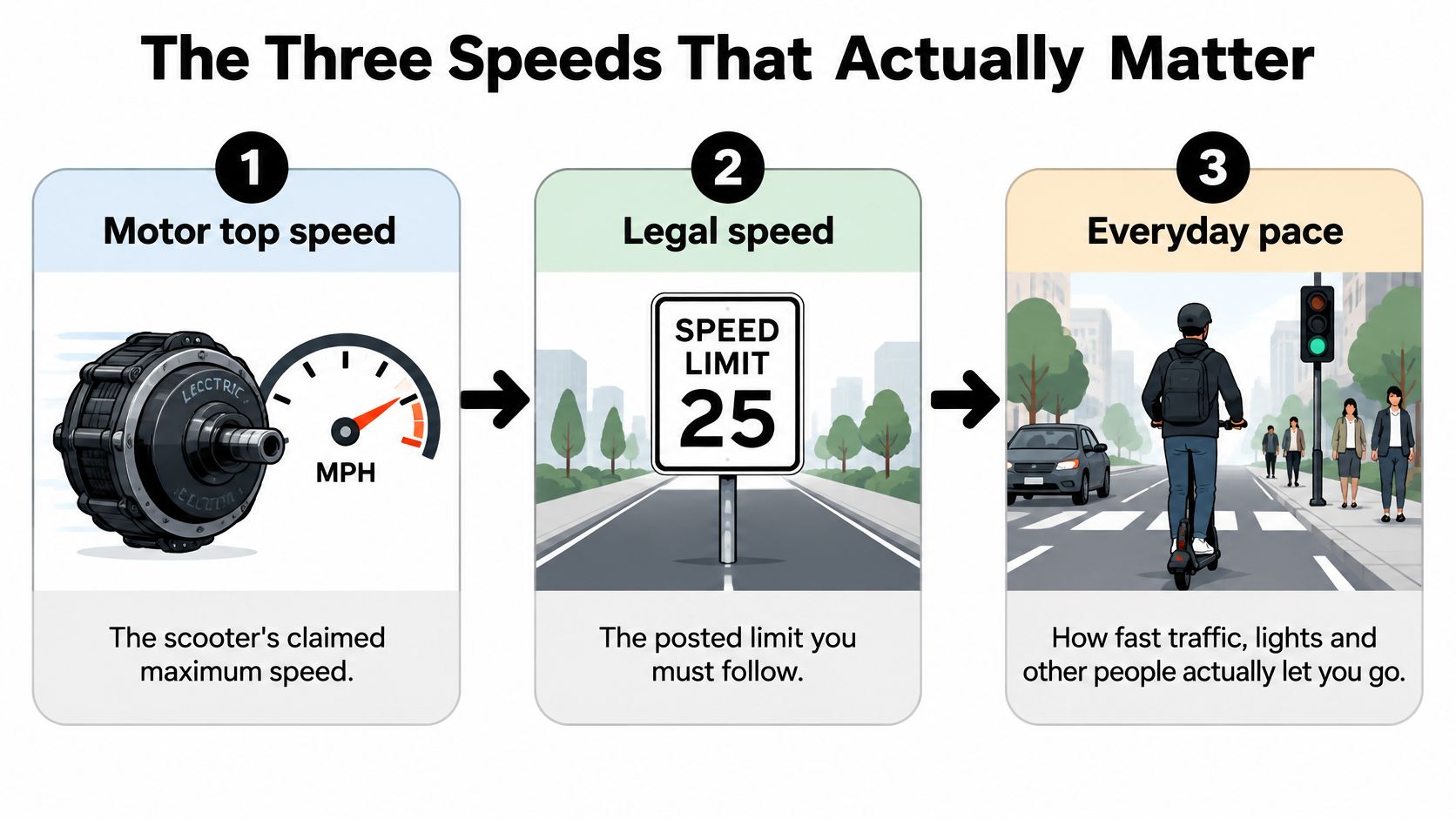
Top Speed Is Only Capability
A scooter may be mechanically capable of about 20–30 mph, but that does not mean you can legally ride it at that speed. The New York DMV guidance on electric scooters shows the distinction: New York defines electric scooters as devices capable of no more than 20 mph, while riders are prohibited from travelling above 15 mph. The motor's ceiling and the permitted riding speed are separate figures.
The same distinction applies across Europe, where national rules set different caps for road-legal scooters. A model suited to one country's limit may exceed the permitted speed in another, even though its hardware has not changed. Check the rules for the place you plan to ride rather than assuming one speed limit applies across borders.
The Three Figures to Write Down
Before buying, note three figures for each scooter on your shortlist:
- Manufacturer-rated maximum: The top speed stated on the spec sheet. It describes the scooter's capability, not necessarily a speed you can use on public roads.
- Jurisdictional legal limit: The maximum allowed where you ride. This takes precedence over the manufacturer's figure.
- Realistic commuting speed: The pace you can maintain in everyday conditions, accounting for factors such as rider weight, hills, wind, tyre pressure, temperature, and battery charge.
Units can trip you up, too. US listings often use mph, while European listings commonly use km/h. A US listing quoting an unrestricted figure and a German listing showing a limited figure may therefore describe different things. Check both the unit and whether the listed speed is a capability or a legal limit before comparing models.
The Speed You Can Actually Use
Suppose your route has a speed cap, shared paths, or frequent junctions. A higher motor ceiling may make little difference to journey time when you cannot legally or practically ride at that speed. It can also bring compliance and insurance concerns if the scooter does not fit the category recognised by local rules.
Caps may depend on where you ride as well as the country. A scooter allowed on one route may face a lower permitted speed in a park or on a shared path. The same principle applies wherever pedestrians and scooters use the same space: the device's maximum does not set your lawful pace.
The fastest lawful trip is the lowest of the three speeds.
That is the figure to use when comparing scooters for a commute. If your legal limit and everyday pace are both modest, paying more for a higher top-speed ceiling buys capability, not necessarily minutes off the journey.
What Rider Weight Hills and Wind Do
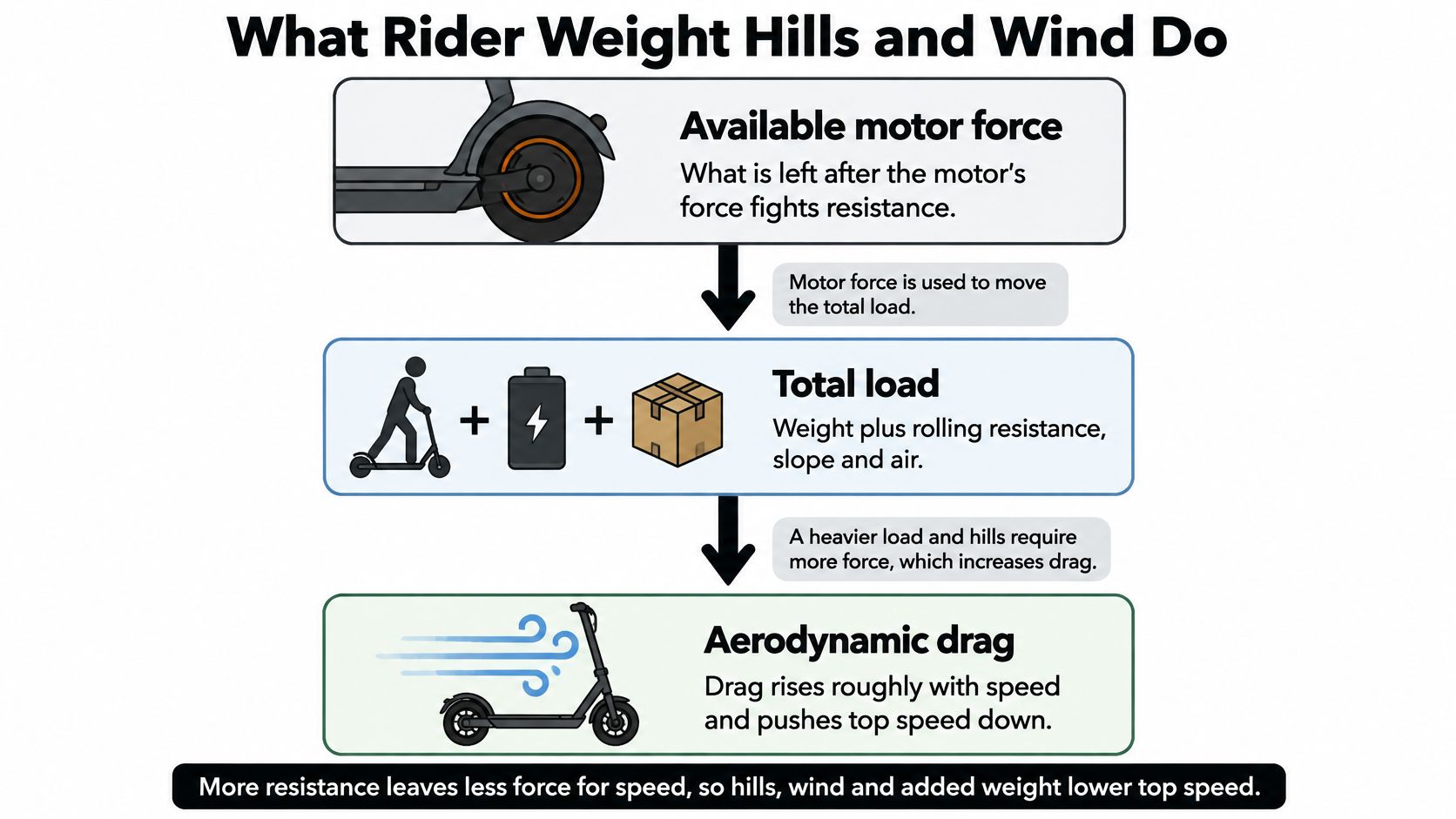
A scooter's top speed is the result of the motor pushing against the load, the road and the air. Rider and scooter weight, rolling resistance and slope all matter, but air resistance grows roughly with the square of speed. Double your pace and the aerodynamic pushback is about four times greater.
That is why a headwind can feel minor at 15 km/h yet bite hard as you approach a claimed 25 or 40 km/h. The last few km/h are the hardest to gain: the motor is working against more drag, and wind makes that job tougher. Removing scooter mass usually gives a smaller speed gain than riders expect, because air resistance dominates at speed.
What Independent Testing Found
The Transport Research Laboratory evaluation of e-scooters used in UK trials measured maximum speeds from 14.0 to 27.5 km/h. Nearly all tested devices clustered around the 25 km/h trial limit. Testing used an 84 kg rider, with an additional 20 kg load in some runs. These results show how measured top speed can vary between scooters and test conditions, even when many models sit near the same limit.
The Factors in the Order You Feel Them
- Motor power: Commuters often use 250 to 500 W, while performance machines can be much more powerful. On a firmware-limited scooter, extra watts can improve acceleration and hill climbing without raising its legal top speed. For a closer look at electric scooter dual motor setups, see how a second motor can help.
- Battery charge: Voltage can sag under load and as the battery drains, softening the scooter's pull before it is empty. A scooter may feel livelier at full charge than on the ride home.
- Rider weight and luggage: Extra load gives the motor more mass to accelerate from each stop and carry uphill. You may feel this most when pulling away or climbing.
- Hills, tyres and weather: Gradients, under-inflated tyres, cold conditions and strong headwinds can each reduce speed. Their effects can stack.
Fair comparison rule: Compare scooters with the same rider mass, battery state, tyre pressure, slope and wind. Prefer a published test with a realistic payload over an unloaded marketing run.
Treat the brochure top speed as a ceiling reached under favourable conditions, not a promise of everyday pace. Your actual speed will also depend on your route and load, while the legal limit determines how fast you may ride.
Legal Speed Caps Across the UK and EU
These are the caps to match a scooter against before you look at anything else. Find your row first, then shop.
Public-Road Speed Caps in the UK and EU
| Place | Speed cap | What the cap applies to |
|---|---|---|
| England rental trials | 15.5 mph (25 km/h) | Approved rental scooters in trial areas until May 2028; local areas may go lower |
| Germany | 20 km/h | Road-legal e-scooters |
| Ireland | 20 km/h | Both design speed and the ordinary public-road limit |
| Spain | 25 km/h | Road-legal e-scooters |
| Belgium | 25 km/h | Road-legal e-scooters |
| Austria | 25 km/h and 600 W | Bicycle-accessible areas; above this can be a moped |
| Pedestrian geofenced zones | As low as 8 km/h | Shared schemes that slow scooters in busy walking areas |
In England's government-backed rental trials, the GOV.UK guidance for e-scooter trial users puts the maximum permitted speed at 15.5 mph (25 km/h), chosen because it matches the maximum assistance speed for electrically assisted pedal cycles. The trials began in July 2020 and are currently scheduled to run until May 2028. Individual trial areas can impose lower limits, so the sticker on the scooter isn't always the local cap.
That ceiling covers approved rental vehicles on roads other than motorways and in cycle lanes within official trial areas. Step outside a trial area and the same scooter at the same speed is no longer inside the framework that made it lawful. England's rule is rental-only, which catches out buyers who assume a trial top speed means private scooters are fine at that pace.
The Picture Across Europe
For road-legal electric scooters in major European markets, the City of Vienna guide to kick e-scooters sits within a practical maximum of generally 20–25 km/h (12–15.5 mph), while Austria permits scooters up to 25 km/h and 600 W in bicycle-accessible areas. Ireland's 2024 regulations set both the ordinary public-road limit and the scooter's maximum design speed at 20 km/h. The European Commission's policy overview also documents 20 km/h in Germany and several other jurisdictions, 25 km/h in Spain and Belgium, and geofenced reductions to as low as 8 km/h in pedestrian zones.
Cross a threshold in Austria and the device can be classified as a moped, which brings licensing and helmet requirements with it. That's the mechanical reality behind the table. The usable public-road speed is set by firmware limiting, homologation, lighting, braking, insurance, and which roads you're allowed on, not by how hard the motor can spin on a dyno.
So compare the advertised maximum with the row for your country, then check the scooter is approved for public roads. Our overview of electric scooter laws is a good place to confirm the details for your area before you spend anything. A higher spec isn't a shortcut around any of this.
City Speeds From Real Measurements
Real-world speeds put brochure figures in context. A scooter's top speed describes what it can reach under suitable conditions; everyday speed reflects crossings, traffic, and the route itself.
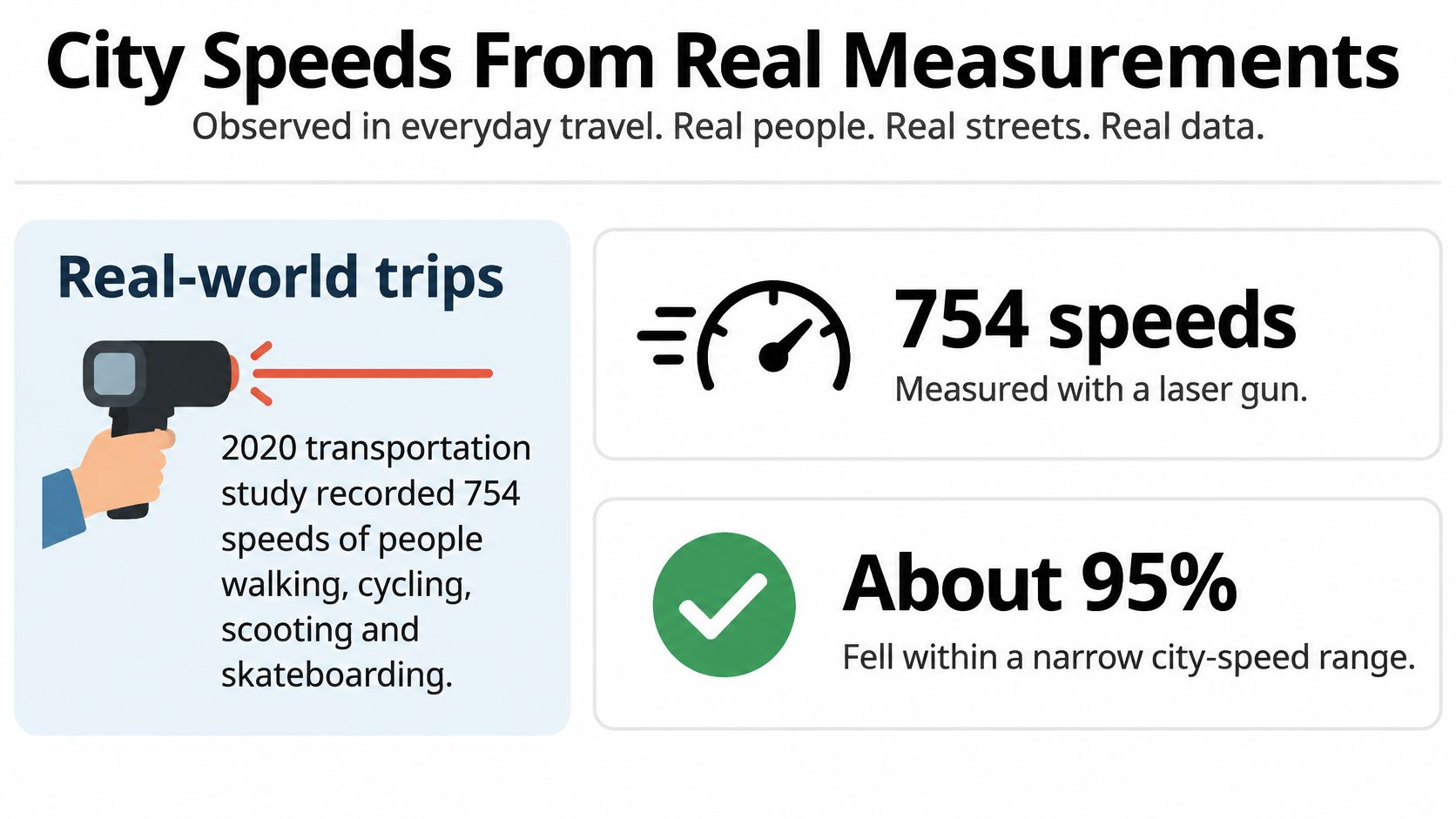
What a Laser Gun Saw
A 2020 transportation-engineering study recorded 754 speeds across pedestrians, bicycles, electric scooters, skateboards, and electric skateboards using a laser speed gun. Approximately 95% of recorded e-scooter speeds were below 15 mph, or about 24 km/h. The study also found no statistically significant difference between bicycle and e-scooter speeds.
That comparison helps explain why a scooter's advertised ceiling rarely predicts its pace in town. Scooters and bicycles share paths and traffic, where other road users and the layout shape how quickly they can travel. A capable motor cannot make a busy route clear.
A Commute at Real Pace
A scooter might be able to hold 25 km/h on an empty stretch. In town, a rider accelerates from lights, eases off near a crossing, slows behind pedestrians, and stops before setting off again. The moving average can settle well below the top speed, and the door-to-door average falls further once stops are included.
That is normal city riding, not a sign that the scooter is faulty. The same rider's average speed can differ on a road, a cycle path, and in a pedestrian zone, even without changing the scooter's settings.
Typical urban electric-scooter movement is often around 13–17 km/h, while speeds near or above 24 km/h are less common in ordinary traffic.
Use that typical pace to interpret listings. A scooter with twice another model's advertised top speed will not necessarily cut a shared city journey in half. Much of the route may be spent below either scooter's ceiling, with crossings and stops setting the pace. For UK and EU riders, the useful comparison is therefore among the scooter's top speed, the legal speed they can hold, and its everyday speed on their route.
Where a Faster Scooter Is Worth It
Start from the route, not the product page. The right scooter for a crowded high street and the right scooter for a private track aren't the same machine, and pretending otherwise is how people overspend or end up riding something they shouldn't.
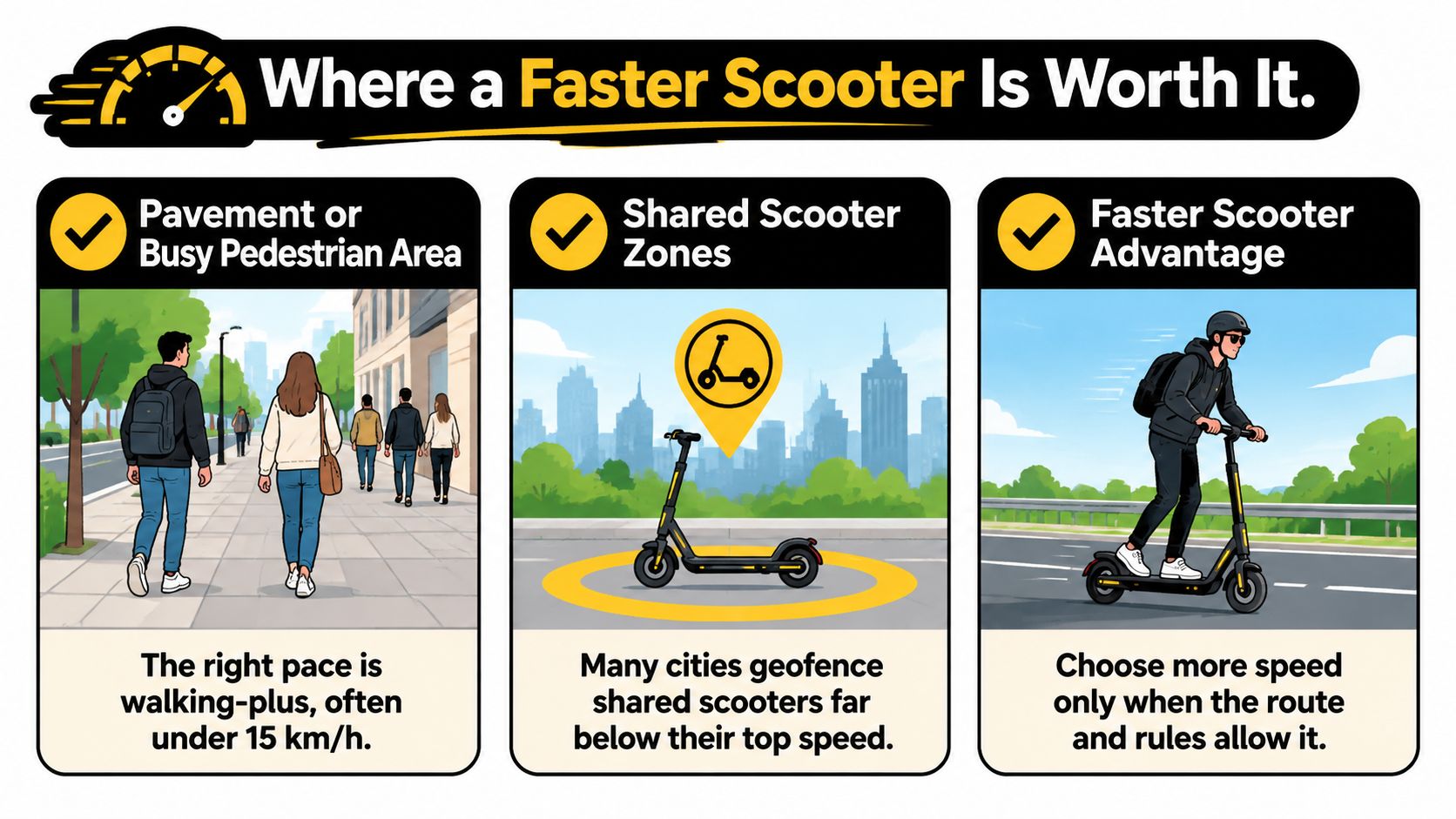
Match the Pace to the Place
On a pavement or in a busy pedestrian area, the right pace is walking-plus, often under 15 km/h. Many cities geofence shared scooters far below their motor limit in exactly these spots, because a scooter threading through shoppers at full tilt helps nobody.
A protected cycle lane or a quiet neighbourhood street in a UK trial area or an EU city that allows scooters is where 20 to 25 km/h becomes the useful ceiling. That pace sits comfortably alongside e-bike assistance and ordinary cycling, which is precisely why regulators settled there.
A higher-capability machine only earns its speed on private land, a closed course, or in a jurisdiction that permits that class of device. Even then, the surface, your braking distance, and your protective kit have to match the pace. Speed without stopping power is just a faster way to arrive at a problem.
The UK Trap Worth Understanding
Under the GOV.UK rental e-scooter trials publication, UK trial e-scooters are treated as motor vehicles rather than bicycles, despite their relatively low 15.5 mph maximum, so users need the appropriate driving licence and insurance and the vehicle must satisfy the technical definition, including a maximum speed not exceeding 15.5 mph. A privately owned scooter may be capable of the same speed but still be unlawful to use on public roads outside the approved rental-trial framework.
Read that twice if you're shopping in the UK. Matching a commuter listing to a British high street isn't a wattage question. Two scooters with identical top speeds can have completely different legal status.
Run through this before you buy:
- Name your roads: Write down the actual streets, lanes, and paths you'll use each week.
- Look up that cap: Find the limit for those specific places in the country table.
- Ignore speed above it: For journey planning, any advertised figure past your cap doesn't exist.
- Keep fast machines private: If you want the higher pace, plan to use it on private land.
Choose the Scooter for Your Legal Speed
If your trip is a UK or EU public-road commute, shop for a scooter whose firmware top speed sits on the 20 or 25 km/h cap for your country. Then judge it on brakes, lights, fold, and range. Those are the things you'll notice every single day, long after you've forgotten the headline number.
Extra speed only belongs on the shortlist when the riding will happen on private land. That's the whole decision, and it's a simpler one than most listings want you to think.
We group our e-scooters into Commuter Scooters, Folding Scooters, Fat Tyre Scooters, Off-Road Scooters and Performance Scooters, which maps cleanly onto that split. Commuter and folding models suit the capped city trip, while fat tyre, off-road, and performance models only make sense where the faster pace is allowed. For lighter city machines, the AOVOPRO ES80 at £149.00 and the AOVOPRO ESMAX at £219.00 give you two in-stock price anchors to start from.
One caution applies to range just as it does to speed. Advertised range figures for AOVO electric scooters are manufacturer estimates, and actual range varies with rider weight, terrain, temperature, and riding settings. The same forces that cut your top speed will shorten your range, so treat both numbers as best cases.
Do one last check before you buy. Write down the legal cap for your city, ignore any listed speed above it for commute planning, and use our guide to compare electric scooter models to pick the category that matches the roads you can lawfully use. Buy for the speed you're allowed to hold, and you'll end up with the right scooter.
If you're ready to match a scooter to the cap where you ride, browse the commuter, folding, fat tyre, off-road, and performance ranges at Punk Ride LLC and filter by the trip you've got in mind rather than the biggest number on the page. Pick the model built around your legal speed, and you'll get the brakes, lights, and range that make that pace comfortable every day.