


Virginia's statewide scooter speed ceiling is 20 mph, even when the scooter can go faster. Whether your device qualifies for the scooter category also depends on tests including a weight under 100 pounds and no manufacturer-issued VIN.
But does riding slowly make a powerful scooter legally equivalent to an ordinary commuter scooter? Not necessarily. The scooter's specifications matter before your riding habits do, and that's the gap that catches buyers who check the speed limit but never check the vehicle definition.
Scooter laws in Virginia also involve separate questions about the rider, equipment, road position and local restrictions. A scooter that fits the state definition still isn't automatically welcome on every sidewalk.
Virginia Scooter Rules at a Glance
Virginia caps a qualifying motorized skateboard or scooter at 20 miles per hour, including operation of a scooter capable of going faster, under the Code of Virginia's scooter operating-speed provision.
Use this table as a practical lookup, not as proof that your particular device qualifies. The classification tests come first, and the local-control row deserves attention even if you've ridden the same scooter elsewhere without trouble.
| Rule | Virginia value | Explained in |
|---|---|---|
| Top speed | 20 mph at all times and in all places | Speed Limit and Lane Position Rules |
| Weight | Under 100 lb | Does Your Scooter Count as a Motorized Scooter |
| Manufacturer VIN | None on a qualifying scooter | Does Your Scooter Count as a Motorized Scooter |
| Minimum age | Riders under 14 need direct supervision by an adult aged 18 or older | Age Limits, Supervision and Helmets |
| Lane position | As close as safely practicable to the right curb when slower than traffic | Speed Limit and Lane Position Rules |
| Riding side by side | No more than two abreast | Speed Limit and Lane Position Rules |
| Night lights | White front light visible from 500 ft and red rear reflector visible from 600 ft | Night Lights and Equipment Requirements |
| Sidewalks and crosswalks | Local ordinances and posted signs decide whether use is restricted | Where Scooters Can and Cannot Go |
| Interstate Highway System | Prohibited, subject to statutory exceptions | Where Scooters Can and Cannot Go |
| Local control | Counties, cities and towns can restrict scooters | Local Rules, Pilot Programs and the 2026 Work Group |
Read the table in the right order
Start with the machine, then the rider, then the route. A seller's description such as commuter, off-road or performance doesn't settle a legal classification, and an app's slow mode doesn't necessarily establish the device's motor-only capability.
The table also separates statewide obligations from location-specific restrictions. Meeting the equipment requirements won't cancel a sidewalk prohibition, just as permission to use a path won't cancel the duty to yield to pedestrians.
Practical rule: Check the specification sheet before planning the ride. Check the local route before leaving home.
Keep the manufacturer's specifications available while working through the classification checklist. If a required detail is missing, resolve it before treating the scooter as an ordinary street-ready device.
Does Your Scooter Count as a Motorized Scooter
The Code of Virginia's vehicle-definition provision defines a qualifying motorized skateboard or scooter as a vehicle designed for someone to sit or stand, powered wholly or partly by an electric motor, weighing less than 100 pounds, lacking a manufacturer-issued VIN, and capable of no more than 20 miles per hour on a paved, level surface using only its electric motor.
That's a specification test, not just a description of how you intend to ride. Work through every element rather than stopping when the product looks like a scooter.
Check the machine itself
- Rider design: Confirm it's designed to carry someone seated or standing.
- Electric power: Check the actual propulsion system. Don't assume a gas-powered device belongs in this electric-scooter category.
- Vehicle weight: Use the manufacturer's vehicle-weight specification, not the maximum rider load. If the specification is unclear, weigh the complete device.
- VIN status: Inspect the frame and purchase paperwork. A product serial number isn't automatically a manufacturer-issued vehicle identification number.
- Motor-only capability: Check the documented top speed on paved, level ground. A downhill result or an unloaded wheel spinning in the air doesn't answer that question.
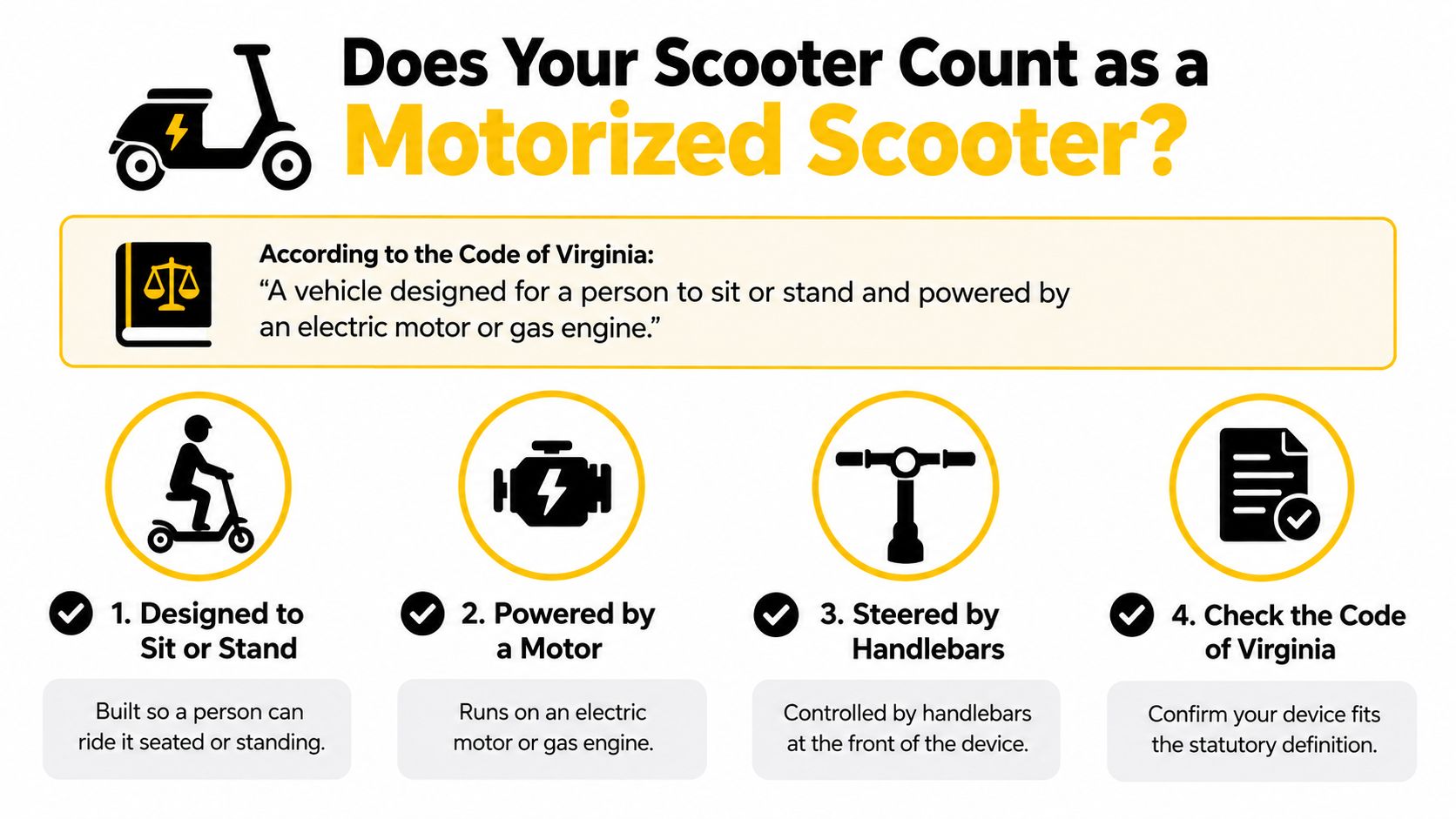
Treat the statutory checklist as controlling if a simplified graphic or sales description leaves out weight, VIN status or speed capability. Handlebars become important for the lighting provision, but they aren't a substitute for these classification checks.
Slow riding doesn't resolve excess capability
A device whose motor-only capability exceeds the definition's ceiling doesn't satisfy that element just because its rider chooses a gentle throttle setting. A selectable riding mode and a documented permanent configuration aren't interchangeable evidence.
That distinction matters when comparing high-powered electric scooters. Extra performance may suit private-property use, but it can complicate the legal category for public riding.
Don't assume a failed classification test automatically makes the device a registrable moped or motorcycle, either. Another vehicle category needs its own assessment. The definition alone isn't enough to promise registration eligibility or establish every title and registration exemption.
Keep the specification sheet, configuration details and purchase paperwork together. If the device's legal category remains unclear, resolve that issue before spending money on road-use accessories.
Age Limits, Supervision and Helmets
A rider younger than 14 may operate a qualifying scooter only under the immediate supervision of someone at least 18 years old, according to the Code of Virginia's general vehicle provisions.
For a parent, the sensible approach is active supervision nearby, with an unobstructed view and the ability to respond promptly. Watching from a window isn't a sound substitute for that approach. This is practical guidance, not an attempt to replace the statute's wording with an invented distance rule.
| Age band | Scooter rule |
|---|---|
| Under 14 | Allowed only with direct supervision by an adult aged 18 or older |
| 14 to 17 | The younger-rider supervision restriction no longer applies; check helmet rules separately |
| 18 and older | No age-based supervision requirement under this scooter provision |
Keep the helmet question separate
Don't translate an age-based supervision rule into a helmet rule. They address different obligations, and a blanket claim that every minor scooter rider faces the same statewide helmet requirement needs a provision that specifically names the device.
The statutory material supporting this guide doesn't establish that blanket helmet claim. Check the applicable helmet provision and local ordinance for your device, and wear a properly fitted helmet regardless of whether a legal mandate applies.
For example, a younger child riding alone fails the supervision requirement even if they're wearing a helmet. An older teenager may clear that supervision threshold but still needs the helmet question resolved separately.
- Confirm age: Use the rider's actual age, not the product's recommended age.
- Confirm supervision: Identify the adult who will actively supervise when required.
- Confirm helmet coverage: Check the device category and locality, then adjust the helmet so it sits level and stays secure.
If you're also riding across state lines, BDISchool's guide to scooter licensing requirements in Florida is a useful separate reference. Don't carry another state's licensing or age assumptions into Virginia.
Where Scooters Can and Cannot Go
Virginia doesn't give scooter riders an unrestricted sidewalk entitlement. Under the Code of Virginia's bicycle and scooter operating provisions, riders on sidewalks, shared-use paths and crosswalks must yield to pedestrians and give an audible signal before overtaking and passing.
Official traffic-control devices can prohibit sidewalk or crosswalk use. Local ordinances can also restrict designated locations, including areas associated with schools, churches, recreational facilities and businesses open to the public.
| Area | Statewide rule | Check locally |
|---|---|---|
| Public roadway | Stay as close as safely practicable to the right edge when slower than traffic, subject to exceptions | Posted restrictions and lane rules |
| Sidewalk | No unrestricted entitlement; yield and signal before passing | Local ordinances and posted prohibitions |
| Crosswalk | Traffic-control devices can prohibit use | Local restrictions near schools, churches and recreational facilities |
| Shared-use path | Yield to pedestrians and signal before passing | Path signs and applicable local rules |
| Interstate Highway System | Prohibited, subject to statutory exceptions | Confirm any claimed exception in the Code before riding |
Plan the awkward connections
The tricky part of a commute often isn't the long straight stretch. It's the connection between the road, a path entrance and the last sidewalk outside your destination.
Say your route passes a school. Riding along the roadway may comply with the applicable rules, while moving onto a locally prohibited sidewalk outside the school may not. The scooter hasn't changed, but the legal setting has.
A guide to choosing an electric scooter for daily commuting can help with portability and route practicality. Legal route planning still requires checking each surface you'll use in practice.
A permitted road segment doesn't make the adjoining sidewalk permitted.
Give pedestrians enough warning to react without startling them. A bell or clear spoken warning should come before the pass, not while you're already alongside someone.
If a path is crowded, slowing down or walking the scooter is the practical choice. Don't use an Interstate shoulder as a shortcut, and don't assume a statutory exception applies merely because a navigation app suggests the route.
Speed Limit and Lane Position Rules
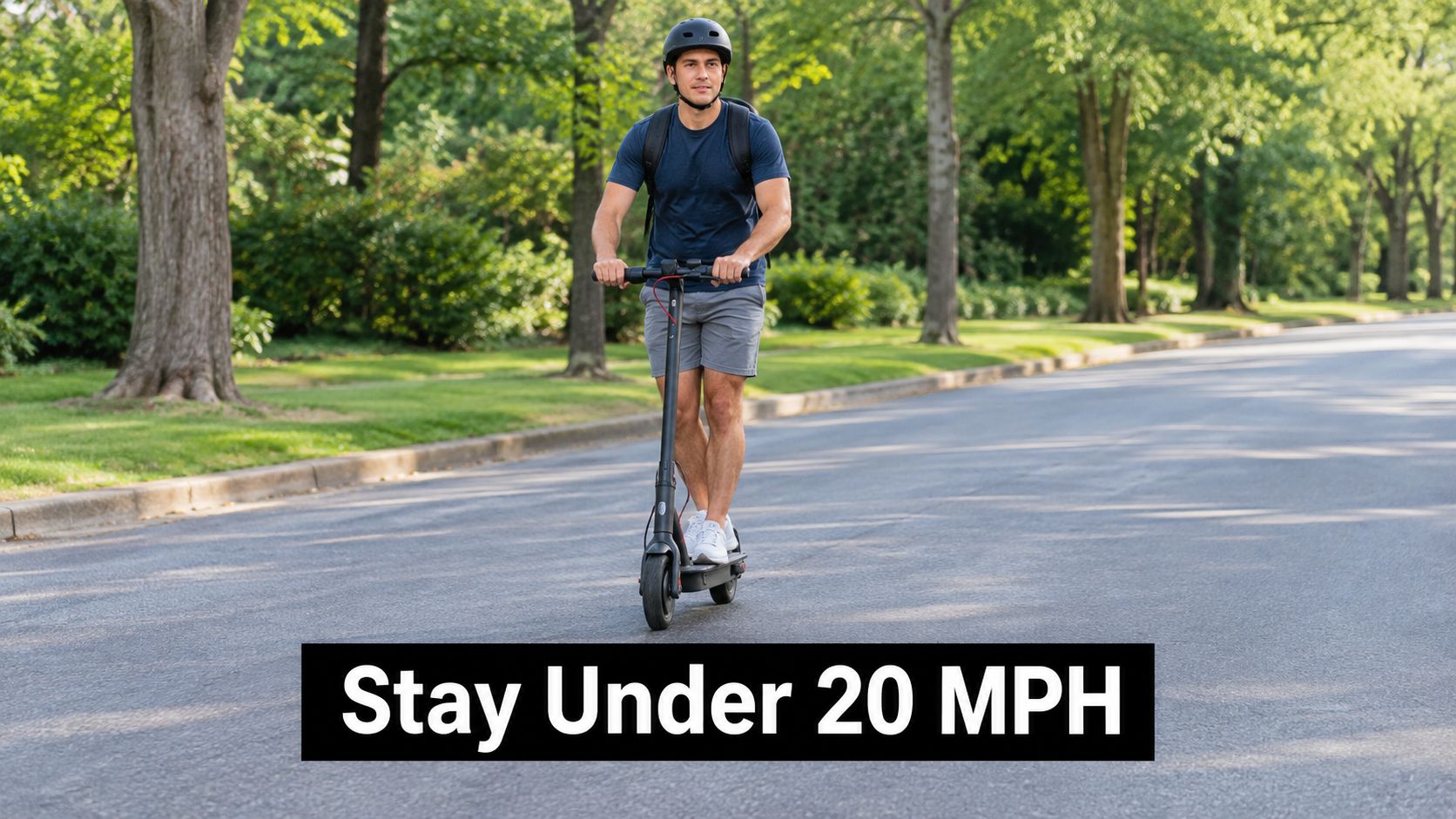
The statewide operating ceiling is 20 miles per hour, regardless of place or time, and exceeding it remains prohibited when the scooter itself is capable of more, under Virginia's scooter speed statute.
That's a ceiling, not a recommended cruising speed. Pedestrians, loose gravel, standing water and limited sightlines can all call for slower riding.
Stay right without riding into hazards
When you're slower than normal roadway traffic, the Code of Virginia's lane-position provision requires riding as close as safely practicable to the right curb or edge; it also limits riders to two abreast and requires moving into single file as quickly as practicable when necessary for faster traffic.
The word safely matters. The listed exceptions include:
- Passing: Move out when overtaking another vehicle.
- Turning left: Position appropriately while preparing for the turn.
- Avoiding hazards: Leave room for parked vehicles, pedestrians, animals and damaged surfaces.
- Narrow lanes: Don't squeeze against the curb where the lane is too narrow for safe side-by-side passing.
A gutter full of debris isn't a sensible riding line. Nor should you weave in and out between parked vehicles just to remain physically close to the curb.
Riding with a friend
Suppose you're riding beside a friend on a narrow road and a faster car approaches from behind. Move into single file promptly and predictably rather than staying alongside each other to finish a conversation.
Agree on who will move ahead before the situation becomes rushed. Sudden braking and simultaneous sideways movements make an otherwise straightforward adjustment harder.
For a routine commute, choose a controllable speed, hold a predictable line and leave enough space to avoid hazards. When traffic builds behind a group, make the required single-file adjustment without treating the curb as a place you must enter at any cost.
Night Lights and Equipment Requirements
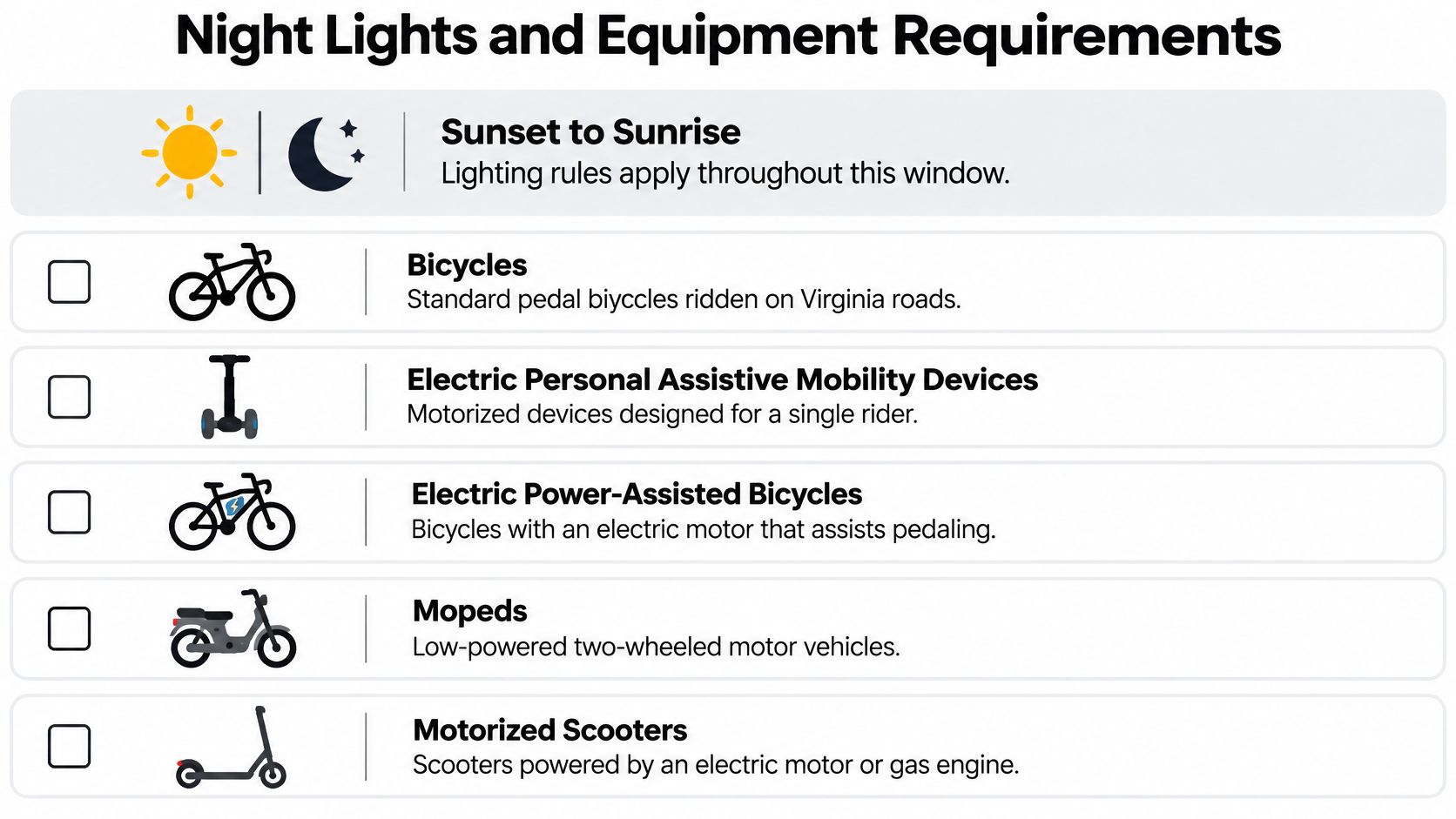
Between sunset and sunrise, Virginia requires covered devices to have a white front headlight visible from at least 500 feet and a rear red reflector visible from at least 600 feet, under the Code of Virginia's lighting provision.
That wording covers bicycles, electric personal assistive mobility devices, electric power-assisted bicycles, mopeds, and motorized skateboards or scooters equipped with handlebars. Read your own spec sheet before assuming the rule fits, because an unusual deck, seated layout or missing handlebar can change which definition applies.
Check visibility, not just whether a lamp turns on
A glowing dashboard is not a front headlight. Decorative deck lighting also fails to prove that the required forward light and rear reflector meet the visibility standard.
- Front lamp: Confirm it is white, charged and aimed forward without dazzling approaching riders.
- Rear reflector: Keep it clean, unobstructed and facing rearward. A bag or jacket can hide it.
- Mounting: Tighten brackets and recheck them after folding or transporting the scooter.
- Visibility test: Use a safe, traffic-free location and a helper to judge visibility at the statutory distances.
The same provision adds a bicycle-specific rear-taillight requirement on highways with speed limits of 35 mph or higher. I would not transfer that bicycle clause straight onto a scooter, and I would not treat an add-on rear lamp as a substitute for the specified reflector.
Separate required equipment from useful extras
A brighter rear lamp can make you easier to spot, but it belongs alongside the required reflector. The guide to choosing scooter LED lights helps distinguish practical riding lights from decorative accessories.
Before leaving after dark: Look at the scooter from the front and rear, not just from the riding position.
For equipment planning, treat the statute as the baseline and any pending safety recommendations as a reason to recheck requirements before replacing parts.
Local Rules, Pilot Programs and the 2026 Work Group
Local permission is a separate layer of compliance. Virginia law lets cities, towns and counties restrict scooters on designated sidewalks and crosswalks, and it authorizes scooter-for-hire ordinances, demonstrations and pilot programs within the state's motor-vehicle framework.
That means a town can create a restriction that hits your daily route even when your scooter fully meets the statewide definition. Pull up the city or county code and read the actual locations and conditions. A broad search-result summary will miss the one block where riding is banned.

Rentals add another operating check
A rental operator's app can impose no-ride zones, capped speed settings and parking conditions on top of the law. Those are the operator's terms, and an app letting a ride start doesn't prove every nearby surface is legal.
Take a school-area sidewalk prohibition. A rental scooter started nearby gives its rider no permission to roll past the sign. The posted restriction wins, and the rider carries the responsibility for knowing it.
A work group report is not a rule change
Virginia's 2026 safety review is still in progress, with a work group developing recommendations across these device categories. Treat that work as policy development, not a reason to guess at new helmet, registration or equipment duties that don't exist yet.
A proposal can still shape a buying decision without being enforceable. Before you change your setup off the back of a headline, check whether the recommendation became an enacted requirement and when it takes effect. Until then, the current statewide rules and your local code are what an officer will measure you against.
- Local code: Check sidewalk and crosswalk restrictions along your actual route.
- Rental terms: Read the app's zone, speed and parking conditions before you start a ride.
- Policy updates: Review published recommendations and separate them from rules already in force.
For a regular commute, save the municipal page alongside your route notes and recheck it when signs change or you start riding somewhere new.
Enforcement and Penalties
A scooter-related stop can involve separate questions about the vehicle, the rider and the location. Complying with the speed rule doesn't answer a lighting or sidewalk allegation, and each can be treated on its own.
Fines and penalties differ by violation, so check the specific cited provision and the notice you receive rather than relying on a generic scooter fine quoted online. The citation on the notice controls what you are being charged with, which provision to read and how to respond.
Keep the issues separate
An officer assessing compliance may work through the device's category, its operation, the rider's supervision status, the equipment and any posted restriction. Prepare an answer for each question on its own terms.
- Device documents: Keep the specification sheet and configuration details accessible.
- Location details: Note the road, path or sidewalk and relevant signs.
- Notice details: Read the alleged provision and response instructions carefully.
A rider travelling at a lawful speed after sunset without the required lighting still has an equipment problem, and the absence of speeding doesn't resolve it. Adding lights the next morning won't help a device that falls outside the claimed scooter category either, since classification is argued from the spec sheet rather than the accessories bolted on later.
If a collision occurs, prioritize immediate safety and medical needs, then preserve photographs, witness details and relevant documents when it's safe. AskLegally's guide to what to do after a crash offers a separate starting point for understanding injury-related next steps.
Keep the purchase receipt and manufacturer's specifications together, preferably with an offline copy on your phone. They help explain what the scooter is if the device category gets disputed, although they don't settle the legal classification or prove that later modifications left it unchanged.
Confirm Your Scooter Is Legal Before You Ride
Use this routine before a first ride, a new route or a significant modification. It's more useful than assuming a familiar-looking scooter must be legal everywhere.
- Match the device to the definition. Check the complete vehicle's weight, manufacturer-VIN status, electric propulsion and documented motor-only capability. Resolve missing specifications before relying on the scooter category.
- Match the rider to the supervision rule. Confirm whether an adult must supervise and who will do it. Check helmet obligations separately, and fit the helmet before departure.
- Prepare for darkness. Inspect the white headlight, red rear reflector and secure mounting. Confirm that the lighting provision matches the device's configuration and that accessories don't block visibility.
- Check the complete route. Include sidewalks, crossings, shared-use paths and the approach to your destination. Look for school-area restrictions, church-area restrictions and prohibited highway access.
- Set a predictable riding plan. Stay within the operating ceiling, use a safe right-side position when required and adjust group formation for faster traffic.
Repeat the specification and equipment checks after changing a battery, motor, controller or accessory. Modifications can affect weight, speed capability or visibility.
Recheck current state and local requirements before each riding season or purchase. Follow enacted rules, and keep proposed safety changes separate until they become applicable law.
Punk Ride LLC offers Commuter Scooters, Folding Scooters, Fat Tyre Scooters, Off-Road Scooters and Performance Scooters, and the scooter comes with a 2-year warranty. Visit Punk Ride LLC to compare options, then match the specific model's weight, motor-only speed and VIN status against Virginia's classification tests before buying.

Share:
Electric Scooters with Removable Battery: A Buyer's Guide