


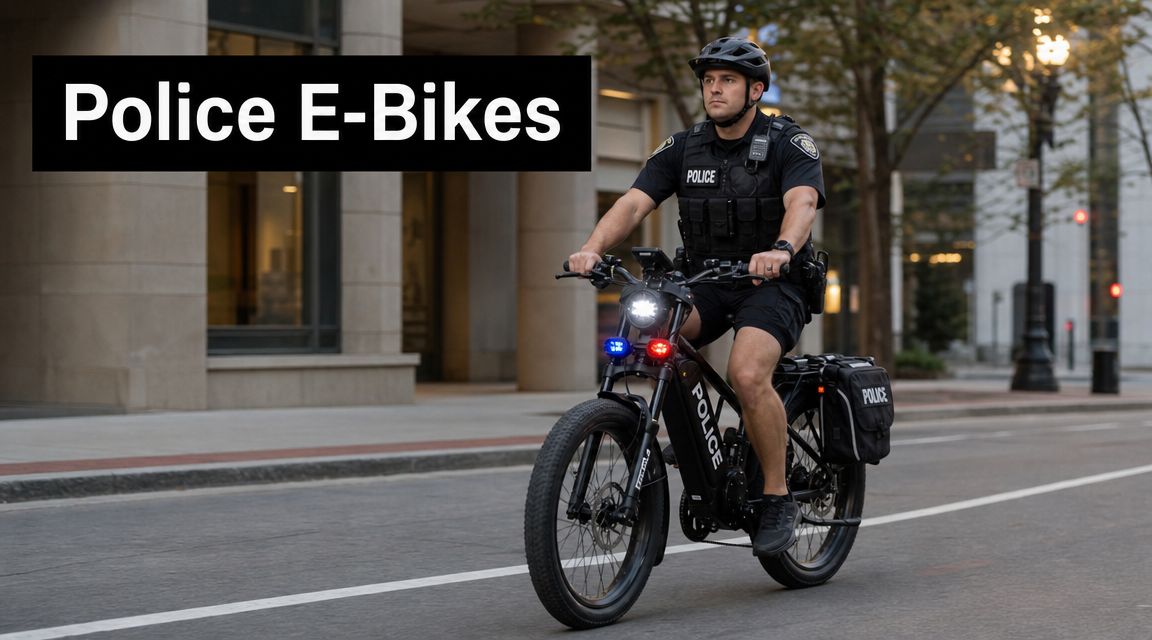
If you're a chief or procurement lead looking at patrol gaps in parks, downtown cores, campuses, beachfronts, or event zones, you've probably already had the same thought: a cruiser is too bulky, foot patrol is too slow, and a standard bike doesn't always hold up once the officer is carrying full duty gear. That's where police electric bikes start to make sense.
The catch is that many agencies approach them like consumer e-bikes with lights bolted on. That usually leads to the wrong purchase, the wrong policy, or both. In the US and Australia especially, the hard part isn't just choosing a capable platform. It's making sure the bike fits patrol work, officer training standards, and the legal definition of what you're putting on the street.
What Makes an E-Bike Police Grade
A police-grade e-bike should be treated like a patrol car, not like a retail commuter model. A civilian sedan and a marked patrol unit may share a basic shape, but they aren't built for the same duty cycle. The same logic applies here.

The frame and running gear have to survive patrol use
Most consumer e-bikes are built around commuting assumptions. Smooth pavement. Light cargo. Predictable braking. Police work is the opposite. Officers curb-hop, stop hard, idle in crowds, carry radios, body armor, and extra equipment, then ride again.
That changes what matters:
- Frame stiffness matters more than showroom comfort. A patrol bike has to stay stable under load, especially during low-speed control work and repeated stop-start riding.
- Wheel strength and tires aren't minor details. If the platform can't handle rough surfaces, broken pavement, park access routes, and debris, uptime drops fast.
- Brakes have to deal with heat, not just stopping power. Patrol riding often means repeated braking with extra mass on the bike.
A good procurement team should review the full component stack, not just the motor headline. If your team needs a refresher on how those systems fit together, this overview of electric bike parts is a useful baseline before drafting requirements.
Motor and battery specs only matter if the bike stays controllable
Agencies sometimes get distracted by raw speed. That's a mistake. A patrol e-bike needs predictable torque delivery, stable handling, and clean response in crowded areas. If the power comes in abruptly, the officer pays for it in low-speed control.
Field rule: The best patrol bike isn't the fastest one. It's the one an officer can ride precisely through pedestrians, curbs, trail entries, and sudden stops without fighting the machine.
Some duty-oriented models in the US and European market now sit much closer to light electric moped territory than standard commuter bikes. One widely discussed example reported a 5 kW motor, nearly 3.5 kWh of battery, a claimed range of up to 174 miles (280 km), and a top speed of 50 mph (80 km/h) in an Electric Bike Review forum discussion of the Delfast Top Cop. Those numbers show what's technically possible, but they also raise immediate questions about braking, classification, and where the vehicle can legally operate.
Patrol equipment has to be integrated, not improvised
A police-grade platform also needs room for mission equipment without becoming unstable. That usually means:
- Integrated emergency lighting and signaling
- Mounting points for communications gear
- Cargo support for duty loadouts
- Service access for fleet maintenance
What doesn't work is hanging equipment from a frame that was never designed for it. Once the bike carries duty gear, every weak point shows up sooner. For chiefs, the practical takeaway is simple. Buy for control, durability, and serviceability first. Power comes after that.
The On-Street Advantages of E-Bike Patrols
The operational case for police electric bikes gets strongest where patrol cars struggle. Downtown festivals, waterfront promenades, mixed-use trails, university corridors, transit-adjacent blocks, and large public parks all create the same problem. Officers need more mobility than foot patrol provides, but they also need access that a cruiser can't give them.

An industry review of police deployment noted that e-bikes can be deployed more rapidly than cruisers in dense urban areas and are inexpensive enough for agencies to use more of them, which supports quicker response times. The same review also noted that officers can travel farther with less fatigue than on standard bikes, improving pursuit capability during patrol operations, as summarized by the International Police Mountain Bike Association.
Why they work in places cars don't
The strongest patrol use case isn't replacing cars. It's filling the dead space between foot patrol and motor patrol.
An officer on an e-bike can move through:
- Sidewalk-adjacent zones where cars are excluded
- Parks and trails with narrow or irregular access
- Crowd-heavy event routes where a cruiser becomes a barrier
- Beachfront and campus corridors with short, frequent transitions
That flexibility is why many agencies treat e-bikes as force multipliers rather than transportation gadgets. They extend presence without cutting off approachability.
Officers stay visible and approachable
A cruiser creates distance. That's often appropriate, but not always helpful. In community-heavy patrol settings, the officer who can stop, dismount, and speak with someone at eye level usually gets better informal contact than the officer behind glass.
There's also a tactical upside. E-bikes let officers approach with minimal noise, reposition quickly, and patrol broader beat areas without the fatigue that comes with an all-day conventional bike assignment. That matters during long details, rolling events, and areas with repeated short calls for service.
A related planning principle comes from logistics. If your agency already thinks in terms of patrol density, response zones, and event coverage, the same thinking used in optimizing sales team routes can help map where e-bike patrols outperform foot posts and vehicle loops.
After that planning work, the public-facing benefits become easier to see.
Where chiefs usually get the best return
The best deployments are usually narrow and intentional, not agency-wide at the start.
A practical rollout often starts with:
- Entertainment districts where vehicle congestion slows response
- Parks units that need trail and open-space access
- School and campus details where visibility matters
- Special events teams that need fast repositioning without road blockage
If your command staff is still weighing whether the patrol concept fits your city layout, this short read on the benefits of electric bikes is a decent primer for non-technical stakeholders.
The best use of police electric bikes isn't “everywhere.” It's in the zones where conventional patrol methods lose either speed, access, or public contact.
Navigating the Legal and Safety Maze in the US and Australia
Many good e-bike programs go sideways at this stage. The bike may work mechanically. The deployment plan may look smart. Then legal review asks a basic question: is this an e-bike under local rules, or did the agency just buy something that functions more like an electric motorcycle?

That line matters because the vehicle class determines where officers can ride, what equipment rules apply, whether registration or insurance enters the picture, and what liability follows a collision. In the US, this often gets reduced to a simple class discussion. In practice, it's more complicated once agencies look at patrol-ready machines with higher power, higher speed, and heavier builds.
A Police1 discussion of enforcement gaps noted that police are scrambling because many riders, parents, and even officers misunderstand the legal line between a classed e-bike and an out-of-class high-speed vehicle that may be treated as an unregulated motorcycle, which makes that article a useful reference on the enforcement confusion around electric bicycles.
The practical legal test chiefs should apply
Forget marketing labels. Start with operational reality.
Ask these questions before procurement signs anything:
- Does local law still treat this platform as a bicycle once power and speed are considered?
- Can it legally access the sidewalks, trails, parks, or shared paths where your officers plan to ride?
- Do local equipment rules change once the vehicle crosses out of standard e-bike classification?
- Will prosecutors, judges, insurers, and risk managers all view the platform the same way your vendor does?
If those answers aren't aligned, the agency is buying trouble.
For Australia, the challenge is similar even though the rules are handled differently across jurisdictions. Chiefs there should assume that state or territory interpretation, road rules, and path access controls may differ enough to affect procurement, policy, and training. Imported high-power models create extra risk because a machine that looks like an e-bike in marketing may be treated very differently in enforcement.
Policy has to match the street
One mistake I see often is a broad policy that says "bike patrol" without distinguishing among conventional bikes, class-compliant e-bikes, and high-power units. That's too loose. Supervisors need a policy that tells them exactly where each platform can be used, who can ride it, and what restrictions apply.
A short comparison helps:
| Issue | Standard class-compliant e-bike | High-power out-of-class build |
|---|---|---|
| Access expectations | More likely to fit existing bike access rules | More likely to trigger restriction or exclusion |
| Procurement risk | Lower if local rules are checked first | Higher because classification can shift |
| Officer perception | Usually understood as a bike patrol tool | Often confused with a motorcycle-style platform |
| Liability posture | Easier to defend if policy is clear | Harder to defend if local legality is disputed |
For agencies building policy frameworks, some of the same governance habits used in a guide for trucking fleet owners also apply here: define vehicle classes, assign accountability, document inspections, and tie policy to actual operating conditions.
Compliance check: If your agency can't explain in one page why a given unit is legally an e-bike in your jurisdiction, you aren't ready to deploy it.
Chiefs in the US should also remember that vehicle legality isn't the only issue. Trail authority, park rules, downtown pedestrian-zone restrictions, and local ordinances can still override what looks permissible under broader state treatment. For agencies needing a starting point on that review, this roundup of electric bike laws by state is useful for early screening before local counsel takes over.
Smart Procurement and Budgeting for Your Agency
The sticker price is only the first line in the budget. Chiefs get burned when they approve a pilot based on bike cost alone, then discover the actual spend sits in batteries, charging, training time, fleet tools, replacement wear items, and policy work.
Build the budget around total operational readiness
A workable procurement plan should account for more than units delivered to the garage. It should cover what keeps them deployable.
Start with these categories:
-
Base vehicle package
Include the actual patrol configuration, not the stripped consumer version. If the bike needs racks, lighting integration, or upgraded brakes for duty use, price it that way from the start. -
Battery strategy
Decide whether the agency needs spare packs, fixed charging windows, or rotation capacity. A patrol fleet without a battery plan turns into a part-time fleet. -
Fleet maintenance support
Some platforms are easy to service with in-house staff. Others require brand-specific parts, diagnostics, or long lead times. Those differences matter more than a low initial quote. -
Training and policy rollout
Budget for rider training, supervisor familiarization, written SOP updates, and risk review. If procurement ignores those items, operations pays for them later.
Write the RFP around patrol performance, not marketing language
A weak RFP asks for "police e-bikes." A good one asks for the characteristics your officers need.
Require vendors to address:
- Load handling under duty gear
- Brake performance under repeated stop-and-go use
- Parts availability and servicing pathways
- Battery replacement process
- Frame and component durability
- Compatibility with your local legal environment
In Florida, that compliance angle is especially important. A public-safety report from 2026 noted that state-level micromobility policy requires the Florida Highway Patrol and local police to maintain a list of compliant devices under a safety framework, which shows procurement has to align with regulation, not just transport choice, as discussed in this public-safety video report.
What doesn't work
Cheap consumer platforms with tactical accessories added later usually fail in predictable ways. The brakes run hot. Wheels go out of true. Battery support is weak. Fleet staff can't source replacement parts quickly. Command then concludes the concept was flawed, when the underlying problem was the buying process.
The procurement decision isn't “Should we buy e-bikes?” It's “Can we buy a platform we can legally deploy, maintain, and defend after an incident?”
Essential Training and Maintenance Protocols
A patrol e-bike asks more from the rider than a standard bicycle. It accelerates differently, carries more weight, and punishes sloppy braking faster. That means training can't be informal and maintenance can't be occasional.

The International Police Mountain Bike Association notes that LAPD requires officers to complete a 40-hour Basic Bike Patrol Course on a conventional bike before moving to an e-bike, which shows that agencies treat handling, braking, and control as essential skills, not optional add-ons. That requirement appears in IPMBA's guidance on training and use considerations for duty electric bicycles.
What officers need to practice before deployment
The common failure point isn't straight-line riding. It's low-speed precision and emergency control while carrying equipment.
A serious program should include:
- Emergency braking drills with realistic duty load
- Tight-turn and low-speed balance work for crowds, plazas, and park paths
- Surface transition drills across curbs, gravel, pavement seams, and ramps
- Traffic scanning and hazard recognition at e-bike speed
- Battery and display familiarization so officers understand the machine's behavior
Officers who are strong on conventional bikes still need transition training. The extra weight and power change timing, stopping distance, and body positioning.
The maintenance routine that keeps a fleet usable
A patrol fleet doesn't need exotic maintenance. It needs disciplined maintenance.
A simple schedule works best:
Before each shift
- Brake check for lever feel, rotor noise, and stopping confidence
- Tire inspection for pressure, cuts, and embedded debris
- Battery check for charge status and secure mounting
- Lighting and controls to confirm all patrol equipment works
Weekly
- Fastener review on racks, bars, and critical mounting points
- Wheel and tire condition with attention to spoke tension and wear
- Drivetrain inspection for contamination and rough shifting
- Charging equipment check for cable or connector damage
Scheduled shop service
- Brake system servicing
- Battery health review
- Firmware or system diagnostics if the platform uses them
- Replacement of worn consumables before failure
A police e-bike fleet stays reliable when supervisors treat pre-shift checks the same way they treat vehicle walk-arounds. Small faults become safety issues very quickly on two wheels.
Police E-Bike Implementation FAQ
When does an e-bike stop being a bike and start being a motorcycle
Use local law, not vendor language. If the machine's power, speed, or configuration pushes it outside the local e-bike framework, the agency may be dealing with a motor vehicle even if the product page still says "bike." That's the legal gray area that causes most enforcement and liability problems. Chiefs should require legal review before buying any high-power platform intended for paths, parks, or mixed-use public space.
What kind of range should an agency expect on patrol
There isn't one honest number that fits every shift. Real patrol range depends on stop-start riding, officer weight, duty load, terrain, speed bursts, and how often the bike idles between calls. That's why battery planning matters more than brochure claims. For command staff, the practical move is to test candidate bikes on the exact routes and surfaces officers will patrol, then build charging and spare-pack policy around that result.
What liability sits behind a collision involving a high-power patrol bike
The biggest exposure usually isn't that the vehicle is electric. It's that the agency deployed something that may not have fit the local classification, access rule, or policy language governing where it was ridden. If a collision happens on a restricted trail, shared path, or pedestrian-heavy corridor, investigators will look at authorization, training, equipment setup, and whether the platform was lawfully there in the first place.
Should agencies start with a full fleet or a pilot
Start with a narrow pilot tied to a specific mission set. Parks, event patrol, tourism districts, campuses, and waterfront beats usually reveal the concept quickly. A limited rollout lets fleet staff test service demands, lets supervisors refine policy, and lets command identify whether the chosen platform is bicycle-grade or creeping into motorcycle territory.
What is the simplest implementation mistake to avoid
Don't buy speed before you buy policy. A controllable, supportable, legally compliant patrol platform will outperform a more powerful machine that officers can't confidently ride where your agency needs access.
If your team is evaluating electric mobility options and wants a practical starting point, Punk Ride LLC is worth a look. They focus on modern urban electric rides and can help agencies or individual riders compare platform types before a purchase decision, especially when the primary question isn't just what looks capable, but what fits the job and the rules around it.
Share:
Electric Scooter Racing: Pro Events & 2026 Starter Guide
Electric Bike Payment Plan: Your Guide to Smart Financing