


Felt like your electric scooter is holding back? You’re probably right. Manufacturers often cap the speed on their scooters right out of the box, especially in places like the UK and EU, to meet strict local regulations. This means your scooter likely has some untapped power just waiting to be unleashed.
Whether you're trying to shave a few minutes off your daily commute in a US city or cruise the coastal paths of Australia, you can definitely squeeze more speed out of your ride.
This guide gets straight to the point. We'll walk through the methods that actually work, from quick, no-cost tweaks to more serious hardware upgrades. Think of it as your roadmap to a faster, more capable scooter.
Unlocking Your E-Scooter's Real Speed Potential
Getting more speed from your ride really boils down to three things: basic upkeep, software adjustments, and physical upgrades. The easiest (and cheapest) wins? Simply checking your tire pressure and ditching any extra weight. These two things alone can reduce drag and give you an instant boost.
Here's a visual breakdown of the different paths you can take to get more performance.
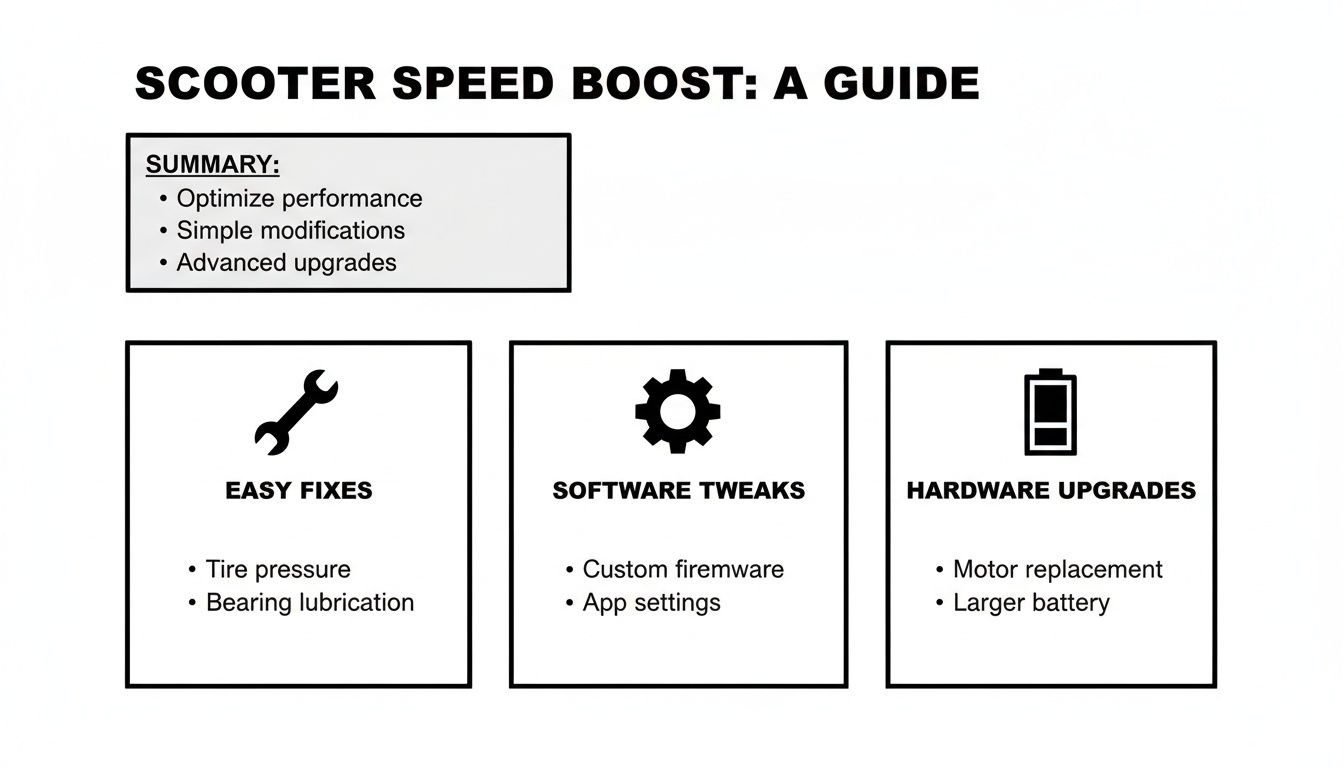
As you can see, you don't always have to break the bank to see a real difference. Sometimes, a little maintenance is all it takes.
To give you a clearer picture of what's involved, here's a quick rundown of the most common methods.
Speed Boosting Methods At A Glance
| Method | Difficulty Level | Estimated Cost | Potential Speed Gain |
|---|---|---|---|
| Basic Maintenance (Tires, Weight) | Easy | $0 - $20 | +1-2 mph (2-3 km/h) |
| Firmware/App Tweaks | Easy to Medium | $0 | +3-5 mph (5-8 km/h) |
| Battery Upgrade | Medium to Hard | $200 - $600+ | +5-10 mph (8-16 km/h) |
| Motor Upgrade | Hard | $150 - $500+ | +10+ mph (16+ km/h) |
| Gearing/Tire Changes | Medium | $50 - $150 | +2-4 mph (3-6 km/h) |
This table should help you decide which path makes the most sense for your budget and technical skill.
Before you start dreaming of new motors and batteries, though, let's cover the essentials. A well-maintained scooter is always a faster scooter, and you'd be surprised how much performance you can gain from simple tune-ups that most riders ignore. We'll start there, making sure you’re getting every bit of power from your scooter before you spend a dime.
And, of course, we’ll go over the critical safety checks and legal rules for riders in the US and Australia. Pushing the limits is fun, but doing it safely and legally is what matters most.
The Easiest Wins: Maintenance and Quick Fixes
Before you even think about dropping cash on new parts or messing with software, let's cover the basics. This is the low-hanging fruit—the simple tune-up that costs you almost nothing but can make a real difference. A happy, well-maintained scooter is a faster scooter. It's that simple.
I’ve seen riders gain an extra 2-3 mph just by getting these fundamentals right.
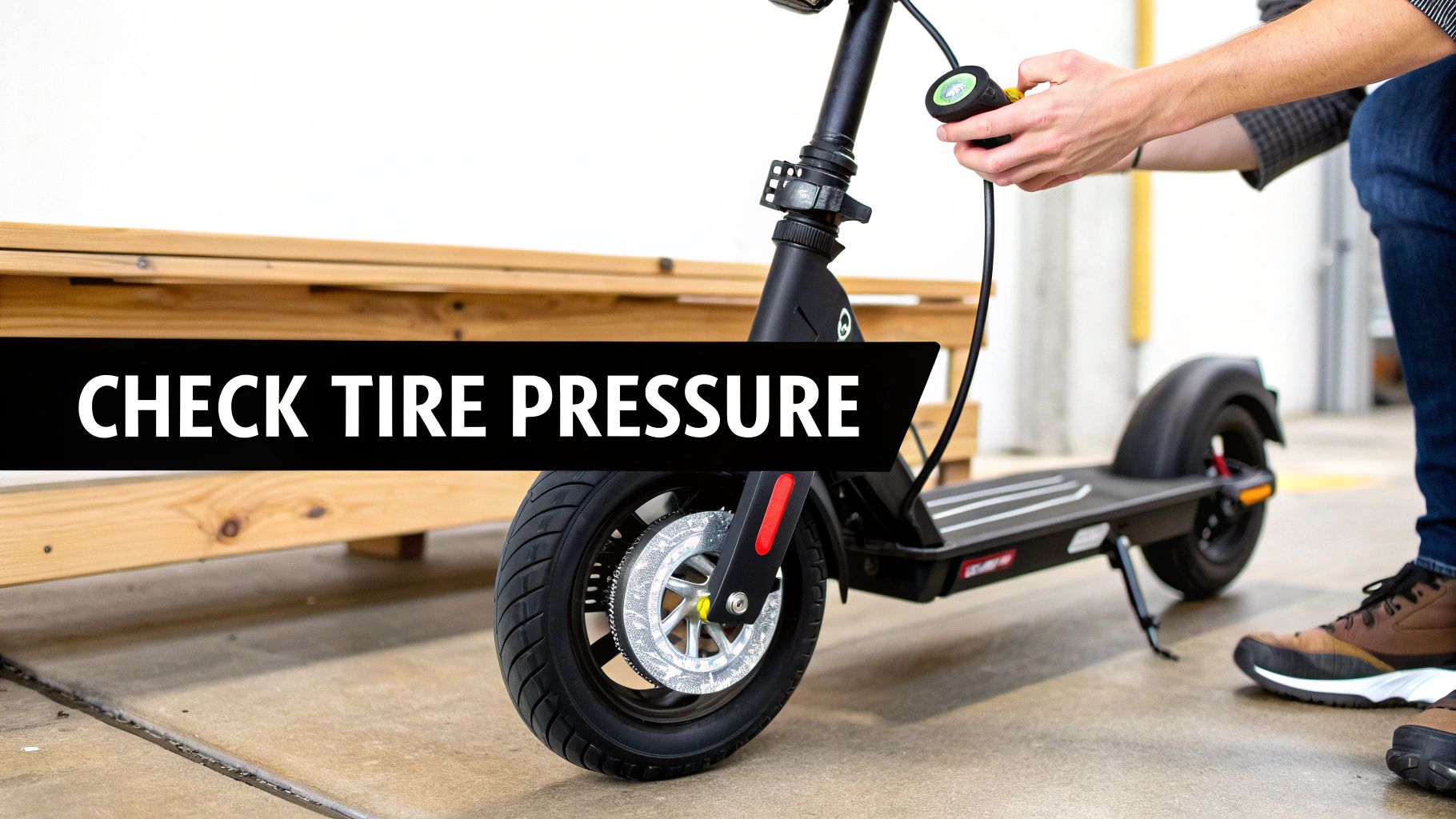
Often, the biggest thing holding you back isn't your motor or battery—it's friction. Annoying little things like low tire pressure or a brake pad that’s rubbing just a tiny bit can create enough drag to kill your speed and drain your battery. Let's fix that.
Dial In Your Tire Pressure
Seriously, this is the most important check you can do for speed. Your tires are the only thing connecting you to the road, and if they're soft, you're creating a ton of rolling resistance. It's like trying to pedal a mountain bike with flat tires on pavement. You're just not going anywhere fast.
When your tires are underinflated, they flatten out and stick to the ground, which creates a huge amount of drag. Properly inflated tires have a smaller, harder contact patch, letting you glide over the surface with way less effort from the motor.
Look for the recommended PSI (pounds per square inch) on the side of your tire or in your scooter's manual. For zipping around on smooth streets, inflate them to the higher end of that range. A cheap digital pressure gauge is a must-have tool for any rider.
Clean Your Bearings and Drivetrain
Your wheels spin on tiny metal bearings. Over time, they get gummed up with dirt, grit, and all sorts of street crud. This gunk creates friction and literally slows your roll. If you spin your wheel and hear a gritty, grinding sound instead of a smooth, silent whir, it's time for a cleaning.
A quick spray with a dedicated bearing cleaner, followed by some lubricant, can work wonders. It’s a small detail that ensures your wheels spin as freely as possible, so all your motor's power goes into moving you forward.
Pro Tip: While you’re down there, give your chain or belt (if you have one) a look. A clean and properly tightened drivetrain is way more efficient at getting power from the motor to the wheel. No wasted energy, just a smoother, faster ride.
Make Sure Your Brakes Aren't Dragging
This is a sneaky speed killer. Even the slightest rub from a brake pad on the rotor creates constant friction, basically hitting the brakes for you while you're trying to accelerate. It’s a surefire way to slow you down, not to mention it chews through your brake pads.
Here’s a quick way to check for drag:
- Get the wheel off the ground so it can spin freely.
- Give it a good, hard spin with your hand.
- Listen closely. Do you hear any scraping or rubbing sounds?
- Watch it. A healthy wheel should spin for several seconds before stopping.
If you hear that tell-tale shhh-shhh-shhh sound or the wheel stops almost immediately, your brake caliper is probably out of alignment. Don't worry, it's usually an easy fix—just loosen a couple of bolts, reposition the caliper so it's perfectly centered, and tighten everything back up.
Learning the basics of electric motors service and optimization is a game-changer for any serious rider. These quick maintenance checks are the foundation—get them right before you move on to the bigger mods.
Hacking Your Scooter’s Speed with Software and Firmware
Beyond all the physical tweaks, your scooter has a digital brain—the controller. And right now, that brain is probably holding it back. To comply with local laws, manufacturers install a digital speed governor. This is great for them, but it means your scooter has untapped potential.
Unlocking this digital limit is often the quickest way to get a real speed boost, sometimes without spending a dime. It's all about changing the scooter's firmware or using a special app to dive into hidden settings. You're basically telling your scooter it's okay to break the factory rules. It's a powerful trick, but it comes with a big warning: messing with firmware is risky. Get it wrong, and you could "brick" your scooter, turning it into a very expensive paperweight.
The Nitty-Gritty of Firmware Flashing
Think of firmware as the scooter's operating system. Custom firmware, usually cooked up by passionate riders in the community, overwrites the manufacturer’s software with a version that has no speed limits. This is a huge deal for popular models from brands like Xiaomi and Ninebot, which have massive online communities sharing tools and guides.
The whole process usually involves connecting your scooter to your phone or computer and using an app to "flash" the new software onto the controller. It's not just about top speed, either. These custom firmwares often let you fine-tune everything—you can sharpen the acceleration, adjust the regenerative braking feel, or even get rid of that annoying kick-to-start safety feature.
Before you even think about downloading anything, do your homework. Find a trusted source for your exact scooter model and look for firmware that’s been tried and tested by other people. You don't want to install something unstable that makes your scooter act possessed on your way to work.
My Two Cents: If you can, always back up your original firmware before you start. It’s your get-out-of-jail-free card if something goes sideways. Also, make sure your scooter is fully charged. A power cut mid-flash is the number one cause of bricking.
The Easier Route: Companion Apps
If flashing firmware sounds like you're one wrong click away from disaster, don't worry. There's a much friendlier path. Many scooters can be tweaked using third-party companion apps on your phone. These connect via Bluetooth and give you a simple interface to change settings the official app keeps hidden.
This is a much safer way to dip your toes into software mods. You're not replacing the scooter's entire OS; you're just flipping a few digital switches.
Here are a few things you can typically change:
- Region Code: Scooters are often limited based on where they're sold. Switching the region from a restricted one to "Global" can instantly unlock a higher speed cap.
- Speed Modes: You can often bump up the limits for Eco, Drive, and Sport modes, giving you more oomph whenever you need it.
- Power Output: Some apps let you feed more amps to the motor. This won't necessarily increase your top speed, but it will give you that satisfying, punchy acceleration off the line.
I've seen it firsthand. A scooter sold for a market with strict speed limits might be stuck at a sluggish 20 km/h (12.4 mph). A quick change in an app—sometimes by tweaking the serial number to trick the scooter into thinking it's a global version—can unleash its true 30 km/h (18.6 mph) potential.
A Quick Reality Check on Risks and Warranties
Let's be clear about the trade-offs. The moment you modify your scooter's software, you can kiss your manufacturer's warranty goodbye. If your controller fries itself after you've flashed custom firmware, that repair bill is coming out of your pocket.
Pushing your motor and battery harder than they were designed for can also cause them to overheat, which will shorten their lifespan. A small speed boost is usually no big deal, but cranking everything to the max puts a serious strain on components. My advice? Start with small, incremental changes. Go for a test ride and check if anything's getting too hot. This way, you get the extra speed without killing your scooter in the long run.
Boosting Performance with Battery and Motor Upgrades
If basic maintenance and software tweaks are the appetizers, then upgrading your battery and motor is the main course. This is where you'll find the most dramatic speed gains, and it's for the rider who's looked at their daily commuter and thought, "I need more."
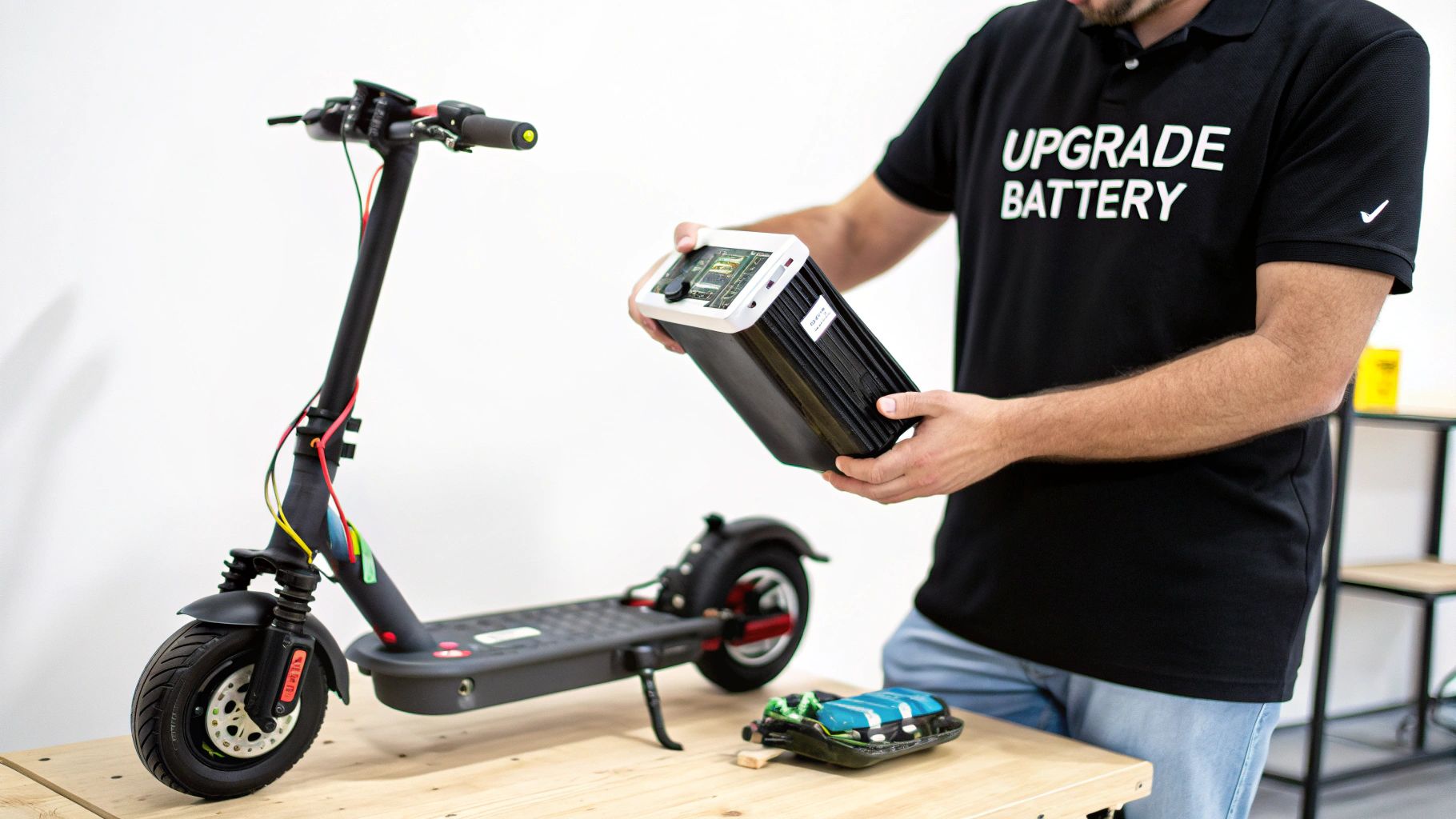
Swapping these core components fundamentally changes your scooter's DNA. We're talking about more than just a few extra miles per hour—this is how you get that jaw-dropping acceleration and the raw power to chew up steep hills without breaking a sweat. It transforms your scooter from a simple A-to-B machine into something genuinely thrilling.
Why a Bigger Battery Equals More Speed
Think of your scooter's battery in terms of voltage (V). A higher voltage battery pushes more electricity to the motor, kind of like how higher water pressure blasts more water through a hose. This directly translates to a higher potential top speed and better-sustained power, especially when you're already flying.
A standard commuter scooter might have a 36V or 48V battery, which is totally fine for cruising around the city. But when you make the jump to a beefier 60V or even a 72V pack, you're playing in a different league entirely. That extra voltage lets the motor spin faster, which is the key to unlocking some serious speed.
Key Takeaway: More voltage doesn't just bump up your peak speed; it also helps you maintain that speed. A higher voltage system is less likely to "sag" under a heavy load, meaning you won't feel that frustrating drop in power when you're gunning it up a hill or accelerating hard.
Of course, this upgrade isn't always a simple plug-and-play job. You absolutely have to make sure your scooter's controller and motor are rated to handle the increased voltage. Hooking a 72V battery up to a system designed for 36V is a surefire way to fry your electronics. Always, always check for compatibility first.
Here’s a general idea of how battery voltage typically translates to speed.
Battery Voltage vs Potential Top Speed
This table shows the general relationship between an e-scooter's battery voltage and its potential top speed. Keep in mind these are estimates—real-world performance depends on many other factors!
| Battery System Voltage | Typical Top Speed Range (mph) | Best For |
|---|---|---|
| 36V | 15 - 20 mph | Casual urban commuting and mostly flat terrain. |
| 48V | 20 - 30 mph | Daily commuters who need a bit more punch and hill-climbing ability. |
| 60V | 30 - 45 mph | Performance enthusiasts looking for thrilling acceleration and speed. |
| 72V | 45 - 60+ mph | Extreme performance riders building custom rigs for maximum power. |
As you can see, the jump in performance potential is pretty significant with each step up in voltage.
The Ultimate Power Move: The Motor Upgrade
While a bigger battery provides the juice, the motor is what actually turns that electrical energy into raw, forward motion. Upgrading your motor is probably the single most impactful change you can make. It doesn't just affect your top speed—it also defines your acceleration and torque for climbing hills.
Many entry-level scooters come with a single motor, often around 500W. That’s fine for city streets, but it’s going to struggle on serious inclines and won't deliver that exhilarating rush of speed. The real fun starts when you explore more powerful single motors or, even better, a dual-motor setup.
Putting a motor on each wheel completely changes the game. With power being delivered to both wheels, you get insane traction and acceleration that a single motor just can't touch. It’s like the difference between a standard car and an all-wheel-drive beast. For riders in hilly cities or anyone who just craves that instant, neck-snapping torque, a dual-motor setup is the holy grail. If you're curious about the specifics, you can learn more about the benefits of dual-motor electric scooters in our detailed guide.
The performance gains can be staggering. Swapping a standard 500W motor for a high-performance dual-motor system like those from brands such as Dualtron or YUME can boost top speeds from around 25 mph to over 60 mph. Take the YUME Predator, for instance—it hit a record 63 mph thanks to its dual 5040W motors and 72V system. That's a massive increase of over 150% in top speed compared to your average city scooter.
What You'll Need for the Swap
Diving into a battery and motor upgrade is a project for the confident DIYer. You'll need more than just the new parts; you have to make sure the entire system can work together in harmony.
Here’s a quick checklist of what you'll need to consider:
- The Battery: Make sure it physically fits in your scooter's deck and that its discharge rating (Amps) is high enough for your new motor's demands.
- The Motor(s): Check that the motor hub fits your scooter's wheel size and fork.
- The Controller: This is the brain of the operation. It must be compatible with both your battery's voltage and your motor's wattage. Upgrading one without the other is pointless.
- The Display/Throttle: Often, a new controller requires a specific, matching display to work properly.
- Connectors & Wiring: Be prepared to do some soldering or use new connectors to get everything hooked up correctly.
Brands like DUOTTS and IENYRID are known for pushing the envelope with powerful stock configurations, often featuring 60V systems and dual motors right out of the box. Looking at their specs can give you a great idea of what a well-matched, high-performance system looks like. This isn't just about making your scooter faster; it's about re-engineering it for a whole new level of performance.
Fine-Tuning Your Ride: Mechanical and Aero Tweaks
So, you’ve maxed out your scooter's software and squeezed every last volt from the battery. What’s next? This is where we get into the physical stuff—the mechanical and aerodynamic changes that can tack on those last few, hard-earned miles per hour. These are the tricks that separate the fast scooters from the really fast ones.
Think of it this way: if software and battery upgrades are your engine, then mechanical tweaks are the transmission and chassis. They’re all about making sure none of that raw power is wasted.
Swapping Gearing for a Higher Top End
One of the most impactful mods you can make, if your scooter has a chain or belt drive, is to mess with the gearing. Most manufacturers set up the gear ratio for a happy medium between zippy acceleration and a respectable top speed. But we're not here for a happy medium, are we?
By changing the sprockets, you can shift that balance heavily towards top-end speed.
- Go with a smaller rear sprocket (or a larger one at the motor). This will give you longer legs, letting the scooter reach a higher maximum speed.
- The catch? You'll lose some of that neck-snapping torque right off the line. It's a trade-off.
This mod is perfect if your commute involves long, flat stretches where you can really open it up. It’s a classic hot-rodding trick that lets you get more speed out of the power you already have.
How Bigger Tires Can Boost Speed and Comfort
Another surprisingly effective upgrade is simply fitting larger tires. It sounds almost too easy, but the physics are simple: for every rotation of the motor, a bigger wheel travels a greater distance.
Just swapping from standard 8.5-inch tires to 10-inch street tires can add a solid 2-3 mph to your top speed, no other changes needed. As a bonus, bigger tires roll over bumps and cracks more easily, giving you a noticeably smoother and more stable ride.
Heads Up: Before you run out and buy bigger rubber, double-check that your scooter’s frame and forks have room for them. The last thing you want is a tire rubbing against the mudguard or frame—that's a recipe for a bad day.
Don't Underestimate Aerodynamics
Aerodynamics is the ghost in the machine, the invisible force that’s almost always ignored by scooter riders. Once you get moving, the single biggest thing holding you back isn't road friction; it's the air you're punching a hole through. The more air you have to move, the more power you waste.
It's amazing how much speed you can find just by changing your body position. Tucking down into a lower, more compact crouch makes you a smaller target for the wind and can genuinely make a difference.
You can also find easy gains by stripping off anything that creates drag. Got a big basket on the front? A floppy jacket? Oversized mirrors? Each one is like a tiny parachute slowing you down. Sure, that basket is handy for groceries, but it could be robbing you of speed. This is literally how you can make your scooter faster without spending a dime.
Riding Fast While Staying Safe and Legal
Alright, so you’ve cranked up the power and your scooter is now a whole lot quicker. That’s awesome! But before you go flying down the street, we need to talk about the serious side of things. Pushing your scooter's limits is a thrill, but with great speed comes, well, you know the rest.
This isn't about ruining your fun. It's about making sure you can enjoy that extra zip without getting a ticket or, worse, taking a nasty spill. Let's make sure you're geared up and legally covered.
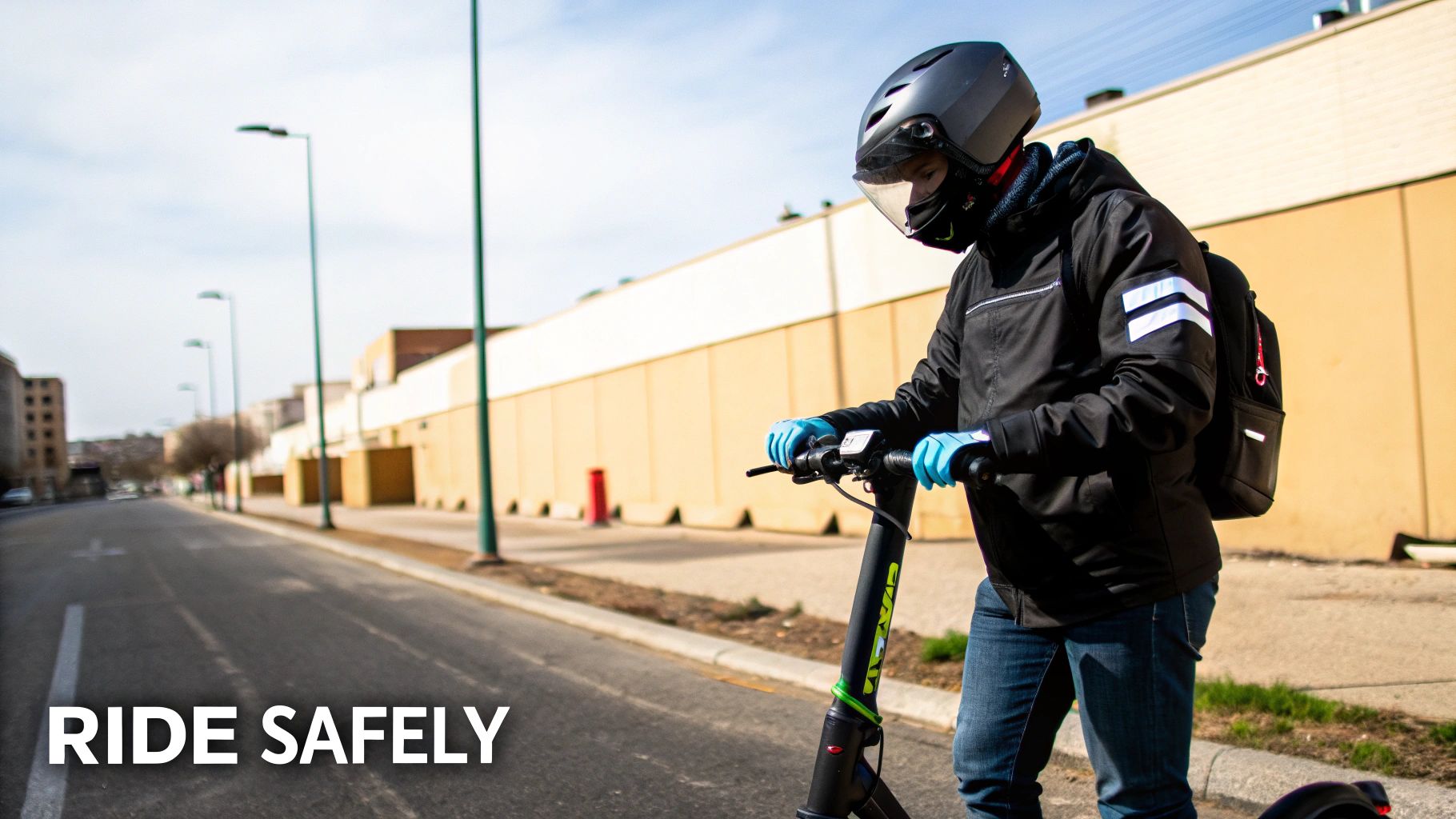
Upgrading your safety gear is absolutely non-negotiable. That old helmet just isn't going to cut it anymore. When you're messing with hardware and firmware, a little knowledge goes a long way, so it's smart to review some general electrical safety guidelines to understand the basics of what you're working with.
Gear Up for Higher Speeds
Think of your safety gear as part of the performance package. If you upgrade your scooter, you have to upgrade your protection to match.
- Upgrade Your Helmet: Seriously, ditch the flimsy bike helmet. You need something rated for higher impacts. Look for an ASTM F1952 (downhill mountain biking) certified helmet or even a proper motorcycle-rated one (DOT in the US, ECE in Australia). Your brain will thank you.
- Protect Your Hands and Joints: A solid pair of riding gloves with reinforced palms can literally save your skin if you go down. Knee and elbow pads are a no-brainer, especially when you're weaving through unpredictable city traffic.
A faster scooter closes the distance to obstacles in a flash, slashing your reaction time. Better gear gives you the confidence to handle that speed responsibly.
Riding fast is a skill. Practice braking from your new top speed in a safe, empty parking lot. Get a feel for the new stopping distance—I guarantee it's longer than you think.
Know the Law Where You Ride
Heads up: modifying your scooter could easily bump it into a completely different legal vehicle class. "I didn't know" won't fly with law enforcement. E-scooter rules are a chaotic mess that changes from state to state and city to city, so you have to do your homework.
In the United States, laws are a total patchwork. Some states have zero specific speed limits, while others cap them at 15 or 20 mph. Tweaking your scooter could put you in violation of a local ordinance you've never even heard of.
In Australia, the rules also vary by state and territory. Some places like Queensland and the ACT allow private e-scooters with a 25 km/h (15.5 mph) speed limit, while others like New South Wales have much stricter rules, largely limiting them to private property. Modifying your scooter to go faster than the legal limit can result in heavy fines and confiscation.
It's worth a few minutes of research to understand the specific complexities of electric scooter speed limits in your area. Staying informed is the only way to enjoy your faster ride without the legal headache.
Got More Questions?
You're not alone. When you start talking about pushing your scooter past its stock limits, a few key questions always pop up. Here are the straight-up answers you're looking for.
Will I Void My Warranty if I Make My Scooter Faster?
Let’s be real: almost certainly, yes. The moment you flash custom firmware or start swapping out the battery, controller, or motor, you've pretty much given the manufacturer a get-out-of-warranty-free card.
Before you even think about picking up a wrench, dig out your warranty paperwork and give it a good read. If you decide to go for it, just be ready to become your own mechanic for any future fixes.
How Much Faster Can This Thing Actually Go?
That's the million-dollar question, isn't it? It all boils down to your specific scooter model and, frankly, your budget. A simple firmware flash can often squeeze out an extra 5-10 mph, which is a fantastic first step and doesn't cost a dime.
But if you’re chasing serious speed, you’ll need to open your wallet. Upgrading to a higher voltage battery and a beefier motor could potentially double your scooter's original top speed. Just make absolutely sure the frame and—most importantly—the brakes are up to the task of handling that kind of power.
A Word of Caution: If your goal is a massive jump, say from 15 mph to 40+ mph, it's often smarter (and safer) to just buy a scooter that's built for that speed from the factory. High-performance models have the brakes, suspension, and frame designed to handle the stress right out of the box.
Should I Bother Upgrading or Just Buy a Faster Scooter?
If you just want a little more zip for your commute and you enjoy getting your hands dirty, upgrading is a great project. It’s a rewarding way to learn the ins and outs of your machine without breaking the bank.
On the flip side, if you're dreaming of blowing past cyclists on the hills, it might be time to start shopping. It can be a tough pill to swallow, but once you add up the cost of a new battery, controller, motor, and better brakes, you might find you’re already at the price of a brand-new performance scooter.
Ready to see what a purpose-built speed machine feels like? Check out the high-performance electric scooters and e-bikes from top brands at Punk Ride LLC. You might just find your next ride.
Share:
What Is a Step Through Bike and Why You Might Want One
What Is the Real Range of Electric Scooter Models?
1 comment
Chcem tu aplikáciu