


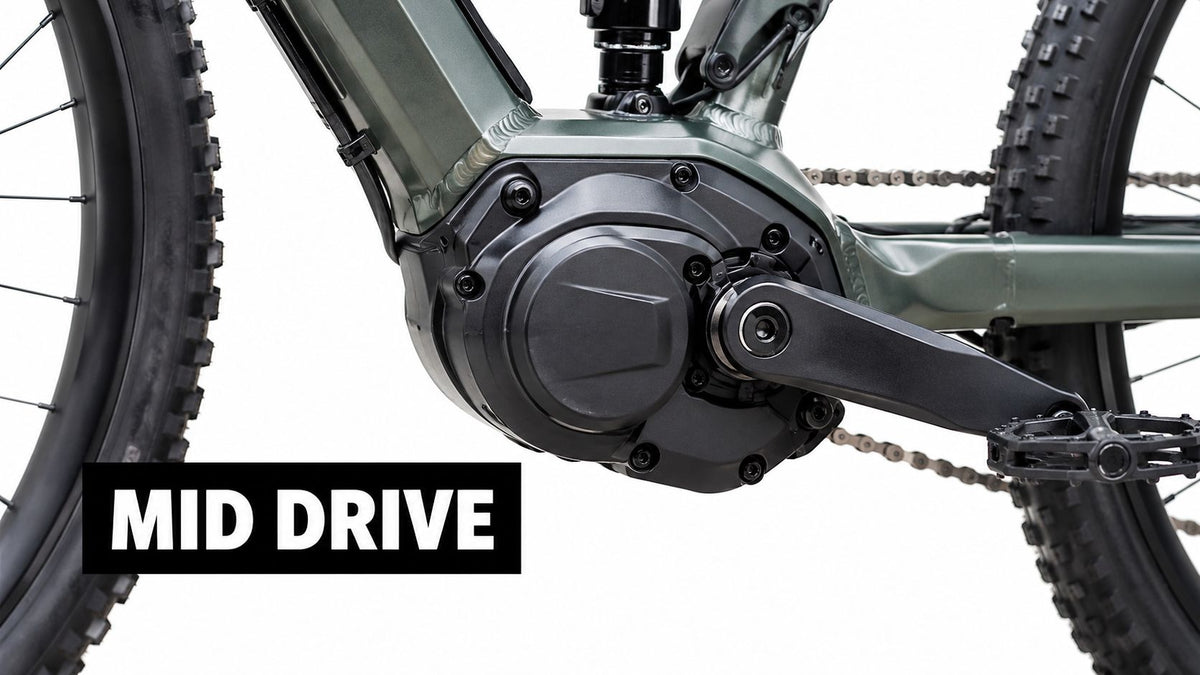
A mid-drive e-bike has its motor mounted at the crankset, sending power through the chain and gears to multiply torque for hill climbing and balanced handling. In a 2026 dataset, mid-drive motors appeared on 77% of EU e-bike models, compared with 72% in the UK and 40% in the US. Source data
You're probably asking because a normal commute has turned into a daily negotiation with one particular hill. A hub-motor e-bike may get you there, but it can feel like someone is pushing the bike from the wheel while you're working hard at the pedals. A mid-drive feels different because the motor works through the same gears you do.
That distinction affects much more than acceleration. It changes how the bike climbs, how naturally assistance responds, how balanced the frame feels, and how quickly the chain and cassette may wear. The right choice depends on your route, your load, and how much maintenance you're willing to handle.
The Core Concept Behind Mid Drive E-Bikes
A route that starts beside a river and ends on a steep cobblestone street exposes the difference between motor layouts. A hub motor sits inside the front or rear wheel and drives that wheel directly. Your pedals still use the chain and gears, but the motor remains tied to a single wheel ratio.
A mid-drive motor sits around the bottom bracket, where the crankset turns the drivetrain. The motor adds force at the same point as your pedals. That force then travels through the chain, cassette, and selected gear before reaching the rear wheel.
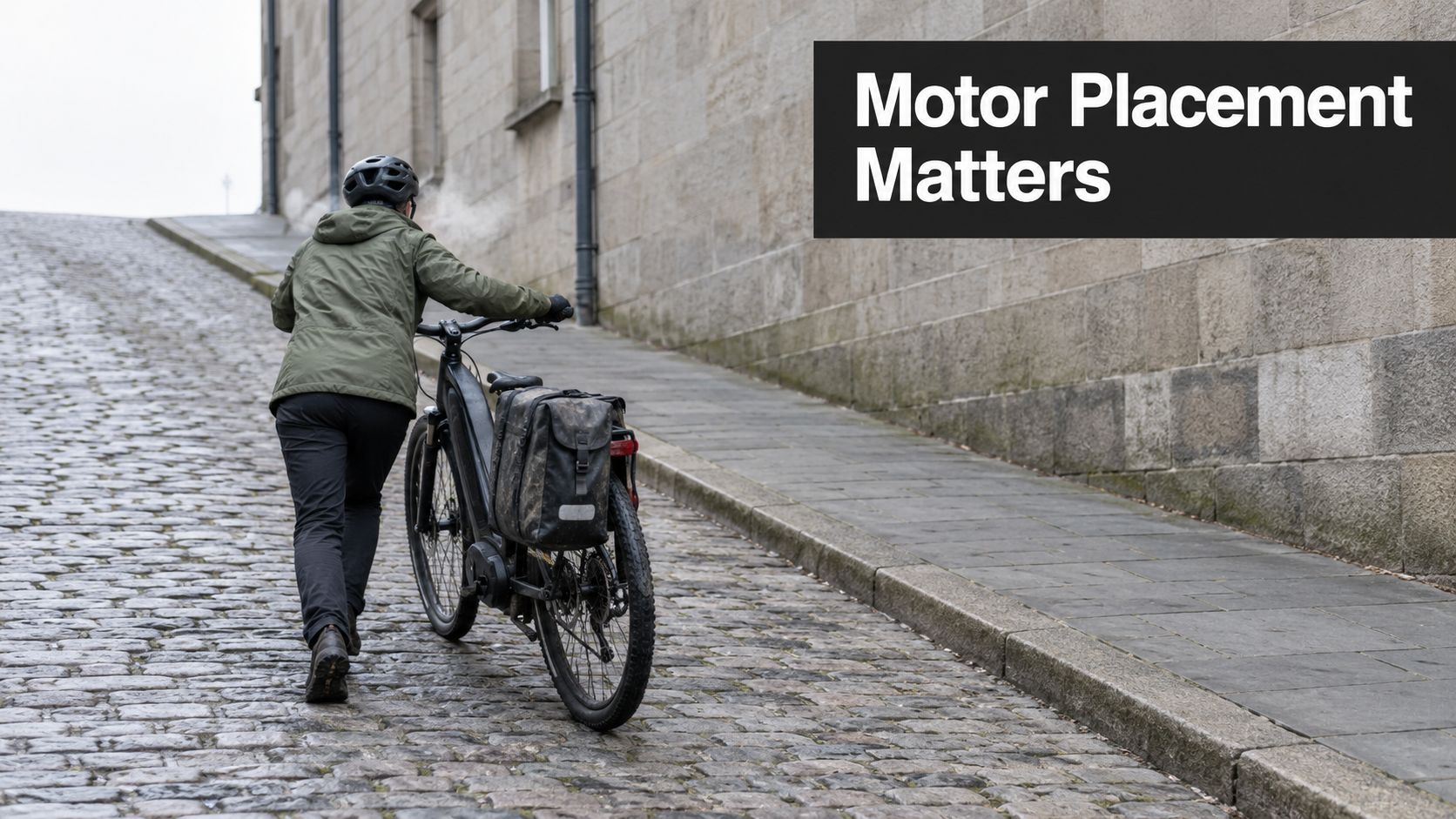
The arrangement gives the drivetrain a useful way to respond to changing terrain. Select a lower gear for a steep climb, and the motor's force reaches the rear wheel through that easier ratio. The motor does not push from a fixed wheel position while your legs manage the gears separately.
Motor placement also changes the bike's balance. A motor mounted low and near the frame's center usually distributes weight more evenly than a motor concentrated in one wheel. You may notice that difference during tight turns, slow riding, rough surfaces, or a loaded climb.
An old idea with a modern job
Mid-drive technology predates current e-bike systems. A 1897 U.S. patent described an electric bicycle whose motor drove the pedal cranks, an early version of today's layout. Historical background on electric bicycle evolution
The design became a premium choice by the 2010s, particularly on performance and cargo bikes. The engineering reason is practical: a motor connected to the bicycle's gears can adapt more easily to changes in slope, speed, and load.
That adaptability carries a trade-off. Because motor power passes through the chain and cassette, those parts can wear faster and may cost more to replace than components on a simpler hub-motor system. A flat-path rider may rarely need the gearing advantage, while someone carrying groceries up a long incline may value it every day.
Mechanic's rule: Motor location shows how power reaches the wheel. Terrain, load, and maintenance expectations determine whether that arrangement suits you.
How Gears Multiply Motor Torque on Climbs
A hill that feels manageable on a flat route can expose the difference between motor power and usable wheel force. Torque is the turning force that gets the wheel moving, so it matters when you are climbing, carrying cargo, or riding with a heavier load. Wattage describes electrical output, but it does not show how effectively that power reaches the ground.
A mid-drive sends the motor's force through the chain, cassette, and bicycle gears. The transmission works like a car gearbox: it trades some wheel speed for more pulling force. Explanation of mid-drive gearing and mechanical advantage
What happens when you select a low gear
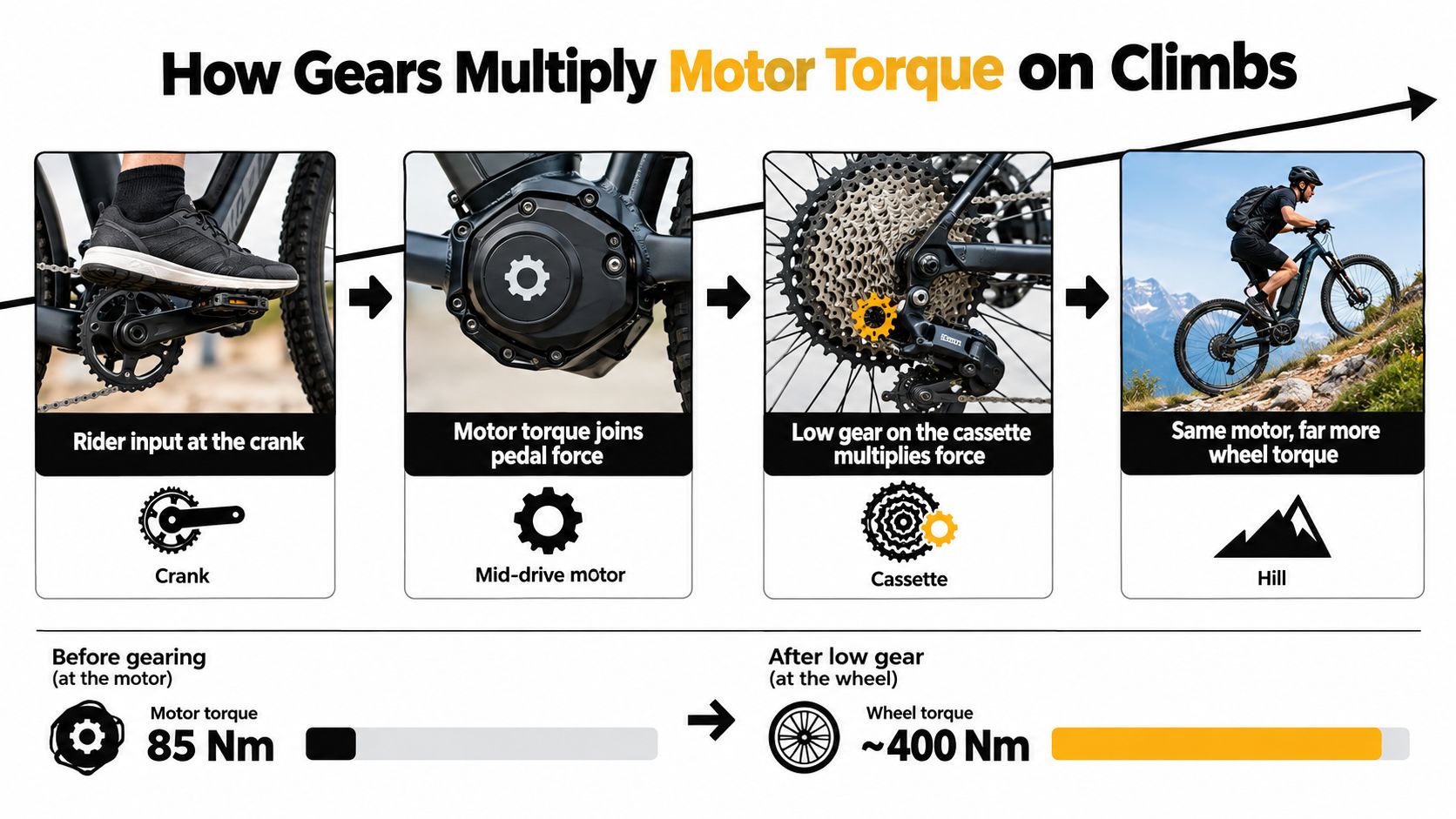
Follow the force through the drivetrain:
- Your legs and the motor turn the crank. Both sources add force at the bike's center.
- The chain transfers that force to the rear cassette. Different sprocket sizes suit different speeds, slopes, and loads.
- You shift onto a larger rear sprocket. The lower gear increases wheel torque and reduces travel speed.
- The motor continues turning within a useful cadence range. It does not have to push against the hill through one fixed wheel ratio.
The basic relationship is:
Wheel torque = crank torque × rear sprocket teeth ÷ chainring teeth
A smaller chainring paired with a larger cassette sprocket creates greater mechanical advantage at the wheel. You sacrifice speed in that gear, but gain the force needed to keep the bicycle moving uphill. Good shifting matters because selecting the lower gear before the slope becomes severe helps the motor and rider maintain steady rotation.
A hub motor drives the wheel directly and does not use the bicycle's transmission to multiply its torque. Changing gears mainly changes the effort required from your legs. The motor remains tied to the wheel's mechanical situation, which can make a long, steep climb harder on the electrical system, especially with extra weight.
The difference is noticeable in practice. Shift early, keep the pedals turning, and the assistance builds with your effort. The bike feels controlled rather than as if it is losing speed under a heavy load. For route ideas and models suited to this terrain, compare electric bikes for hills.
Manufacturer data and drivetrain engineering references put mid-drive torque at around 80 to 120 Nm, with effective wheel torque in low gears estimated above 300 to 400 Nm. Those figures describe the advantage of gearing, not a guarantee that every bicycle will feel the same. Rider weight, battery state, tyres, controller settings, gear selection, and shifting technique all affect the result.
That extra force also passes through the chain and cassette, so frequent hill riding can increase wear and replacement costs. The terrain benefit is real, but it comes with a drivetrain maintenance bill that a flat-route commuter may rarely need.
Mid-Drive vs Hub Motor Performance Differences
A commuter leaving a flat neighborhood for a long, steep climb will notice the difference between motor types quickly. The useful comparison is transmission-driven assistance versus direct wheel assistance, not merely an expensive motor versus an inexpensive one.
A mid-drive sends power through the bicycle's gears. Selecting a lower gear gives the motor more mechanical advantage at the wheel, much like using a smaller gear to make a heavy load easier to move. This can help the motor maintain a productive operating range during sustained climbs. One industry comparison reports steep-hill efficiency of roughly 80–88% for mid-drives versus 45–68% for hub motors, though test conditions vary by motor and controller.
A hub motor drives the wheel directly, so it does not use the bicycle's gear range to multiply motor torque. That can limit its climbing performance on long or steep gradients, but the design has practical advantages. It can feel direct from a stop, often supports a throttle where local rules allow one, and keeps motor power separate from the chain and cassette. For a flat city route, that simpler arrangement may matter more than climbing efficiency you rarely use.
| Feature | Mid-Drive Motor | Hub Motor |
|---|---|---|
| Motor location | At the crankset or bottom bracket | Inside the front or rear wheel hub |
| Power path | Through the chain, cassette, and gears | Directly to the wheel |
| Steep climbing | Strong, because low gears multiply wheel torque | More limited because the motor uses a fixed wheel ratio |
| Flat commuting | Capable, but more system complexity than some riders need | Simple and practical for steady, flat routes |
| Pedal feel | Often natural, especially with a torque sensor | Can feel more like a steady push from the wheel |
| Load carrying | Well suited to cargo and changing gradients | Suitable when the bike and motor match the load and terrain |
| Drivetrain wear | Higher motor-driven strain on the chain, cassette, and chainring | Less motor-driven drivetrain strain |
| Wheel service | Conventional wheel motor-free servicing | Motor-wheel removal and wiring can complicate wheel work |
Sensor choice changes the ride as much as motor position. Mid-drive systems are commonly paired with torque sensors, which measure pedal pressure and adjust assistance with the rider's effort. Torque sensors compared with cadence sensors
A cadence sensor detects whether the cranks are rotating. It can deliver steady support, but the response may feel less connected because the system reacts to movement rather than force. A torque sensor can make a mid-drive feel like stronger legs, especially when starting, climbing, or changing pace in traffic.
Where hub motors make more sense
A flat-route commuter with short stops may prefer a hub motor's uncomplicated response. The bike provides direct assistance without requiring careful gear management, and the chain does not carry the motor's full output.
The workload has moved elsewhere. A powered wheel can require more care during puncture repairs or wheel removal, while its motor may be harder to inspect than a conventional hub. Terrain, load, and service priorities should decide the choice. Neither system eliminates maintenance. Each places it in a different part of the bicycle.
Global Market Adoption and Regional Preferences
Regional buying patterns show where mid-drive systems fit naturally. In the UK and EU, dense cities, older roads, mixed gradients, cargo cycling, and established bicycle cultures favour a bike that still handles like a bicycle while adding power through its drivetrain.
A 2026 dataset of 956 EU e-bike models found that 77% used mid-drive motors. The UK sample covered 793 models, with 72% using mid-drives. The US sample covered 560 models, with 40% using mid-drives. Regional model data for hub-drive and mid-drive systems
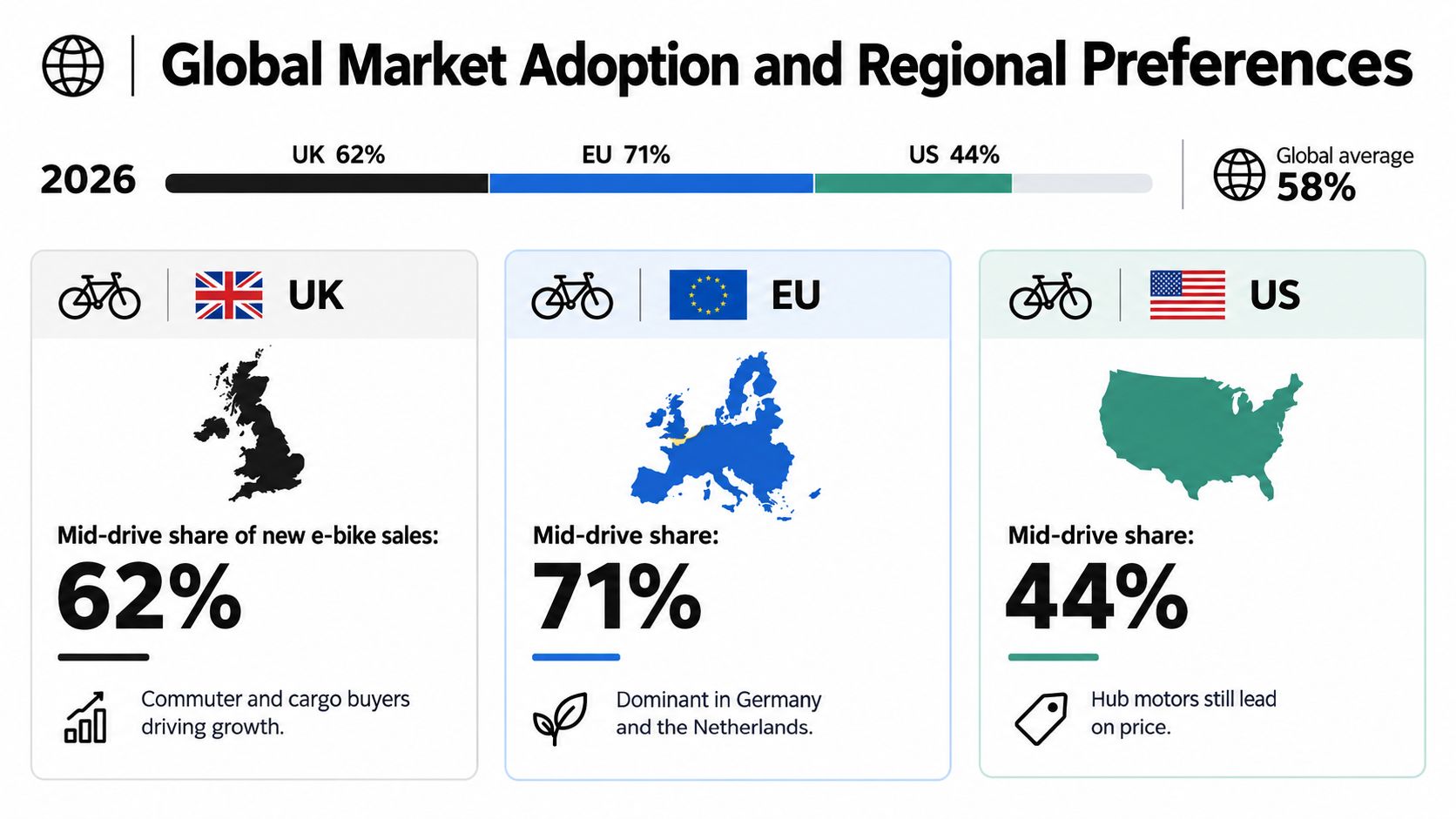
These figures describe sampled models, not every bike sold or every rider's choice. They still show a marked regional difference: mid-drives dominate the sampled UK and EU ranges, while hub motors hold a larger share in the US.
Why the buying logic differs
European and British buyers often want controlled, pedal-focused assistance for narrow streets, cycle paths, and changing gradients. A central motor, torque-sensitive support, and a useful gear range suit that riding environment because the rider can select a lower gear before a climb and keep the motor working efficiently.
US riding conditions vary more widely. A commuter travelling across flat suburban roads may value a hub motor's direct assistance and simpler drivetrain demands. Another rider may need long-distance comfort, cargo capacity, or throttle access. For those uses, a hub system can make sense without paying for a motor designed around frequent gear-based climbing.
The wider market is also measured in different ways. A market-research report projects mid-drive growth at a 13.46% CAGR globally, while a separate 2025 industry survey puts the US mid-drive motor share at 28.6%. These figures use different definitions, so they should not be compared as if they measured the same thing. They do indicate that mid-drive systems have expanded beyond a specialist category into a major e-bike design.
Regional popularity offers context, not a buying instruction. A UK commuter on a flat route may prefer a hub motor, while a US rider in a hilly city may benefit from a mid-drive more than regional averages suggest.
Choose according to the route in front of you. Check the steepest regular section, the weight you carry, and whether you are comfortable shifting deliberately as the road changes.
The Hidden Maintenance Costs of Mid-Drive Systems
A mid-drive can make a steep commute feel controlled and predictable, but the assistance travels through the bicycle's working drivetrain. Motor force reaches the chain, cassette, chainring, and derailleur before it reaches the rear wheel, so these parts can face more load than they would on a comparable hub-motor bike. Mid-drive drivetrain maintenance considerations
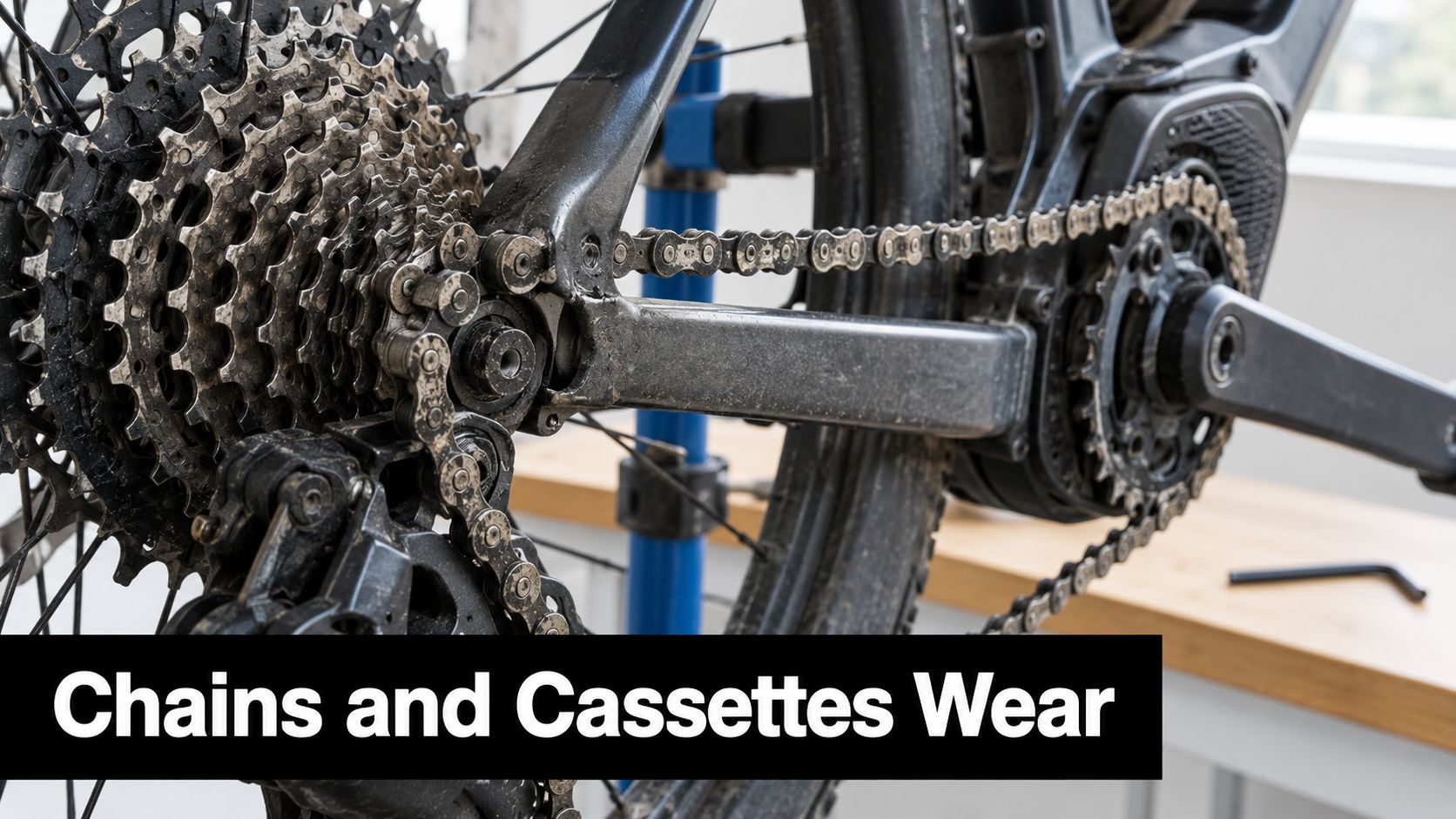
Riding technique changes how quickly that wear appears. Shift into a suitable gear before the climb, keep the chain lubricated, and briefly ease pedal pressure during a gear change. Holding high assistance while grinding slowly uphill, then shifting under heavy load, asks much more from the same components.
Where the wear appears
The chain often shows the first warning. As it elongates, its fit with the cassette and chainring becomes less precise. Leave it too long and the worn chain can damage the teeth, turning a smaller service job into a broader drivetrain replacement.
The cassette and chainring receive this strain because the motor's torque passes through them before reaching the rear tyre. A cargo bike or a commuter on repeated steep climbs can apply that load again and again, especially when starting from a standstill on an incline.
Check these areas during routine maintenance:
- Chain condition: Use a chain-wear gauge to check elongation instead of waiting for skipping.
- Shifting quality: Watch for hesitation, grinding, or chain movement while applying light pedal pressure.
- Cassette teeth: Inspect for hooked or uneven teeth, especially on the sprockets used most often.
- Chain lubrication: Clean the chain first, then apply a suitable lubricant sparingly so grit does not collect.
- Gear changes: Reduce pedal pressure briefly while shifting, particularly when the motor is assisting.
Ownership reality: A mid-drive can reduce effort on a climb while asking more from the parts between your feet and the rear wheel.
Torque levels in the 100–120 Nm range are increasingly framed as suitable for real-world riding and steep terrain. Mid-drive motor torque and performance guide More torque can help on difficult routes, yet it also makes gear choice, shifting technique, and service discipline more important. High assistance does not replace selecting an appropriate gear.
Budget for the whole system
Ownership cost includes more than the purchase price. Allow for cleaning, chain measurement, drivetrain adjustments, replacement chains, cassette wear, and professional diagnosis if the motor or sensors develop a fault.
A mid-drive can still be a sensible choice for steep climbs or heavy loads. Its ability to use the bike's gears may justify the extra upkeep, provided you budget for wear rather than assuming the motor's premium construction makes the entire bicycle maintenance-free.
Before choosing a model, use this guide to choosing an e-bike alongside the manufacturer's service information. Ask which drivetrain parts are standard, whether replacement components are readily available, and which local workshops are familiar with that motor system.
Choosing the Right Motor for Your Commute and Legal Limits
Your morning ride may feel easy on flat streets, then change completely on the way home when a long climb, child seat, or trailer enters the route. Choose a motor for that hardest regular section, not for the easiest kilometre.
Use the terrain and your maintenance priorities as the decision guide:
- Mostly flat city streets: A hub motor may suit you better. It delivers direct assistance without sending motor power through the chain and cassette, which can reduce drivetrain wear.
- Repeated steep hills: A mid-drive can make climbing more controlled because it works through the bike's gears. You still need to select an appropriate gear before the slope becomes severe.
- Cargo or heavy loads: Give mid-drives serious consideration. Gearing can multiply torque at the wheel, but the complete bike's load rating matters more than the motor label alone.
- Mixed terrain and technical riding: A centrally mounted motor and responsive torque-sensor assistance can make slow turns, uneven surfaces, and changing gradients easier to control.
- Low-maintenance priorities: A hub motor limits motor-driven chain and cassette wear, although repairs at the powered wheel may be more involved.
Match the system to your riding habits
A mid-drive rewards active gear use. Shift into a sensible climbing gear early, keep the chain clean, and ease pedal pressure briefly while changing gear. That reduces shock through the drivetrain. A hub motor may feel more natural for a flat route if you prefer simple assistance and minimal gear decisions.
Budget for the parts that transfer the motor's force. Cleaning, chain checks, drivetrain adjustments, replacement chains, cassette wear, and diagnosis of motor or sensor faults can all affect ownership cost. The motor itself may last well while the chain and sprockets need attention sooner.
Legal limits come before performance claims. In Great Britain, an e-bike qualifies as an Electrically Assisted Pedal Cycle, or EAPC, when it has usable pedals, a motor with maximum continuous rated power of no more than 250 watts, and assistance that cuts off at 15.5 mph. See the Great Britain EAPC requirements before buying. Compliant EAPCs do not need registration, insurance, or tax in Great Britain. A non-compliant bike is treated as a motor vehicle, so check its specification and intended road access.
Rules vary across the EU, US, and Australia. Review local classification, speed limits, power definitions, throttle rules, and path access. US riders can use this state-by-state electric bike law guide, then confirm current requirements with local authorities.
Before deciding, test the steepest available slope, shift under moderate climbing pressure, make a slow turn, and listen for drivetrain noise. Compare the same route with a hub motor. Use this guide to choosing an e-bike and ask about standard drivetrain parts, replacement availability, and local workshop support.
Punk Ride LLC sells electric bikes and scooters from brands including ENGWE. Its range includes mid-drive models such as the ENGWE N1 Pro, described with an Ananda M81 250W brushless mid-drive motor. Visit Punk Ride LLC to compare models for commuting, hills, cargo, and outdoor use across the UK, Germany, and the US.
Share:
Electric Scooter Brake Guide: Types, Maintenance & Safety