


A steep city climb can expose an e-bike's weaknesses within seconds. You leave a junction, the road rises, your cadence drops, and a rear hub motor starts feeling like it's pushing against the hill instead of helping you ride over it. The battery may be healthy and the advertised power may look impressive, but the bike still loses momentum when the gradient and your total load increase.
That's where an e bike mid motor, also called a mid-drive motor, changes the conversation. Its position near the pedals lets the motor use the bicycle's gears, so the assistance responds to your cadence, gear choice, and the terrain beneath you. That design brings better climbing and balance, but it also sends more force through the chain and cassette. For a daily commuter, the core question is which motor feels stronger. It's whether the performance gains justify the purchase price and long-term drivetrain maintenance.
Why Your Commute Feels Different With A Mid Motor
On a flat road, most motor layouts can feel perfectly convincing. The difference usually appears when the route turns upward. A hub-motor bike drives the wheel directly, so the motor has one fixed mechanical relationship with the road. As speed falls on a climb, the motor has fewer ways to adapt.
A mid-drive motor sits close to the bottom bracket, where the crank arms attach. Instead of driving the wheel directly, it adds power at the crank and sends that force through the chain, cassette, and selected gear. You still need to shift, but that extra step gives the motor a mechanical advantage on a sustained incline.

The sensation under your feet
The ride feel is less like a push from behind and more like stronger legs. A torque-sensing system can increase assistance as you press harder, while the gears let you keep your cadence in a useful range. On a tight urban corner, a central motor also feels less pendulous than a heavy wheel motor, particularly when you're carrying a backpack, panniers, or groceries.
That balance matters in cities with frequent stops, narrow cycle lanes, and uneven junctions. The heaviest powered components sit low and near the bicycle's centre of gravity, which generally improves weight distribution and handling. A mid-drive doesn't make a bicycle magically light, but it places the mass where your steering and body movements can control it more naturally.
Practical rule: Test the steepest part of your commute, not just the showroom car park. A motor that feels smooth on level ground may behave very differently when your speed drops and the drivetrain is under load.
A mid-drive can be especially useful for commuters in hilly cities, recreational riders on changing terrain, and cargo-bike users who repeatedly accelerate with extra weight. It isn't automatically the right choice for a flat route. A hub motor can be simpler, cheaper to integrate, and less demanding on the chain.
If you're comparing different forms of electric transport for short urban trips, the practical differences between an e-bike and a scooter are laid out in this electric bike versus scooter commuting guide. The important distinction here is that a mid-drive preserves the bicycle's gearing and pedalling behaviour. That's why it can feel more like cycling with assistance than riding a small powered vehicle.
The Mechanics Behind Mid Drive E Bike Systems
The simplest way to understand a mid-drive is to follow the power path. The battery sends electricity to the controller, the controller regulates the motor, and the motor turns the crank area. From there, the chain carries the combined motor and rider input to the rear cassette and wheel.
A hub motor skips most of that mechanical route. It sits inside the front or rear wheel hub and drives the wheel directly. That layout is straightforward, particularly for an entry-level commuter or a conversion kit, but the motor can't use the bicycle's gears to change its mechanical advantage.
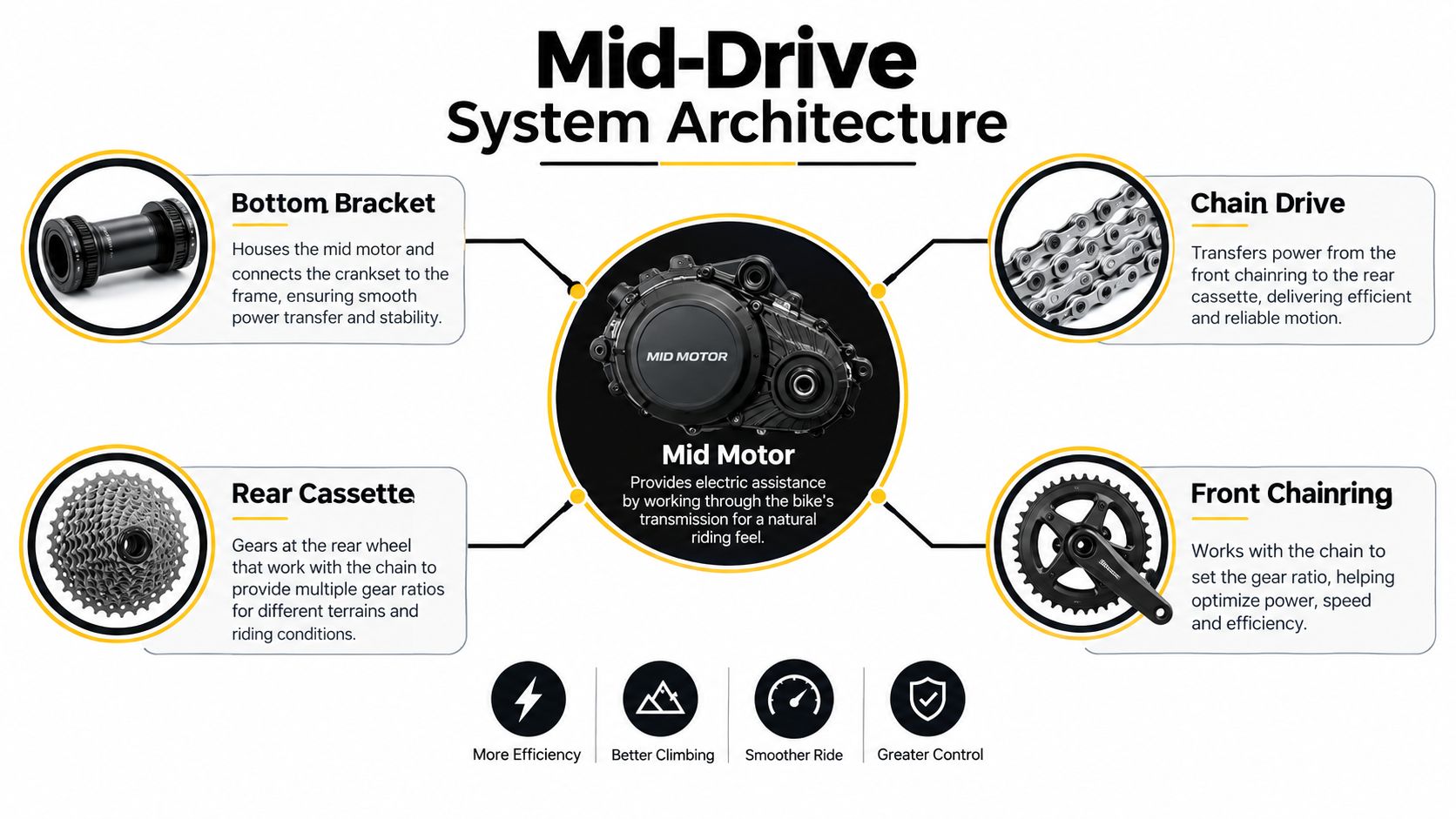
Why central placement changes handling
Think of a bicycle as a lever you're constantly balancing. Weight at the centre is easier to manage than the same weight placed at the far end of a wheel. With a mid-drive, the motor is positioned near the bottom bracket rather than inside the front or rear hub, so the bike tends to feel more settled when cornering, filtering through traffic, or lifting over a kerb.
A 2023 review of e-bike motor-drive configurations found that mid-drive systems generally offer better hill-climbing performance than hub motors with comparable rated power because the motor transmits torque through the existing gear system. The review also identifies the trade-off. A mid-drive needs a specially designed frame and typically costs more to integrate than a hub-motor layout. You can read the engineering discussion in the review of e-bike motor-drive configurations.
What the gearing actually does
A bicycle gear doesn't create energy, but it changes how force reaches the rear wheel. A lower gear makes it easier to turn the cranks against a hill, while a higher gear supports faster riding on level ground. Since the mid-drive motor adds force at the cranks, it benefits from the same adjustment.
That also explains why shifting technique matters more on a mid-drive than on many hub-motor bikes. If you approach a hill in too high a gear, the motor and rider both face a heavy torque demand. Shift before the climb becomes severe, keep the chain running smoothly, and avoid treating the highest assistance mode as a substitute for sensible gearing.
The design has another engineering benefit. For a given power output, a mid-drive unit can be smaller because the bicycle's gearing helps the motor operate in a more favourable rotational-speed range. The gain depends on calibration, gear selection, rider input, and mechanical losses. It isn't a guarantee of longer range on every route.
A purpose-built frame, motor mount, sensors, chainline, and drivetrain all need to work together. That integration helps produce the balanced, responsive ride people buy a mid-drive for, but it also makes the system more complex to manufacture and repair. A useful buying checklist should therefore examine the complete bicycle, not just the motor casing. Punk Ride's guide to choosing an e-bike is a practical place to compare the wider setup.
Mid Motor Vs Hub Motor For Daily Commuting
For a mostly flat commute, a hub motor can be the sensible choice. It offers direct wheel propulsion, often has a lower initial cost, and keeps the motor's force separate from the chain and cassette. That simplicity can matter more than climbing efficiency if your daily route consists of flat roads, short errands, and occasional gentle rises.
A mid-drive earns its place when hills, changing terrain, or heavy loads are routine. Its power travels through the bicycle's gears, so the rider can select a lower ratio when speed falls. That gives the motor more mechanical advantage than a direct-drive wheel motor has on the same climb.
| Feature | Mid-Drive Motor | Hub Motor |
|---|---|---|
| Motor position | Near the bottom bracket and crank | Inside the front or rear wheel hub |
| Hill behaviour | Uses the bicycle's gears to support climbing | Uses a fixed wheel-drive ratio |
| Weight distribution | Central and low, usually giving balanced handling | Concentrated in the powered wheel |
| Initial cost | Typically higher because frame and system integration are more complex | Often lower and simpler to integrate |
| Drivetrain load | Motor power passes through the chain, cassette, and gears | Motor bypasses the chain and cassette |
| Flat commuting | Strong, though its climbing hardware may be unnecessary | Often practical and economical |
| Cargo and trekking | Well suited to repeated climbs and changing loads | Can work well when correctly matched to the route |
| Workshop considerations | May require a mechanic familiar with the drive unit | Wheel, wiring, and powered-hub service can be more involved |
Where each system works best
A hub motor is attractive for a rider who wants predictable assistance without changing gear as often. It can suit flat city streets, uncomplicated errands, and casual riding where low entry cost and straightforward operation carry more weight than responsive climbing.
A mid-drive is more convincing on a route with a steep approach to work, repeated stop-start hill sections, or a loaded return journey. The system can use a lower gear for launch and climbing, which reduces the need to force the motor through a single fixed ratio. That advantage also makes mid-drives relevant to cargo and trekking bicycles, where payload and terrain can change from one ride to the next.
Neither design removes the need to check the rest of the bike. A poorly chosen battery, narrow gear range, weak brakes, unsuitable tyres, or an inappropriate payload rating can undermine a good motor. A mid-drive with poor shifting setup won't deliver its potential, while a correctly matched hub motor may be entirely adequate on a flatter route.
The right motor is the one that handles the hardest regular part of your journey without creating a maintenance burden you'll resent.
For riders in the United States and Australia, the same route-first logic applies, though local speed classifications, road access, and retailer support need separate checks. Don't assume that a motor marketed for one region will have the same legal or service implications in another.
Understanding Torque And Gear Ratios On Hills
Torque is useful, but an advertised newton-metre figure isn't a complete hill-climbing score. The result depends on the gear range, wheel size, rider and cargo weight, gradient, speed, traction, controller limits, battery state, and heat management.
That's why a 60 Nm mid-drive with a wide-range drivetrain can outperform a higher-torque system paired with poor gearing. The lower gear multiplies force at the rear wheel, allowing the motor to turn in a more suitable speed range while the rider maintains control of the bicycle.
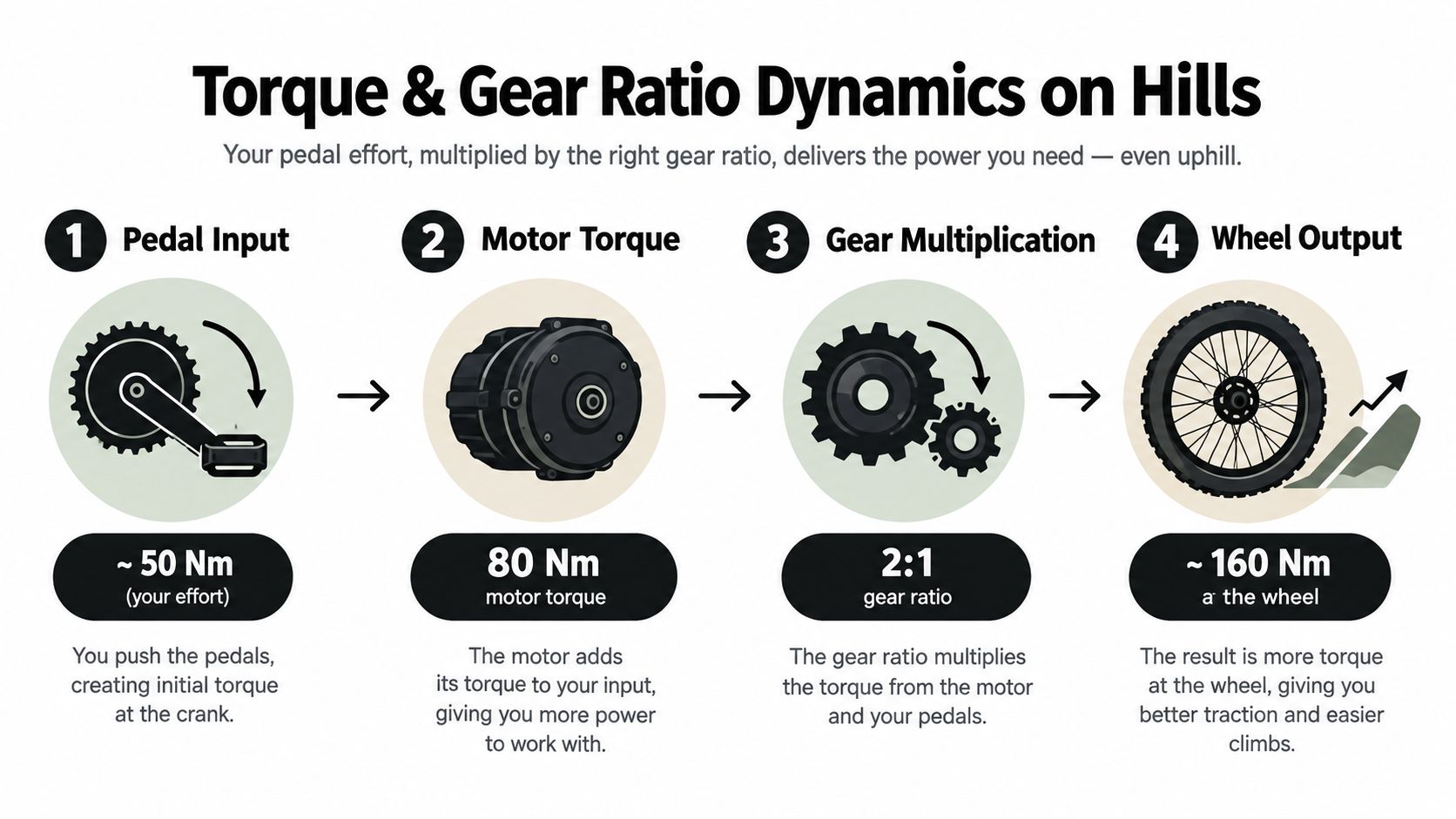
Shift before the climb bites
The most common mistake is waiting until the bicycle is already crawling before changing down. At that point, the motor is dealing with a large resistance load, the chain is under high tension, and the rider may be tempted to select maximum assistance and keep pushing.
Shift into a lower gear before the gradient becomes severe. This reduces the torque load and current demand placed on the motor during launch and climbing. It also gives your legs a usable cadence, which helps the motor and rider share the work rather than making the drive unit do everything.
A gearbox-assisted mid-drive experiment recorded electrical demand of 659 W during acceleration from 0 to 10 km/h, falling to 183 W at 19 km/h, then rising to 867 W at 39 km/h. Maintaining 15 km/h on a 15-degree incline required approximately 1,120 W in that test. These results are reported in the experimental mid-drive study, and they show why a nominal motor rating doesn't describe every real riding condition.
The same tests recorded route consumption of roughly 21.1 to 26.5 Wh/km, with consumption increasing as rider weight increased. Those figures describe the tested setup and conditions, not a universal range promise. Temperature, tyre pressure, assistance level, cadence, gradient, speed, battery state, and total payload can all change the result.
For a clearer explanation of how torque relates to climbing rather than just reading the largest number on a product page, this resource on e-bike torque for climbing is useful context.
What to ask a retailer
Ask for more than peak torque. A serious comparison should include:
- Sustained climbing ability: Find out how the system behaves during a long incline, not just a short acceleration burst.
- Controller current: This helps indicate how aggressively the system can draw electrical power under load.
- Battery capacity: Compare watt-hours alongside the motor and route, rather than treating a larger battery as a replacement for correct gearing.
- Thermal behaviour: Ask how the motor manages heat during repeated starts and long climbs.
- Drivetrain range: Check whether the lowest gear is low enough for your steepest regular section.
The technical point is simple. Motor power, gearing, gradient, and payload work as a system. Torque alone can't tell you whether a mid-drive will climb your route comfortably.
The Hidden Maintenance Costs Of Mid Drive Systems
A mid-drive's strength becomes its ownership challenge because the motor drives through the same chain, cassette, chainring, and derailleur that carry your own pedal input. Every hard hill start adds motor force to those parts. Frequent high-assistance launches, late shifting, poor lubrication, and riding in a high gear can accelerate wear.
That doesn't make mid-drives unreliable. It means the drivetrain deserves more attention than it would on a comparable bicycle where the hub motor drives the wheel independently. A worn chain can affect shifting, damage cassette teeth, and make the motor work harder to deliver smooth assistance.
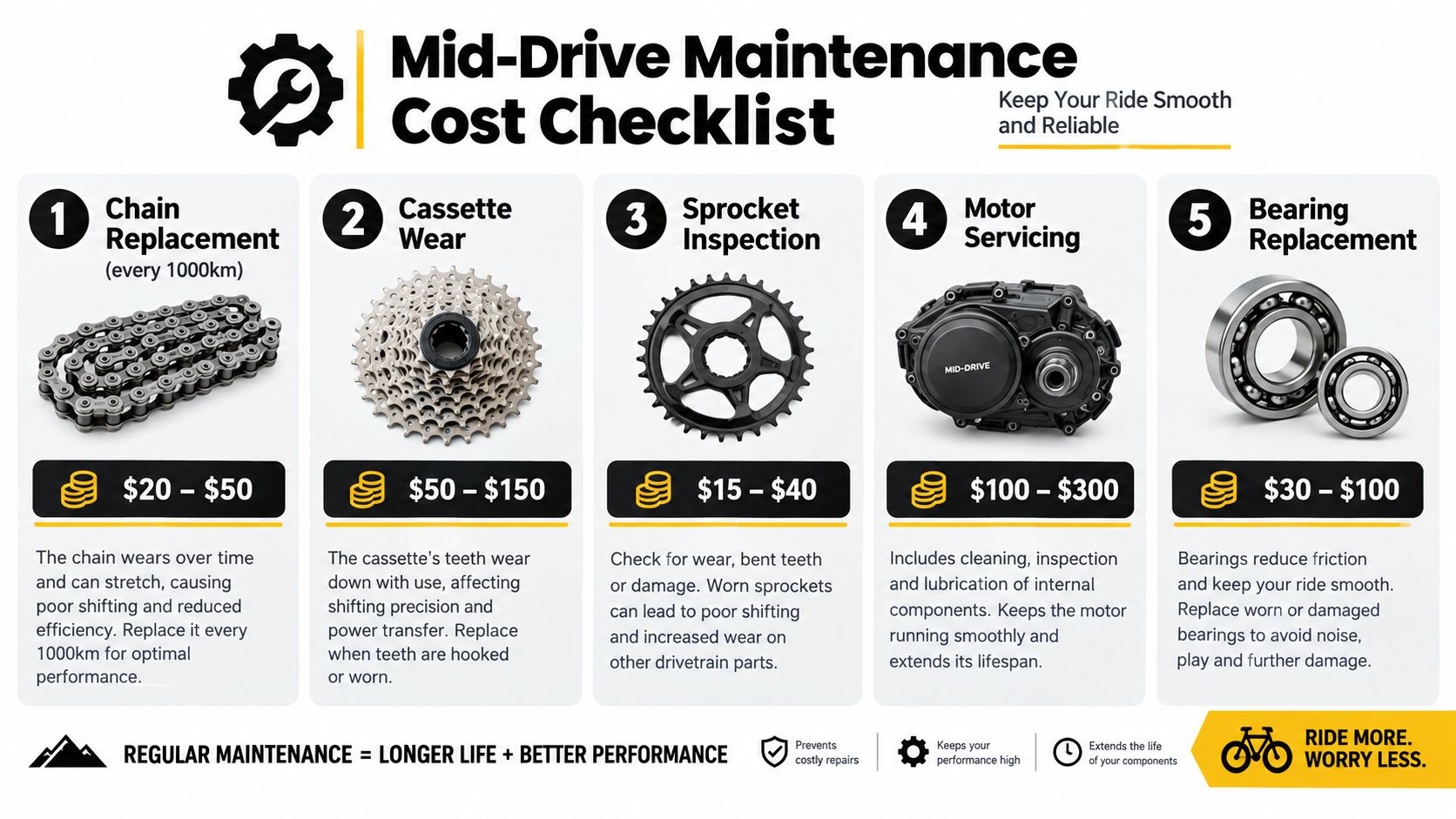
Ride in a way that protects the drivetrain
The best maintenance strategy starts before the workshop. Shift down before a climb, avoid forcing a gear while the chain is heavily loaded, and keep the chain clean and lubricated with a product suited to your riding conditions. If the chain starts skipping, the cassette teeth look hooked, or gear changes become hesitant, investigate early rather than continuing to apply motor torque.
Use a simple routine:
- Inspect the chain and cassette regularly. Look for stiff links, unusual noise, missed shifts, and visible tooth wear.
- Clean before lubricating. Oil applied over grit creates an abrasive paste.
- Ease pressure during shifts. Briefly reduce pedal force while changing gear, especially on a climb.
- Check the chainline. Poor alignment can increase noise and wear across the cassette.
- Use an experienced workshop. Proprietary drive units may need diagnostic tools, firmware knowledge, and approved parts.
A hub motor trades some of this drivetrain stress for different service considerations. The powered wheel can make puncture repairs, wheel removal, wiring checks, and spoke work more involved. Mid-drive ownership isn't maintenance-free, but its service burden appears mainly in the transmission that you use on every ride.
Don't ignore the battery and charger
Mechanical upkeep isn't the only ownership issue. UK government-commissioned research published in January 2025 examined real-world e-bike battery failures, foreseeable misuse, manufacturing materials, and gaps in safety standards. Separate UK guidance published in December 2024 says safer e-bike batteries should include mechanisms capable of preventing thermal runaway. The government's e-bike battery safety research provides the relevant safety context.
Use the supplied or properly approved charger, inspect cables and connectors, and stop using equipment that shows damage or unusual heat. Store the battery according to the manufacturer's instructions, keep modifications conservative, and make sure replacement batteries are compatible with the drive system and charger.
Battery range advice also needs context. A larger battery can increase available energy, but it won't correct an unsuitable gear choice, excessive payload, underinflated tyres, or a motor operating outside an efficient range. This guide to e-bike battery service life is useful when comparing the battery portion of total ownership rather than focusing only on motor performance.
Navigating UK And EU E Bike Legal Requirements
In Great Britain, a mid-motor e-bike can qualify as an Electrically Assisted Pedal Cycle, or EAPC, when it meets specific conditions. It must have pedals capable of propelling the bicycle, use an electric motor with a maximum continuous rated power of no more than 250 watts, and stop providing electrical assistance when the bicycle reaches 15.5 mph, or 25 km/h. These requirements are set out in Transport for London's e-bike safety guidance.
The power limit concerns the motor's continuous rated output. It doesn't refer to the battery's watt-hour capacity, so a higher-capacity battery isn't automatically outside the EAPC category. A compliant EAPC doesn't require vehicle registration, insurance, taxation, or a driving licence under the stated framework.
Check how the motor assists
The legal test isn't based only on whether the bike has a motor. The bicycle must have pedals that can propel it, and ordinary pedal assistance must stop at the relevant speed threshold. UK guidance also distinguishes pedal assistance from throttle operation. A bicycle may be propelled without pedalling up to 15.5 mph only where it has been approved for that function, commonly described as a compliant “twist and go” EAPC.
An off-road switch or riding mode that lets the motor continue assisting above 25 km/h can take an apparently compliant e-bike outside the EAPC definition. If the bicycle exceeds the relevant power or assistance thresholds, it may be treated as a motor vehicle and could require registration, insurance, taxation, or other obligations. Review the current UK electric bike rules before buying, modifying, or importing a system.
Across the European Union, the standard low-speed pedelec category is also built around a 250-watt maximum continuous motor output and assistance that progressively reduces and cuts off before 25 km/h. Regulation (EU) No. 168/2013 exempts qualifying pedelecs from the vehicle type-approval framework that applies to faster or more powerful electric cycles. The exemption depends on pedal operation, the assistance threshold, and continuous rated power. The category overview and regulation context are summarised in this EU pedelec reference.
Treat proposals as proposals
The UK government has proposed raising the maximum continuous motor rating from 250 watts to 500 watts and allowing throttle assistance up to 15.5 mph, or 25 km/h, without type approval. Those are proposed legislative changes, not the established current EAPC rules. The published UK consultation outcome explains the proposal, but buyers should check the law in force at the time of purchase and use.
Is A Mid Motor E Bike Right For Your Route
A mid-drive makes the strongest case when your route includes sustained hills, repeated climbs, heavy cargo, or frequent changes in speed and load. The motor's central position helps the bicycle feel balanced, while the gears let you manage climbing effort rather than relying on a single fixed wheel ratio.
Choose a hub motor when your route is mainly flat and you value a lower initial cost, simpler drivetrain loading, and uncomplicated assistance. It can be the better ownership decision if you rarely use the capability that makes a mid-drive more expensive.
Before buying, assess four things:
- Your hardest gradient: Test it at commuting speed with your actual bags or cargo.
- Your shifting habits: A mid-drive rewards early, deliberate gear changes.
- Your service access: Confirm that a local shop can support the specific motor system.
- Your legal category: Check continuous power, assistance cut-off, pedal operation, and any throttle function.
A mid-drive isn't automatically superior. It's a specialist tool for riders who'll use its climbing, balance, and load-carrying strengths often enough to justify greater drivetrain care. Match the motor to the route, then budget for the chain, cassette, servicing, battery safety, and local support that make the whole bike work.
Punk Ride LLC offers a curated range of electric rides for urban commuting and outdoor use, with fulfilment support through warehouses in the UK and Germany alongside its Florida headquarters. Visit Punk Ride LLC to compare e-bike options and choose a setup whose motor, gearing, legal category, and maintenance demands fit your daily route.
Share:
Used E Scooter for Sale: The Complete Buyer's Guide 2026