


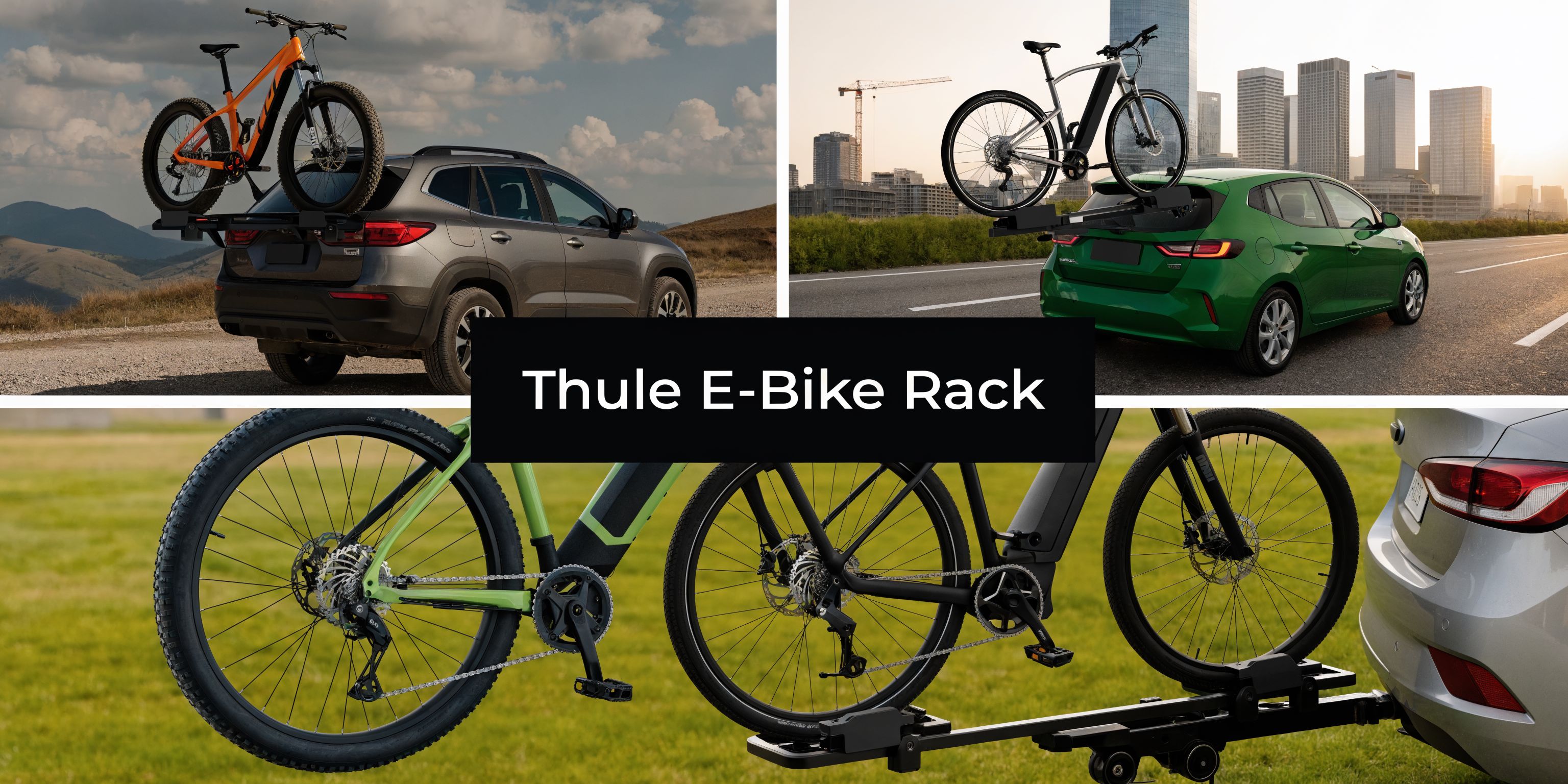
You unbox the bike, peel off the last bit of foam, and step back for that first proper look. It’s bigger than the photos suggested. Heavier too. The battery, the wider tyres, the chunkier frame, the rack mounts, the mudguards. It looks ready for real miles.
Then the practical question lands. How are you getting it anywhere?
That’s the point where a lot of riders start eyeing an old trunk rack in the garage and hoping for the best. With a heavy e-bike, especially the kind common in the US and Australia, that’s where expensive mistakes start. A good thule e bike rack isn’t just a convenience buy. It’s protection for a bike that costs real money and often weighs enough to expose every weakness in a cheap carrier.
Your New E-Bike is Here So How Do You Move It
The usual story goes like this. Someone buys a fat-tyre folder, a big commuter, or a hardtail-style e-bike for weekend rides outside town. It arrives. They love it. Then they try lifting it onto the old rack they used for a lightweight hybrid years ago and realise the whole plan is shaky.

That sinking feeling is justified. E-bikes don’t just weigh more. They carry that weight in ways that stress racks differently. A hub motor bike with a rear battery feels different to load than a mid-drive commuter with a low-slung frame, and both are a different job from a normal bike.
For riders trying to make sense of that before buying a rack, it helps to first check the bike itself. This guide on electric bike weight limit is worth reading because the rack choice starts with the loaded weight of the bike, not the optimistic number in your head.
You don’t want your first long drive with a new e-bike to be the same trip where you find out the rack was the weak link.
For UK and EU riders, the issue usually shows up with compact urban bikes and storage constraints. For US and Australian riders, it’s often heavier bikes, thicker tyres, bigger vehicles, and longer highway runs. That changes the rack decision fast.
Why Your Old Bike Rack Is a Disaster Waiting to Happen
A standard bike rack can hold a bike. That doesn’t mean it should hold an e-bike.
The easiest analogy is a car and caravan. A small hatchback might physically move a trailer for a short distance. That doesn’t make it a safe towing setup. The same logic applies here. If the rack is marginal, every bump, lane change, driveway exit, and pothole works against you.
Weight is only half the problem
Weight is only half the problem. Many riders fixate on bike weight first, and they should. But the bigger problem is how that weight behaves once the car is moving.
An e-bike carries more mass in the battery and motor area. Many also have accessories fitted before you ever leave the house. Rear racks, baskets, locks, lights, mudguards, suspension seatposts, and phone mounts all add bulk and odd loading points. The rack has to manage the static load and the movement of that load on the road.
A flimsy hanging rack usually gives itself away fast. You’ll see sway. You’ll hear straps working loose. You’ll notice the bike settling into a position you didn’t load it into.
E-bike frames don’t play nicely with generic carriers
Modern e-bike geometry is awkward for old-school support arms.
Step-through frames are common. So are chunky downtubes, battery housings, integrated rear carriers, and broad mudguards. A rack that expects a simple diamond frame often turns loading into a compromise. You end up clamping a strange tube angle, crushing cable runs, or forcing the bike into a position that never feels quite right.
Tyres are another issue. Many guides still talk in standard-bike terms, but there’s a compatibility gap for riders on fat-tyre models. One detailed rundown points out that many guides mention a 2.3-inch tyre limit, while bikes from brands like ENGWE or HITWAY often run 4-inch tyres, and that some setups such as the EasyFold XT2 may need XXL Fat Tire Straps to work safely. That same piece notes fat-tyre e-bike sales surged by 35% in 2025 for US and Australian riders dealing with this exact problem, according to Really Good Ebikes.
Road forces make weak racks worse
The driveway test means almost nothing. Plenty of bad setups look fine parked outside the house.
Once you’re on the road, the bike pitches, twists, and tries to move independently of the car. Heavy e-bikes amplify that. If the rack isn’t built for it, little issues become big ones.
- Paint damage: Frame-contact designs can rub where the bike shifts.
- Wheel movement: Narrow trays and short straps struggle with larger tyres.
- Hitch play: Any slack at the receiver gets magnified at the outer end of the rack.
- Bike-to-bike contact: Two heavy bikes placed too close can knock together under braking or over rough surfaces.
Practical rule: If loading the bike feels like forcing a solution, it probably is one.
That’s why a purpose-built e-bike rack matters. It solves fit, support, and stability at the same time, instead of asking you to improvise around all three.
Choosing Your Foundation Hitch vs Roof Racks
For heavy e-bikes, this decision is usually made by physics before personal preference gets a vote.
Roof racks can work for lighter bikes. They’re still useful in some setups. But for the kind of e-bikes many US and Australian riders own, a hitch-mounted platform rack is the practical answer most of the time.

Why hitch racks dominate for e-bikes
The main advantage is simple. You load lower.
That matters more than people think. Wrestling a heavy bike up to chest height is awkward. Lifting it over your head onto a roof system is where backs get tweaked, mudguards get bent, and cars get scratched.
A hitch rack also keeps the bike in a more stable loading zone. You can line up the bike, roll or lift it onto the tray, secure it, then do your strap checks without standing on door sills or reaching overhead.
Here’s the practical comparison:
| Rack type | What works | What doesn’t |
|---|---|---|
| Hitch platform rack | Better for heavy bikes, easier loading, less overhead lifting, usually the cleanest fit for odd frame shapes | Adds length to the vehicle, can affect rear access depending on tilt design |
| Hanging hitch rack | Fine for some lighter standard bikes | Poor match for many e-bike frames, more sway, less confidence with heavy loads |
| Roof rack | Useful if the hitch is needed for something else, keeps rear of vehicle clear | Hard to load heavy bikes, increases height risk, less forgiving for daily use |
For riders comparing receiver options before they buy, this guide on a bike rack adapter hitch helps sort out the vehicle side of the decision before you get stuck with the wrong mount.
When a roof rack still makes sense
There are cases where roof transport still earns a place.
If you already run a full roof system and your bikes are lighter, it can be tidy. If your hitch is occupied for other gear, you may prefer to keep the rear free. Some riders also like the clear boot access and the fact that there’s nothing sticking out behind the car.
But for a heavy e-bike, roof loading is usually the point where convenience collapses. Even if you can do it, that doesn’t mean you’ll want to do it regularly. A rack you dread using becomes a rack you stop using.
Platform vs hanging matters more than many buyers realise
Platform vs hanging matters more than many buyers realise. Generic buying guides often undersell the issue. Not all hitch racks are equal.
A platform-style rack supports the bike by the wheels or trays. That suits e-bikes because many have unusual frame shapes, integrated batteries, and accessories that make frame clamping awkward. Platform racks also tend to keep the bike more settled over rough roads.
A hanging rack suspends the bike from arms. That’s old logic built around lighter bikes with simpler top tubes. On an e-bike, it often creates a chain of small compromises. Weird fit. More movement. More fiddling. More risk of contact where you don’t want it.
The fat-tyre issue is where details matter
The tyre question catches out a lot of buyers.
A rack may look perfect in photos, then the stock straps or trays turn out to be aimed at narrower tyres. The bike technically fits, but not in a way you’d trust for a motorway or outback run. This is especially common with US and Australian fat-tyre models.
Buy the rack for the bike you own, including the tyre width, mudguards, wheelbase, and accessories. Don’t buy for an imaginary stripped-down version of it.
If you’ve got a big step-through commuter in the UK or EU, fit often revolves around frame shape and storage. If you’ve got a broad-tyred adventure bike in Texas, Queensland, or WA, tyre clearance and total system weight usually become the deciding factors.
The Workhorse Thule T2 Pro XTR Deep Dive
If I had to pick the Thule model that best matches the word workhorse, it’s the Thule T2 Pro XTR. This is the rack for riders who care more about stability and broad bike fit than compact storage.

The headline numbers tell you why it gets so much attention. The T2 Pro XTR supports up to 60 lbs per bike and 120 lbs total, weighs 52.04 lbs, takes 20-29 inch wheels, fits tyres up to 5 inches, and works with a maximum wheelbase of 1270 mm, according to Aventon’s Thule T2 Pro XTR listing.
What the design gets right
The biggest win is the no-frame-contact approach.
That matters on expensive bikes. Instead of grabbing the frame in a way that can rub paint or put pressure in the wrong place, the system secures the bike by the tyres. On e-bikes with unusual tubing, battery integration, or delicate finishes, that’s a much better solution than hoping a frame clamp lands somewhere sensible.
The same source notes the rack uses a tool-free hitch system and integrated wheels that can reduce setup time by 50% compared to competitors. Those wheels sound like a minor convenience until you’ve had to drag a heavy rack out of a garage, around a parked car, and into the receiver on your own.
Why it suits US and Australian riding
This rack makes sense for riders who do longer drives, rougher access roads, and more mixed-use trips.
A lot of larger e-bikes sold in the US and Australia have exactly the kind of broad tyres and sturdy frames that expose weak racks. The T2 Pro XTR’s tray format and tyre-based hold suit that job better than a lot of more delicate systems.
A few details matter in practice:
- Tyre capacity: Up to 5 inches gives it real fat-tyre usefulness.
- Receiver fit: It works with 1.25-inch or 2-inch receivers.
- Bike spacing: 12.5-inch spacing helps reduce bike-on-bike contact.
- Rack loading logic: Platform support makes awkward e-bike frames less of a drama.
A rack can be heavy and still be easy to live with if the handling details are sorted. The integrated wheels on this one make a difference.
For riders carrying bikes near that upper weight bracket, I’d still strip removable accessories before loading. Batteries, panniers, and baskets don’t belong on the bike during transport if you can avoid it. The rack may be rated for serious weight, but less load is always kinder to the whole setup.
Where the T2 Pro XTR isn’t the best fit
The trade-off is that it’s not the neatest option once removed from the car. If your life involves carrying the rack up steps, tucking it into a small flat, or constantly taking it on and off, you’ll notice its bulk.
That doesn’t make it the wrong choice. It just means this model rewards riders who value on-road confidence more than compact storage.
A closer look at the rack in use helps make those details clearer:
For adventure-focused e-bike transport, this is the one I’d put in the tough-use column first.
The Urban Strategist Thule EasyFold XT 2 Deep Dive
The Thule EasyFold XT 2 answers a different question. It’s less about maximum ruggedness and more about making daily transport less annoying.

That matters if you live in a flat, share parking, store the rack in the boot, or just hate wrestling with hardware every weekend. A lot of commuters don’t need the most overbuilt rack on the market. They need one they’ll use without swearing at it.
According to Thule’s EasyFold XT 2 product page, it carries 130 lbs total, with 65 lbs max per bike, weighs 45 lbs, and folds down to 31 x 12 x 26 inches.
Why commuters like this one
That foldability is the whole story.
A rack that disappears into a manageable shape changes how often people use it. You can keep it in the car, store it in a hallway cupboard, or move it around the garage without dedicating a huge amount of space to it. For UK and EU riders, where storage is often tighter, that’s a major practical advantage. For suburban US and Australian riders, it’s still useful if the rack comes on and off often.
The optional loading ramp is another standout detail. Thule says it can cut the effort of lifting a heavy e-bike by 70%, which is exactly the kind of feature that matters more after the honeymoon period than on day one. If your bike is a daily commuter rather than a weekend-only toy, reducing lifting hassle is a real quality-of-life gain.
What to check before buying
This isn’t a universal yes for every bike.
The EasyFold XT 2 covers 16-29 inch wheels, supports a 1300 mm wheelbase, and has a standard 3-inch max tyre width, extendable to 4.7 inches with XXL straps, from the same Thule listing. That means it can work for a lot of bikes, but this is also where buyers need to be honest about tyre width and accessory needs.
If you own a chunky fat-tyre e-bike, don’t assume the stock setup is enough. Confirm what the bike needs before ordering, not after the first loading attempt.
Real-world trade-offs
The EasyFold XT 2 is excellent for people who value convenience, but it does give something up compared with a more dedicated rough-use rack.
- Best for: Frequent fitting and removal, compact storage, urban and suburban use.
- Less ideal for: Riders who want the most overbuilt feel for repeated rough-road use.
- Worth paying attention to: Tyre width, wheelbase, and whether you’ll need the ramp from day one.
This is the rack for the rider who wants the process to feel easy, not heroic.
For city riders with heavier commuters, that’s often the smarter buy. A rack that folds neatly, stores cleanly, and reduces lifting strain can be the one that gets used every week rather than sitting in the garage as a “trip only” accessory.
Proper Installation and Long-Term Care Tips
A premium rack can still do a poor job if it’s fitted carelessly.
A lot of trouble starts here. The owner buys the right rack, gets impatient, rushes the install, and assumes “tight enough” is good enough. Then the first motorway run or long regional drive exposes a small mistake that should’ve been caught in the driveway.
Start with a clean, deliberate install
Fit the rack on level ground. Give yourself room to move around the back of the vehicle. Don’t install in a hurry five minutes before leaving.
The receiver fit matters most. The rack should slide in cleanly, seat properly, and tighten down so the connection feels like part of the vehicle rather than an attachment hanging off it. A little movement at the hitch becomes a lot of movement at the bike trays.
My basic install routine is simple:
- Seat the rack fully: Don’t stop when it “looks in.” Make sure it’s fully home in the receiver.
- Engage the anti-wobble system properly: Tighten it until the rack feels planted, not merely attached.
- Test for play by hand: Push up, down, and side to side before loading a bike.
- Load one bike and test again: The feel changes under weight.
- Load the second bike only after rechecking spacing and strap path.
If a rack still feels vague after proper tightening, I don’t drive and “see how it goes.” I start over.
Build a pre-trip habit
Most transport issues don’t come from catastrophic failure. They come from one overlooked detail.
Check these every time:
- Wheel straps: Make sure each strap is routed cleanly and tightened properly.
- Arm position: Confirm the hold-down arm is where it should be and hasn’t landed on a bad contact point.
- Loose accessories: Remove batteries, panniers, baskets, pumps, and anything else that can shift or fly off.
- Light and plate visibility: Check what the rack and bikes block on your specific vehicle.
- Tyre pressure and bike stability: A bike that sits strangely in the tray often tells you something is wrong.
For riders learning the best way to secure the bike itself, this guide on an e-bike mount is a useful companion to the rack setup.
The near-max-load issue is real
This is the part manuals tend to treat lightly, but owners worry about it for good reason.
A recurring concern in rider forums is the long-term safety of racks used close to their maximum capacity, especially as e-bikes have risen to an average heavy weight. Forum discussion also points out that manuals specify tightening torques but don’t offer much real-world data on long-term vibration wear or hitch stress, which leaves owners carrying two heavy bikes watching for signs of fatigue over time, as noted in this Electric Bike Review forum thread.
That doesn’t mean the rack is unsafe. It means the owner should act like a mechanic and inspect it like one.
What to monitor over time
A rack used often needs regular inspection, not blind trust.
Look for:
- Fastener loosening: Especially after long trips or rough roads.
- Wear at moving joints: Tilt mechanisms and folding points take repeated stress.
- Strap condition: Tyre straps wear faster than many people expect.
- Corrosion or grime buildup: Coastal areas and winter roads are hard on metal parts.
- Receiver wear: If the fit feels looser than when new, don’t ignore it.
Check the rack after the first few miles of a long trip, then again at fuel or coffee stops. Small problems usually show themselves early.
Keep it simple with maintenance
Routine care isn’t glamorous, but it works.
Wipe road grime off the trays and moving parts. Clean out grit before it gets ground into pivots and locks. Lightly lubricate hinges and locking parts where appropriate. If the rack isn’t living on the car, store it indoors. If it does stay on the vehicle often, inspect it more frequently.
A thule e bike rack lasts best when the owner treats it as load-bearing equipment, not just an accessory.
Making Your Final Decision The Right Rack for You
The right choice usually becomes obvious when you stop shopping by brand name and start shopping by use case.
If your bike is heavy, broad-tyred, and likely to see rougher access roads or long drives, the T2 Pro XTR is the stronger fit. It’s the rack for riders who value secure tray support, broad tyre compatibility, and a tougher everyday feel.
If your bike is still heavy but your life revolves around city use, limited storage, and frequent rack removal, the EasyFold XT 2 makes more sense. It’s easier to store, easier to handle off the car, and more friendly to routine commuting life.
A simple way to decide:
| Your situation | Better fit |
|---|---|
| Heavy fat-tyre e-bike, rougher roads, more weekend travel | Thule T2 Pro XTR |
| Commuter e-bike, tighter storage, frequent on-off use | Thule EasyFold XT 2 |
| Need the easiest loading process possible | EasyFold XT 2 with ramp |
| Need the broadest fat-tyre confidence | T2 Pro XTR |
If your travels also include motorhomes or tow vehicles, it’s worth reading this guide on the best bike rack for RV adventures because RV use introduces a different set of stability and mounting questions than a normal passenger car.
Buy for your bike, your vehicle, and your routine. That’s how you end up with a thule e bike rack that feels right every time you load it, not just on the day it arrives.
If you’re comparing electric bikes, scooters, and urban mobility gear across the US, UK, and Germany, Punk Ride LLC is worth a look. They stock a wide mix of commuter and adventure-focused models, so if you’re trying to match the right rack to the right ride, it’s a useful place to start narrowing down what you’ll be transporting.
Share:
Explore Stylish Electric Bikes for City and Trail Adventures
Electric Bikes vs. Scooters: Your Ultimate Guide