


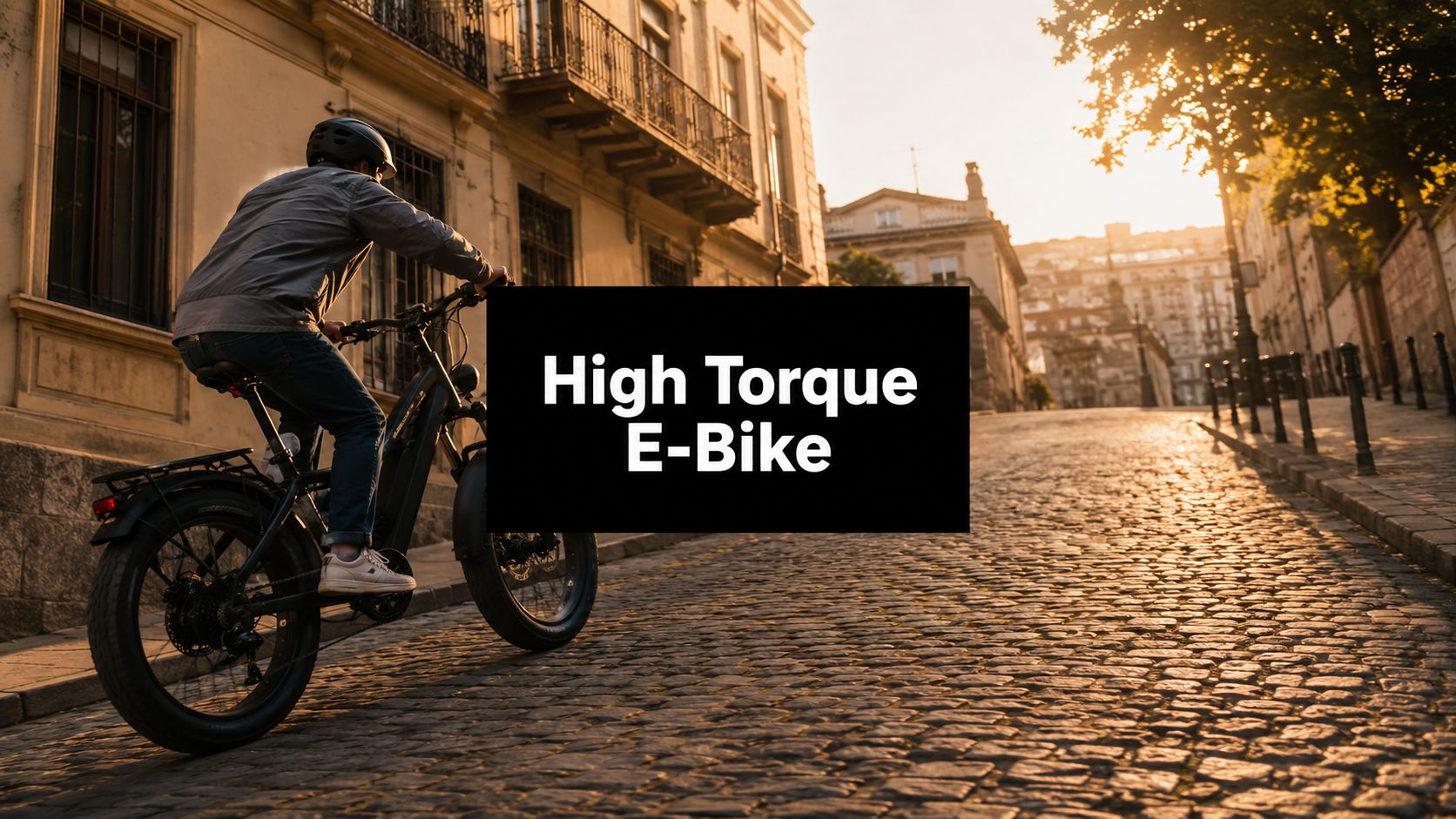
You're halfway up a familiar city hill, panniers loaded, legs turning slowly and the motor sounding busy. The bike may advertise the same wattage as another model in the shop, yet it can feel completely different when the road tilts upward. That difference usually comes down to torque, the twisting force that helps the motor start, climb, and pull weight.
A high torque electric bike can make steep commutes, cargo trips, and loose trails feel controlled rather than laboured. But a bigger Newton-metre figure isn't automatically the right choice. Motor placement, gearing, battery capacity, rider weight, assist tuning, and local law all shape what you'll experience.
Why Torque Changes Everything on an E-Bike
Wattage tells you about the motor's electrical power. Speed tells you how fast assistance can take you. Torque tells you how strongly the motor can turn the drivetrain when resistance appears, which is why it becomes most noticeable when you're starting on a slope or carrying a load.
At a traffic light on level ground, a modest motor may feel perfectly lively. Add a heavy backpack, a child seat, or a set of grocery panniers, and the motor has more work to do. Gravity pulls the combined bike and rider downhill, while rolling resistance and wind push back. Torque is the motor's ability to keep applying turning force through that difficult first part of the climb.

Why identical wattage can feel different
Two e-bikes can carry the same nominal wattage and still deliver noticeably different rides. Their controllers may release assistance differently, their motors may produce different torque, and their drivetrains may put that force to the wheel in different ways.
A motor with useful low-speed torque can help you pull away without a long delay. It can also maintain forward movement when cadence drops on a steep gradient. A lower-torque setup may still reach its advertised assisted speed on a flat road, but it can feel strained when you ask it to climb slowly under load.
Practical rule: If your route includes steep starts, frequent hills, cargo, or rough surfaces, read the torque figure before you get distracted by the wattage headline.
Torque doesn't automatically determine top speed. Once the bike is moving, speed depends on the motor's power delivery, controller settings, battery system, gearing, wheel size, rider position, terrain, and legal assistance limit. Torque is the muscle you notice at the start of a climb, not a promise that the bike will travel faster everywhere.
The shop-floor test
When you compare a high torque electric bike with a lighter commuter model, ask how you'll ride it rather than which number looks biggest. A flat cycleway and a steep urban route place very different demands on a motor. The right bike is the one that gives you enough pulling force without adding equipment you won't use.
Understanding Torque Numbers and What They Mean
Torque is measured in Newton-metres, written as Nm. You can think of it as the effort needed to twist something. Pushing open a light interior door takes little force. Moving a heavy door against a strong closer takes more. An e-bike motor with a higher Nm rating can apply more turning force when the bike is moving slowly or fighting a hill.
Everyday e-bike torque commonly sits around 35–50 Nm, while high-performance models are often placed at 80 Nm or more, according to the technical ranges and peer-reviewed measurements collected in this electric-assisted bike control study. That doesn't create a universal ranking system, but it gives you a useful starting point when reading a specification sheet.
Reading the ranges
A bike around 35–50 Nm generally suits ordinary urban riding, especially when the route is reasonably flat and the load is light. It can provide a smooth push away from junctions and useful help on modest inclines, but it may feel less convincing when you combine a steep gradient with cargo.
The 50–80 Nm range covers a broad middle ground. A technical source describes 50–80 Nm as a good torque range for most riders, which helps explain why many all-round e-bikes sit in this territory. These bikes can feel more capable on rolling roads and loaded commutes without necessarily being built like off-road machines.
At 80 Nm and above, you're looking at a category commonly associated with steep hills, cargo, trail riding, and performance use. The extra force matters most when speed is low and resistance is high. It won't make a flat commute magically better, and it won't remove the need for suitable brakes, tyres, gearing, and battery capacity.
A measured example
The same peer-reviewed study recorded total torque values of 74.37 Nm under one assisted method, 81.11 Nm under another, and 87.67 Nm under a higher-control protocol. Those measurements show how assisted riding can reach the upper end of what many riders call high torque.
The study also reported average total torque of 29.81 Nm without assistance compared with 58.05 Nm under a controlled assist method. In that test condition, electric assistance roughly doubled effective pedal torque, although you shouldn't treat the result as a guaranteed output for every motor or riding mode.
Remember: A torque number describes available force under a particular system and measurement method. It doesn't describe the complete ride by itself.
Hub Motors Versus Mid-Drive Motors for Torque
The first question isn't only “How many Nm?” It's where is that torque measured?
A hub motor sits in the wheel and sends its turning force directly to the tyre. A mid-drive motor sits around the crank, where your pedals connect, and sends torque through the bicycle's gears. That difference changes how the bike behaves, particularly on steep climbs.
A hub motor can feel direct and uncomplicated. Its torque reaches the wheel without passing through the chain and cassette, which can make the system attractive for straightforward urban use. A mid-drive asks you to use the gears properly, but low gearing lets the motor spin effectively while the wheel turns slowly.
Independent technical guidance explains that a mid-drive's stated Nm figure isn't directly comparable with a hub motor's figure. Under low-speed climbing or acceleration, mid-drives can produce roughly 2x to 5x the wheel torque of an equivalently rated hub setup because the bicycle's gears multiply the force. See the mid-drive versus hub motor torque guide for the measurement distinction.
Hub Motor vs Mid-Drive Torque Comparison
| Feature | Hub Motor | Mid-Drive Motor |
|---|---|---|
| Torque location | At the wheel | At the crank |
| Gear multiplication | Usually unavailable through the bicycle drivetrain | Available through the bike's gears |
| Low-speed climbing | Direct, but limited by wheel-side gearing | Strong when paired with an appropriate low gear |
| Riding feel | Often simple and predictable | More responsive to cadence and gear choice |
| Best match | Flat routes, simple commuting, some utility bikes | Steep hills, cargo, trails, and loaded riding |
| Drivetrain involvement | Motor force bypasses much of the bicycle's gearing | Motor force uses the chain, cassette, and selected gear |
Why the number can mislead
Suppose a hub motor and a mid-drive both show similar torque on their product pages. The mid-drive may still climb more effectively because it can shift into a low gear. That gear reduction gives the motor mechanical advantage at the wheel, much like selecting a low gear in a car before a steep ascent.
The trade-off is that mid-drives place more demand on the chain and gears, especially if you shift under heavy motor load. A hub motor can reduce that drivetrain burden, but it may not offer the same climbing power. Your route and maintenance habits should decide the motor layout, not the headline number alone.
For broader buying considerations, use Punk Ride's guide to choosing an e-bike alongside a test ride whenever possible.
Real-World Use Cases That Demand High Torque
Torque becomes easier to understand when you attach it to a job. A bike carrying a parcel load through stop-start traffic needs a different setup from a lightweight commuter travelling across flat roads.
Urban cargo riding is a clear example. Research on the motor market reports that average torque demand in urban cargo applications has increased from 50 Nm to 75 Nm, reflecting the extra work involved in heavier loads and frequent starts. The same source reports that off-road, cargo, and heavy-rider applications often move toward 100 Nm or more, while common high-torque classes for steep urban terrain cluster around 60–90 Nm. These figures appear in the technical comparison of hub and mid-drive e-bike motors.

Match the motor to the route
- Urban delivery: Frequent stops and a loaded rack make low-speed pull important. Insufficient torque can leave the motor labouring every time you restart on an incline.
- Hilly commuting: A rider with panniers may value strong assistance between junctions more than a high top speed. A setup in the 60–90 Nm class is commonly associated with steep urban terrain, according to the same technical comparison.
- Off-road trails: Loose ground, roots, gravel, and technical climbs reduce the traction available at the tyre. Higher torque can help the rider keep moving at low speed, but smooth control matters as much as raw force.
- Heavy rider use: Rider mass is part of the load the motor must move uphill. A high-torque system can make starts and climbs less frustrating, but the frame, wheels, tyres, and brakes must also be designed for the total load.
The comparison source gives geared hub motors around 55–85 Nm at the wheel. It places some mid-drive motors in the 80–160 Nm motor-torque range, which can translate to approximately 160–480 Nm of effective wheel torque in low gears, depending on the drivetrain ratio. Those figures illustrate why you must ask whether a manufacturer is quoting motor torque or wheel torque.
Watch the embedded demonstration with one question in mind: does the bike maintain controlled forward motion when speed falls, or does it surge and spin?
Before choosing a powerful system for rider-specific use, compare the rest of the bike as well. Punk Ride's electric bike guide for heavier riders is a useful place to check the relationship between motor output, payload, and bike design.
The Hidden Trade-Off Between Torque and Range
A high torque electric bike can solve a climbing problem while creating a range problem. More available force makes it easier to accelerate a heavy bike, but aggressive acceleration and sustained hill assistance demand more energy from the battery.
One technical study recorded 30.08 km on a full-charge throttle test for a high-torque prototype, as reported in the study's published technical document. That result isn't a universal range promise or a direct prediction for your commute. It does show why torque and range must be judged together rather than separately.
Why your route matters more than the badge
A rider on flat pavement may rarely use the motor's maximum torque. A rider climbing repeatedly with cargo may call on it at every difficult section. The second rider will usually notice energy consumption more quickly, particularly if they use high assist continuously instead of saving it for steep sections.
Technical guidance commonly places urban commuting around 35–50 Nm, off-road use around 70–90 Nm, and cargo use around 75–125 Nm. Those ranges are useful for matching a bike to a task, but they shouldn't replace a look at battery size, rider weight, terrain, tyre pressure, or assist settings.
A bike with moderate torque and a larger battery may be more practical for a regular commute than a higher-torque bike with less stored energy. That's especially true when the route is mostly level and you can maintain a steady cadence. The strongest motor isn't necessarily the one that gets you home with the most charge remaining.
A sensible range check
Before buying, write down the parts of your journey that need extra assistance:
- Mark the climbs: Identify where you start uphill, not just where the route reaches its highest point.
- Add the load: Include luggage, work equipment, locks, and anything you carry regularly.
- Choose an assist habit: Decide whether you'll reserve high assistance for climbs or use it throughout the trip.
- Plan charging: Consider whether you can charge at work, at home, or between regular journeys.
Punk Ride's electric bike battery life guide can help you assess battery capacity and charging habits alongside the torque rating.
Legal Limits That Shape High-Torque E-Bike Choices
Torque itself isn't the main legal boundary for a standard pedelec in the UK and EU. Regulators focus on the bike's pedals, continuous motor rating, and assisted speed. That means manufacturers can develop strong-feeling systems within a regulated category, but a bike that exceeds the relevant limits may no longer be treated as an ordinary bicycle.
In the UK, an electric bike qualifies as an Electrically Assisted Pedal Cycle only when it has pedals capable of propelling it, a continuous rated motor output of no more than 250 watts, and assistance that cuts off at 15.5 mph, or 25 km/h, as set out in the UK government's electric bike rules. A bike that exceeds the power or speed boundary falls outside the EAPC definition.
UK and EU boundaries
EU standard pedelec rules use a closely aligned threshold. Regulation (EU) No 168/2013 excludes bicycles from type approval when they have a maximum assisted speed of 25 km/h and a continuous rated motor output of 250 W, as explained in European Parliament documentation.
The practical lesson is simple. A manufacturer may advertise peak output or a high torque figure, but you still need to check the continuous rating, assistance cutoff, pedal operation, and the market-specific compliance information. Don't assume that a powerful-feeling motor is automatically illegal, and don't assume that a legal-looking frame makes an unrestricted version road legal.
Australia and the wider market
Australian buyers should check their state or territory rules before purchasing, particularly when a model is imported or marketed internationally. References for the Australian market commonly use the EU-style 250 W and 25 km/h pedelec threshold, with higher-output or faster-assisted bikes potentially treated as mopeds or motorcycles rather than bicycles, as discussed in this Australian and European e-bike regulation guide.
US buyers face different regulations, so a model compliant in one state or city may not fit another local classification. Check the rules where you'll ride, then verify the bike's delivered configuration, including throttle operation, assistance speed, and motor rating.
Before you ride: Treat the legal specification as part of the bike's equipment, not as paperwork you can sort out later.
The 2025-2026 Torque Race and What to Buy Now
Motor development has moved toward stronger low-speed assistance, particularly for cargo and performance bikes. In 2025, Bosch increased its Cargo Line from 85 Nm to 100 Nm and from 600 W peak to 750 W peak, while other launches reached 105 Nm and 111 Nm, according to Electrek's coverage of the motor updates.
Those figures show a clear race at the top end, but they don't create a universal buying rule. A commuter on a mostly flat route may gain little from the largest available motor. A cargo rider, heavier rider, or hill commuter may appreciate the extra reserve, provided the battery, drivetrain, brakes, tyres, and frame suit the job.
Use this quick filter:
- Choose moderate torque when your route is flat, your load is light, and easy handling matters most.
- Look higher when you regularly start on steep gradients, carry cargo, or ride loose and uneven surfaces.
- Compare motor placement before comparing Nm figures.
- Check the legal configuration for your country, especially in the UK, EU, and Australia.
- Treat battery capacity and assist tuning as equal parts of the decision.
Punk Ride LLC offers electric bikes and other electric rides across its regional retail network, including service to customers through warehouses in the UK and Germany as well as its Florida headquarters. Visit Punk Ride LLC to compare available models, then match the torque, battery, motor layout, and legal specification to the roads you ride.
Share:
Affordable Electric Bike for Commuting: Smart Buyer's Guide
Do Electric Scooters Have Gears? the Full Guide