


You press the thumb throttle at a junction, the display is lit, the battery indicator looks normal, and nothing happens. Then you try it again after rolling a few metres, or the motor cuts out when you touch the brake, and the fault starts to feel unpredictable.
A dead throttle isn't automatically a broken throttle. It can be a brake-cutoff signal, a loose connector, a controller interlock, a damaged 5 V supply, a battery-system shutdown, or a regional setting that only permits walk assist. Treating it as a control-system fault first keeps you from buying parts blindly or restoring a throttle mode that your bike isn't approved to use.
When the Throttle Stops Responding
The useful distinction is between a throttle that is completely dead, one that works intermittently, and one that works only within a narrow programmed limit. Those symptoms point in different directions.
A commuter may report that pedal assist still works while the thumb control does nothing. That makes the motor, battery and controller less likely to be completely dead, but it doesn't prove the throttle itself has failed. A brake inhibitor can block throttle output, while a damaged signal wire can produce the same silence after a bump or a turn of the handlebars.
If the throttle behaves strangely, stop riding rather than testing it in traffic. A control that cuts out can leave you without propulsion when you need to clear a junction. A signal fault can also create unexpected motor behaviour, particularly if a damaged wire intermittently touches another conductor.
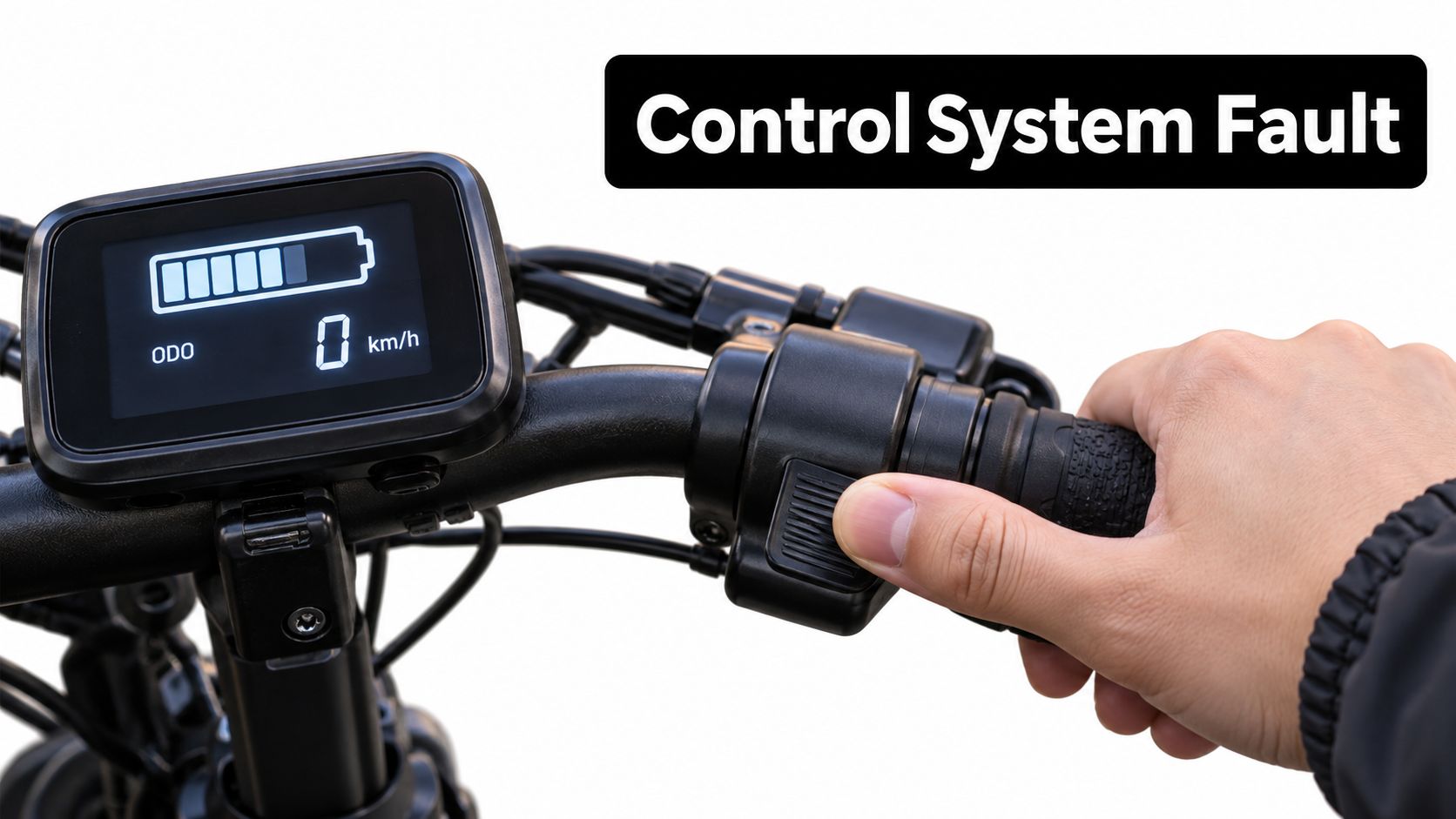
The safety concern is more than theoretical. A 2024 U.S. Consumer Product Safety Commission review covering 2017–2022 identified 30 additional e-bike incidents through its risk-management system, including motor shutoff, unintended acceleration, and a chain-and-throttle issue. The same review identified 100 fatalities associated with mechanical hazards involving e-bikes. Those figures don't establish a throttle failure rate, but they do show why a nonresponsive control belongs in the fault category, not the minor-inconvenience category. The CPSC review is a useful reminder to diagnose the whole control path.
Start by recording what still works. Does the display boot? Does pedal assist respond? Does walk assist operate? Does the throttle fail after rain, a handlebar movement or a brake application? That short description will guide every later check and give a technician something better than “it just stopped.”
Five Symptoms That Point to Different Faults
Use the symptom before the tool. A throttle that fails in one specific situation needs a different first check from one that remains dead everywhere.
| Symptom | Most Likely Cause | First Check |
|---|---|---|
| Throttle is completely dead | Loose connector, failed Hall sensor, disabled setting or no 5 V supply | Inspect the throttle plug, then check display errors and brake-cutoff status |
| Throttle works after a bump or while the cable is moved | Pinched wire, loose pin or corrosion | Trace the cable and inspect the connector for movement, moisture and recessed contacts |
| Motor cuts out only when a brake lever moves | Active or misaligned brake inhibitor | Confirm both levers return fully and inspect their cutoff wiring |
| Display powers on but motor stays silent | Controller interlock, battery-management shutdown, motor connection or controller fault | Check error codes, battery seating, brake inputs and motor connections |
| Connector is hot, wet, loose or discoloured | High-resistance connection or broader electrical fault | Stop testing, isolate the battery and arrange professional inspection |
If the throttle is dead from startup
Check whether the bike has a throttle enable setting or a market-specific operating mode. Don't copy random P-setting values from a different display, because labels and controller logic vary. A display replacement or controller swap can leave an otherwise healthy throttle disabled.
If movement changes the result
That points toward a physical connection before an internal sensor. Turn the handlebar slowly with the bike powered off and inspect where the throttle cable enters the housing and where it joins the harness. A cable stretched tight at full steering lock can break internally while looking perfect outside.
If braking causes the failure
A permanently active brake cutoff makes a healthy throttle appear dead. Look for a brake icon or controller warning, check that each lever springs fully back, and isolate the brake inputs only in the manner allowed by the manufacturer. Don't ride with safety cutoffs disconnected.
This triage prevents the classic wasted repair. Replacing a thumb control won't cure a melted controller plug, a stuck brake sensor or a battery-management shutdown.
Safe Diagnostic Checks You Can Do at Home
Put the bike on a stable stand with the drive wheel off the ground. Remove the key, switch the system off and remove the battery when practical. The wheel shouldn't be able to contact your hands, clothing or a nearby object if the motor activates unexpectedly.
Start with the unpowered inspection
Follow the throttle cable from the handlebar to its connector. Look for crushed insulation, sharp bends, stretched sections, loose locking collars, green corrosion, moisture, bent contacts and pins that have been pushed back inside the plug. Check the display and main harness connections too, because a display-side interruption can leave the screen lit while the controller refuses motor input.
Power the bike back on only after the connectors are seated. Read any error code before clearing it, and photograph the display if possible. A code is evidence. Resetting the bike may restore operation temporarily without removing the underlying fault.
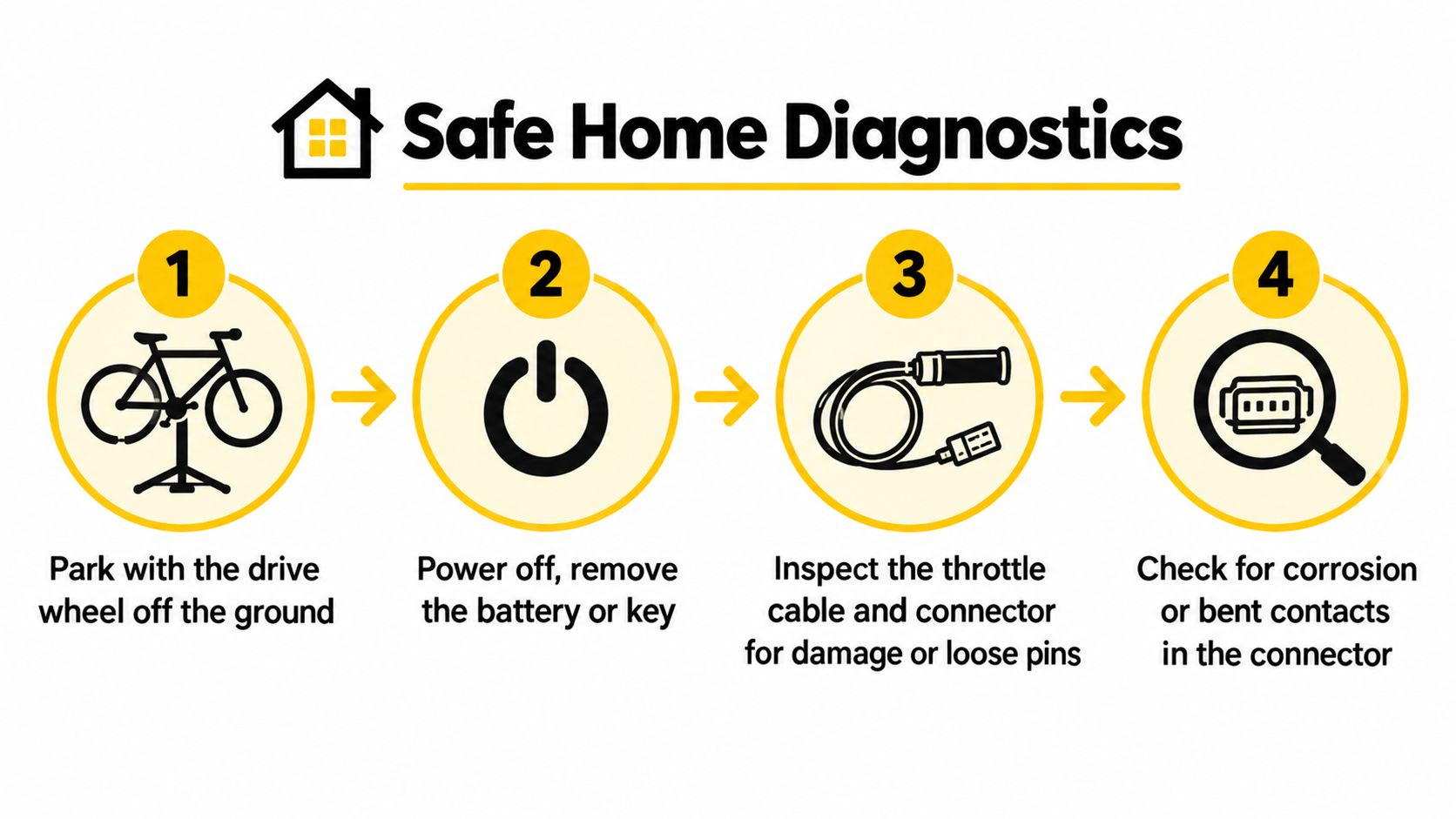
Test the brake inhibitors without guessing. Squeeze and release each brake lever, watching whether the lever returns cleanly and whether a brake indicator changes on the display. If one lever remains slightly pulled, the sensor may be telling the controller to suppress motor output. A technician may temporarily isolate an input for diagnosis, but you shouldn't permanently bypass it.
Safety rule: Never short pins, jumper controller terminals or probe exposed battery-current conductors. A throttle circuit may use a low-voltage signal, but the nearby battery and controller wiring can carry hazardous current.
An e-bike isn't just a hand control and a motor. It includes the battery, battery-management system, motor, controls, wiring and power inlet. A CPSC review of 59 e-bike incidents found 29 involving battery fires or other electrical issues, which is why connector and wiring checks come before a throttle swap. The CPSC micromobility transcript supports that broader view.
If the basic inspection is clean, a multimeter can separate a throttle fault from a controller-supply fault. If you're not comfortable identifying ground and signal pins, stop at the visual checks and take the bike to a qualified workshop.
Multimeter Checks for the Throttle Signal
A conventional Hall-effect throttle normally has a supply, ground and variable signal. The exact connector shape and wire colours aren't universal, so identify the pinout from the wiring diagram or verified continuity testing before applying probes.
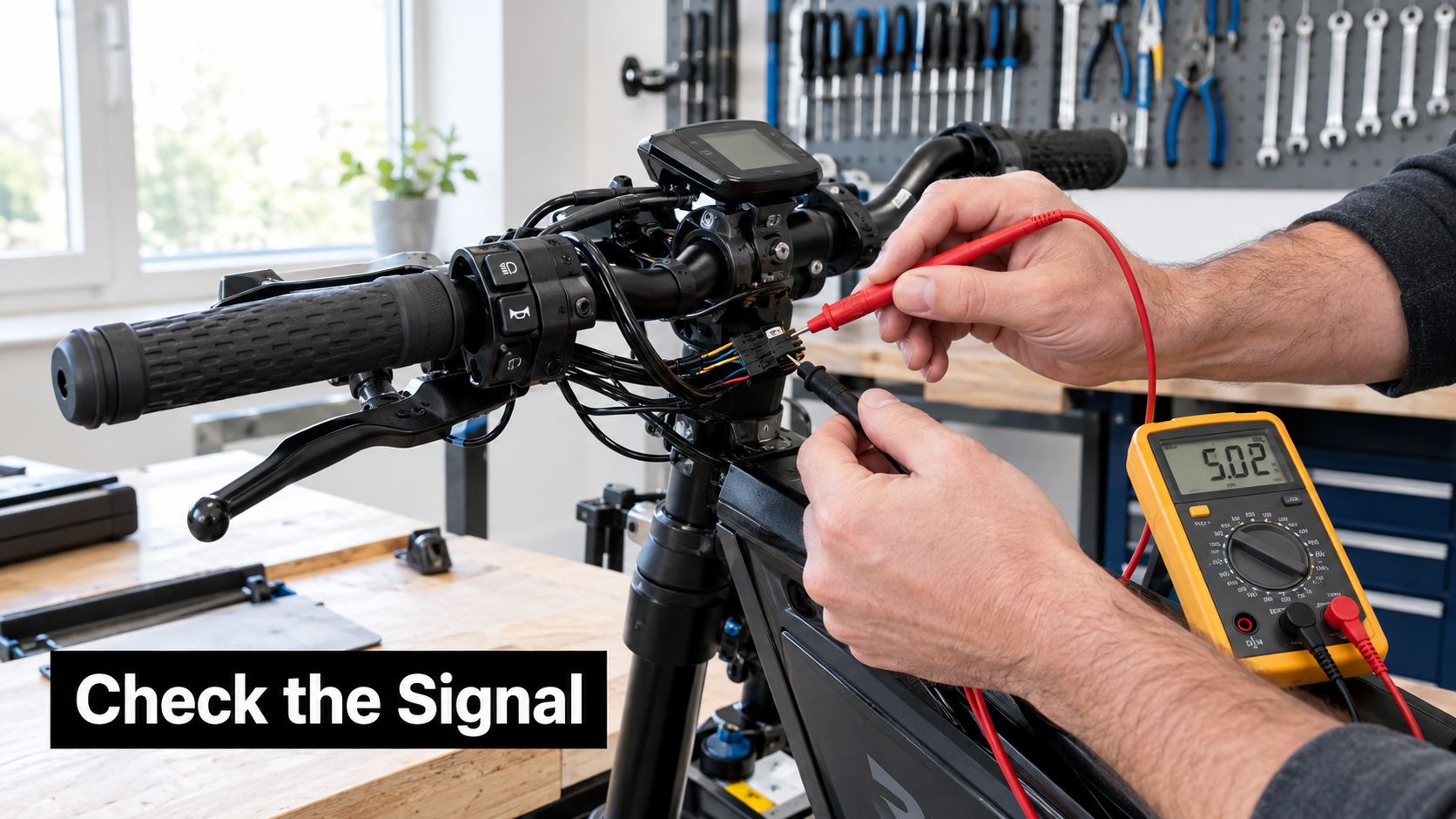
Set the meter to DC voltage. Keep the wheel raised, keep loose clothing clear and connect the throttle normally. Measure between the controller's throttle supply and ground. You should generally see a supply close to 5 V, though the exact reading depends on the system.
Next, place the negative probe on ground and measure the signal wire. With the throttle released, a conventional Hall-effect unit normally sits around 0.84 to 1.2 V. Rotate or press it slowly. The signal should rise progressively toward roughly 4.0 to 4.2 V at full input. EDN's Hall-sensor reference provides the underlying sensor context for this type of voltage response.
Interpret the pattern, not just one number:
- No 5 V supply: Investigate the controller, fuse, connector or shared low-voltage rail. Replacing the throttle won't create missing supply voltage.
- Supply is present, signal stays flat: Suspect the Hall sensor, internal throttle wiring or a broken signal conductor.
- Signal jumps abruptly: Look for a damaged sensor, loose pin or cracked internal assembly. A smooth control should not leap unpredictably.
- Signal sits below roughly 0.4 V or above 4.2 V: Suspect a sensor, wiring or controller-input fault rather than a mechanical grip problem.
- Signal rises normally but the motor stays off: Look at brake inhibitors, controller logic, battery protection, motor wiring and error codes.
Don't assume red means supply, black means ground or green means signal. Manufacturers reuse colours differently, and an incorrect connection can damage the sensor. If you're developing general electrical diagnostic habits, this step-by-step car electrical troubleshooting guide is useful background, but an e-bike still requires its own wiring diagram and safety limits.
A throttle that passes the voltage test can still be blocked by a brake input or software rule. A throttle that fails the signal test with a healthy supply is a strong replacement candidate. When both supply and signal are wrong, the controller or harness deserves attention first.
Replacing or Repairing the Throttle
Repair the connection before replacing the assembly. Clean light surface contamination with an appropriate electrical-contact cleaner, allow it to dry completely and reseat the plug without forcing it. A bent or recessed pin may be repairable by a technician, but repeatedly pushing it with a screwdriver can loosen the terminal inside the connector.
If the cable is visibly damaged, replacement is usually more reliable than patching a section beside the handlebar. Vibration and steering movement make that area hostile to improvised repairs. A sealed, correctly rated connector is preferable to a twisted joint covered with tape, and any soldering should be followed by strain relief and protection from water entry.
Match the electrical identity
Before ordering a thumb or half-twist throttle, match:
- Connector shape and pin count.
- Pinout from the wiring diagram.
- Supply voltage and Hall-sensor signal range.
- Physical mounting and handlebar clearance.
- Compatibility with the controller or proprietary communication system.
The plug fitting is not proof of compatibility. Two three-pin connectors can place supply, ground and signal in different positions. Verify the pinout with the manufacturer's diagram, then compare the replacement throttle before connecting it.
Don't bypass the controller, jump pins or keep riding an intermittent throttle. Those actions can hide the fault and can turn an uncertain signal into unexpected motor output.
After installation, secure the cable so steering doesn't pull on the connector. With the drive wheel raised, power up without touching the throttle, check that the control returns to neutral and test the response gradually. Confirm that releasing the control stops motor input immediately, then test the brake cutoff before any road ride.
For broader buying and maintenance context, Punk Ride's electric scooter reviews for adults can help you compare the practical differences between complete rides and repairable components. For a proprietary system, use the authorised part rather than assuming a universal throttle will communicate correctly.
When the Throttle Is Limited by Law Not by Fault
A throttle that works only at walking pace may be operating correctly. In the UK, an electric bike that can propel itself to 15.5 mph without pedalling must be approved, while a standard EAPC must provide motor assistance that cuts out at that speed. GOV.UK's electric-bike rules explain why a control limitation can be a legal configuration rather than an electrical failure.
For a UK-compliant EAPC, walk assist is limited to approximately 3.7 mph, or 6 km/h, while pedal assistance cuts out at 15.5 mph, or 25 km/h. Transport for London describes walk assist as low-speed help without pedalling, not unrestricted throttle propulsion. Its e-bike safety guidance is especially relevant when the throttle seems dead above walking pace.
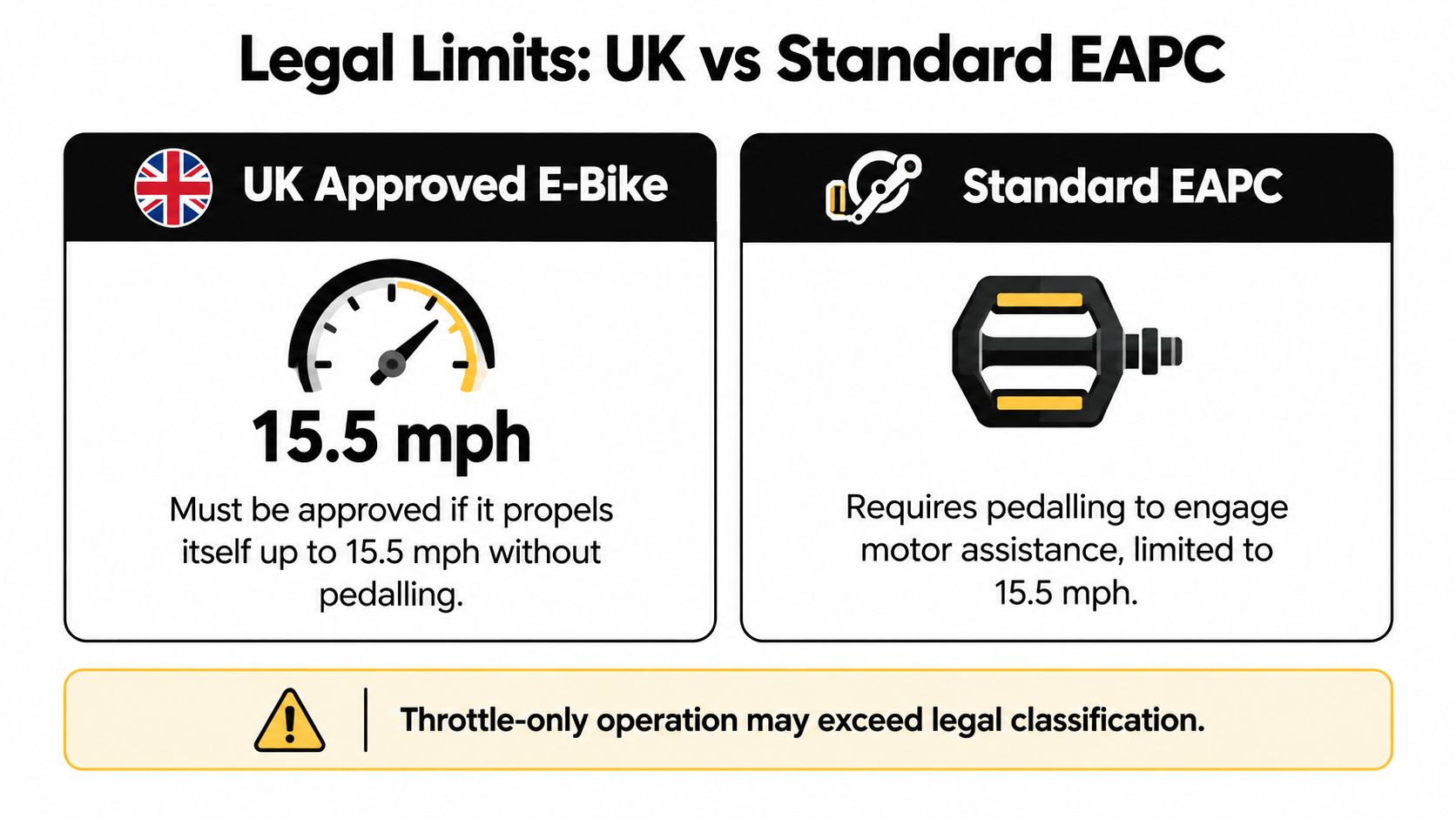
EU pedelec rules generally allow start-up or walk assistance only up to 6 km/h, with standard pedelecs limited to 250 W and assistance up to 25 km/h. Faster 45 km/h speed-pedelecs are a separate category, not an ordinary bicycle configuration. This EN 15194-based EU rules summary outlines that distinction.
The compliance risk is real. A 2026 UK product-safety report rejected an electric bicycle whose single-action throttle could propel it to 24.9 km/h without pedalling, citing injury risk and noncompliance with EAPC rules. The GOV.UK product-safety report is a clear warning against treating every throttle restriction as something to bypass.
Record the bike's market, model, controller and display part numbers before changing settings. A configuration that is acceptable in one jurisdiction may alter the vehicle's classification in another. Check the relevant rules in the United States too, because throttle classes and local road requirements vary, rather than applying a UK or EU assumption to a U.S. bike. A practical electric scooter buying guide is useful when comparing vehicle categories, but it isn't a substitute for local compliance advice.
When to Stop and Call a Professional
Stop immediately if the throttle connector becomes hot, smells burnt, shows melted plastic or discolouration, or feels loose while powered. Stop for swelling, smoke, repeated fuse or battery-management trips, water inside the controller area, or a throttle that works only when you wiggle the cable. Isolate the battery when practical and don't keep resetting the system to make one more trip.
A professional should also handle faults where the display powers up but the motor remains silent after the basic checks, where the 5 V supply is missing, or where controller and battery symptoms appear together. Those problems can involve the shared electrical system rather than the throttle housing.
Prepare useful information before booking service:
- Bike identity: Record the model, serial information and region of purchase.
- Component details: Photograph controller and display part numbers, connectors and warning codes.
- Fault behaviour: Note whether pedal assist, walk assist and braking cutoffs work.
- Fault history: Record whether the throttle ever worked, whether the issue followed rain or a part change, and whether it is intermittent.
- Evidence: Take clear photos of heat marks, damaged insulation or connector corrosion without reopening sealed battery packs.
The reason workshops take these signs seriously is the scale of injury reporting. A Consumer Product Safety Commission statement estimated 53,200 U.S. emergency-department visits linked to e-bikes from 2017 through 2022, rising from about 3,500 visits in 2017 to 24,000 in 2022, with 2022 representing roughly 45% of the six-year total. The CPSC statement doesn't attribute those injuries to throttle faults, but it reinforces the need to respect control and electrical warnings.
A repair directory such as BenchKey for e-bike repair can help you identify a suitable service route. The safe order is simple: power down, isolate the battery, inspect connectors and brakes, read the error code, test only the low-voltage circuit you can identify, and stop when heat, damage or uncertainty appears.
Punk Ride LLC offers electric bikes and scooters across its UK, German and U.S. operations, alongside troubleshooting guidance for controls, connectors and brake cutoffs. If your electric bike throttle isn't working and you'd rather match the repair to the right ride or part, visit Punk Ride LLC.
Share:
How to Charge Electric Bike Battery Safely