


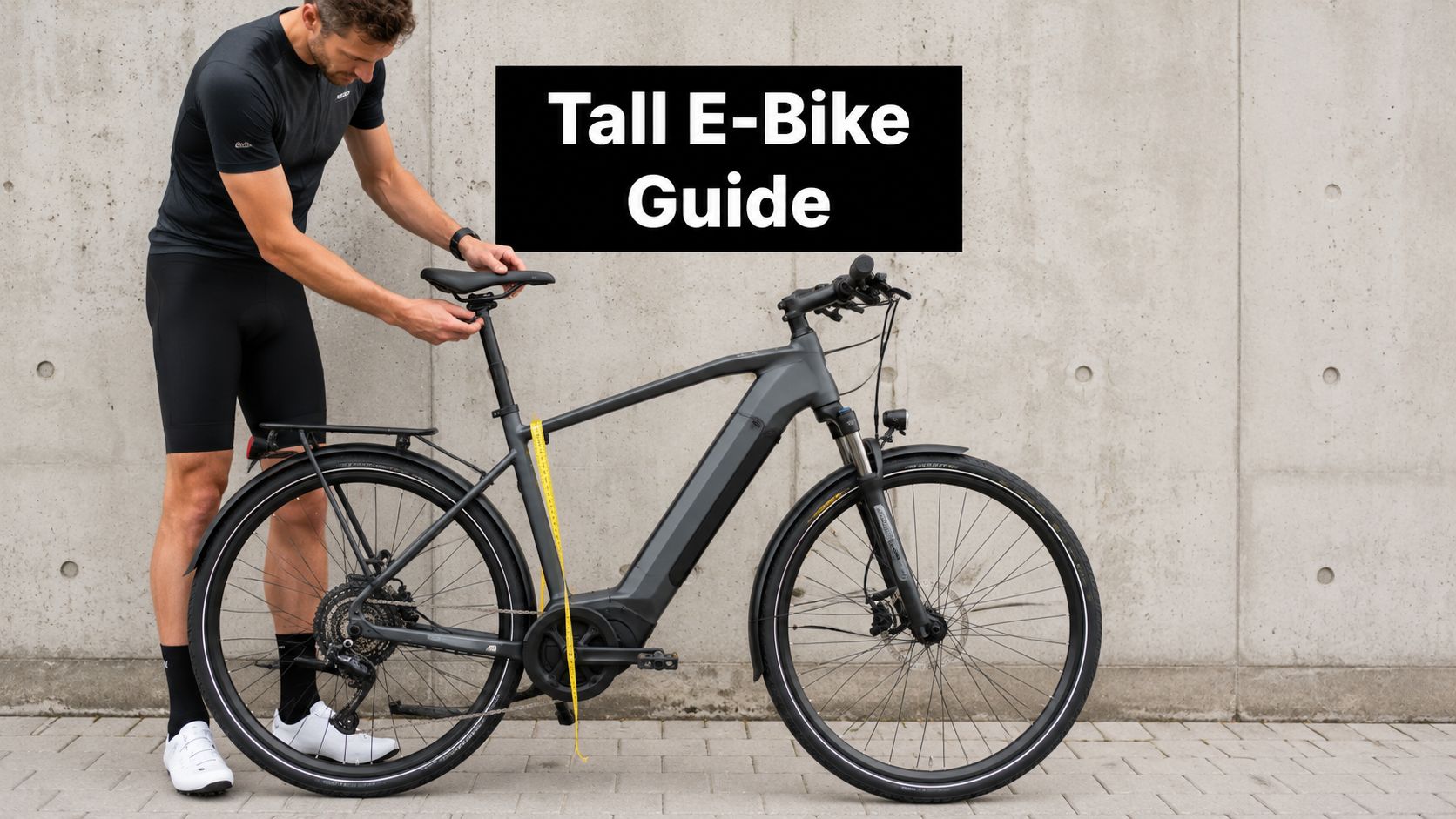
You're probably here because you've already done the annoying part. You found a few e-bikes that looked good online, checked the size chart, picked the biggest option, then realized the cockpit still looks cramped. Maybe you've already ridden one and your knees came up too high, your back rounded over, and the whole thing felt less like transport and more like balancing on a child's bike with a motor.
I know that feeling. If you're tall, shopping for an electric bike for tall people can feel weirdly personal. It's not just inconvenience. It's that constant sense that the bike industry expects you to adapt to the bike instead of the other way around.
Most bad advice starts and ends with “just get an XL.” That's lazy advice. Tall riders don't need a bigger sticker on the frame. They need the right geometry, the right contact points, and enough adjustment range to make the bike work practically.
The Tall Rider's Dilemma
Tall riders usually know something is wrong before they know why. The saddle goes up, but the bars still feel too close. Your knees rise too high. Your hips feel jammed. After half an hour, your lower back starts talking to you. After an hour, it's shouting.
That frustration isn't in your head. The market is built around average-height riders. According to EBike24's tall rider guide, the global electric bike market is dominated by frames engineered for riders up to 1.79 meters (approximately 5 feet 10 inches), with significantly fewer frames produced for riders between 1.85 meters (6'1") and 2.01 meters (6'7"). That's the supply problem in one sentence. If you're tall, especially well over six feet, the odds are already stacked against you before you even compare brands.
A lot of riders blame themselves first. They think they're inflexible, out of shape, or just too picky. Usually, the problem is that the bike is too short in the front, too low in the stack, or too limited in seatpost extension. Your body then compensates badly. If you've dealt with shoulder tension, neck strain, or a rounded upper back off the bike too, PosturaZen's view on poor posture is worth reading because the same postural habits get amplified on an undersized e-bike.
Riding a too-small e-bike doesn't just feel silly. It changes how you steer, pedal, and absorb bumps.
What the bad fit usually feels like
- Cramped legs: Your knees track too high and never get a clean extension.
- Folded torso: You hunch because the bars are too low or too close.
- Light front end: Your weight sits awkwardly, which can make steering feel twitchy.
- False confidence from the motor: The motor hides a bad fit for a while, then your joints pay for it later.
Weight capacity matters too, especially for bigger frames and bigger bodies. If you haven't checked that yet, Punk Ride's guide to e-bike weight limits and what they actually mean is a useful reality check.
The good news is simple. Finding a proper electric bike for tall people isn't luck. It's geometry.
Decoding Frame Geometry That Actually Fits
You find an XL e-bike, raise the saddle, and head out expecting relief. Ten minutes later your knees feel crowded, your hands are carrying too much weight, and your back is asking why the bars are sitting in your lap. That is the tall-rider fit problem in one ride. The frame looked big. The geometry still rode small.
“XL” is only a size label. It does not tell you whether the front of the bike is long enough, high enough, or balanced well enough for a tall body. As noted earlier from Himiway's tall-rider guidance, frame geometry matters more than wheel size or the sticker on the seat tube.

Reach, stack, and top tube work together
Tall riders get bad advice all the time here. One person says, “Just get more reach.” Another says, “You need a more upright bike.” Both can be wrong if you look at only one number.
Reach sets the horizontal room from the bottom bracket to the front of the cockpit. It decides whether your torso has space and whether your knees feel like they are chasing the bars.
Stack sets the handlebar height potential. It decides how much drop you have from saddle to bars, which changes how much your hips must fold and how much pressure ends up in your hands.
Effective top tube helps explain the seated feel between saddle and bars. It is not a substitute for reach, but it helps you spot bikes that look long on paper yet still place you awkwardly once the saddle is at full pedaling height.
The fit comes from the relationship between those numbers. A bike with decent reach and low stack can still force a tall rider into a deep hinge with locked elbows. A bike with tall stack and short reach can feel upright but cramped, like the bars are too close to your chest. The right bike gives you both room and height, so your hips stay open, your shoulders relax, and your weight stays centered instead of drifting too far rearward.
What a bad geometry match feels like
A short front end usually shows up fast:
- Knees crowd the bars during tight turns or out-of-saddle efforts
- Elbows stay bent and tucked because the cockpit has no room
- Hands take too much load because the bar position forces you to brace
- You slide rearward on the saddle trying to create space the frame never had
Low stack creates a different problem. Your saddle goes up to match your leg length, then the bar stays low. That closes the hip angle, rounds the upper back, and often irritates the front of the hips. If that sounds familiar, hip pain solutions for KC riders is worth reading alongside your fit check.
Tall riders usually do best on a bike that is long enough in reach and tall enough in stack. One without the other is still a compromise.
Standover still matters, but it is not the main event
Yes, you need safe clearance over the top tube. You also need enough seatpost extension to get proper leg extension. Those are basic checks.
But tall riders get into trouble when they stop there. Standover tells you whether you can stand over the bike safely. It does not tell you whether the bike will feel open and stable once you are seated and pedaling. Top tube length helps, but reach and stack tell you more about how the bike will support your body on the road.
What to scan on a spec sheet
Before you book a test ride, check the geometry chart in this order:
| Geometry detail | What it tells you in real life |
|---|---|
| Reach | Whether the cockpit gives your torso and knees enough room |
| Stack | Whether the bars can sit high enough without forcing too much forward bend |
| Effective top tube | Whether the seated position will feel open once the saddle is set correctly |
| Standover height | Whether you can mount and stop with safe clearance |
Start with reach and stack. Use top tube length to confirm the seated layout. Use standover as a safety check, not your main fit decision. If you want a broader buying filter before comparing geometry charts, Punk Ride's guide on how to choose an eBike is a useful companion.
Essential Components for a Tall Rider's E-Bike
A tall-friendly frame still rides poorly if the contact points shrink the bike under you. I see this all the time. The geometry chart looks promising, then the bike shows up with a short seatpost, narrow bars, and average-rider cranks. The result is a bike that measures big but feels cramped.
That matters because fit is not just frame size. Stack, reach, and top tube length set the rider position. The parts decide whether you can use that position in comfort.

Standard parts versus tall-rider parts
Kingbull's tall rider guide is useful here because it highlights the difference between a large frame and a complete tall-rider setup. On paper, a bike may fit a rider up to 6'7" and use longer cranks than the usual average-bike spec. In practice, that only works if the rest of the bike supports the same body proportions.
Here's the short version:
| Component | What you often get | What taller riders should look for |
|---|---|---|
| Crank arms | Standard length that can feel rushed through the pedal stroke | Length that matches your leg length and pedal clearance needs |
| Seatpost | Limited extension range | Enough safe extension to reach full leg extension without maxing out the post |
| Handlebars | Narrow cockpit feel | Width that suits broad shoulders and gives stable steering |
| Stem | Generic fit for average riders | Length and rise that support the frame's reach and stack, not fight them |
Crank length changes how a big bike pedals
Long legs on short cranks often feel bunched up at the top of the stroke. Riders describe it as pedaling on a bike that never quite opens up. That feeling gets worse when the frame is already a bit short in reach or effective top tube.
Longer cranks can help, but only on a bike that already has enough room. If the frame is too short, longer cranks do not fix the fit. They just change the pedal circle while your torso and knees still feel crowded.
Bars and stem decide whether the geometry works
Tall riders often get fooled by size labels. A frame can have decent reach and stack, then lose that advantage with a low-rise stem and bars that are too narrow. Suddenly the cockpit feels shorter, your shoulders roll inward, and too much weight lands on your hands.
Wider bars can calm the steering and give broad-shouldered riders a more natural upper-body position. Stem choice matters just as much. A slightly longer or higher-rise stem can make a good frame feel right. The wrong stem can make a good frame feel small.
Use the frame numbers first. Then use the cockpit parts to support those numbers, not to rescue bad geometry.
Seatpost range is a hard pass or hard no
Tall riders often need a lot of saddle height. If the stock post barely gets there, do not talk yourself into it. A bike that needs the seatpost pushed to its limit on day one is already telling you it was not built around your proportions.
Check the minimum insertion mark. Check how much post is left for adjustment. If the bike only fits with a replacement post, factor that into the price. If you want a clearer parts checklist before making swaps, Punk Ride's guide to electric bike parts and how they affect fit is a solid reference.
Don't judge a tall-rider e-bike by frame size alone. If the bars, stem, cranks, and seatpost are average-rider parts, the bike will still feel like an average-rider bike.
How to Test Ride an E-Bike When You're Tall
If you're in the UK or EU, you'll often have better access to city-focused e-bikes through local dealers. In the US and Australia, direct-to-consumer brands are common, and that makes proper test rides harder. I still wouldn't skip one if there's any way to avoid it.
A parking-lot spin is not enough. A tall rider needs to test for clearance, posture, and steering feel under real movement.

What to ask the shop before you roll
Tell the staff exactly what you need. Don't say “I'm just browsing.” Say you want the saddle set high enough for a meaningful test and that you want to feel the bike with a realistic bar position. Any decent shop should help.
Use this checklist:
- Set the saddle first: If the saddle is too low, the whole test is fake.
- Check knee clearance in turns: Pedal lightly through a tighter turn and see whether your knee gets near the bars.
- Stand over the frame: You should feel secure when stopping and starting.
- Ride seated and relaxed: If your shoulders bunch up right away, the cockpit is wrong.
- Try slow speed handling: Tall riders notice front-end weirdness quickly at walking pace.
- Ride over rougher ground if possible: A bike that fits poorly often feels worse once your body has to absorb bumps.
What your body should tell you
The right bike usually feels boring in the best way. You're not negotiating with it. You're not making excuses for it. You're just riding.
The wrong bike speaks up quickly:
- Hands loaded with pressure
- Lower back getting tense
- Knees rising too high
- Neck craning to look ahead
- A sense that you're perched on top rather than sitting in the bike
Here's a useful visual before you head out for a ride review.
Don't let the motor distract you
A strong motor can disguise a poor fit for the first few minutes. You feel the shove, the novelty, the easy acceleration, and you forget to evaluate posture. That's the trap.
Spend part of the test ride focusing only on body position. Ignore speed. Ignore app features. Ignore display gadgets. Ask one blunt question: would I want to sit like this for a real ride, not a demo ride?
If the answer is no, move on.
Common E-Bike Modifications to Perfect Your Fit
Even if you buy the right frame, you may still need to tune the bike. That's normal. For very tall riders, it's often unavoidable.
The big problem shows up once you get beyond the height range most stock bikes are built around. Actbest's guide for tall riders notes that most mass-market e-bikes cap recommendations at 6'4" to 6'5", and riders 6'7" and taller often report being “sore after one hour” because stock seatposts are often under 400mm and reach is inadequate. The common fixes include 400mm+ seatposts, 760mm+ handlebars, and adjustable stems.

The modifications that usually matter most
You do not need to replace everything. Start with the parts that solve the biggest fit problem.
-
Longer seatpost
If you can't achieve proper leg extension, nothing else matters yet. A longer post is often the first fix. -
Adjustable stem
This helps if the bars feel too low, too close, or both. It's one of the most effective changes for tall commuters and hybrid riders. -
Wider handlebars
Good for riders with broad shoulders or bikes that feel twitchy and narrow in the front. -
Setback seatpost
Useful when the saddle position needs to move rearward to create more room through the cockpit. -
Ergonomic grips and comfort upgrades
These won't rescue a bad frame, but they can finish off a mostly-correct fit.
A longer seatpost can fix saddle height. It cannot fix a frame that's fundamentally too short.
What you can do yourself and what needs a fitter
Some changes are straightforward if you know basic bike setup and torque discipline. Grips, handlebars, and many stems fall into that category. Seatposts are simple too, as long as insertion depth and clamp security are respected.
Other changes deserve more care:
- Cockpit changes affecting steering feel: Small changes can make a bike feel better or worse fast.
- Saddle fore-aft changes: These alter knee position and hip loading.
- Crank changes: They affect pedaling mechanics and clearance.
- Anything that pushes component limits: If you're near the edge of safe extension or fit range, get a mechanic involved.
The order I'd change things
If a tall rider rolled into my workshop complaining about a cramped e-bike, I'd usually work in this order:
| Priority | Change | Reason |
|---|---|---|
| First | Saddle height and seatpost length | Restores proper leg extension |
| Second | Stem height and length | Opens the torso and reduces hunching |
| Third | Handlebar width and rise | Improves control and upper-body comfort |
| Fourth | Saddle position | Fine-tunes balance and knee clearance |
The important mindset is this: modify with purpose, not panic. Don't throw random parts at the bike because a forum post said “wider bars fixed mine.” Match the change to the complaint.
Conclusion Riding Tall and Riding Safe
You roll a bike out of the shop, pedal for five minutes, and know the truth. Your knees crowd the bars, your back rounds, and your hands carry too much weight. That is not a small fit issue. It is the result of geometry numbers that do not work together for a tall rider.
That is the filter to keep.
Stop shopping by frame label alone. XL means very little without the numbers behind it. A tall rider needs enough stack to avoid folding at the waist, enough reach to open the cockpit without forcing a dead stretch, and a top tube length that supports both of those numbers instead of fighting them. When those three line up, the bike feels calm, centered, and easy to control. When one is off, you spend the ride compensating.
The buying filter that works
Use this sequence every time:
- Start with geometry, not marketing
- Check whether the frame's stack, reach, and top tube make sense together
- Make sure the cockpit parts support that fit instead of shrinking it
- Test ride with the saddle set to your height
- Change parts only after you can name the exact problem
Comfort matters because control matters. A cramped position reduces breathing room, loads your hands, and makes steering feel nervous. On an e-bike, that gets old fast.
Here's my blunt advice. If a bike feels short in the shop, leave it there. If a brand hides geometry, skip it. If a seller says “it fits most riders,” that tells you nothing useful if you are well over average height.
The right electric bike for tall people feels normal. That's the standard.
Once you understand how stack, reach, and top tube length work together, bad options become easy to spot. You stop guessing. You stop trying to rescue a too-small frame with random parts. You're just done settling for the wrong ones.
Where to Start Your Search
If you're comparing models and want a practical place to start, Punk Ride LLC is worth a look. They serve riders across the US, UK, and Germany, and they focus on modern electric mobility instead of generic big-box inventory. If you already know the fit numbers you need, that makes shopping a lot easier.
Share:
How to Extend Battery Life: E-Scooter & E-Bike 2026
Scooter for Sale: Your 2026 Buyer's Guide